Every Bitcoin miner faces a fundamental decision before their first hash is computed: pool mining or solo mining? This choice shapes your economics, your privacy, your relationship with the Bitcoin network, and — whether you realize it or not — the health of Bitcoin’s decentralization itself.
Pool mining offers predictable, steady payouts by combining hashrate with thousands of other miners. Solo mining means you point your hardware directly at the Bitcoin network, accepting extreme variance in exchange for the full block reward — currently 3.125 BTC — and the philosophical satisfaction of mining Bitcoin the way Satoshi intended.
This guide breaks down every dimension of the pool vs solo mining debate with real numbers, honest analysis, and a clear recommendation framework based on your hashrate, goals, and values. Whether you are running a single Bitaxe on your desk or a rack of S21s in your garage, this is the decision guide you need.
How Pool Mining Works
A mining pool is a collective of miners who combine their computational power to increase the probability of finding a valid block. When the pool successfully mines a block, the 3.125 BTC reward (plus transaction fees) is distributed among participants proportionally to the work each miner contributed.
The Share System
Pools track each miner’s contribution through “shares” — proof-of-work solutions that are valid at a lower difficulty than the actual Bitcoin network difficulty. Think of it this way: if the network requires finding a number below 1 in a trillion, the pool might accept any number below 1 in a billion. These easier solutions (shares) prove you are actually hashing without requiring you to find an actual block.
Your share count relative to the pool’s total shares determines your payout percentage. If you contributed 0.001% of the pool’s total shares during a block-finding period, you receive 0.001% of the reward.
Payout Methods Explained
Not all pools pay the same way. The payout method significantly impacts your earnings stability and risk exposure:
| Payout Method | How It Works | Risk Profile |
|---|---|---|
| PPS (Pay Per Share) | Fixed payment per share submitted, regardless of whether the pool finds a block. Pool absorbs all variance. | Lowest risk for miner. Highest fees (2-4%). |
| FPPS (Full Pay Per Share) | Like PPS but also distributes estimated transaction fees. Most common method on major pools. | Low risk. Moderate fees (2-3%). Includes tx fee income. |
| PPLNS (Pay Per Last N Shares) | Payment based on shares in the last N shares before a block is found. Rewards loyal miners, penalizes pool-hoppers. | Medium risk. Lower fees (0-2%). Higher variance. |
| TIDES (Time Duration per Entity per Share) | OCEAN’s transparent scoring method. Shares weighted by recency with full auditability. No custodial risk. | Medium risk. Transparent. 0% pool fee (2% payout to dev fund). |
| SOLO (via pool) | Pool handles the connection infrastructure but you keep the entire block reward if YOUR hashrate finds a block. Zero sharing. | Highest risk/reward. Low fees (1-2%). Binary outcome. |
Pool Fees and Hidden Costs
Pool fees typically range from 0% to 4%, but the advertised fee is not the whole story. Watch for these hidden costs:
- Minimum payout thresholds — many pools require 0.005-0.01 BTC before they release funds, locking up your earnings
- Withdrawal fees — some pools charge additional fees to withdraw your balance
- Transaction fee withholding — PPS pools may keep transaction fees entirely (FPPS addresses this)
- Custodial risk — your BTC sits in the pool’s wallet until you withdraw. Pools have been hacked, gone insolvent, or simply vanished
- Stale share penalties — if your share arrives after the pool already found a block, it may not count
For a detailed breakdown of every major pool’s fee structure, payout methods, and trustworthiness, see our Bitcoin Mining Pool Comparison 2026.
How Solo Mining Works
Solo mining is the original form of Bitcoin mining. You run mining hardware connected directly to a Bitcoin node (or through a solo mining proxy like ckpool), and your miner attempts to find a valid block entirely on its own. There is no pool. No shares. No intermediary between you and the Bitcoin network.
The Mechanics
When solo mining, your hardware cycles through nonces attempting to produce a block hash below the current network difficulty target. As of February 2026, the difficulty is approximately 125.86 trillion — meaning the network requires roughly 125.86 trillion hash attempts, on average, to find one valid block.
If your miner finds a valid block, you receive the entire 3.125 BTC block subsidy plus all transaction fees included in that block. Transaction fees in 2026 typically add 0.1-0.5 BTC per block, sometimes spiking significantly higher during periods of network congestion.
Solo Mining Proxies
Most solo miners do not run a full Bitcoin Core node at home (though it is recommended for sovereignty). Instead, they connect to solo mining proxies — services that maintain the node infrastructure but route your hashrate as an individual miner:
- ckpool (solo.ckpool.org) — the most popular solo mining proxy, operated by Bitcoin Core developer Con Kolivas. 2% fee. Has facilitated hundreds of solo block finds.
- public-pool.io — open-source, zero-fee solo mining pool. Community-operated. Growing quickly among sovereignty-focused miners.
- OCEAN — while technically a pool, OCEAN’s non-custodial design and transparent TIDES payout method make it a compelling option for miners who want pool-like payouts with solo-mining-like sovereignty.
What Happens When You Find a Block
When a solo miner’s hardware produces a valid hash, the block is broadcast to the network and — after 100 confirmations (approximately 16.5 hours) — the full coinbase reward is spendable. There is no waiting for minimum payout thresholds. No custodial risk. The Bitcoin goes directly to your wallet.
This is how Bitcoin mining was designed to work. One miner, one node, one block, one reward.
Pool Mining vs Solo Mining: The Complete Comparison
Here is every dimension that matters, compared honestly:
| Dimension | Pool Mining | Solo Mining |
|---|---|---|
| Earnings Variance | Low — steady, predictable payouts | Extreme — nothing for months/years, then a full block |
| Expected Revenue | Slightly lower (fees deducted) | Slightly higher (no fees, keep tx fees) |
| Fees | 0-4% of block rewards | 0-2% (solo proxy fee only) |
| Minimum Hashrate | Any amount (even 1 GH/s) | Any amount — but time to block increases dramatically at low hashrate |
| Payout Frequency | Daily to weekly (once threshold is met) | Only when a block is found (could be never) |
| Privacy | Low — pools require account registration, track your hashrate, know your wallet | High — especially with your own node. No KYC, no registration |
| Custodial Risk | Yes — pool holds your BTC until withdrawal | None — coinbase reward goes directly to your wallet |
| Setup Complexity | Easy — create account, enter pool URL, start mining | Moderate — need solo proxy or full node, configure miner |
| Decentralization Impact | Negative — concentrates block construction power in pool operators | Positive — distributes block construction, strengthens censorship resistance |
| Transaction Selection | Pool decides which transactions go in blocks | YOU decide (with your own node) |
| Censorship Resistance | Weak — pools can (and have) filtered transactions | Strong — no one can tell you which transactions to include |
| Downtime Impact | Missed earnings proportional to downtime | Minimal impact on already-low probability per day |
| Best For | Revenue-dependent miners, operations that need predictable income | Ideologically motivated miners, lottery players, Bitcoin sovereigntists |
Earnings Analysis: Real Numbers at Every Hashrate Tier
Let us look at what pool mining and solo mining actually earn at different hardware levels. These calculations use February 2026 network conditions: ~1,000 EH/s network hashrate, 125.86T difficulty, 3.125 BTC block reward, and ~$85,000 BTC price.
| Device | Hashrate | Pool Monthly Income | Solo: Avg Time to Block | Solo: Block Value |
|---|---|---|---|---|
| Bitaxe GT | ~1.2 TH/s | ~$0.30 | ~95,000 years | ~$265,000+ |
| NerdQAxe++ | ~4 TH/s | ~$1.00 | ~28,500 years | ~$265,000+ |
| Antminer S19 XP | 140 TH/s | ~$35 | ~815 years | ~$265,000+ |
| Antminer S21 | 200 TH/s | ~$50 | ~570 years | ~$265,000+ |
| 10x S21 Farm | 2 PH/s | ~$500 | ~57 years | ~$265,000+ |
| 100x S21 Farm | 20 PH/s | ~$5,000 | ~5.7 years | ~$265,000+ |
Key takeaway: The pool monthly income column shows what you can reliably count on. The solo column shows the lottery ticket. At Bitaxe-level hashrates, pool income is negligible — a few cents per month. But the solo block reward, if it ever hits, is life-changing. This is why solo mining at low hashrates is called “lottery mining” and why it attracts a passionate community.
Run your own numbers with our Bitcoin Mining Profitability Calculator and Solo Mining Probability Calculator.
The Decentralization Argument: Why Solo Mining Matters for Bitcoin
This is where the conversation moves beyond economics into ideology — and for Bitcoiners, ideology is not optional. The decentralization of mining is a core security property of the network.
The Pool Centralization Problem
As of early 2026, just two mining pools — Foundry USA and AntPool — control over 50% of Bitcoin’s total hashrate. This concentration creates several serious risks:
- Transaction censorship — pool operators choose which transactions to include in blocks. A small number of pools could collude or be coerced into filtering specific transactions (OFAC-compliant mining already exists)
- 51% attack surface — with fewer entities controlling majority hashrate, the coordination cost for an attack drops dramatically
- Regulatory capture — governments only need to pressure a handful of pool operators to influence Bitcoin’s transaction processing layer
- Single points of failure — pool infrastructure outages can cause sudden hashrate drops, destabilizing block production
Satoshi’s white paper describes a system where “one CPU, one vote.” Today’s pool-dominated landscape looks nothing like that vision. The hashrate is real and distributed across thousands of individual machines worldwide — but the block construction power is concentrated in the hands of fewer than ten pool operators.
How Solo Mining Fixes This
Every solo miner who finds a block is a miner who constructed that block template independently. They chose which transactions to include. No pool operator made that decision for them. At scale, solo mining:
- Distributes block template construction — the most important function in Bitcoin’s censorship resistance
- Eliminates custodial risk — no pool holding your BTC
- Removes KYC requirements — many major pools now require identity verification
- Demonstrates that Bitcoin works as designed — individual miners, individual blocks, individual sovereignty
Even if a solo miner only finds one block per decade, that block is a block that was constructed outside the pool oligopoly. Every solo block mined is a vote for decentralization.
The Stratum V2 Middle Ground
Stratum V2, the next-generation mining protocol, introduces a critical compromise: miners in a pool can construct their own block templates while still receiving pooled payouts. Under the original Stratum protocol (still used by most pools), the pool operator builds the block template — deciding which transactions to include — and sends work units to miners. Miners just hash. They have zero say in what goes into the block.
Stratum V2 flips this model. With its Job Declaration Protocol, individual miners can build their own block templates and submit them to the pool. The pool validates the proof-of-work, handles payout distribution, but the miner retains sovereignty over transaction selection. This is a massive step forward for decentralization: it separates the economic smoothing function of pools (payouts) from the governance function (block construction).
OCEAN pool uses its own DATUM protocol for decentralized block template construction, and Braiins Pool supports it through their open-source Braiins OS firmware. As Stratum V2 adoption grows, the line between pool and solo mining blurs — and that is a good thing for Bitcoin. But true solo mining, where you find and claim an entire block independently, remains the gold standard for decentralization and sovereignty.
Solo Mining Probability: Understanding the Math
Solo mining is fundamentally a probabilistic exercise. Each hash your miner computes has an independent, equal chance of being the one that produces a valid block. Understanding the math helps you set realistic expectations.
The Core Formula
Your probability of finding a block in any given time period is:
P(block per day) = (your_hashrate / network_hashrate) x blocks_per_day
With ~144 blocks mined per day, a Bitaxe GT at 1.2 TH/s against a 1,000 EH/s network has a daily probability of:
(1.2 x 10^12) / (1.0 x 10^21) x 144 = 0.000000173 = 0.0000173% per day
That is roughly 1 in 5.8 million days, or one block every ~15,800 years on average. But “on average” is doing heavy lifting in that sentence.
Variance and the Lottery Effect
Mining follows a Poisson distribution. This means:
- Your expected time to find a block might be 15,000 years
- But you have a non-zero chance of finding one today
- Every hash is independent — there is no “you are due” effect
- Running for 15,000 years does NOT guarantee a block (you would have about a 63.2% cumulative probability by then)
The probability of finding at least one block over a given period follows the formula:
P(at least 1 block) = 1 – e^(-expected_blocks)
For a Bitaxe GT running for one full year:
| Time Period | Expected Blocks | Probability of 1+ Block |
|---|---|---|
| 1 day | 0.000000173 | 0.0000173% |
| 1 month | 0.0000052 | 0.00052% |
| 1 year | 0.0000631 | 0.00631% |
| 10 years | 0.000631 | 0.0631% |
The numbers look discouraging at small hashrates — and they should. Nobody runs a Bitaxe for guaranteed income. You run it because every hash counts, because you believe in decentralization, and because that 0.00631% annual chance of winning 3.125+ BTC is the most exciting lottery ticket in existence.
For detailed probability calculations with your specific hardware, use our Solo Mining Probability Calculator.
Real-World Solo Block Finds
Despite the long odds, solo miners find blocks regularly across the network. In 2025 and early 2026, solo miners on ckpool and public-pool have found multiple blocks with hashrates as low as a few hundred TH/s. These events make headlines in the Bitcoin community every time — and they prove that the math works. Someone wins. Every block.
Recommended Strategy by Hashrate Tier
Based on economics, philosophy, and practical considerations, here is our honest recommendation framework:
| Hashrate Tier | Hardware Examples | Recommended Strategy | Reasoning |
|---|---|---|---|
| Under 1 TH/s | Bitaxe Supra, Nerdminer, NerdAxe | Solo only | Pool income is literally pennies. The only rational play is the lottery ticket. Plus the educational and philosophical value. |
| 1-10 TH/s | Bitaxe GT, NerdQAxe++ | Solo only | Pool income is still under $5/month. Not worth the KYC, custodial risk, and centralization cost. Solo mine and enjoy the ticket. |
| 10-100 TH/s | Single S19/S21, small setups | Solo or decentralized pool | Pool income starts to matter ($5-50/month) but solo remains viable if you can absorb the variance. OCEAN is a strong middle ground. |
| 100 TH/s – 1 PH/s | Multiple ASICs, small farm | Hybrid | Split your hashrate: majority to a decentralized pool (OCEAN, Braiins) for income, some to solo for the lottery and the principle. |
| 1-10 PH/s | Medium farm (5-50 machines) | Decentralized pool + solo allocation | You need predictable income for operations. Use OCEAN or Braiins for the bulk. Dedicate 10-20% of hashrate to solo as a long-term bet. |
| 10+ PH/s | Large farm (50+ machines) | Pool with Stratum V2 | At this scale, solo variance is still years. Use a pool that supports Stratum V2 for decentralized block template construction. You get pool-smooth income with solo-like sovereignty. |
The Hybrid Approach
For miners with multiple machines, a hybrid strategy is often optimal. Run your primary hashrate through a decentralized pool like OCEAN for steady income that covers electricity and operational costs. Then dedicate one or more machines to solo mining via ckpool or public-pool. This way, you get predictable revenue AND a lottery ticket, while supporting Bitcoin’s decentralization on both fronts.
Many D-Central customers run exactly this setup: a fleet of Bitcoin Space Heaters on pool mining for daily income, plus a Bitaxe or NerdQAxe++ on solo for the dream.
Best Mining Pools in 2026: A Brief Overview
If you choose pool mining — or the pool portion of a hybrid strategy — your choice of pool matters for your earnings, privacy, and Bitcoin’s decentralization. Here are the pools worth considering:
| Pool | Payout | Fee | Why Consider |
|---|---|---|---|
| OCEAN | TIDES | 0% (2% dev) | Non-custodial, transparent, Stratum V2, aligned with decentralization values |
| Braiins Pool | FPPS / Score | 2% | Stratum V2 support, Lightning payouts, open-source firmware (Braiins OS) |
| ckpool (solo) | Solo | 2% | Most popular solo proxy, proven track record, Bitcoin Core dev operated |
| public-pool.io | Solo | 0% | Zero-fee, open-source, community-run, privacy-focused |
| Foundry USA | FPPS | 0%* | Largest pool, institutional-grade. *Fee built into payout calculations. KYC required. |
For a comprehensive analysis of every major mining pool including hashrate distribution, uptime history, payout details, and our recommendations, read our full Bitcoin Mining Pool Comparison 2026 guide.
Our recommendation for home miners: OCEAN for pooled mining (non-custodial + decentralized), ckpool or public-pool for solo mining. Avoid the mega-pools (Foundry, AntPool, ViaBTC) unless you have a specific operational reason — your hashrate there just makes the centralization problem worse.
D-Central’s Solo Mining Hardware
D-Central Technologies is a pioneer in the open-source solo mining ecosystem. We were among the first to manufacture Bitaxe accessories, created the original Bitaxe Mesh Stand, and we stock the most complete lineup of solo mining devices available anywhere. If you want to mine solo, we have the hardware:
Open-Source Solo Miners
| Device | Hashrate | Power | Best For |
|---|---|---|---|
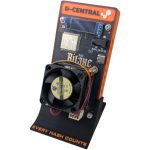
| Bitaxe GT | ~1.2 TH/s | ~15W | Latest generation, best performance-per-watt Bitaxe, solo lottery mining |
| NerdQAxe++ | ~4 TH/s | ~20W | Quad-chip design, highest open-source hashrate, serious solo miners |
| NerdAxe | ~500 GH/s | ~10W | Compact open-source miner, great for learning and solo mining |
| All Bitaxe Variants | 200 GH-1.2 TH | 5-15W | Full lineup: Supra, Ultra, Hex, Gamma, GT — choose your price point |
Dual-Purpose Miners (Pool or Solo)
Our Bitcoin Space Heaters are full-power ASIC miners enclosed in whisper-quiet heating cases. They produce real hashrate suitable for pool mining income while heating your home. Many customers run Space Heaters on pools for income during winter heating season, then switch a Bitaxe to solo for the summer.
Accessories for the Solo Mining Setup
Every solo miner needs a solid setup. D-Central manufactures and stocks the accessories:
- Bitaxe Mesh Stand — the original, designed and manufactured by D-Central
- Premium Bitaxe Heatsink — aluminum cooler for silent overclocking
- Bitaxe Power Supply — optimized 5V 6A PSU for reliable operation
- Bitaxe Mini Miner DIY Kit — enclosure and cooling upgrade
Browse our complete Bitaxe Hub for setup guides, overclocking tips, troubleshooting, and the full accessory catalog.
Frequently Asked Questions
Can I solo mine Bitcoin with just a Bitaxe?
Yes. A Bitaxe connects to a solo mining proxy like ckpool (solo.ckpool.org) or public-pool.io and independently attempts to find blocks. The odds of finding a block with a single Bitaxe are extremely low (roughly 1 in 15,000+ years on average), but the probability is non-zero for every single hash. Solo miners with small hashrates have found blocks — it happens. The Bitaxe is purpose-built for solo mining: low power, always-on, and supporting Bitcoin’s decentralization.
Is solo mining profitable?
In terms of expected value, solo mining and pool mining are mathematically equivalent (minus fees). A solo miner with 100 TH/s will earn the same amount over an infinite timeframe as a pool miner with 100 TH/s. The difference is variance: pool mining delivers small, steady payments, while solo mining delivers nothing for potentially very long periods, then delivers a massive payout (3.125+ BTC). For small-scale miners, solo mining is better understood as a lottery ticket with positive expected value rather than a predictable income stream.
How much hashrate do I need to solo mine successfully?
There is no minimum. Any hashrate can solo mine. The question is how long you are willing to wait statistically. With 100 TH/s, average time to block is roughly 800 years. With 1 PH/s, it drops to about 80 years. With 10 PH/s, roughly 8 years. To have a reasonable probability (say, 50%) of finding at least one block within a year, you would need approximately 80 PH/s. Most solo miners accept that they are playing a long game and mine for the principle, not the probability.
What happens if a solo miner finds a block?
The full block reward (currently 3.125 BTC subsidy + transaction fees) is sent directly to your configured wallet address. After 100 confirmations (~16.5 hours), the funds are fully spendable. There are no pool fees, no minimum payout thresholds, and no withdrawal waiting periods. At current prices, a solo-mined block is worth approximately $265,000 or more.
Is pool mining bad for Bitcoin?
Pool mining itself is not inherently harmful — it is a natural market response to mining’s high variance. The problem is pool centralization. When a small number of pool operators control the majority of hashrate, they gain disproportionate power over transaction selection and block construction. This undermines Bitcoin’s censorship resistance. The solution is not to eliminate pools but to choose decentralized pools (like OCEAN with non-custodial payouts and its DATUM protocol), support solo mining, and push for protocol-level improvements that separate block construction from hashrate provision.
What is the best pool for small miners?
For small miners who choose to pool mine, OCEAN is our top recommendation. It offers non-custodial payouts (BTC goes directly to your wallet, no minimum threshold), transparent TIDES scoring, and support for decentralized block template construction via its DATUM protocol. For small miners who want solo, public-pool.io (zero-fee) or ckpool (2% fee) are the best options. See our complete mining pool comparison for detailed analysis.
Can I switch between pool and solo mining easily?
Yes. Switching between pool and solo mining is as simple as changing the stratum URL in your miner’s configuration. Most miners can be reconfigured in under a minute. There is no penalty for switching, and you can run a hybrid setup with some machines on a pool and others on solo simultaneously. The Bitaxe web interface makes this particularly easy — just update the pool URL and your wallet address.
Does solo mining use more electricity than pool mining?
No. Your mining hardware uses exactly the same amount of electricity whether it is pointed at a pool or solo mining. The hardware performs the same SHA-256 computations either way. The only difference is where the resulting work is submitted and how rewards are distributed. Your electricity cost per TH/s is identical in both modes.
What is the difference between solo mining and lottery mining?
“Lottery mining” is an informal term for solo mining at low hashrates, where the probability of finding a block is extremely small but the potential reward is extremely large — like a lottery. All solo mining is technically lottery mining at today’s difficulty levels unless you control a significant percentage of network hashrate. The term has been popularized by the Bitaxe and open-source mining communities who embrace the variance as part of the adventure. D-Central calls it what it is: every hash is a lottery ticket, and every hash counts.
Should I run my own Bitcoin node for solo mining?
Running your own full Bitcoin node is the ultimate sovereignty setup for solo mining, but it is not required. Solo mining proxies like ckpool and public-pool maintain the node infrastructure for you. However, if you want maximum decentralization — choosing your own transactions, validating your own blocks, zero reliance on third parties — then running a full node with mining software like Bitcoin Knots or Bitcoin Core with a compatible Stratum server is the way to go. It requires about 600+ GB of disk space and a reliable internet connection.
The Evolution of Mining: From CPUs to Pools to Solo Again
Understanding where we are requires understanding where we have been. Bitcoin mining has gone through four distinct eras, and each one reshaped the pool vs solo equation:
- 2009-2010: CPU era — Every miner was a solo miner. Satoshi mined on a laptop CPU. Block difficulty was 1. Finding a block took minutes to hours. This was solo mining paradise — and the world Satoshi designed Bitcoin for.
- 2011-2013: GPU and early ASIC era — As difficulty climbed, solo mining became impractical for most individual miners. The first mining pools (Slush Pool, 2010) emerged as a cooperative solution. Pool mining was born out of necessity.
- 2014-2020: Industrial ASIC era — Mining became dominated by industrial operations running thousands of ASICs in data centers. Solo mining virtually disappeared. Pool mining was the only viable approach for all but the largest operations.
- 2021-present: The solo renaissance — Open-source hardware like the Bitaxe, combined with solo mining proxies (ckpool, public-pool) and a growing philosophical awareness of pool centralization, has reignited solo mining. Hundreds of miners run Bitaxe units as lottery tickets, and solo block finds make regular headlines. We are in the renaissance of solo mining — not because the economics changed, but because the community remembered why decentralization matters.
D-Central has been part of this renaissance since the beginning, manufacturing accessories and stocking hardware for the open-source mining movement since its earliest days.
Conclusion: Make Your Choice, Support the Network
The pool vs solo mining decision is not purely economic. If it were, the math would be simple: pool mine for steady income, solo mine for lottery variance, expected value is roughly the same minus fees.
But Bitcoin mining is not just an economic activity. It is a vote. Every hash submitted to a centralized pool is a vote for that pool’s power over transaction selection. Every hash submitted to solo mining — or to a decentralized pool like OCEAN — is a vote for the Bitcoin that Satoshi described: a peer-to-peer electronic cash system secured by a distributed network of independent miners.
At D-Central Technologies, we have been building for the home miner since 2016. We stock every Bitaxe variant, the NerdQAxe++, the NerdAxe, and the full lineup of open-source solo mining devices — because we believe that decentralization is not just a talking point. It is a practice. Every miner you plug in, whether it is a 500 GH/s NerdAxe or a 200 TH/s S21, is a node in the most important decentralized network ever built.
Solo mine. Pool mine. Run a hybrid. Just mine — and mine with intention.
Every hash counts.
Ready to start? Explore our Solo Mining Probability Calculator, browse the Bitaxe Hub, or contact our team for personalized recommendations on the right mining setup for your goals.
Can I solo mine Bitcoin with just a Bitaxe?
Yes. A Bitaxe connects to a solo mining proxy like ckpool (solo.ckpool.org) or public-pool.io and independently attempts to find blocks. The odds of finding a block with a single Bitaxe are extremely low (roughly 1 in 15,000+ years on average), but the probability is non-zero for every single hash. Solo miners with small hashrates have found blocks — it happens. The Bitaxe is purpose-built for solo mining: low power, always-on, and supporting Bitcoin’s decentralization.
Is solo mining profitable?
In terms of expected value, solo mining and pool mining are mathematically equivalent (minus fees). A solo miner with 100 TH/s will earn the same amount over an infinite timeframe as a pool miner with 100 TH/s. The difference is variance: pool mining delivers small, steady payments, while solo mining delivers nothing for potentially very long periods, then delivers a massive payout (3.125+ BTC). For small-scale miners, solo mining is better understood as a lottery ticket with positive…
How much hashrate do I need to solo mine successfully?
There is no minimum. Any hashrate can solo mine. The question is how long you are willing to wait statistically. With 100 TH/s, average time to block is roughly 800 years. With 1 PH/s, it drops to about 80 years. With 10 PH/s, roughly 8 years. To have a reasonable probability (say, 50%) of finding at least one block within a year, you would need approximately 80 PH/s. Most solo miners accept that they are playing a long game and mine for the principle, not the probability.
What happens if a solo miner finds a block?
The full block reward (currently 3.125 BTC subsidy + transaction fees) is sent directly to your configured wallet address. After 100 confirmations (~16.5 hours), the funds are fully spendable. There are no pool fees, no minimum payout thresholds, and no withdrawal waiting periods. At current prices, a solo-mined block is worth approximately $265,000 or more.
Is pool mining bad for Bitcoin?
Pool mining itself is not inherently harmful — it is a natural market response to mining’s high variance. The problem is pool centralization. When a small number of pool operators control the majority of hashrate, they gain disproportionate power over transaction selection and block construction. This undermines Bitcoin’s censorship resistance. The solution is not to eliminate pools but to choose decentralized pools (like OCEAN with non-custodial payouts and its DATUM protocol), support solo…
What is the best pool for small miners?
For small miners who choose to pool mine, OCEAN is our top recommendation. It offers non-custodial payouts (BTC goes directly to your wallet, no minimum threshold), transparent TIDES scoring, and support for decentralized block template construction via its DATUM protocol. For small miners who want solo, public-pool.io (zero-fee) or ckpool (2% fee) are the best options. See our complete mining pool comparison for detailed analysis.
Can I switch between pool and solo mining easily?
Yes. Switching between pool and solo mining is as simple as changing the stratum URL in your miner’s configuration. Most miners can be reconfigured in under a minute. There is no penalty for switching, and you can run a hybrid setup with some machines on a pool and others on solo simultaneously. The Bitaxe web interface makes this particularly easy — just update the pool URL and your wallet address.
Does solo mining use more electricity than pool mining?
No. Your mining hardware uses exactly the same amount of electricity whether it is pointed at a pool or solo mining. The hardware performs the same SHA-256 computations either way. The only difference is where the resulting work is submitted and how rewards are distributed. Your electricity cost per TH/s is identical in both modes.
What is the difference between solo mining and lottery mining?
“Lottery mining” is an informal term for solo mining at low hashrates, where the probability of finding a block is extremely small but the potential reward is extremely large — like a lottery. All solo mining is technically lottery mining at today’s difficulty levels unless you control a significant percentage of network hashrate. The term has been popularized by the Bitaxe and open-source mining communities who embrace the variance as part of the adventure. D-Central calls it what it is:…
Should I run my own Bitcoin node for solo mining?
Running your own full Bitcoin node is the ultimate sovereignty setup for solo mining, but it is not required. Solo mining proxies like ckpool and public-pool maintain the node infrastructure for you. However, if you want maximum decentralization — choosing your own transactions, validating your own blocks, zero reliance on third parties — then running a full node with mining software like Bitcoin Knots or Bitcoin Core with a compatible Stratum server is the way to go. It requires about…