Every ASIC miner has a finite competitive lifespan. The SHA-256 arms race is relentless — newer chips push joules-per-terahash lower, network difficulty climbs past 110 trillion, and global hashrate blows through 800 EH/s. At some point, the math stops working for your older unit at stock settings. But “no longer competitive at full power” is not the same thing as “worthless.” Not even close.
At D-Central, we have been repairing, modifying, and repurposing ASIC miners since 2016. We have torn apart thousands of machines — S9s, S17s, S19s, Whatsminers, and everything in between. The conclusion is always the same: a well-maintained ASIC miner is a thermodynamic machine that converts electricity into heat and hashrate. When the hashrate-per-watt ratio no longer justifies pure mining, you still have a machine that converts electricity into heat with near-perfect efficiency. That is not waste. That is an engineering opportunity.
This guide covers every practical method for repurposing used ASIC miners, from Bitcoin space heaters to greenhouse integration and beyond. If you own older hardware — or you are thinking about buying used miners from our shop — this is how you squeeze every last satoshi of value out of them.
Why ASIC Miners Become “Obsolete” (And Why That Word Is Misleading)
An ASIC miner does not break down because a newer model launches. The silicon still hashes. The fans still spin. The power supply still delivers clean DC voltage. What changes is the economic equation: when Bitcoin’s mining difficulty adjusts upward and newer machines offer 20-40 J/TH while your unit runs at 80+ J/TH, your electricity cost per BTC mined rises above what most miners consider acceptable.
But here is what the “upgrade or die” narrative misses:
- Electricity is not uniformly priced. A miner that is “unprofitable” at $0.12/kWh might be perfectly viable at $0.04/kWh hydro power in Quebec.
- Heat has economic value. Every watt an ASIC miner consumes becomes heat. If that heat displaces an electric heater, the effective mining cost drops to near zero — you were going to spend that electricity on heating anyway.
- Underclocking changes everything. Custom firmware (Braiins OS, vnish, LuxOS) lets you downclock an older unit to a fraction of its rated power. A 1,400W S9 underclocked to 600W runs cooler, quieter, and at dramatically better efficiency per watt.
- Solo mining is a probability game, not an efficiency game. A single hash has the same chance of finding a block whether it comes from an S9 or an S21. At current block reward of 3.125 BTC, every hash genuinely counts.
The machines are not obsolete. The old operating model is.
Repurposing Strategy 1: Bitcoin Space Heaters
This is the flagship use case, and it is the one D-Central has been pioneering since the early days. The concept is straightforward: ASIC miners are electric resistance heaters that also mine Bitcoin. Every watt of electricity consumed becomes heat at nearly 100% efficiency — the exact same efficiency as any resistive electric heater you would buy at a hardware store.
The difference? Your electric heater gives you nothing but warmth. A Bitcoin space heater gives you warmth AND hashrate pointed at the Bitcoin network.
Which Miners Work Best as Space Heaters
The ideal candidates are mid-power machines that can be underclocked and silenced for residential use:
- Antminer S9 (and variants): The workhorse of the space heater world. At 1,100-1,400W stock, underclocked to 400-800W with custom firmware, these units produce comfortable residential heat output comparable to a portable space heater. Replacement parts are cheap and widely available.
- Antminer S17: Higher hashrate than the S9, more flexible underclocking range. Excellent for larger rooms or basements.
- Antminer L3+: Scrypt algorithm, but still produces clean, consistent heat. Popular for its compact form factor.
- Antminer S19 series: For those who want serious heat output (3,000W+) in a workshop, garage, or dedicated mining room. Can heat an entire basement in Canadian winters.
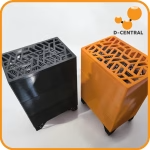
D-Central builds and sells purpose-built Bitcoin Space Heater editions based on the S9, L3, S17, and S19 platforms — pre-configured with custom firmware, quiet fans, and shrouds designed for residential use.
The Conversion Process
If you are converting a standard ASIC miner into a space heater yourself, here is what the process looks like:
- Clean and inspect the unit. Compressed air to blow out dust. Visual inspection of hashboards, connectors, and fans. If anything looks damaged, send it to our repair team before proceeding.
- Flash custom firmware. Braiins OS+ is the most popular choice. It gives you granular control over clock speed, voltage, and fan curves. This is what transforms a screaming industrial machine into something that can coexist with humans.
- Underclock to target wattage. For a bedroom or office, 400-800W is the sweet spot. For a garage or workshop, 1,000-1,500W. Adjust based on the room size and your heat requirements.
- Replace stock fans (optional but recommended). Noctua or Arctic fans running at reduced RPM cut noise dramatically. Alternatively, use a shroud or duct adapter to channel hot exhaust air where you want it.
- Install a duct or shroud. Direct the hot exhaust air into the room (winter) or out a window (summer). D-Central sells universal ASIC shrouds and duct adapters purpose-built for this.
- Point hashrate at a pool — or go solo. Pool mining gives you steady, small payouts. Solo mining gives you a lottery ticket at 3.125 BTC per block. Your call.
The Economics of Heat Mining
Here is the math that makes space heater mining compelling:
A standard 1,500W electric space heater costs roughly $0.18/kWh in many Canadian provinces. Running it 8 hours a day for 6 months of winter costs approximately $486 in electricity, and you get nothing but heat.
An Antminer S9 underclocked to 1,500W costs the same $486 in electricity. You get the same heat output. But you also earn Bitcoin — even at reduced hashrate, an underclocked S9 mining in a pool generates a small but non-zero stream of sats. The heat was free. The Bitcoin is a bonus. When people talk about “free mining,” this is what they mean.
Repurposing Strategy 2: Greenhouse and Agricultural Heating
Canadian winters are brutal on greenhouses. Traditional greenhouse heating — propane, natural gas, electric radiant — is expensive and produces nothing beyond warmth. ASIC miners change that equation.
How It Works
- Duct the exhaust. Position the miner outside the growing area (for noise and humidity control) and duct the hot exhaust air directly into the greenhouse through insulated ducting.
- Control with firmware. Use custom firmware to set temperature-based power profiles. When the greenhouse hits target temperature, the miner downclocks. When temperature drops, it ramps up. The miner becomes a thermostat-controlled heater that also mines Bitcoin.
- CO2 bonus. The warm, dry air from an ASIC miner can benefit certain growing environments where increased air circulation and consistent temperature are advantages.
This is not theoretical. Miners across Canada are already running this setup — growing herbs, vegetables, and cannabis in mining-heated greenhouses. The economics are particularly strong in provinces with low hydro rates.
Other Agricultural Applications
- Food dehydration: The consistent 50-70C exhaust air from an ASIC miner is ideal for drying fruits, herbs, jerky, and mushrooms. Build a simple drying chamber with the miner’s exhaust as the heat source.
- Aquaponics and fish tanks: Mining heat can maintain water temperature in aquaponic systems or fish breeding tanks during winter months.
- Livestock barns: Keeping a barn above freezing in -30C Canadian winters is expensive. A few underclocked miners can supplement heating while contributing hashrate to the network.
Repurposing Strategy 3: Hot Water Pre-Heating
This is an advanced integration that requires plumbing work, but the payoff is significant. The concept: route water through a heat exchanger attached to the miner’s exhaust, pre-heating your domestic hot water before it reaches the water heater. Your water heater does less work, your electricity or gas bill drops, and the miner earns Bitcoin.
Several open-source projects and commercial products exist for this. The engineering is sound — ASIC miners produce consistent, predictable heat output that makes them reliable as a pre-heating stage. For homes with electric water heaters, the economics are especially compelling since you are displacing expensive electric heating with mining heat.
Repurposing Strategy 4: Dedicated Solo Mining Rigs
Not every repurposing strategy involves heat capture. Some miners keep their older hardware running purely for the solo mining lottery.
With a block reward of 3.125 BTC (post-2024 halving), a single successfully mined block is worth approximately six figures in fiat terms. Yes, the probability of an S9 finding a block solo is astronomically low. But it is not zero. And for many in the Bitcoin community, running a solo miner is an act of ideology as much as economics — you are contributing to hashrate decentralization, running your own node, and participating directly in the protocol.
D-Central carries open-source solo mining devices like the Bitaxe, NerdAxe, and NerdQAxe for those who want purpose-built solo mining hardware. But there is something satisfying about pointing an old S9 at solo.ckpool.org and letting it grind. Every hash counts.
Repurposing Strategy 5: Education and Tinkering
Used ASIC miners are some of the best hands-on learning tools in the Bitcoin ecosystem:
- Learn Bitcoin mining from hardware up. Understanding how hashboards, control boards, fans, and PSUs work together gives you a deeper grasp of proof-of-work than any YouTube video.
- Practice ASIC repair. A dead or semi-functional S9 is a perfect training platform. Learn to diagnose hashboard failures, replace ASIC chips, reflow solder joints, and test with a multimeter. D-Central’s ASIC repair service exists because these skills are valuable and in demand.
- Teach the next generation. Schools, hackerspaces, and Bitcoin meetups use running miners as educational props. There is no better way to explain proof-of-work than showing someone a running ASIC miner, pointing at the hashboard, and saying “this chip is doing 50 billion SHA-256 calculations per second right now.”
- Firmware development. Custom firmware projects like Braiins OS started because people wanted to push their hardware further. Your old miner can be a development testbed.
Maintenance for Repurposed Miners
A repurposed miner is still an ASIC miner. It needs the same care:
Regular Maintenance Schedule
- Every 3 months: Blow out dust with compressed air. Inspect fan bearings for noise or wobble. Check all cable connections.
- Every 6 months: Deep clean — remove hashboards, clean heatsinks, reapply thermal paste if temperatures are creeping up. Update firmware to latest stable release.
- Annually: Full inspection of PSU (capacitor bulging, fan wear), power cables, and electrical connections. Replace any fans showing signs of bearing failure.
Troubleshooting Common Issues
- Overheating or thermal shutdown: Usually dust accumulation or failed fans. Clean thoroughly, replace fans, verify thermal paste contact.
- Hashrate drops: Check for failed ASIC chips on the hashboard (firmware dashboard will show chip status). A single failed chip reduces board output. D-Central repairs hashboards with chip-level diagnostics.
- Excessive noise: Bearing failure in fans. Replace with quality replacements (Noctua, Delta, Sunon). Underclocking also reduces fan speed requirements.
- Network connectivity issues: Check Ethernet cable and router. ASIC miners need stable, wired connections — WiFi adapters are unreliable for most models.
If your miner needs professional attention, D-Central’s ASIC repair team has been fixing these machines since 2016. We repair at the chip level — not just board swaps.
Safety: Non-Negotiable Fundamentals
ASIC miners are high-power electrical devices. Treat them with respect:
- Dedicated circuits. A 1,500W miner needs its own 15A or 20A circuit. Never daisy-chain power strips. S19-class miners (3,000W+) require 240V circuits — have an electrician install one if you do not already have it.
- Grounding. Always use grounded outlets and PSUs. Never defeat the ground pin.
- Fire safety. Place miners on non-flammable surfaces. Keep combustible materials away. Install a smoke detector in the same room. Have a fire extinguisher accessible.
- Capacitor discharge. Before opening any ASIC miner or PSU, unplug it and wait at least 5 minutes for capacitors to discharge. PSU capacitors can hold lethal voltage.
- Ventilation. Even in “heater mode,” the room needs adequate airflow. Do not seal a miner in an unventilated closet.
The Open-Source Advantage
The ASIC miner repurposing movement is deeply aligned with the open-source, cypherpunk values at the heart of Bitcoin. Custom firmware projects, 3D-printed shrouds and enclosures, community-developed duct designs, and shared monitoring software — all of this exists because people refuse to accept that hardware has a fixed, corporate-defined lifespan.
D-Central has been part of this movement from the beginning. We created the original Bitaxe Mesh Stand. We develop heatsinks, cases, and accessories for open-source mining hardware. We stock the full range of Bitaxe variants, NerdAxe, NerdQAxe, and NerdNOS devices. And we repair the machines that the manufacturers would rather you throw away and replace.
Every miner you repurpose instead of scrapping is a small act of resistance against planned obsolescence. It is also a contribution to Bitcoin’s decentralization — more hashrate, more geographic distribution, more nodes, more sovereign participation in the network. That is the mission.
Where to Source Used ASIC Miners
If you are looking to start a repurposing project, here is where to find hardware:
- D-Central’s shop: We carry new and used ASIC miners, tested and cleaned, with known operational status. No guessing games.
- Your own closet: That S9 you shelved three years ago is a perfectly good space heater waiting to happen.
- Local Bitcoin meetups: Miners often sell older hardware at meetups. You can inspect before buying.
- Online marketplaces: Exercise caution. Verify hashboard count, test before paying, and avoid deals that seem too good to be true.
Before buying used, check the unit’s model, firmware compatibility, and hashboard status. If you are unsure about a machine’s condition, D-Central offers diagnostic and repair services to get any unit back to operational status.
Hosting Repurposed Miners
Not everyone has the electrical capacity or noise tolerance to run miners at home. D-Central’s hosting facility in Quebec offers low-cost hydro power and purpose-built infrastructure for miners of all sizes. If you have hardware that is too loud or too power-hungry for home use but still has hash life left, hosting is the answer.
Frequently Asked Questions
Can an old ASIC miner really heat my home?
Yes. Every watt consumed by an ASIC miner becomes heat at nearly 100% efficiency — identical to a resistive electric heater. An S9 underclocked to 1,000-1,500W produces the same heat output as a portable space heater from any hardware store, with the bonus of mining Bitcoin simultaneously.
Is it worth mining Bitcoin with an old S9 in 2026?
As a standalone mining operation at standard electricity rates, likely not. But as a dual-purpose device (heater + miner), the economics are compelling. If you are already spending money on electric heating, the mining revenue is essentially free income on top of heat you were paying for anyway.
What firmware should I use for underclocking?
Braiins OS+ is the most widely used and well-supported option. Vnish and LuxOS are also excellent choices. All three offer granular control over voltage, clock speed, and fan curves — essential for residential or agricultural use.
How loud is a repurposed ASIC miner?
Stock ASIC miners are extremely loud (75-85 dB). With custom firmware underclocking and aftermarket quiet fans, you can reduce noise to 40-55 dB — roughly equivalent to a household refrigerator or quiet conversation. D-Central’s Space Heater editions come pre-configured for quiet residential operation.
Can I solo mine with a repurposed miner?
Absolutely. Point your miner at a solo mining pool like solo.ckpool.org. The probability of finding a block with an S9 is extremely low, but the current block reward is 3.125 BTC. Many Bitcoiners run solo miners as both a lottery ticket and an ideological contribution to hashrate decentralization. Every hash counts.
What if my used miner has a dead hashboard?
A miner with 2 out of 3 working hashboards still runs — just at reduced hashrate. For space heating, this barely matters since the heat output scales with power consumption regardless. If you want full performance restored, D-Central offers chip-level ASIC repair services for all major manufacturers.
Is repurposing ASIC miners environmentally responsible?
Significantly more so than scrapping them. ASIC miners contain metals and electronic components that become e-waste in landfills. Repurposing extends their useful life by years, displaces other energy consumption (heating, drying, water pre-heating), and contributes to Bitcoin network decentralization. It is one of the most practical sustainability moves a miner can make.