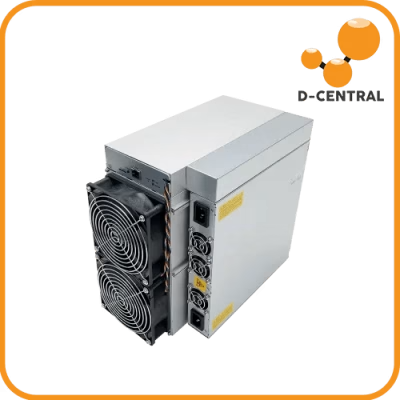
ASICs — Application-Specific Integrated Circuits — are the backbone of Bitcoin’s security model. These purpose-built machines do one thing and do it better than anything else on the planet: compute SHA-256 hashes at staggering speed and efficiency. Without ASICs, Bitcoin’s Proof-of-Work consensus would be a fraction of what it is today. The network’s hashrate, its security, and its resistance to attack all trace back to these silicon workhorses.
If you mine Bitcoin in 2026, you are running ASICs. There is no competitive alternative. Understanding how they work, why they matter, and how the landscape has evolved is essential knowledge for anyone serious about mining — from home miners running a single unit to operators managing entire facilities.
This guide breaks down ASIC technology from first principles, covers the current state of the market, and explains why D-Central Technologies has built its entire operation around keeping these machines running at peak performance.
The Evolution of Bitcoin Mining Hardware
CPU Mining: The Genesis Era (2009–2010)
When Satoshi Nakamoto launched Bitcoin in January 2009, mining happened on ordinary desktop CPUs. A single-core processor could find blocks. The network hashrate was measured in megahashes per second (MH/s) — a number so small it seems laughable by today’s standards. But it worked. CPU mining secured Bitcoin during its most vulnerable period, when the network effect was zero and every hash genuinely mattered.
The beauty of CPU mining was its accessibility. Anyone with a computer could participate. The barrier to entry was nonexistent. This era embodied the cypherpunk ideal: a truly decentralized network where every participant had roughly equal mining power.
GPU Mining: The First Arms Race (2010–2013)
By late 2010, miners discovered that Graphics Processing Units could compute SHA-256 hashes far more efficiently than CPUs. A single GPU could deliver the equivalent of dozens of CPUs. The economics were immediately clear — more hashes per watt meant more bitcoin per dollar of electricity.
GPU mining introduced the first real specialization to Bitcoin mining. It also introduced the first tensions around centralization, as miners with access to better graphics cards had a measurable advantage. Still, GPUs were consumer hardware. You could walk into a store and buy one.
FPGA Mining: The Bridge (2011–2013)
Field-Programmable Gate Arrays represented a brief but important transitional step. FPGAs offered better energy efficiency than GPUs by allowing miners to program the chip’s logic gates specifically for SHA-256 computation. They were faster per watt, but they were also harder to set up, more expensive, and produced in smaller quantities. FPGAs proved a critical concept: purpose-built silicon would always beat general-purpose hardware for a fixed computational task.
The ASIC Revolution (2013–Present)
In early 2013, the first Bitcoin ASIC miners shipped. Companies like Canaan (Avalon) and later Bitmain entered the market with chips designed from the ground up to do nothing but compute SHA-256 hashes. The performance leap was enormous. A single ASIC could match the output of hundreds of GPUs while consuming a fraction of the power.
This was the inflection point. Within months, GPU mining for Bitcoin became unprofitable. The network hashrate exploded from gigahashes to terahashes to petahashes. By 2026, Bitcoin’s total network hashrate exceeds 800 exahashes per second (EH/s) — a number built entirely on ASIC silicon.
How ASICs Work: The Technical Foundation
Purpose-Built Silicon
An ASIC is a chip designed to perform one specific computation. In Bitcoin mining, that computation is the SHA-256 double-hash. Every Bitcoin block header gets hashed, the nonce is incremented, and the hash is computed again — billions of times per second. An ASIC chip contains millions of logic gates arranged specifically to execute this hashing algorithm with maximum throughput and minimum energy waste.
Unlike a CPU or GPU, there is no instruction decoder, no branch predictor, no cache hierarchy, and no general-purpose arithmetic logic unit. Every transistor serves the singular purpose of SHA-256 computation. This extreme specialization is what gives ASICs their overwhelming efficiency advantage.
The Manufacturing Process
Modern ASIC chips are fabricated at the world’s most advanced semiconductor foundries. The leading Bitcoin ASICs in 2026 use process nodes as small as 3nm (nanometers) — the same cutting-edge fabrication technology used in the latest smartphones and data center processors.
The process starts with chip design, where engineers create the circuit layout optimized for SHA-256 throughput and power efficiency. This design is converted to photomasks, which are used to etch the circuit patterns onto silicon wafers through photolithography. Each wafer produces hundreds of individual ASIC chips, which are then packaged, tested, and assembled into complete mining units with power delivery systems, cooling, and control boards.
Only a handful of foundries on the planet can fabricate chips at these process nodes — primarily TSMC and Samsung. This manufacturing bottleneck shapes the entire ASIC market and determines which companies can bring competitive products to market.
Key Performance Metrics
Two numbers define every ASIC miner:
- Hashrate — measured in terahashes per second (TH/s). This is the raw computational output. Higher is better.
- Power efficiency — measured in joules per terahash (J/TH). This is how much energy it costs to produce each unit of hashrate. Lower is better.
In 2026, the most efficient Bitcoin ASICs on the market achieve approximately 15–17 J/TH, with flagship models like the Bitmain Antminer S21 XP delivering around 13.5 J/TH. Compare this to the first-generation ASICs from 2013 that operated at roughly 1,000 J/TH — a 70x improvement in energy efficiency over 13 years.
Why ASICs Dominate Bitcoin Mining
Unmatched Efficiency
The efficiency gap between ASICs and general-purpose hardware is not marginal — it is several orders of magnitude. A modern ASIC mining rig consumes roughly the same power as a high-end gaming GPU but produces thousands of times more SHA-256 hashes. This makes any form of non-ASIC Bitcoin mining economically irrational. The electricity cost alone would exceed any possible mining revenue.
This efficiency dominance is not a flaw in Bitcoin’s design — it is a feature. Bitcoin’s security model depends on mining being a competitive, capital-intensive process. ASICs ensure that attackers face an enormous economic barrier: to threaten the network, you would need to acquire and power more ASIC hardware than the entire existing network combined.
Network Security Through Hashrate
Bitcoin’s security is directly proportional to its hashrate. The more total computational power the network has, the more expensive it becomes for any attacker to execute a 51% attack — the scenario where a single entity controls enough hashrate to rewrite transaction history.
With Bitcoin’s hashrate exceeding 800 EH/s in early 2026, the cost of such an attack is measured in billions of dollars of hardware alone, not counting electricity, facility costs, and logistics. ASICs made this level of security possible. No collection of CPUs or GPUs could ever approach this hashrate, even theoretically.
The Decentralization Question
Critics argue that ASIC dominance centralizes mining because expensive, specialized hardware is required. There is truth to this at the industrial level — large mining farms with access to cheap power and bulk ASIC purchases have structural advantages.
But the counter-narrative is equally important: ASICs have also enabled home mining at unprecedented efficiency. A single modern ASIC can run in a basement, garage, or dedicated room, producing meaningful hashrate while generating useful heat. Products like Bitcoin space heaters take this further by integrating ASIC hardware into functional home heating units, turning every watt of mining energy into dual-purpose output.
The rise of open-source mining hardware like the Bitaxe also pushes back against centralization by making mining accessible at a micro scale. While Bitaxe devices use a different approach (single-chip, low-power solo mining), they complement the ASIC ecosystem by bringing more individual participants into the network.
The ASIC Market in 2026
Major Manufacturers
Three companies dominate the Bitcoin ASIC market:
- Bitmain — The largest ASIC manufacturer by market share. Their Antminer series (S21, S21 XP, S21 Pro, T21) represents the current generation of high-performance miners. Bitmain has consistently led in hashrate-per-unit and has the deepest relationship with TSMC for advanced node production.
- MicroBT — Manufacturer of the Whatsminer series (M60S, M63S, M56S). MicroBT has carved out a strong position, particularly in large-scale deployments, with competitive efficiency and aggressive pricing.
- Canaan — The original ASIC manufacturer (Avalon series), Canaan continues to produce competitive miners (A1466, A1366) and holds particular strength in certain geographic markets.
The concentration of manufacturing among three companies is a legitimate centralization concern. However, the semiconductor economics make this nearly inevitable — designing and fabricating sub-5nm chips requires billions of dollars in investment and deep foundry relationships.
The Current Generation
The state of the art in early 2026 centers around a few key models:
| Model | Manufacturer | Hashrate | Efficiency (J/TH) |
|---|---|---|---|
| Antminer S21 XP | Bitmain | 270 TH/s | ~13.5 |
| Antminer S21 Pro | Bitmain | 234 TH/s | ~15.0 |
| Antminer S21 | Bitmain | 200 TH/s | ~17.5 |
| Whatsminer M63S | MicroBT | 390 TH/s | ~18.5 |
| Whatsminer M60S | MicroBT | 186 TH/s | ~18.5 |
| Avalon A1466 | Canaan | 150 TH/s | ~19.5 |
These numbers shift with each generation, but the trajectory is clear: more hashes, fewer joules. Each new process node shrink (from 7nm to 5nm to 3nm) delivers meaningful efficiency gains, pushing older hardware toward obsolescence while raising the bar for profitability.
For a side-by-side comparison of current models, check our ASIC Miner Comparison Tool.
ASIC Economics: Investment, Operation, and Profitability
The Cost Equation
Mining profitability comes down to a simple formula: revenue from mined bitcoin minus electricity costs minus hardware amortization. ASICs determine two of these three variables — their hashrate determines revenue potential, and their efficiency determines electricity cost.
The initial investment for a current-generation ASIC ranges from roughly $2,000 to $15,000+ depending on the model and market conditions. This hardware depreciates as newer, more efficient models are released, but the depreciation curve has flattened compared to earlier generations. A machine that is 20% less efficient than the cutting edge can still be profitable in the right location with the right electricity rate.
Electricity: The Dominant Variable
For most mining operations, electricity is the single largest operating expense. This is where geography becomes strategy. Miners in regions with cheap hydroelectric, wind, or stranded natural gas have structural advantages. Canada, with its abundant hydroelectric power and cold climate (reducing cooling costs), is one of the most favorable mining jurisdictions on the planet.
This is precisely why D-Central Technologies operates from Canada — the combination of cold climate, renewable energy access, and favorable regulations creates ideal conditions for Bitcoin mining operations of every scale.
The Post-Halving Reality
Bitcoin’s fourth halving in April 2024 cut the block reward from 6.25 BTC to 3.125 BTC. This event forced a reckoning across the mining industry. Older, less efficient ASICs were pushed offline as they could no longer cover electricity costs. The surviving fleet is composed primarily of machines achieving 25 J/TH or better.
This halving cycle reinforces a fundamental truth: efficiency is survival. Every halving doubles the importance of J/TH as a metric. Miners who invest in newer hardware or optimize their existing fleet through maintenance, underclocking, and firmware tuning are the ones who remain profitable.
Maintaining and Repairing ASICs: Why It Matters
ASICs Are Industrial Equipment
An ASIC miner is not a consumer electronics device you replace when something goes wrong. These are industrial machines with a typical operational lifespan of 3–7 years, running 24/7 under significant thermal and electrical stress. Components fail. Fans wear out. Hashboards develop faults. Power supplies degrade.
Maintaining these machines — rather than discarding them — is both economically smart and environmentally responsible. A hashboard repair that costs a few hundred dollars can restore thousands of dollars worth of hashrate. This is the core of what D-Central Technologies does.
D-Central’s ASIC Repair Expertise
D-Central Technologies is Canada’s leading ASIC repair center, with expertise spanning every major manufacturer and model series. Since 2016, D-Central has repaired thousands of mining units, from legacy Antminer S9s to the latest S21 and Whatsminer M60 series.
Repair capabilities include:
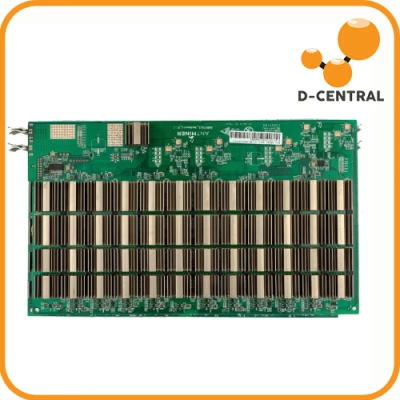
- Hashboard diagnostics and repair — identifying and replacing failed ASIC chips, fixing broken traces, resoldering BGA connections
- Control board troubleshooting — firmware issues, network connectivity, sensor calibration
- Power supply testing and replacement — APW series PSU repair, voltage regulation diagnostics
- Thermal management — fan replacement, heatsink reseating, thermal compound application
- Custom modifications — converting standard miners into space heater configurations, noise reduction modifications, custom firmware deployment
Every repair extends the useful life of mining hardware, keeps hashrate on the network, and saves miners from the full cost of replacement. For home miners especially, having a trusted repair partner is the difference between an interruption and a total loss.
Preventive Maintenance
The best repair is the one you never need. Regular maintenance practices that extend ASIC lifespan include:
- Dust removal — compressed air cleaning every 3–6 months depending on environment
- Thermal paste replacement — every 12–18 months for optimal heat transfer
- Fan inspection — checking for bearing wear, blade damage, RPM degradation
- Electrical connections — verifying all power connectors are seated firmly, checking for oxidation
- Firmware updates — keeping firmware current for efficiency improvements and security patches
- Environmental control — maintaining proper intake air temperature, humidity levels, and dust filtration
ASICs and Home Mining: The Decentralization Opportunity
Mining at Home in 2026
The narrative that ASIC mining is only for large-scale industrial operations is outdated. In 2026, home mining is not only viable — it is a growing movement driven by Bitcoiners who understand that network decentralization depends on geographic and operational diversity.
A single ASIC miner running at home contributes hashrate to the network from a unique location, under a unique operator’s control. Multiply this across thousands of homes, and you get a meaningfully more decentralized Bitcoin network. This is the mission D-Central was founded on: decentralization of every layer of Bitcoin mining.
Dual-Purpose Mining: Heat Recovery
One of the most compelling arguments for home ASIC mining is heat recovery. An ASIC miner converts virtually 100% of its electrical input into heat. In a cold-climate country like Canada, that heat has real value. Instead of venting it outdoors (as industrial facilities must), home miners can direct it into living spaces, workshops, garages, or greenhouses.
Bitcoin space heaters formalize this concept by packaging ASIC hardware into enclosures designed for home heating. The miner runs, produces hashrate, earns bitcoin, and heats the room. The electricity cost is not a mining expense — it is a heating expense that happens to also mine bitcoin. In Canadian winters, this economic math is extremely favorable.
Noise and Power Considerations
The two practical challenges of home ASIC mining are noise and power consumption. A standard industrial ASIC (like an Antminer S21) produces 70–80 dB of fan noise — roughly equivalent to a vacuum cleaner running continuously. Solutions include:
- Custom enclosures — sound-dampening boxes that reduce noise by 15–25 dB
- Immersion cooling — submerging the miner in dielectric fluid eliminates fans entirely
- Underclocking — reducing hashrate and power draw also reduces noise and heat output
- Dedicated spaces — basements, garages, or outbuildings where noise is less of a concern
Power requirements for a single modern ASIC are typically 3,000–5,000 watts, requiring a dedicated 240V circuit. Home miners need to verify their electrical panel capacity and may need an electrician to install appropriate wiring. This is a one-time setup cost that enables years of mining operation.
The Future of ASIC Technology
Process Node Roadmap
The semiconductor industry continues pushing toward smaller process nodes. TSMC’s 3nm process is in mass production, and 2nm is on the roadmap. Each shrink offers potential improvements in both performance and efficiency, though the gains are diminishing compared to earlier transitions (e.g., from 28nm to 16nm).
For Bitcoin ASICs, this means future generations will continue to improve J/TH, but the pace of improvement is slowing. The era of 10x efficiency jumps between generations is over. Future improvements will be measured in single-digit percentage gains — making maintenance and optimization of existing hardware more important than ever.
Cooling Innovation
As ASIC power density increases, cooling becomes a bigger engineering challenge. Air cooling is approaching its practical limits for the highest-performance units. Immersion cooling (submerging miners in dielectric fluid) is gaining adoption in both industrial and advanced home setups. Hydro cooling, where liquid coolant circulates through integrated channels, is another approach gaining traction in next-generation mining hardware.
These cooling innovations have implications for home miners too. Quieter, more efficient cooling solutions make home mining more practical and expand the range of environments where ASICs can operate effectively.
Open-Source Hardware: A Parallel Path
While industrial ASICs represent the cutting edge of hashrate and efficiency, the open-source mining hardware movement represents something equally important: accessibility and sovereignty. Devices like the Bitaxe use individual ASIC chips (like the BM1366 or BM1368) to create small, low-power solo miners that anyone can build, modify, and run.
These devices will never compete with industrial ASICs on raw hashrate. That is not the point. They exist to put mining hardware in the hands of individuals, to educate, to decentralize, and to give every Bitcoiner the ability to participate in securing the network. D-Central Technologies is a pioneer in this ecosystem, having created the original Bitaxe Mesh Stand and developed many of the leading accessories and solutions for the Bitaxe family.
D-Central Technologies: Built on ASIC Expertise
Since 2016, D-Central Technologies has operated at the intersection of ASIC hardware and Bitcoin’s decentralization mission. The company was founded on a simple conviction: the tools of institutional mining should be accessible to everyone.
What started as repair work has grown into a full-service mining operation encompassing:
- ASIC repair and maintenance — Canada’s largest independent repair center with expertise across all major manufacturers
- Custom mining solutions — space heaters, slim editions, custom-configured miners for specific use cases
- Open-source mining hardware — Bitaxe, NerdAxe, NerdQAxe, Nerdminer, and the full ecosystem of accessories
- Mining hosting — facility-based hosting in Quebec for miners who want professional management
- Education and consulting — helping new miners get started and existing miners optimize their operations
Every service and product traces back to the same mission: decentralization of every layer of Bitcoin mining. ASICs are the foundation of that mission. Understanding them, maintaining them, and making them accessible to the widest possible audience is what D-Central does every day.
Frequently Asked Questions
What is an ASIC miner and how does it work?
An ASIC (Application-Specific Integrated Circuit) miner is a piece of hardware built to perform one specific computation — in Bitcoin’s case, the SHA-256 hashing algorithm. Every transistor on the chip is dedicated to this task, making it vastly more efficient than general-purpose processors like CPUs or GPUs. The miner rapidly cycles through nonce values, hashing block header data until it finds a hash below the network’s difficulty target, which allows a new block to be added to the blockchain.
Why can’t I mine Bitcoin with a regular computer anymore?
The Bitcoin network’s difficulty adjusts based on total hashrate. With hundreds of exahashes per second coming from ASIC miners, a CPU or GPU produces such a tiny fraction of the network’s hashrate that the expected time to find a block would be measured in millions of years. The electricity cost would far exceed any possible revenue. ASICs are the only economically viable way to mine Bitcoin in 2026.
How long does an ASIC miner last?
With proper maintenance, an ASIC miner can operate for 3–7 years. The primary factors affecting lifespan are operating temperature, dust exposure, power quality, and maintenance frequency. Regular cleaning, thermal paste replacement, and fan inspection extend operational life significantly. D-Central’s ASIC repair services can also restore faulty units to full operation.
What is J/TH and why does it matter?
J/TH stands for joules per terahash — it measures how much energy an ASIC consumes for each terahash of computation. Lower J/TH means better efficiency. After each Bitcoin halving, the block reward drops, making efficiency the primary determinant of profitability. In 2026, competitive miners achieve 15–20 J/TH, while the most efficient models reach approximately 13.5 J/TH.
Can I mine Bitcoin at home with an ASIC?
Yes. Home mining is viable and growing in 2026. A single ASIC miner requires a dedicated 240V circuit (3,000–5,000W) and produces significant noise and heat. Many home miners turn the heat output into an advantage by using their miner to heat living spaces, workshops, or garages. Bitcoin space heaters are purpose-built for this dual-use approach. Noise can be managed with custom enclosures, underclocking, or immersion cooling.
Is ASIC mining bad for the environment?
ASIC mining consumes significant electricity, but the environmental impact depends on the energy source. Miners increasingly use renewable energy — hydroelectric, wind, solar, and stranded natural gas that would otherwise be flared. In Canada, where much of the grid is hydroelectric, Bitcoin mining’s carbon footprint is relatively low. Dual-purpose mining (heat recovery) further improves the energy equation by ensuring no energy is wasted.
What happens to old ASIC miners when newer models come out?
Older ASICs do not become useless overnight. They become less profitable as efficiency decreases relative to newer hardware, but in regions with cheap electricity, older models can remain profitable for years. Many are repurposed as space heaters, where the mining revenue offsets heating costs. Others are refurbished, repaired, and resold. D-Central Technologies specializes in giving older mining hardware extended life through repair, modification, and creative repurposing.
How do I choose the right ASIC miner?
The right ASIC depends on your electricity cost, available power capacity, noise tolerance, and budget. Use D-Central’s Mining Profitability Calculator to model different scenarios. Key factors: J/TH efficiency (determines operating cost), hashrate (determines revenue potential), noise level (determines placement options), and purchase price (determines ROI timeline).
Does D-Central repair all brands of ASIC miners?
Yes. D-Central Technologies repairs miners from all major manufacturers including Bitmain (Antminer series), MicroBT (Whatsminer series), Canaan (Avalon series), and Innosilicon. With model-specific repair pages and expertise spanning every generation from the Antminer S9 through the latest S21 XP, D-Central is Canada’s most comprehensive ASIC repair center.