GPU Mining Is Dead. ASIC Mining Won. Here’s Why That Matters.
There was a time when you could fire up a gaming PC, point your GPU at a Bitcoin mining pool, and stack sats. That era is over — and it has been for years. Bitcoin’s SHA-256 proof-of-work algorithm is now the exclusive territory of Application-Specific Integrated Circuits (ASICs), purpose-built machines that do one thing and do it with ruthless efficiency: compute SHA-256 hashes.
If you’re still hearing people talk about GPU mining for Bitcoin, they’re either confused, selling something, or stuck in 2013. The numbers tell the story with zero ambiguity. Let’s break down exactly why ASICs dominate Bitcoin mining, why GPUs never stood a chance long-term, and what this means for home miners who want to participate in securing the most important network on the planet.
A Brief History: From CPUs to GPUs to ASICs
Bitcoin launched in January 2009. Satoshi Nakamoto mined the genesis block with a CPU. For a brief, beautiful window, anyone with a desktop computer could mine Bitcoin. But Bitcoin’s difficulty adjustment algorithm — one of its most elegant design features — ensures that as more hashrate joins the network, the puzzles get harder.
By 2010, miners discovered that GPUs could compute SHA-256 hashes significantly faster than CPUs. A single GPU could deliver hashrates orders of magnitude beyond what a CPU managed. GPU mining rigs proliferated. Multi-GPU setups became the standard.
But the economics of Bitcoin mining create relentless evolutionary pressure. If a more efficient method exists, the market will find it. In 2012, the first FPGA (Field-Programmable Gate Array) miners appeared, offering better efficiency than GPUs. Then in 2013, the first SHA-256 ASICs shipped — and the game changed permanently.
An ASIC is a chip designed from the transistor level up to perform a single computation. No operating system overhead. No graphics rendering pipeline. No wasted silicon on video output or general-purpose logic. Every transistor serves one purpose: hashing SHA-256.
The efficiency gap was so extreme that GPU mining became economically nonviable for Bitcoin almost overnight. And with every subsequent ASIC generation, the gap has only widened.
The Numbers: GPU vs. ASIC in 2026
Let’s put real numbers on this. Here’s what a top-tier GPU looks like next to modern ASIC miners:
| Specification | NVIDIA RTX 4090 (GPU) | Antminer S21 (ASIC) | Antminer S21 Pro (ASIC) |
|---|---|---|---|
| SHA-256 Hashrate | ~1.5 GH/s | 200 TH/s | 234 TH/s |
| Power Consumption | ~450W | ~3,500W | ~3,500W |
| Efficiency (J/TH) | ~300,000 J/TH | ~17.5 J/TH | ~15 J/TH |
| Unit Cost | ~$1,600 USD | ~$5,000–$6,000 USD | ~$7,000–$9,000 USD |
| Bitcoin Mining Viability | Effectively zero | Profitable at scale | Profitable at scale |
Read that efficiency column again. The RTX 4090 — the most powerful consumer GPU on the market — operates at roughly 300,000 joules per terahash. The Antminer S21 operates at 17.5 J/TH. That’s not a small improvement. The ASIC is approximately 17,000 times more energy-efficient at computing SHA-256 hashes.
At current network difficulty (110T+ as of early 2026) and a network hashrate exceeding 800 EH/s, a single RTX 4090 mining Bitcoin would earn fractions of a penny per year while consuming hundreds of dollars in electricity. It’s not close. It’s not debatable. GPUs cannot mine Bitcoin.
Why ASICs Won: The Engineering Logic
The ASIC advantage isn’t a market quirk — it’s an engineering inevitability. Here’s why:
1. SHA-256 is a fixed algorithm. Bitcoin’s proof-of-work uses SHA-256d (double SHA-256). The algorithm doesn’t change. This stability is what makes ASIC design possible and economically rational. When your target computation is fixed, you can optimize silicon specifically for it, eliminating every unnecessary transistor.
2. Parallel doesn’t mean efficient. GPUs are parallel processors, yes — but they’re general-purpose parallel processors. They carry enormous overhead: memory controllers for GDDR, shader pipelines, texture units, rasterization engines, display output circuitry. None of that helps with SHA-256. An ASIC strips all of that away and dedicates every square millimeter of silicon to hashing.
3. Process node advantages compound. Modern ASICs are manufactured on cutting-edge semiconductor nodes (5nm, 3nm). When every transistor on your chip is doing useful work, smaller process nodes translate directly to better energy efficiency. GPUs on the same nodes waste a significant fraction of their transistor budget on non-hashing functions.
4. Economic natural selection. Bitcoin’s difficulty adjustment creates a Darwinian environment. Miners with better efficiency survive; inefficient miners get priced out. This creates relentless pressure to adopt the most efficient hardware. Any miner still using GPUs in 2026 is burning money.
The Home Mining Revolution: ASICs for Everyone
Here’s where it gets interesting — and where D-Central Technologies lives.
The ASIC dominance narrative might sound like it favors only large industrial operations. It doesn’t have to. The same engineering principles that made ASICs crush GPUs also enabled a new category of hardware: compact, efficient, home-friendly ASIC miners.
Open-Source Solo Miners: The Bitaxe Revolution
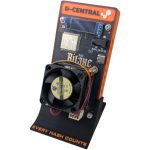
The Bitaxe family of open-source solo miners represents everything Bitcoin’s cypherpunk roots stand for. These are ASIC-based miners — real SHA-256 hashing chips — packed into compact, low-power form factors that run on a 5V barrel jack (5.5×2.1mm DC). They’re silent, they sip power, and they mine Bitcoin directly against the network in solo mode.
No pool. No middleman. Just your miner, the Bitcoin network, and the mathematics of probability. Every hash counts.
D-Central Technologies is a pioneer in the Bitaxe ecosystem. We were the first company to manufacture the original Bitaxe Mesh Stand, and we’ve developed leading solutions including custom heatsinks for Bitaxe and Bitaxe Hex, custom cases, and a full accessories ecosystem. We stock every Bitaxe variant — Supra, Ultra, Hex, Gamma, GT — plus the full Nerd/Open-Source lineup: NerdAxe, NerdNOS, Nerdminer, and NerdQAxe.
This is what the ASIC advantage looks like when it’s hacked for the people. Purpose-built silicon, open-source designs, available to anyone who wants to contribute hashrate to the Bitcoin network.
Bitcoin Space Heaters: Mining Meets Thermodynamics
Every watt consumed by a miner becomes heat. That’s not waste — that’s physics. Bitcoin Space Heaters take full-size ASIC miners and integrate them into heating systems for homes and businesses. Your S9, S17, or S19 doesn’t just mine Bitcoin — it heats your space during Canadian winters.
When your electricity is already going to heat, the effective cost of mining drops dramatically. This is especially powerful in cold climates like Canada, where heating is a mandatory expense for most of the year. Instead of burning natural gas or running a baseboard heater, you’re running an ASIC miner that produces the same heat while simultaneously stacking sats.
This dual-purpose approach is something no GPU could ever deliver. GPUs are noisy, inefficient at hashing, and generate heat without producing meaningful mining output. ASICs produce heat AND mine Bitcoin profitably. The thermodynamic equation only works with purpose-built hardware.
ASIC Longevity: Repair, Don’t Replace
One of the underappreciated aspects of ASIC dominance is hardware longevity. A well-maintained ASIC miner can run for years. When components fail — hashboards, control boards, power supplies, fans — they can be diagnosed and repaired rather than discarded.
D-Central operates Canada’s most comprehensive ASIC repair service, covering 38+ models across Bitmain, MicroBT, Innosilicon, Canaan, and Halong hardware. From hashboard-level component repair to firmware diagnostics, our technicians keep miners running long past what the manufacturer intended.
This repairability is another structural advantage of the ASIC ecosystem. Mining hardware that can be serviced, upgraded, and maintained creates a sustainable mining economy rather than a disposable one. GPUs in mining rigs, by contrast, were often run to failure and discarded — a wasteful approach that didn’t serve miners or the environment.
The Decentralization Imperative
The real reason ASIC dominance matters goes beyond efficiency metrics. It’s about decentralization — the core principle that makes Bitcoin valuable.
Bitcoin’s security model depends on hashrate being distributed across many independent miners. When mining was GPU-based, it was theoretically more accessible — but in practice, GPU mining centralized around large farms with cheap electricity and bulk hardware purchasing power. The same centralization pressures exist with ASICs, but the countermeasure is different: smaller, more efficient, purpose-built devices designed specifically for home miners.
Products like the Bitaxe, NerdAxe, and NerdQAxe exist precisely to counteract mining centralization. They put real ASIC hashing power in the hands of individuals. Solo mining with a Bitaxe isn’t about profitability in the traditional sense — it’s about contributing to Bitcoin’s decentralization, learning how mining works at a fundamental level, and maintaining the possibility (however small) of hitting a solo block for the full 3.125 BTC reward.
D-Central’s mission — decentralization of every layer of Bitcoin mining — is built on this principle. From open-source miners and accessories to ASIC repair services to hosting in Quebec, every service we offer is designed to lower the barriers to mining participation.
What About GPU Mining for Other Coins?
Let’s address this directly: some people will point out that GPUs can still mine certain altcoins that use GPU-friendly algorithms (Ethash, KawPow, Equihash, etc.). That’s technically true, but as a Bitcoin-focused company, here’s our unfiltered take.
Ethereum moved to proof-of-stake in 2022. The largest GPU mining network evaporated overnight, and GPU miners scrambled to find replacement revenue. Many pivoted to other proof-of-work altcoins, but the economics collapsed as hashrate flooded into networks that couldn’t sustain the mining rewards. Some pivoted to AI compute rental.
The lesson is clear: GPU mining is fundamentally unstable because the algorithms can change, the networks can pivot, and the economics are subject to the decisions of centralized development teams. Bitcoin’s SHA-256 proof-of-work is immutable. The rules don’t change. Your ASIC investment is protected by protocol-level stability that no GPU mining opportunity can match.
We are Bitcoin maximalists. We build, sell, and repair hardware for the Bitcoin network. We don’t encourage chasing altcoin mining because we’ve seen where that road leads: wasted capital, stranded hardware, and broken promises.
The Future: More Efficient, More Accessible, More Decentralized
ASIC technology continues to advance. Each generation brings better energy efficiency, more hashrate per chip, and new form factors. The trend is clear:
| Generation | Example Model | Efficiency (J/TH) | Process Node |
|---|---|---|---|
| 2017 | Antminer S9 | ~98 J/TH | 16nm |
| 2020 | Antminer S19 Pro | ~29.5 J/TH | 7nm |
| 2022 | Antminer S19 XP | ~21.5 J/TH | 5nm |
| 2024 | Antminer S21 | ~17.5 J/TH | 5nm |
| 2025+ | Antminer S21 Pro / Next-gen | ~15 J/TH and improving | 3nm |
From 98 J/TH to 15 J/TH in less than a decade — a 6.5x improvement in energy efficiency. Meanwhile, open-source ASIC projects like the Bitaxe are making this technology accessible to anyone with a power outlet and an internet connection.
The future of Bitcoin mining isn’t GPUs making a comeback. It’s ASICs becoming more efficient, more compact, more accessible, and more decentralized. It’s home miners heating their houses with hashrate. It’s open-source hardware that anyone can build, modify, and deploy. It’s repair shops keeping hardware running instead of filling landfills.
That’s the future we’re building at D-Central Technologies. We are Bitcoin Mining Hackers — taking institutional-grade mining technology and hacking it for the home miner. We are the North.
Frequently Asked Questions
Can you still mine Bitcoin with a GPU in 2026?
Technically, a GPU can compute SHA-256 hashes, but it is economically nonviable. The best consumer GPU (RTX 4090) operates at roughly 300,000 J/TH, while a modern ASIC like the Antminer S21 operates at 17.5 J/TH — making ASICs approximately 17,000 times more energy-efficient. At current network difficulty (110T+) and hashrate (800+ EH/s), GPU mining Bitcoin produces negligible returns while consuming significant electricity.
Why did ASICs replace GPUs for Bitcoin mining?
ASICs (Application-Specific Integrated Circuits) are chips designed from the transistor level to perform a single computation — in this case, SHA-256 hashing. Unlike GPUs, which carry overhead from graphics rendering, memory controllers, and general-purpose compute pipelines, every transistor in an ASIC serves the mining algorithm. This specialization makes ASICs orders of magnitude more efficient in both hashrate output and energy consumption. Bitcoin’s fixed SHA-256 algorithm makes this specialization possible and permanent.
What is the most energy-efficient Bitcoin miner available?
As of early 2026, the latest-generation ASIC miners from Bitmain (Antminer S21 Pro) achieve approximately 15 J/TH efficiency on 3nm process nodes. Efficiency improves with each generation as semiconductor manufacturing advances. For the latest models and availability, check the D-Central shop.
Can I mine Bitcoin at home without industrial equipment?
Yes. Open-source solo miners like the Bitaxe family (Supra, Ultra, Hex, Gamma, GT) are compact ASIC miners designed for home use. They run on a 5V barrel jack, consume minimal power, and mine Bitcoin in solo mode directly against the network. While the probability of finding a block solo is low, every hash contributes to network decentralization — and you might hit the 3.125 BTC block reward.
What is a Bitcoin Space Heater?
A Bitcoin Space Heater integrates a full-size ASIC miner into a heating enclosure for homes or businesses. Since 100% of the electricity consumed by a miner is converted to heat, you can heat your space while mining Bitcoin simultaneously. This is particularly effective in cold climates like Canada, where heating is a mandatory expense. The mining revenue effectively subsidizes or eliminates your heating costs.
Is GPU mining profitable for any cryptocurrency?
After Ethereum’s move to proof-of-stake in 2022, the largest GPU mining network disappeared. While some smaller proof-of-work coins still support GPU mining, the economics are generally poor due to oversaturated hashrate from displaced Ethereum miners. D-Central focuses exclusively on Bitcoin and does not recommend GPU-based altcoin mining. Bitcoin’s protocol stability and immutable proof-of-work algorithm provide a reliable foundation that altcoin mining cannot match.
How does D-Central support home Bitcoin miners?
D-Central Technologies provides a complete ecosystem for home miners: open-source ASIC miners (Bitaxe, NerdAxe, NerdQAxe, and more), Bitcoin Space Heaters, ASIC repair services covering 38+ models, replacement parts, mining consulting, and hosting services in Quebec, Canada. We’ve been building for the home mining community since 2016 — taking institutional-grade mining technology and hacking it for everyone.