The GPU Mining Era: A Closed Chapter in Bitcoin’s History
In Bitcoin’s earliest days, you could mine BTC on a laptop CPU. By 2011, GPUs had taken over — their parallel processing architecture could compute SHA-256 hashes orders of magnitude faster than any consumer CPU. For a few golden years, a dedicated home miner with a rack of AMD Radeon cards could compete meaningfully for block rewards.
That era is over. Permanently.
The introduction of Application-Specific Integrated Circuits (ASICs) in 2013 rendered GPU mining for Bitcoin economically extinct. Today, with the Bitcoin network hashrate exceeding 800 EH/s and difficulty surpassing 110 trillion, the gap between GPUs and ASICs isn’t a difference in degree — it’s a difference in kind. Trying to mine Bitcoin with a GPU in 2026 is like trying to outrun a jet fighter on a bicycle.
But here’s what matters: the spirit of GPU mining — accessible, decentralized, run by individuals in their homes — that spirit is alive and thriving in a new form. Open-source ASIC miners like the Bitaxe have brought the pleb mining revolution back to Bitcoin, and this time it’s built to last.
Why ASICs Dominate: The Technical Reality
To understand why GPU mining died for Bitcoin, you need to understand what an ASIC actually is. A GPU is a general-purpose parallel processor — it can render video games, train AI models, and compute hashes. An ASIC does exactly one thing: it computes SHA-256 hashes. Every transistor, every gate, every square millimetre of silicon is purpose-built for that single operation.
The result is a staggering efficiency advantage:
| Metric | NVIDIA RTX 4090 (GPU) | Antminer S21 Pro (ASIC) | Difference |
|---|---|---|---|
| Hashrate (SHA-256) | ~120 MH/s | 234 TH/s | ~1,950,000x faster |
| Power Consumption | ~450W | ~3,510W | 7.8x more power |
| Efficiency (J/TH) | ~3,750,000 J/TH | ~15 J/TH | 250,000x more efficient |
| Daily BTC Revenue* | ~$0.00 | ~$25–35 (varies) | Infinite (division by zero) |
| *Revenue estimates fluctuate with Bitcoin price, difficulty, and fees. As of early 2026. | |||
Read that efficiency column again. A modern ASIC miner is approximately 250,000 times more energy-efficient at Bitcoin mining than the best consumer GPU on the market. No amount of GPU optimization, overclocking, or clever software can bridge that gap. The physics of purpose-built silicon versus general-purpose silicon simply doesn’t allow it.
The Timeline: How ASICs Killed GPU Mining for Bitcoin
| Year | Event | Impact on GPU Mining |
|---|---|---|
| 2009–2010 | CPU mining era. Anyone with a computer could mine. | GPUs not yet used |
| 2011 | GPU mining software released. AMD cards dominate. | Peak GPU mining era begins |
| 2012 | FPGAs appear — first custom hardware for Bitcoin mining. | GPU mining starts losing ground |
| 2013 | First SHA-256 ASICs ship (Avalon, Bitmain Antminer S1). | GPU mining becomes unprofitable |
| 2014–2017 | ASIC efficiency improves rapidly (28nm → 16nm). | GPU Bitcoin mining functionally dead |
| 2018–2023 | GPU miners pivot to altcoins (ETH, etc.). Ethereum goes PoS in 2022. | GPU mining loses its last major chain |
| 2024–2026 | Bitcoin at 3.125 BTC block reward, 800+ EH/s hashrate, 5nm ASICs. | ASIC dominance is absolute and permanent |
The Centralization Problem ASICs Created
Here’s where it gets uncomfortable. ASICs solved one problem (efficiency) but created another: centralization.
In the GPU era, mining was distributed across tens of thousands of individual operators running consumer hardware in their homes and garages. When ASICs arrived, the economics shifted toward industrial-scale operations — massive facilities with thousands of machines, negotiating bulk electricity rates and specialized infrastructure deals. The barrier to entry for meaningful Bitcoin mining went from “buy a graphics card” to “build a data centre.”
This is a direct threat to Bitcoin’s core value proposition. A Bitcoin network where hashrate is concentrated in a handful of industrial facilities is a Bitcoin network with centralization pressure points — points that can be regulated, coerced, or shut down.
At D-Central Technologies, we’ve spent nearly a decade fighting this trend. Our mission is the decentralization of every layer of Bitcoin mining, and our approach is straightforward: take the institutional-grade technology that powers Bitcoin’s security and hack it into solutions that individual miners can run at home. We are Bitcoin Mining Hackers, and the home miner is our client.
Open-Source ASICs: The Bitaxe Revolution
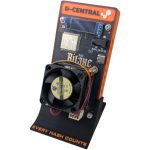
The Bitaxe represents the most important development in home mining since the GPU era ended. It’s an open-source, fully transparent ASIC miner that runs actual SHA-256 ASIC chips — the same technology that powers industrial mining — in a form factor that sits on your desk and draws 15–25 watts from a standard 5V barrel jack power supply.
D-Central Technologies has been a pioneer in the Bitaxe ecosystem from the beginning. We created the original Bitaxe Mesh Stand — the first company to manufacture it. We developed leading heatsink solutions for both the Bitaxe and Bitaxe Hex. We stock every variant: Supra, Ultra, Hex, Gamma, GT, plus the full lineup of accessories, power supplies, stands, and cases.
Here’s why Bitaxe matters for anyone who misses what GPU mining represented:
| GPU Mining (2011–2013) | Bitaxe Mining (2024+) |
|---|---|
| Consumer hardware anyone could buy | Open-source hardware anyone can build or buy |
| Runs at home, no special infrastructure | Runs at home, plugs into a wall outlet |
| Supported decentralization of hashrate | Purpose-built for decentralization of hashrate |
| Community-driven software (cgminer, etc.) | Open-source firmware (AxeOS, ESP-Miner) |
| Power draw: 200–1000W per GPU | Power draw: 15–25W per unit (Supra/Ultra/Gamma) |
| Competed for block rewards via pooled mining | Solo mining — every hash is a lottery ticket for 3.125 BTC |
The Bitaxe isn’t going to out-hash an industrial mining farm. That’s not the point. The point is that every Bitaxe running solo is an independent node of hashrate contributing to network decentralization, and every one of them has a non-zero chance of mining a full Bitcoin block. Every hash counts.
We also carry the complete open-source mining lineup beyond Bitaxe: the NerdAxe, NerdNOS, Nerdminer, and NerdQAxe — each serving different power and performance brackets for the home miner.
Full-Size ASICs for Serious Home Mining
For home miners who want real hashrate at scale, full-size ASIC miners remain the tool of choice. The key is making them work in a residential environment — and that’s where D-Central’s expertise comes in.
Our Bitcoin Space Heaters take repurposed ASIC miners and convert them into dual-purpose machines: they mine Bitcoin and heat your home. In Canada, where heating season runs 6–8 months per year, this isn’t a gimmick — it’s applied thermodynamics. Every watt an ASIC miner consumes is converted to heat with nearly 100% efficiency. If you’re already paying to run an electric heater, you might as well run a miner instead and collect Bitcoin while you stay warm.
We build Space Heater editions based on various ASIC platforms (S9, S17, S19 series), each tuned for residential noise levels and optimized for heat output. Combined with our ASIC repair services — the most comprehensive in North America with 38+ model-specific repair capabilities — we provide the complete lifecycle support that no GPU mining operation ever had.
“But What About Mining Altcoins with GPUs?”
We get this question constantly. The short answer: if you’re reading a Bitcoin mining company’s website, you already know the answer.
After Ethereum moved to proof-of-stake in September 2022, the last major GPU-mineable chain disappeared. What remains are low-cap altcoins with questionable longevity, thin liquidity, and economics that rarely survive electricity costs. The GPU miners who pivoted to these chains after “The Merge” largely found that the math didn’t work.
Some GPU miners pivoted to selling compute for AI workloads — which is a legitimate use of GPU hardware, but it’s not mining, it’s not Bitcoin, and it’s not what we do. D-Central is a Bitcoin company. We build solutions for Bitcoin miners. If your goal is to participate in securing the most important monetary network in human history, the tool is an ASIC, not a GPU.
The Home Mining Stack in 2026
Here’s what a well-equipped home mining operation looks like today — none of it involves GPUs:
| Use Case | Recommended Hardware | Power | Purpose |
|---|---|---|---|
| Solo lottery mining | Bitaxe Supra / Ultra / Gamma | 15–25W | Decentralization + solo block chance |
| Higher-hash solo/pool | Bitaxe Hex / NerdQAxe | 50–100W | More hashrate, still home-friendly |
| Home heating + mining | Bitcoin Space Heater (S9/S17/S19) | 800–3000W | Replace electric heater, earn Bitcoin |
| Serious home operation | Antminer S21 / S19 XP | 3000–3500W | Maximum hashrate for dedicated setup |
| Hosted mining | Any full-size ASIC at D-Central’s Quebec facility | Managed | Industrial hashrate without the noise |
Whether you want a silent desk-side Bitaxe running solo, a space heater warming your basement while stacking sats, or a full-size ASIC hosted at our Quebec facility, there’s a place for you in Bitcoin mining — and it doesn’t involve a GPU.
Getting Started: From GPU Miner to Bitcoin Miner
If you’re a former GPU miner looking to get into Bitcoin mining properly, here’s the path:
Step 1: Start with a Bitaxe. Visit our shop, grab a Bitaxe Supra or Ultra, and set it up for solo mining. It takes 10 minutes. You’ll be mining real SHA-256 hashes on Bitcoin’s actual network. The power draw is negligible, the noise is near-silent, and you’ll learn the fundamentals of ASIC mining hands-on.
Step 2: Explore the ecosystem. Check out our Bitaxe Hub for setup guides, overclocking tips, and model comparisons. Join the open-source mining community.
Step 3: Scale up when ready. When you’re ready for real hashrate, explore our Bitcoin Space Heaters for dual-purpose home mining or our hosted mining options for hands-off operation.
Step 4: Get support. Unlike the GPU mining days where you were on your own, D-Central offers full lifecycle support — from consulting on your setup to professional ASIC repair when hardware needs servicing. We’ve been doing this since 2016.
The Bottom Line
GPU mining for Bitcoin isn’t coming back. The economics don’t work, the physics don’t work, and the network has moved permanently beyond what general-purpose hardware can meaningfully contribute. But the values that made GPU mining special — accessibility, individual sovereignty, decentralization — those values are alive and well in the open-source ASIC movement.
D-Central Technologies exists to serve exactly this mission. We are Bitcoin Mining Hackers: we take the institutional-grade technology that secures the Bitcoin network and hack it into forms that individual miners can own, operate, and control. From a $50 Bitaxe on your desk to a space heater in your basement to a hosted machine in Quebec, the tools for decentralized mining have never been better.
The GPU era is over. The pleb mining era is just getting started.
Frequently Asked Questions
Can I still mine Bitcoin with a GPU in 2026?
Technically, yes — the Bitcoin protocol doesn’t care what hardware computes the hash. Practically, no. A top-end NVIDIA RTX 4090 produces roughly 120 MH/s on SHA-256, while a modern ASIC like the Antminer S21 Pro produces 234 TH/s. That’s nearly 2 million times faster. At current network difficulty (110T+), a GPU would take millions of years to find a block and would lose money on electricity every second it runs. ASICs are the only economically viable hardware for Bitcoin mining.
Why didn’t Bitcoin switch to a GPU-friendly algorithm like some altcoins?
Bitcoin’s SHA-256 algorithm was deliberately kept simple and ASIC-friendly. Some altcoin projects tried “ASIC-resistant” algorithms to preserve GPU mining, but these efforts consistently failed — ASICs were eventually developed for virtually every profitable algorithm. More importantly, Bitcoin’s security model benefits from specialized hardware. ASICs represent a massive sunk cost that can only be used for Bitcoin mining, aligning miners’ economic incentives with the network’s security. GPU miners can always sell their hardware or switch to another chain; ASIC miners are committed to Bitcoin.
Is Bitaxe solo mining actually profitable?
Bitaxe solo mining is best understood as lottery mining rather than income generation. A single Bitaxe unit running at ~500 GH/s has astronomically long odds of finding a block solo, but if it does, the reward is 3.125 BTC — currently worth a significant sum. The electricity cost is minimal (15–25W, pennies per day), making it an extremely low-cost lottery ticket that also contributes to Bitcoin’s decentralization. Many Bitaxe miners run their units as a statement of sovereignty and for the thrill of solo mining, not as a primary income strategy.
What happened to GPU miners after Ethereum went proof-of-stake?
After Ethereum’s transition to proof-of-stake in September 2022, GPU miners had limited options. Some pivoted to smaller proof-of-work altcoins (Ravencoin, Ergo, Kaspa), but most found the economics unsustainable — low coin values, thin liquidity, and electricity costs that exceeded revenue. Others sold their GPUs to gamers or repurposed them for AI compute tasks. The GPU mining era for major chains is effectively over. For Bitcoin specifically, GPU mining had already been dead since 2013–2014 when ASICs arrived.
How does a Bitcoin Space Heater work?
A Bitcoin Space Heater is an ASIC miner that has been reconfigured for residential use — typically with noise-reduction modifications, custom shrouding for directed airflow, and tuned firmware for optimal heat output. Since ASIC miners convert electricity to heat at nearly 100% efficiency (the same as any electric heater), they can replace a conventional space heater while simultaneously mining Bitcoin. During Canada’s long heating season, this effectively makes your heating bill productive — you’re paying for heat you need anyway, and the miner earns Bitcoin as a byproduct. Check out our Space Heater collection for available models.
I have old ASIC miners — can they be repaired or repurposed?
Absolutely. D-Central operates the most comprehensive ASIC repair service in North America, with 38+ model-specific repair capabilities covering Bitmain, MicroBT, Innosilicon, Canaan, and more. Older miners like the Antminer S9 series are excellent candidates for space heater conversions — they may not be competitive for pure mining economics, but as heaters that also mine, they get a productive second life. Visit our ASIC Repair page for details on supported models and turnaround times.