The Bitmain Antminer S9 is arguably the most iconic Bitcoin miner ever produced. Released in 2016, it was the first miner to use the revolutionary BM1387 ASIC chip built on a 16nm process node, delivering a then-groundbreaking 14 TH/s of SHA-256 hashpower. The S9 dominated Bitcoin mining for years and became the backbone of both large-scale operations and the early home mining movement.
While the S9 is no longer competitive for pure Bitcoin mining profitability in 2026, it remains one of the most important miners in Bitcoin history. Millions of units were produced, and a massive secondary market still exists. Today, the Antminer S9 finds new life as a Bitcoin space heater, a learning tool for aspiring miners, and a solo mining lottery ticket for optimistic plebs. D-Central Technologies has deep expertise with the S9 platform, offering repair services, space heater conversions, and replacement parts.
The S9 generation also spawned several variants — the S9i and S9j — each with incremental improvements in efficiency and hashrate. Understanding the original S9 is foundational to understanding the entire evolution of Bitcoin mining hardware.
Antminer S9 Full Specifications
| Specification | Details |
|---|---|
| Manufacturer | Bitmain |
| Model | Antminer S9 |
| Release Date | 2016 |
| Algorithm | SHA-256 |
| Hashrate | 14 TH/s (±5%) |
| Power Consumption | 1,350W (±5%) |
| Efficiency | 96.4 J/TH |
| Input Voltage | 11.6–13.2V DC |
| Dimensions | 350 × 135 × 158 mm |
| Weight | 4.2 kg |
| Noise Level | ~85 dB |
| Operating Temperature | 0–40°C |
| Cooling | 2 × 12038 fans |
| Network Connection | Ethernet (RJ45) |
| ASIC Chip | BM1387 (16nm) |
| Chips per Hashboard | 63 |
| Number of Hashboards | 3 |
| Total Chip Count | 189 |
| Power Supply | APW3++ (sold separately) |
Performance Analysis
At 96.4 J/TH, the Antminer S9 is roughly 5.5 times less efficient than the Antminer S21 (17.5 J/TH) and about 2.8 times less efficient than the Antminer S19 (34.2 J/TH). In terms of raw efficiency, the S9 has been thoroughly surpassed by every generation that followed it. However, efficiency is not the only metric that matters — the S9’s extremely low acquisition cost on the secondary market changes the equation entirely.
For miners with access to cheap or free electricity (solar, hydro, stranded gas), the S9 can still produce Bitcoin at minimal marginal cost. The key is that the hardware cost approaches zero on the used market, so the only real expense is electricity.
Daily and Monthly Power Costs
| Electricity Rate | Daily Power Cost | Monthly Power Cost | Viability |
|---|---|---|---|
| $0.05/kWh | $1.62 | $49 | Viable only with near-free hardware — best as a space heater that earns sats |
| $0.08/kWh | $2.59 | $78 | Not profitable for pure mining — excellent as a dual-purpose heater |
| $0.10/kWh | $3.24 | $97 | Unprofitable — only makes sense if heat output offsets your heating bill |
| $0.12/kWh | $3.89 | $117 | Unprofitable — consider upgrading to a newer generation miner |
Heat Output
The Antminer S9 produces approximately 4,606 BTU/h of heat (1,350W × 3.412 BTU/W). This is equivalent to a small-to-medium portable space heater, making the S9 one of the most popular miners for Bitcoin space heater conversions. In Canadian winters, that heat output is not waste — it is offsetting your heating bill while stacking sats.
Noise Characteristics
At approximately 85 dB with stock fans, the S9 is loud — comparable to a food blender running continuously. This is one reason space heater conversions are so popular: D-Central replaces the stock fans with quieter alternatives and adds sound dampening. For stock units, the S9 needs a dedicated room, garage, or basement — it is not suitable for living spaces without modification.
Best Use Cases in 2026
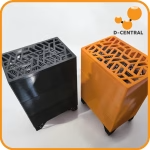
Bitcoin Space Heater: The number-one use case for the S9 today. D-Central offers purpose-built Bitcoin Space Heater conversions using S9 hardware. At ~4,600 BTU/h, it heats a small room while mining Bitcoin. You are paying for heat either way — why not get sats back? See our Bitcoin Space Heater vs Electric Heater cost comparison.
Learning and Education: The S9 is the perfect starter miner for understanding how ASICs work. With abundant documentation, community support, and rock-bottom prices, new miners can learn pool configuration, firmware flashing, monitoring, and basic repair skills without risking expensive hardware.
Solo Mining Lottery: At 14 TH/s, your odds of solo-mining a Bitcoin block are astronomically low — but they are not zero. Some plebs run S9s on solo mining pools as an always-on lottery ticket. The expected time to find a block solo is measured in centuries, but someone has to win.
Parts Donor: The S9 shares components (fans, control boards, PSU connectors) with other Bitmain products. Broken S9 units are valuable as parts inventory for repair shops.
Common Issues & Repair
The Antminer S9 is a mature and well-understood platform. Common failure modes include:
- Hashboard ASIC chip failures: Individual BM1387 chips can burn out, dropping hashrate on one or more chains. A skilled technician can replace individual chips to restore full hashrate.
- Fan failures: The 12038 fans are high-wear components. Seized or noisy fans should be replaced promptly to prevent thermal shutdown.
- Control board issues: Corrupted firmware or damaged Ethernet ports can prevent the miner from booting or connecting to a pool. SD card recovery often resolves firmware issues.
- PSU compatibility: The APW3++ power supply is required. Using an underpowered or incompatible PSU causes instability, hash drops, and potential hardware damage.
D-Central offers professional Antminer S9 Repair services from our Canadian workshop. We diagnose and repair hashboard, control board, and fan issues with fast turnaround. For firmware recovery, see our SD Card Firmware Recovery Guide.
D-Central Services for the Antminer S9
- Repair: Full hashboard, control board, and fan repair — Antminer S9 Repair
- Space Heater Conversion: Turn your S9 into a quiet, effective space heater — Bitcoin Space Heaters
- Replacement Parts: Fans, control boards, and hashboard components — Shop Parts
- Repair Cost Estimate: ASIC Repair Cost Estimator
Frequently Asked Questions
Is the Antminer S9 still profitable in 2026?
For pure Bitcoin mining, the S9 is not profitable at typical electricity rates. At 96.4 J/TH, the power cost per Bitcoin mined far exceeds revenue at most electricity prices. However, if you are using the S9 as a space heater, the equation changes — you are converting electricity to heat (which you would buy anyway) and earning Bitcoin as a byproduct. With very cheap electricity under $0.05/kWh, the S9 can still produce small amounts of Bitcoin at near-breakeven.
How much electricity does the Antminer S9 use per day?
The S9 consumes approximately 1,350W continuously, which translates to 32.4 kWh per day or about 972 kWh per month. At $0.10/kWh, that is $3.24/day or $97/month in electricity costs.
Can the Antminer S9 be used as a space heater?
Yes — this is the most popular use for the S9 in 2026. The S9 outputs approximately 4,606 BTU/h of heat, equivalent to a small portable heater. D-Central offers purpose-built Bitcoin space heater conversions with reduced noise and optimized airflow for home use.
What is the difference between the S9, S9i, and S9j?
The S9i and S9j are incremental upgrades over the original S9. The S9i offers slightly better power efficiency (~94.3 J/TH at 14 TH/s) and reduced noise (76 dB vs 85 dB). The S9j further improves hashrate to 14.5 TH/s while maintaining similar power consumption (~1,350W), yielding ~93.1 J/TH efficiency. All three share the same BM1387 chip architecture and form factor.
How loud is the Antminer S9?
The stock S9 operates at approximately 85 dB — roughly the volume of a food blender. This makes it unsuitable for living spaces without modification. Fan replacements or space heater conversions can reduce noise significantly. The later S9i and S9j models run quieter at approximately 76 dB.