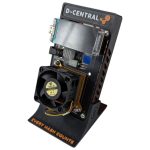
The open-source Bitcoin mining revolution has produced two standout devices that dominate every home miner’s shortlist in 2026: the Bitaxe family and the NerdQAxe++. Both run on Bitmain’s industry-leading BM1370 ASIC chips, both are fully open-source under permissive licenses, and both let you solo mine Bitcoin from your desk with nothing more than a WiFi connection and a power outlet.
But they are fundamentally different machines built around different philosophies. The Bitaxe lineup offers a modular, single-chip-to-six-chip range that lets you pick exactly the hashrate tier you want. The NerdQAxe++ takes a different approach: pack four BM1370 chips onto one board, crank the hashrate to nearly 5 TH/s stock, and give serious solo miners the highest single-board performance available outside the Bitaxe Hex.
D-Central Technologies carries both product lines. We are a Bitaxe pioneer — the company that created the original Bitaxe Mesh Stand and developed many of the leading heatsink and accessory solutions for this ecosystem. We also stock the full NerdAxe family. This article is not a sales pitch for one over the other. It is an honest, data-driven comparison to help you decide which device earns a spot on your desk.
Let us break it down.
What Is the Bitaxe?
The Bitaxe is the original open-source Bitcoin ASIC miner, born from the idea that institutional mining silicon should be accessible to every individual on the planet. Designed by Skot and the Open Source Miners United (OSMU) community, the Bitaxe puts a genuine Bitmain ASIC chip on a compact PCB with an ESP32-S3 microcontroller, WiFi connectivity, and the browser-based AxeOS firmware.
What started as a single-chip experiment has evolved into a full product family:
- Bitaxe Supra — Single BM1368 chip (5nm, Antminer S19k Pro generation). Stock hashrate: ~625-775 GH/s at ~12W. The affordable entry point.
- Bitaxe Ultra — Single BM1366 chip (5nm, Antminer S19 XP generation). Stock hashrate: ~500-600 GH/s at ~12W. The original crowd favorite.
- Bitaxe Gamma 602 — Single BM1370 chip (3nm, Antminer S21 Pro generation). Stock hashrate: ~1.0-1.2 TH/s at ~18-21W. The current sweet spot for single-chip efficiency.
- Bitaxe GT 801 — Dual BM1370 chips on a wider 6-layer PCB. Stock hashrate: ~2.15 TH/s at ~43W. The most powerful single-board Bitaxe without going to Hex.
- Bitaxe Hex — Six ASIC chips (BM1366 or BM1368 variants) on one board. Stock hashrate: ~3.0-4.2 TH/s at ~75-90W. The maximum-hashrate Bitaxe for serious solo miners.
Every Bitaxe model runs AxeOS, connects over WiFi, and is fully open-source — schematics, gerber files, firmware, everything published on GitHub under the MIT license. This is not a black box. You can audit every line of code and every trace on the PCB.
What Is the NerdQAxe++?
The NerdQAxe++ is the flagship quad-chip miner from the NerdAxe family, developed by BitMaker-hub and the Open Source Miners United community. It is the spiritual successor to the original NerdAxe (single-chip) and the NerdQAxe+ (quad BM1368 chips), upgraded with four of Bitmain’s latest BM1370 chips — the same 3nm silicon found in the Antminer S21 Pro and the Bitaxe Gamma.
The NerdQAxe++ represents a different design philosophy than the Bitaxe. Where the Bitaxe family offers a graduated lineup from one chip to six, the NerdQAxe++ focuses on packing maximum hashrate into a single, compact four-chip board. The result is a device that delivers ~4.8 TH/s at stock settings while drawing only ~70W — an efficiency of approximately 14.7 J/TH that rivals industrial miners costing tens of thousands of dollars.
Key NerdQAxe++ features include:
- Four BM1370 ASIC chips delivering ~4.8 TH/s stock, overclockable to 6+ TH/s
- 1.9-inch color LCD display (LilyGO T-Display S3) showing real-time hashrate, temperature, and pool status
- AxeOS-based firmware with browser-accessible dashboard for monitoring and configuration
- 12V DC input via XT30 connector supporting up to 15A for overclocking headroom
- Spring-mounted heatsink (Rev 6.1) for uniform thermal contact across all four chips
- WiFi 2.4GHz connectivity via ESP32-S3 — no ethernet cable or computer required
- Fully open-source hardware and firmware published on GitHub
The latest Rev 6.1 brought significant improvements: thicker 1oz copper traces and 2mm FR-4 PCB for better power delivery, the elimination of the one-shot fuse from earlier revisions, relocated temperature sensors for more accurate readings, and the beefier XT30 power connector. These are not cosmetic changes — they directly improve stability, especially under overclocked conditions.
Head-to-Head Specifications Comparison
Numbers tell the story. Here is every spec that matters, side by side, for the four devices most commonly cross-shopped in the open-source mining space:
| Specification | Bitaxe Gamma 602 | Bitaxe GT 801 | NerdQAxe++ (Rev 6.1) | Bitaxe Hex |
|---|---|---|---|---|
| ASIC Chips | 1x BM1370 (3nm) | 2x BM1370 (3nm) | 4x BM1370 (3nm) | 6x BM1366/BM1368 (5nm) |
| Stock Hashrate | 1.0 – 1.2 TH/s | 2.15 TH/s | 4.8 TH/s | 3.0 – 4.2 TH/s |
| Overclocked Hashrate | 1.6 – 2.0 TH/s | 2.5 – 3.0 TH/s | 6.0 – 6.5 TH/s | 4.5 – 6.0 TH/s |
| Stock Power Draw | ~18 – 21W | ~43W | ~70W | ~75 – 90W |
| Overclocked Power | ~30 – 35W | ~55 – 65W | ~100 – 115W | ~110 – 130W |
| Efficiency (Stock) | ~15 J/TH | ~18 – 20 J/TH | ~14.7 J/TH | ~25 – 30 J/TH |
| Input Voltage | 5V DC | 12V DC (XT30) | 12V DC (XT30) | 12V DC (XT30) |
| Connectivity | WiFi 2.4GHz | WiFi 2.4GHz | WiFi 2.4GHz | WiFi 2.4GHz |
| Microcontroller | ESP32-S3 | ESP32-S3 | ESP32-S3 | ESP32-S3 |
| Firmware | AxeOS | AxeOS | AxeOS (NerdAxe fork) | AxeOS |
| Display | Small OLED | Small OLED | 1.9″ Color LCD | OLED |
| Noise Level | ~35 – 40 dB | ~40 – 45 dB | ~40 – 45 dB | ~45 – 50 dB |
| Cooling | Heatsink + small fan | Aluminum heatsink + 60mm fan | Spring heatsink + 80mm fan | Arctic P8 80mm fan |
| Approximate Price | $70 – $120 USD | $150 – $225 USD | $280 – $420 USD | $340 – $600 USD |
| Monthly Power Cost* | ~$1.50 | ~$3.70 | ~$6.10 | ~$7.80 |
| PCB Layers | 4-layer | 6-layer, 1oz copper | 2mm FR-4, 1oz copper | Multi-layer |
The numbers reveal something interesting: the NerdQAxe++ at stock settings delivers the best efficiency of the group at ~14.7 J/TH, edging out even the Bitaxe Gamma. This is remarkable for a four-chip device — it means the NerdQAxe++ engineering team has optimized power delivery across all four chips exceptionally well.
Performance Comparison: Stock vs. Overclocked
Every open-source miner ships with conservative default settings. The real question for enthusiasts is: how far can you push them?
Bitaxe Gamma 602 Performance
At stock settings (~490MHz, ~1150mV), the Gamma 602 delivers a rock-solid 1.0-1.2 TH/s at approximately 18-21W. It is whisper-quiet and sips power. For overclockers, the single BM1370 chip has significant headroom. Pushing the frequency to 575-600MHz and adjusting core voltage can yield 1.6-1.8 TH/s, with aggressive tuning hitting 2.0 TH/s in some silicon lottery winners. Power consumption rises to ~30-35W, but even overclocked, the Gamma draws less than a standard light bulb. For a deep dive, see our Bitaxe Overclocking Manual.
Bitaxe GT 801 Performance
The GT 801 ships at ~2.15 TH/s stock, drawing approximately 43W through its dual BM1370 chips. Overclocking both chips to 575-625MHz pushes hashrate to the 2.5-3.0 TH/s range at 55-65W. The 6-layer PCB with 1oz copper and the larger heatsink give the GT thermal headroom that single-chip Bitaxe models cannot match. The XT30 12V connector provides clean, stable power delivery that supports sustained overclocks without voltage droop.
NerdQAxe++ Performance
The NerdQAxe++ Rev 6.1 delivers approximately 4.8 TH/s at default settings (600MHz, 1150mV), drawing about 70W. This is where things get exciting: push the frequency to 700-750MHz and the NerdQAxe++ climbs to 6.0-6.5 TH/s. Reports from the community have documented units hitting 7+ TH/s with aggressive cooling modifications, and one notable case pushed a unit beyond 10 TH/s — though this is far outside safe operating parameters and not recommended.
The safe overclocking range for daily operation is 625-700MHz, which puts the NerdQAxe++ in the 5.0-6.2 TH/s range at 85-110W. The Rev 6.1’s improved copper traces and fuse-free design make sustained overclocks more reliable than earlier revisions. For detailed settings, refer to our NerdQAxe++ Overclocking Guide.
Bitaxe Hex Performance
The Hex delivers 3.0-4.2 TH/s stock depending on the chip variant (BM1366 or BM1368), drawing 75-90W. Overclocking pushes into the 4.5-6.0 TH/s territory at 110-130W. The six-chip design distributes heat across more silicon, but the higher total power density requires careful thermal management. The Arctic P8 fan handles stock loads well, but overclocked Hex units benefit from aftermarket cooling solutions.
Solo Mining Probability: Your Block-Finding Odds
Let us be direct: solo mining is lottery mining. With the Bitcoin network hashrate hovering around 1 ZH/s (1,000 EH/s) in early 2026, no desktop miner will give you favorable odds. But that is not why we do it. We do it because every hash is a lottery ticket for a full block reward (currently 3.125 BTC), because it is the most decentralized form of mining possible, and because someone with a Bitaxe has found a block — it happens.
Here are the approximate odds at stock hashrates, assuming ~1,000 EH/s network hashrate:
| Device | Stock Hashrate | Share of Network | Expected Time to Find Block | Odds per Day |
|---|---|---|---|---|
| Bitaxe Gamma 602 | 1.2 TH/s | 0.00000012% | ~95,100 years | 1 in 34.7 million |
| Bitaxe GT 801 | 2.15 TH/s | 0.000000215% | ~53,100 years | 1 in 19.4 million |
| NerdQAxe++ | 4.8 TH/s | 0.00000048% | ~23,800 years | 1 in 8.7 million |
| Bitaxe Hex | 4.2 TH/s | 0.00000042% | ~27,200 years | 1 in 9.9 million |
| NerdQAxe++ (OC 6.5 TH/s) | 6.5 TH/s | 0.00000065% | ~17,500 years | 1 in 6.4 million |
The NerdQAxe++ at stock settings gives you roughly 4x the odds of a single Bitaxe Gamma and roughly 2.25x the odds of a Bitaxe GT. Overclocked to 6.5 TH/s, the NerdQAxe++ offers the best block-finding probability of any single-board open-source miner except a fully overclocked Hex.
Are these odds good? In absolute terms, no. But Bitcoin block finds by solo miners with small hashrates are documented and real. And every hash you submit strengthens the decentralization of the Bitcoin network, which has value beyond any probability calculation. For the philosophy behind it, read Every Hash Counts.
User Experience: AxeOS vs. NerdAxe Firmware
Both the Bitaxe and NerdQAxe++ run on AxeOS or closely related forks, which means the core experience is remarkably similar. But there are meaningful differences in how you interact with each device day-to-day.
Bitaxe (AxeOS Native)
- Setup: Power on, connect to the Bitaxe WiFi hotspot, configure your pool and wallet address via the browser dashboard, save, and mine. Five minutes from unboxing to hashing.
- Web Dashboard: Clean, functional interface showing hashrate, chip temperature, fan speed, power consumption, accepted/rejected shares, uptime, and pool status. All settings (frequency, voltage, fan curve, pool configuration) are adjustable from the browser.
- Display: Small OLED screen showing basic stats (hashrate, temperature). Functional but limited.
- OTA Updates: Firmware updates can be applied over-the-air through the web interface — no physical access required. See our Firmware Update Guide.
- Community: Massive. AxeOS is the most widely used open-source miner firmware with extensive documentation and community support.
NerdQAxe++ (AxeOS Fork / NerdAxe Firmware)
- Setup: Same basic flow — power on, connect to the NerdAxe WiFi hotspot (SSID like “Nerdaxe_78B1”), configure via browser portal. Equally straightforward, approximately five minutes to first hash.
- Web Dashboard: Functionally identical to AxeOS with the same settings and monitoring capabilities. Per-chip diagnostics are available, which is valuable when tuning four chips independently.
- Display: 1.9-inch color LCD (LilyGO T-Display S3) with multiple screen display modes. This is a significant upgrade over the Bitaxe OLED — you get hashrate graphs, temperature history, and pool status in full color without opening a browser.
- OTA Updates: Supported via the web interface, similar to AxeOS.
- Community: Smaller but active. BitMaker-hub maintains the GitHub repository and the OSMU community provides support.
Verdict: The daily user experience is nearly identical. The NerdQAxe++ wins on display quality (color LCD vs. small OLED), while the Bitaxe ecosystem has more documentation, tutorials, and community support. If you have used one, you can use the other without a learning curve.
Overclocking: Which Has More Headroom?
Overclocking is where open-source miners truly shine compared to locked-down commercial hardware. Both devices give you full control over clock frequency, core voltage, and fan curves.
Bitaxe Gamma 602 Overclocking
The single BM1370 chip can typically push from its stock ~490MHz to 575-625MHz. Silicon quality varies unit to unit (the “silicon lottery”), but most Gamma 602 units can hit 1.6 TH/s reliably, and well-binned chips can reach 1.8-2.0 TH/s. The limiting factor is usually thermal — the small form factor heatsink needs help from aftermarket cooling (like the Noctua fan upgrade or Ice Cooler Tower) to sustain higher frequencies. Power consumption remains modest even overclocked, rarely exceeding 35W.
NerdQAxe++ Overclocking
Four chips means four opportunities for the silicon lottery — and four chips that must all be stable at the same frequency. The NerdQAxe++ Rev 6.1 can typically push from 600MHz stock to 700-750MHz. The recommended safe range is 625-700MHz, yielding 5.0-6.2 TH/s. The improved 1oz copper traces and fuse-free design of Rev 6.1 make sustained overclocks more practical than earlier revisions.
The key difference: with four chips, you are limited by the weakest chip. If three chips happily run at 725MHz but the fourth becomes unstable above 700MHz, your whole-board frequency ceiling is 700MHz. Bitaxe Gamma owners only need one chip to cooperate. This statistical reality means the NerdQAxe++ typically has a slightly lower percentage overclocking headroom (roughly 30-35% above stock) compared to a lucky single-chip Bitaxe Gamma (potentially 60-70% above stock).
However, in absolute hashrate terms, a 30% overclock on 4.8 TH/s (yielding ~6.2 TH/s) produces far more hashes than a 70% overclock on 1.2 TH/s (yielding ~2.0 TH/s). The NerdQAxe++ is the clear winner for total overclocked hashrate on a single board.
Critical overclocking tip for both devices: never exceed 75 degrees Celsius chip temperature. If you are hitting thermal limits, improve cooling before increasing frequency. Copper MOSFET heatsink kits reduce VRM temperatures by up to 15 degrees and unlock more stable overclocks on both platforms.
Noise and Heat: Desktop-Friendly Assessment
If you are mining at home — and if you are reading this, you probably are — noise and heat matter as much as hashrate.
Bitaxe Gamma 602
The Gamma is the quietest device in this comparison at 35-40 dB. That is genuinely whisper-quiet. You can run this on your nightstand without it waking you up. Heat output at 18-21W is negligible — roughly equivalent to a USB phone charger. With a Noctua fan upgrade, the Gamma becomes effectively silent. It is the undisputed champion of stealth mining.
Bitaxe GT 801
At 40-45 dB and 43W, the GT is noticeable in a quiet room but not disruptive. Comparable to a quiet desktop computer fan. The 60mm fan runs at moderate speed and produces a consistent hum. Thermal output is modest — you might feel warmth if you hold your hand near the exhaust, but it will not heat a room. Acceptable for an office desk or living room shelf.
NerdQAxe++
At stock settings, the NerdQAxe++ sits in the 40-45 dB range — similar to the Bitaxe GT. The 80mm fan (or optional Noctua upgrade) moves more air but at lower RPM, so it produces a low whoosh rather than a whine. Heat output at 70W is noticeable. The heatsink gets warm to the touch, and in a small enclosed space, you will feel the ambient temperature rise slightly. Still desktop-friendly, but not nightstand-friendly.
Overclocked to 6+ TH/s at 100-115W, the NerdQAxe++ becomes comparable to a small space heater (quite literally — 100W of continuous heat output is meaningful in a small room). Fan speed increases, and noise levels can climb to 50+ dB depending on cooling configuration. At this power level, consider placement on a shelf with good airflow rather than buried behind books.
Bitaxe Hex
The Hex is the loudest of the group at 45-50 dB stock, with 75-90W of heat output. The Arctic P8 fan works hard to cool six chips, and you will hear it. Still far quieter than any full-size ASIC miner, but this is a device for a dedicated desk or shelf, not a bedroom. For comprehensive noise data, see our Bitcoin Miner Noise Levels Comparison.
Ecosystem and Accessories
A miner is only as good as the ecosystem around it. Cases, heatsinks, stands, and cooling upgrades can transform the experience.
Bitaxe Ecosystem
The Bitaxe has the most mature accessory ecosystem in open-source mining. D-Central was a pioneer here — we created the original Bitaxe Mesh Stand and developed leading heatsink solutions. Available accessories include:
- Heatsinks: D-Central Dark Horse heatsink, copper MOSFET heatsink kits, Ice Cooler Tower, Argon THRML (overclocking-focused)
- Cases: Multiple color options (Black, Orange, Red, Green, Blue, Galaxy, Pink, and more), protective enclosures from multiple manufacturers
- Stands: D-Central Mesh Stand (the original), minimalist vertical stands, multi-unit rack stands
- Fans: Noctua silent fan upgrades, aftermarket 40mm and 60mm options
- Power Supplies: Region-specific 5V adapters (Gamma/Supra) and 12V PSUs (GT/Hex)
The Bitaxe accessory market is thriving, with 3D-printable designs on Cults3D and Thingiverse, custom CNC cases from CryptoCloaks, and a constant stream of community innovations. For a comprehensive rundown, see our Complete Bitaxe Accessories Guide.
NerdQAxe++ Ecosystem
The NerdQAxe++ ecosystem is growing rapidly but is not yet as mature as the Bitaxe’s. Available accessories include:
- Heatsinks: Stock spring-mounted heatsink (included), copper MOSFET heatsink kits (52Pi and others), aftermarket copper cooling solutions
- Cases: CryptoCloaks NerdAxe Q++ stand/case, Bitronics cases, 3D-printable designs on Cults3D
- Stands: Metal stands (often included with purchase), 3D-printed vertical and angled options
- Fans: 80mm Noctua upgrades, “Cool Edition” builds with dual fans and copper coolers
- Power Supplies: Mean Well RSP-350-12 (recommended for overclocking), standard 12V 120W+ PSUs
The NerdQAxe++ benefits from cross-compatibility with some Bitaxe accessories (particularly MOSFET heatsink kits and power supplies), and the ecosystem is expanding as the device gains popularity. The “Cool Edition” bundles from some retailers that include copper coolers and dual fans are excellent for overclockers.
Price-to-Performance Analysis
For many home miners, the bottom line is: how much hashrate do I get per dollar spent?
| Metric | Bitaxe Gamma 602 | Bitaxe GT 801 | NerdQAxe++ | Bitaxe Hex |
|---|---|---|---|---|
| Price (Mid-Range) | ~$95 USD | ~$190 USD | ~$350 USD | ~$470 USD |
| Stock TH/s per $100 | 1.26 TH/s | 1.13 TH/s | 1.37 TH/s | 0.89 TH/s |
| OC TH/s per $100 | 1.89 TH/s | 1.45 TH/s | 1.71 TH/s | 1.17 TH/s |
| J/TH (Efficiency) | ~15 J/TH | ~18-20 J/TH | ~14.7 J/TH | ~25-30 J/TH |
| Annual Power Cost | ~$18 | ~$45 | ~$74 | ~$95 |
The analysis reveals some surprises:
- Best stock hashrate per dollar: NerdQAxe++ (1.37 TH/s per $100). The quad-chip design delivers the most raw hashrate per dollar at stock settings.
- Best overclocked hashrate per dollar: Bitaxe Gamma 602 (1.89 TH/s per $100). The low purchase price and impressive overclocking headroom make the Gamma the overclocker’s value champion.
- Best efficiency: NerdQAxe++ (14.7 J/TH). Marginally better than the Gamma and significantly better than the Hex.
- Lowest total cost of ownership: Bitaxe Gamma 602. Sub-$100 purchase price plus $18/year in electricity. Hard to beat.
- Highest absolute hashrate per board: NerdQAxe++ overclocked (6.0-6.5 TH/s), though an overclocked BM1368 Hex can compete.
The Bitaxe Hex deserves a note: its use of older BM1366/BM1368 chips (5nm vs. the BM1370’s 3nm) means it draws more power per terahash. The Hex’s strength is raw hashrate in a single device, not efficiency. If the Hex family moves to BM1370 chips, this calculus will change dramatically.
Which Should You Buy? Decision Matrix by Use Case
There is no single “best” device. The right choice depends entirely on what you are optimizing for. Here is our recommendation for every common use case:
Budget Entry: Bitaxe Gamma 602
If you are new to open-source mining and want to get your feet wet without significant financial commitment, the Bitaxe Gamma 602 is the clear choice. Under $100 gets you a genuine ASIC miner with the latest 3nm BM1370 chip, five-minute setup, whisper-quiet operation, and negligible power costs. It is the perfect first miner — and many people who start with a Gamma end up building a fleet. See our Bitaxe product page for current pricing and variants.
Maximum Single-Board Hashrate (BM1370): NerdQAxe++
If you want the most BM1370-based hashrate on a single board, the NerdQAxe++ is unmatched. Four 3nm chips delivering 4.8 TH/s stock (6+ TH/s overclocked) at best-in-class efficiency. No Bitaxe model using BM1370 chips comes close to this hashrate on a single PCB — the Bitaxe GT tops out around 3 TH/s overclocked with its two BM1370 chips. The NerdQAxe++ is the serious solo miner’s weapon of choice. Check availability on our NerdQAxe product page.
Best Multi-Chip Value: NerdQAxe++
Dollar for dollar at stock settings, the NerdQAxe++ delivers the most hashrate. Buying four individual Bitaxe Gamma units would cost roughly $380-$480 and deliver ~4.4-4.8 TH/s total — about the same hashrate as one NerdQAxe++ at a similar or higher price. But four Gammas mean four devices to manage, four power supplies, and four WiFi connections. The NerdQAxe++ consolidates everything into one board, one power supply, one IP address. For pure hash-per-dollar efficiency in a single device, the NerdQAxe++ wins.
Fleet Building: It Depends
If you are building a fleet of open-source miners, the calculus shifts. Consider:
- Fleet of Bitaxe Gammas: More units mean more granular control. If one unit fails, you lose 1 TH/s. Easier to distribute across rooms for heat supplementation. Lower individual cost means easier replacement. Overclocking can be tuned per-unit based on silicon quality.
- Fleet of NerdQAxe++ units: Fewer devices to manage for the same total hashrate. Each unit is a self-contained powerhouse. Better efficiency means lower operating costs per TH/s. But each unit failure removes 4.8 TH/s from your fleet.
For most fleet builders, a mixed approach makes sense: NerdQAxe++ units as your hashrate backbone, with individual Bitaxe Gammas distributed throughout the house for maximum decentralization and heat distribution.
Maximum Hashrate Period: Bitaxe Hex
If your only goal is the highest possible hashrate on a single board regardless of efficiency, the Bitaxe Hex with six chips can reach 5-6 TH/s when overclocked. However, it does this with significantly worse efficiency than the NerdQAxe++ (25-30 J/TH vs. 14.7 J/TH). The Hex is for miners who prioritize raw hashrate and are willing to pay the power premium. A fully overclocked NerdQAxe++ at 6.5 TH/s actually matches or exceeds many Hex configurations while using less power — making the NerdQAxe++ arguably the better choice even in this category.
Stealth / Quiet Operation: Bitaxe Gamma 602
No contest. At 35-40 dB and 18W, the Gamma is effectively invisible and inaudible. Apartment miners, bedroom miners, and anyone who needs to mine without drawing attention should start here. For more quiet options, see our guide to the Best Quiet Bitcoin Miners for Home.
Display Enthusiast / Desk Piece: NerdQAxe++
The NerdQAxe++ 1.9-inch color LCD is genuinely beautiful on a desk. Multiple display modes show hashrate graphs, temperatures, and pool statistics in full color. If you want a mining device that is also a conversation piece and a live dashboard, the NerdQAxe++ wins on aesthetics. Pair it with a CryptoCloaks stand or a metal display mount, and it becomes functional desk art.
Can You Run Both? The Portfolio Approach
Here is a perspective that most comparison articles miss: you do not have to choose just one.
The smartest solo miners treat their mining fleet like a portfolio. Diversifying across devices is not about hedging risk (the “risk” with open-source miners is minimal) — it is about maximizing the number of independent hashing units contributing to network decentralization while distributing useful heat throughout your home.
A powerful portfolio approach:
- Living room: NerdQAxe++ on a shelf — high hashrate, color display conversation piece, moderate warmth in winter
- Office/Desk: Bitaxe Gamma 602 — silent operation, negligible power, does not interfere with work
- Bedroom: Bitaxe Gamma 602 with Noctua fan — effectively silent, tiny amount of supplemental heat
- Workshop/Garage: Bitaxe Hex or second NerdQAxe++ — maximum hashrate where noise is irrelevant
Total fleet: ~11-13 TH/s across four locations, approximately 175-225W total draw, $18-23/month in electricity. That is a meaningful solo mining operation for the cost of leaving a few lights on. Every device independently submits shares to your pool of choice, and if any single unit finds a block, you win the full 3.125 BTC reward.
D-Central stocks every Bitaxe variant and the NerdQAxe — so you can build your entire fleet from one trusted source, shipped from our facility in Canada. We inspect every unit before it leaves our doors.
Frequently Asked Questions
Is the NerdQAxe++ just four Bitaxe Gammas on one board?
Conceptually, yes — both use BM1370 chips running on AxeOS-based firmware. But the engineering is different. The NerdQAxe++ has a purpose-built PCB with shared power delivery, a single ESP32-S3 controller managing all four chips, and optimized trace routing for quad-chip operation. It is not literally four Gammas soldered together, though the result (4x the hashrate at approximately 4x the power) is similar.
Which one is easier to set up?
Both are equally easy. Power on, connect to the device’s WiFi hotspot from your phone or computer, enter your wallet address and pool information, save, and mine. Five minutes for either device. If you can connect to a WiFi network and fill in a web form, you can set up both of these miners.
Can I pool mine with these devices instead of solo mining?
Absolutely. Both devices support any Stratum-compatible mining pool. You can point them at public pools like Ocean, CK Solo Pool, Braiins Pool, or any other Bitcoin mining pool. Solo mining gives you a chance at the full block reward; pool mining provides small, regular payouts proportional to your hashrate contribution.
How much Bitcoin will I earn per month?
At current network difficulty and hashrate levels, the expected pool mining revenue from these devices is extremely small — typically fractions of a cent per day. These devices are not profitable in a traditional ROI sense at current Bitcoin prices and network hashrate. They exist for solo mining (lottery-style), network decentralization, education, and the home heating use case. If traditional mining profitability is your primary goal, you need a full-size ASIC miner.
Do I need a computer to run these miners?
No. Both devices are fully standalone. They connect to your WiFi network and mine independently. You only need a phone, tablet, or computer for initial setup (to access the web dashboard) and occasional monitoring or configuration changes. Once configured, they run 24/7 without any other hardware.
Which one is better for overclocking?
In percentage terms, the Bitaxe Gamma 602 often has more headroom (up to 60-70% above stock) because you are only tuning one chip. In absolute hashrate gained, the NerdQAxe++ wins — a 30% overclock on 4.8 TH/s yields far more additional hashing power than a 70% overclock on 1.2 TH/s. If you enjoy the overclocking process itself, the Gamma gives more room to experiment. If you want the most overclocked hashrate on one device, choose the NerdQAxe++.
Can I use these to heat my home?
The Bitaxe Gamma at 18W will not meaningfully heat anything. The NerdQAxe++ at 70-115W produces noticeable warmth in a small room — comparable to a small personal heater on its lowest setting. For serious Bitcoin-powered home heating, look at our Bitcoin Space Heaters which use full-size ASIC miners in insulated enclosures. The open-source miners are supplemental heat at best.
Are these devices loud enough to be disruptive?
The Bitaxe Gamma 602 is whisper-quiet (35-40 dB). The NerdQAxe++ at stock settings is about as loud as a quiet desktop computer (40-45 dB). Neither is disruptive in a normal living space. Overclocked with fans at higher speeds, the NerdQAxe++ can reach 50+ dB, which is noticeable in a quiet room but still far quieter than a window AC unit or a full-size ASIC miner (which typically exceeds 75 dB).
What power supply do I need for each?
The Bitaxe Gamma 602 uses a standard 5V DC adapter (often included or available for a few dollars). The NerdQAxe++ requires a 12V DC power supply with at least 120W capacity for stock operation, or 150W+ for overclocking. The Mean Well RSP-350-12 is widely recommended for NerdQAxe++ overclocking. The Bitaxe GT and Hex also use 12V via XT30 connectors.
Does D-Central sell both devices?
Yes. D-Central Technologies stocks the full Bitaxe lineup (Supra, Gamma, GT, Hex) and the NerdQAxe family, along with all accessories, heatsinks, stands, and power supplies. Every unit is inspected at our facility in Laval, Quebec before shipping. We ship across Canada and worldwide. Browse our Bitaxe collection and NerdQAxe page.
Which has better resale value?
Both hold value well because they use current-generation BM1370 chips. The Bitaxe Gamma tends to have higher liquidity on the secondary market due to its lower price point and larger installed base. The NerdQAxe++ commands a premium due to its higher hashrate. As open-source hardware, both can be repaired, reflashed, and upgraded — they are not disposable electronics.
Will a NerdQAxe++ or Bitaxe ever find a Bitcoin block?
It has happened. Solo miners with small hashrates have found full Bitcoin blocks, and our Bitaxe Block Wins Tracker documents confirmed solo block finds. The odds are long — but they are not zero. Every hash is a valid lottery ticket. The NerdQAxe++ at ~4.8 TH/s gives you roughly 4x the daily odds of a Bitaxe Gamma. Over a year of continuous mining, an overclocked NerdQAxe++ at 6.5 TH/s has approximately a 1 in 17,500 chance of finding a block. Unlikely? Yes. Impossible? Absolutely not.
Final Verdict
The Bitaxe and NerdQAxe++ are not competitors — they are complementary tools in the open-source mining ecosystem. Both are built on the same foundational technology (BM1370 chips, ESP32-S3 controllers, AxeOS firmware), both are fully open-source, and both contribute to the decentralization of Bitcoin’s hash rate.
Choose the Bitaxe Gamma 602 if you want the lowest entry price, quietest operation, most efficient single-chip performance, or if you are building a distributed fleet across multiple rooms.
Choose the Bitaxe GT 801 if you want the middle ground — dual-chip performance without the commitment of a quad-chip device.
Choose the NerdQAxe++ if you want maximum hashrate per board, best efficiency at scale, a gorgeous color display, and the most solo mining lottery tickets per device.
Choose the Bitaxe Hex if you want the absolute highest hashrate available in the open-source ecosystem and efficiency is secondary.
Or do what the most dedicated Mining Hackers do: run both. A NerdQAxe++ in the living room and a Bitaxe Gamma on the desk. Two independent miners, two independent chances at finding a block, two contributions to Bitcoin’s decentralized future.
Whatever you choose, you are doing something that matters. Every hash from an open-source miner on a home internet connection is a hash that no corporation, no pool operator, and no government controls. That is the Mining Hacker ethos. That is what D-Central is about.
Ready to start? Browse our Bitaxe collection or grab a NerdQAxe++ — both ship from Canada with every unit inspected before it leaves our doors.
Is the NerdQAxe++ just four Bitaxe Gammas on one board?
Conceptually, yes — both use BM1370 chips running on AxeOS-based firmware. But the engineering is different. The NerdQAxe++ has a purpose-built PCB with shared power delivery, a single ESP32-S3 controller managing all four chips, and optimized trace routing for quad-chip operation. It is not literally four Gammas soldered together, though the result (4x the hashrate at approximately 4x the power) is similar.
Which one is easier to set up?
Both are equally easy. Power on, connect to the device’s WiFi hotspot from your phone or computer, enter your wallet address and pool information, save, and mine. Five minutes for either device. If you can connect to a WiFi network and fill in a web form, you can set up both of these miners.
Can I pool mine with these devices instead of solo mining?
Absolutely. Both devices support any Stratum-compatible mining pool. You can point them at public pools like Ocean, CK Solo Pool, Braiins Pool, or any other Bitcoin mining pool. Solo mining gives you a chance at the full block reward; pool mining provides small, regular payouts proportional to your hashrate contribution.
How much Bitcoin will I earn per month?
At current network difficulty and hashrate levels, the expected pool mining revenue from these devices is extremely small — typically fractions of a cent per day. These devices are not profitable in a traditional ROI sense at current Bitcoin prices and network hashrate. They exist for solo mining (lottery-style), network decentralization, education, and the home heating use case. If traditional mining profitability is your primary goal, you need a full-size ASIC miner.
Do I need a computer to run these miners?
No. Both devices are fully standalone. They connect to your WiFi network and mine independently. You only need a phone, tablet, or computer for initial setup (to access the web dashboard) and occasional monitoring or configuration changes. Once configured, they run 24/7 without any other hardware.
Which one is better for overclocking?
In percentage terms, the Bitaxe Gamma 602 often has more headroom (up to 60-70% above stock) because you are only tuning one chip. In absolute hashrate gained, the NerdQAxe++ wins — a 30% overclock on 4.8 TH/s yields far more additional hashing power than a 70% overclock on 1.2 TH/s. If you enjoy the overclocking process itself, the Gamma gives more room to experiment. If you want the most overclocked hashrate on one device, choose the NerdQAxe++.
Can I use these to heat my home?
The Bitaxe Gamma at 18W will not meaningfully heat anything. The NerdQAxe++ at 70-115W produces noticeable warmth in a small room — comparable to a small personal heater on its lowest setting. For serious Bitcoin-powered home heating, look at our Bitcoin Space Heaters which use full-size ASIC miners in insulated enclosures. The open-source miners are supplemental heat at best.
Are these devices loud enough to be disruptive?
The Bitaxe Gamma 602 is whisper-quiet (35-40 dB). The NerdQAxe++ at stock settings is about as loud as a quiet desktop computer (40-45 dB). Neither is disruptive in a normal living space. Overclocked with fans at higher speeds, the NerdQAxe++ can reach 50+ dB, which is noticeable in a quiet room but still far quieter than a window AC unit or a full-size ASIC miner (which typically exceeds 75 dB).
What power supply do I need for each?
The Bitaxe Gamma 602 uses a standard 5V DC adapter (often included or available for a few dollars). The NerdQAxe++ requires a 12V DC power supply with at least 120W capacity for stock operation, or 150W+ for overclocking. The Mean Well RSP-350-12 is widely recommended for NerdQAxe++ overclocking. The Bitaxe GT and Hex also use 12V via XT30 connectors.
Does D-Central sell both devices?
Yes. D-Central Technologies stocks the full Bitaxe lineup (Supra, Gamma, GT, Hex) and the NerdQAxe family, along with all accessories, heatsinks, stands, and power supplies. Every unit is inspected at our facility in Laval, Quebec before shipping. We ship across Canada and worldwide. Browse our Bitaxe collection and NerdQAxe page.
Which has better resale value?
Both hold value well because they use current-generation BM1370 chips. The Bitaxe Gamma tends to have higher liquidity on the secondary market due to its lower price point and larger installed base. The NerdQAxe++ commands a premium due to its higher hashrate. As open-source hardware, both can be repaired, reflashed, and upgraded — they are not disposable electronics.
Will a NerdQAxe++ or Bitaxe ever find a Bitcoin block?
It has happened. Solo miners with small hashrates have found full Bitcoin blocks, and our Bitaxe Block Wins Tracker documents confirmed solo block finds. The odds are long — but they are not zero. Every hash is a valid lottery ticket. The NerdQAxe++ at ~4.8 TH/s gives you roughly 4x the daily odds of a Bitaxe Gamma. Over a year of continuous mining, an overclocked NerdQAxe++ at 6.5 TH/s has approximately a 1 in 17,500 chance of finding a block. Unlikely? Yes. Impossible? Absolutely not.