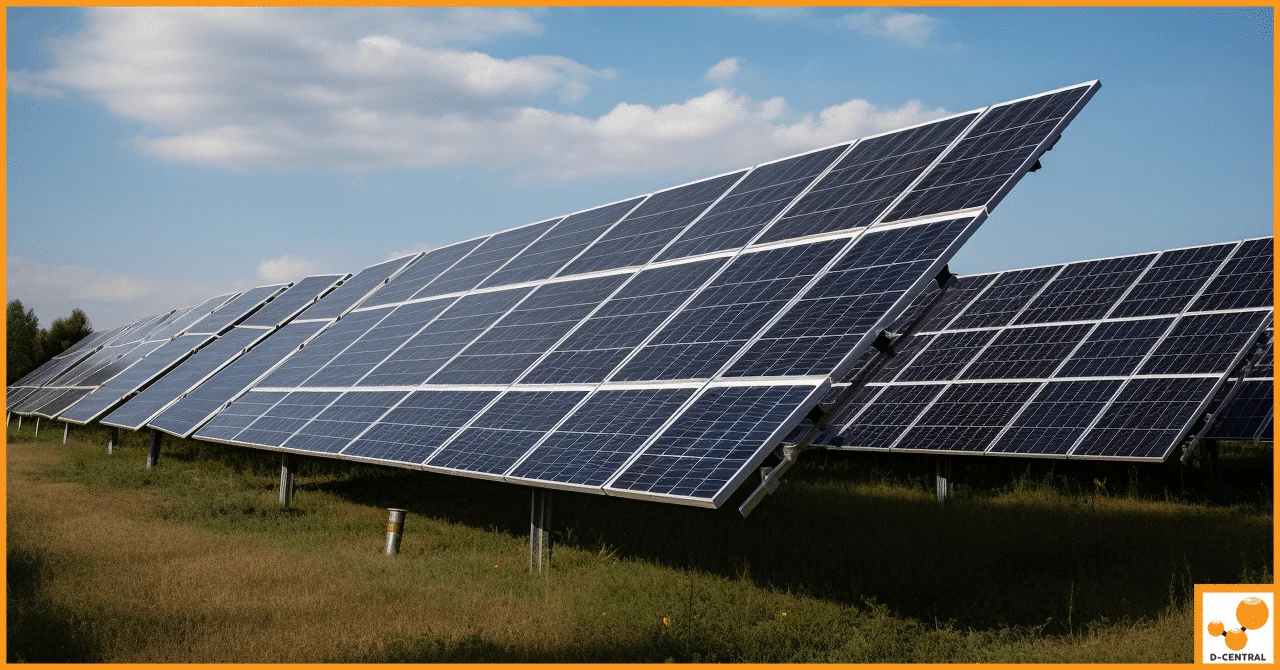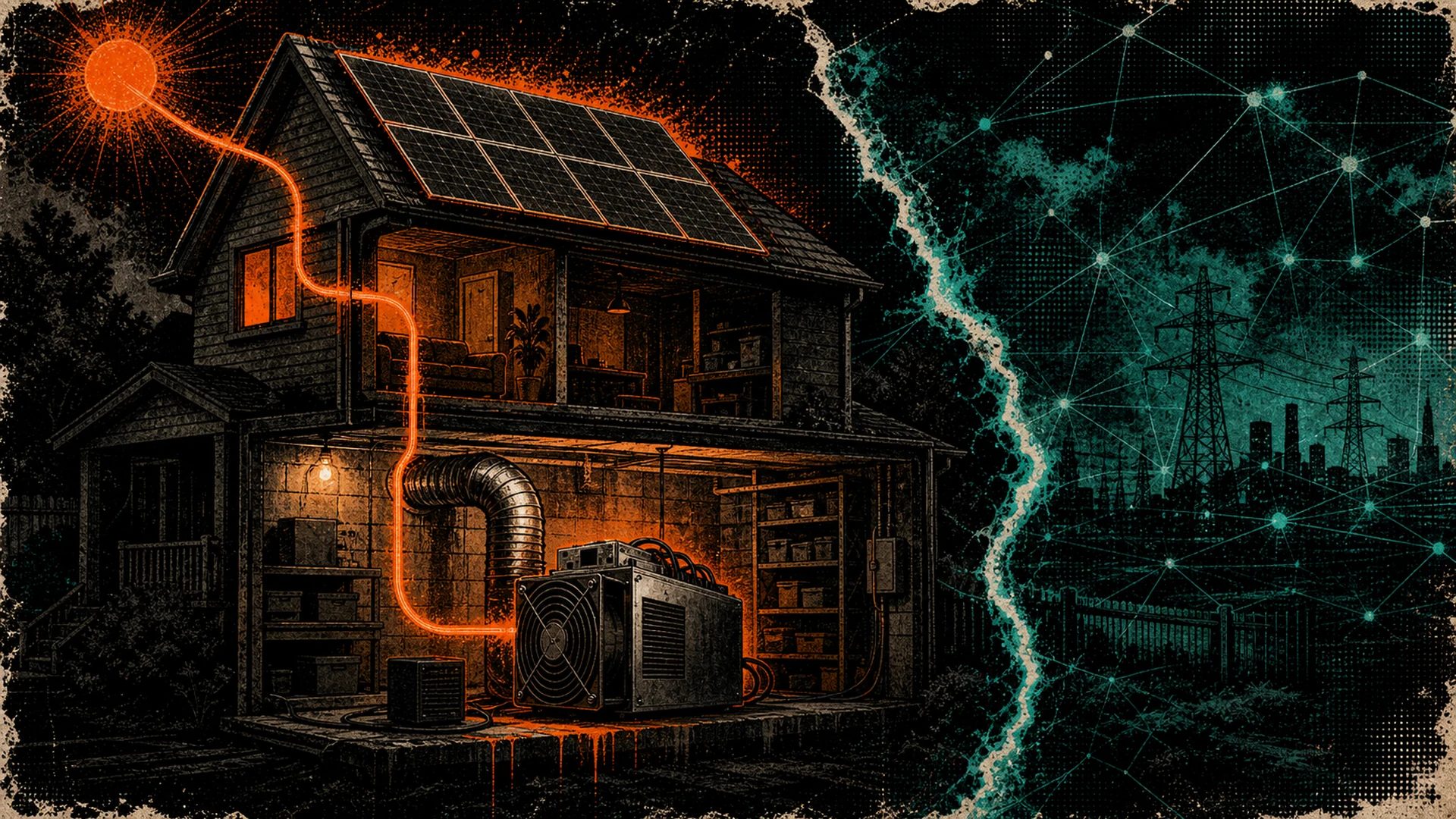
Your rooftop solar array generates kilowatts of clean energy every day. Your utility company pays you pennies for the surplus. Meanwhile, a Bitcoin miner in your basement could be converting that same surplus into sound money — and heating your home in the process. In 2026, the convergence of residential solar and home Bitcoin mining is not a future concept. It is an operational reality for thousands of sovereign individuals worldwide, and it represents one of the most elegant energy monetization strategies available to homeowners today.
This guide covers everything you need to know about pairing rooftop solar with Bitcoin mining at home — from system sizing and economics to hardware selection and D-Central’s Bitcoin Space Heaters that turn every watt of mining power into usable heat. If you have solar panels (or are considering them), this is your playbook for maximizing their value with Bitcoin.
Why Solar Power and Bitcoin Mining Are a Natural Match
Bitcoin mining is, at its core, the conversion of electricity into sound money. Solar panels convert sunlight into electricity. The combination eliminates the middleman — your utility company — and replaces a low-value energy buyback with a high-value digital asset.
Here is the fundamental problem with residential solar in 2026: net metering is dying. Across North America, utilities are slashing buyback rates, imposing demand charges, and capping the amount of energy homeowners can sell back to the grid. California’s NEM 3.0 cut solar export rates by roughly 75%. Ontario’s microFIT program ended years ago. Quebec’s net metering caps credits at your annual consumption. The trend is unmistakable — utilities do not want to buy your surplus power at retail rates.
Bitcoin mining solves this problem permanently. Instead of selling surplus kilowatt-hours to the grid at 3-8 cents per kWh, you convert them into Bitcoin at an effective “purchase price” determined only by your electricity cost and mining efficiency. When your electricity cost is zero (solar surplus), your effective Bitcoin acquisition cost approaches hardware depreciation alone.
The Economics in Plain Numbers
| Scenario | Surplus Energy Use | Value per kWh | Annual Value (5 kWh/day surplus) |
|---|---|---|---|
| Sell to grid (net metering) | Export to utility | $0.03–$0.08 | $55–$146 |
| Battery storage | Store for evening use | $0.10–$0.15 (avoided cost) | $183–$274 |
| Bitcoin mining | Convert to BTC | $0.15–$0.40+ | $274–$730+ |
The Bitcoin mining row assumes current network difficulty and BTC price ranges. The key insight: Bitcoin mining typically delivers 2x to 10x more value per kilowatt-hour than grid export, depending on your utility’s buyback rate and Bitcoin’s market price. And unlike grid export rates, Bitcoin’s value is not set by a utility commission — it is set by a global free market.
Grid-Tied vs. Off-Grid Solar Mining: Two Approaches
There are two fundamentally different ways to pair solar with Bitcoin mining, and each has distinct advantages.
Grid-Tied Solar Mining (Most Common)
In a grid-tied setup, your solar array feeds your home’s electrical panel. When solar production exceeds household consumption, the surplus powers your Bitcoin miner. When solar production drops (cloudy days, nighttime), grid power takes over. The miner runs 24/7, but during peak solar hours, your effective electricity cost for mining drops to zero.
Advantages: Miner runs continuously (maximizing hashrate uptime), no battery investment needed, grid provides backup power. This is the setup most Canadian and American home miners use.
Best for: Homeowners with existing grid-tied solar who want to maximize the value of surplus production while maintaining 24/7 mining uptime.
Off-Grid Solar Mining
In a fully off-grid setup, solar panels charge a battery bank, and the miner runs only when sufficient stored energy is available. This approach is technically more complex and requires battery storage, charge controllers, and careful power management.
Advantages: Complete energy sovereignty — no utility bill, no grid dependency, no permission needed. True cypherpunk mining.
Best for: Dedicated sovereignty maximalists, remote locations, or supplementary setups using smaller miners like the Bitaxe that consume only 15-25 watts.
Sizing Your Solar Array for Bitcoin Mining
The critical question: how much solar capacity do you need to meaningfully power a Bitcoin miner? The answer depends entirely on which miner you choose.
| Miner Type | Power Draw | Solar Panels Needed | Best Use Case |
|---|---|---|---|
| Bitaxe (Supra/Ultra/Gamma) | 15–25 W | 1 panel (400W) | Solo mining, off-grid, education |
| NerdAxe / NerdQAxe++ | 15–60 W | 1 panel (400W) | Solo mining, maker projects |
| Antminer S9 Space Heater Edition | 800–1,400 W | 3–4 panels (400W each) | Dual-purpose heating + mining |
| Antminer S17/T17 Space Heater Edition | 1,200–2,200 W | 4–6 panels (400W each) | Higher hashrate heating |
| Antminer S19 Space Heater Edition | 2,000–3,250 W | 6–9 panels (400W each) | Maximum hashrate + whole-room heating |
| Full ASIC (S21, S21 Pro) | 3,000–5,000 W | 8–13 panels (400W each) | Dedicated mining operation |
Important: These panel counts assume approximately 5 peak sun hours per day (typical for southern Canada and the northern United States). A 400W panel produces roughly 2 kWh/day under these conditions. Your actual production varies by latitude, roof angle, shading, and season.
For most homeowners with a typical 6-10 kW rooftop array, the sweet spot is a D-Central Bitcoin Space Heater — an ASIC miner configured for quiet, safe indoor operation that doubles as a room heater. Your solar surplus during peak hours offsets a significant portion (or all) of the miner’s power consumption, and the heat output replaces your conventional heating system during colder months.
D-Central’s Bitcoin Space Heaters: The Dual-Purpose Solar Mining Solution
Here is where the solar-mining equation becomes truly compelling. Every watt consumed by a Bitcoin miner is converted to heat with near-perfect efficiency (ASIC miners are essentially 100% efficient space heaters). During the 6-8 month heating season in Canada and the northern US, your Bitcoin miner’s electricity cost is not an expense — it is your heating bill, which you were going to pay anyway.
D-Central’s Bitcoin Space Heaters are purpose-built for exactly this use case. Since 2016, D-Central has been engineering custom ASIC configurations designed to operate safely and quietly inside a home. These are not stock miners shoved in a closet — they are professionally modified units with noise reduction, thermal management, and residential-safe enclosures.
The Space Heater Lineup
| Model | Heat Output (BTU/h) | Power Draw | Room Size | Solar Pairing |
|---|---|---|---|---|
| S9 Space Heater Edition | ~4,100 BTU/h | ~1,200 W | Small–medium room | 3–4 panels |
| L3+ Space Heater Edition | ~2,700 BTU/h | ~800 W | Small room / office | 2–3 panels |
| S19 Space Heater Edition | ~10,200 BTU/h | ~3,000 W | Large room / open plan | 8–9 panels |
Use D-Central’s Bitcoin Space Heater BTU Calculator to determine exactly which model fits your room size and climate zone.
Why Space Heaters Are the Ideal Solar Mining Hardware
The dual-purpose advantage is straightforward math. During heating season, your conventional electric heater draws 1,500 watts and produces nothing but heat. A D-Central Bitcoin Space Heater draws a similar amount of power, produces the same heat, and mines Bitcoin. The net cost of mining is effectively zero because you were going to spend that electricity on heating regardless.
When paired with solar:
- Peak solar hours — miner runs on free solar electricity, producing free heat and free Bitcoin
- Off-peak hours — miner runs on grid power, but the heat output displaces your furnace or baseboard heaters
- Summer months — miner runs on cheap solar surplus (you were going to export it for pennies anyway)
- Heating season — the miner IS your heater, and solar covers a significant chunk of the power draw
This is what D-Central means by dual-purpose mining — technology that serves two functions simultaneously, making the economics work in virtually any electricity price environment.
The Bitaxe: Solar-Powered Solo Mining for Everyone
Not everyone wants to run a full ASIC miner. For those interested in a smaller footprint — especially off-grid solar setups — the Bitaxe is the perfect entry point.
The Bitaxe is an open-source solo Bitcoin miner that draws just 15-25 watts. A single 400W solar panel produces more than enough energy to run a Bitaxe continuously, even on partly cloudy days. With a small battery bank (even a portable power station), you can run a Bitaxe entirely off-grid — true sovereign mining powered by nothing but sunlight.
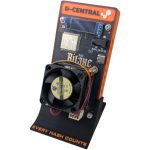
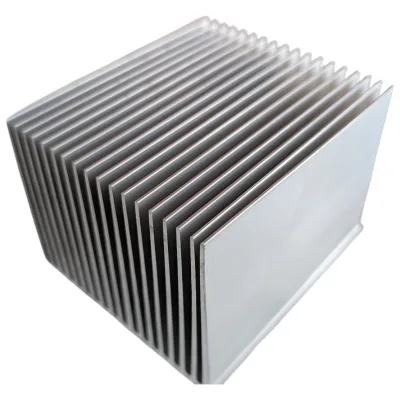
D-Central is a pioneer in the Bitaxe ecosystem, having created the original Bitaxe Mesh Stand and developed leading Bitaxe accessories including custom heatsinks. We stock every Bitaxe variant — Supra, Ultra, Hex, Gamma, GT — plus all compatible accessories and power supplies.
The Bitaxe mines solo, meaning each hash has a chance at winning the full block reward (currently 3.125 BTC). The odds are low for any individual device, but blocks have been found by solo miners running modest hardware. Every hash counts — and when that hash is powered by free solar energy, the lottery ticket costs nothing to play.
System Architecture: How to Wire Solar + Mining
Setting up a solar-powered mining operation at home does not require exotic equipment. Here is the typical architecture for both grid-tied and off-grid approaches.
Grid-Tied Setup (Recommended for Most Homeowners)
- Solar array feeds your home’s main electrical panel through a grid-tied inverter (you likely already have this)
- Bitcoin miner plugs into a standard outlet on a dedicated circuit (240V for full ASICs, 120V for Space Heater Editions and smaller miners)
- Smart plug or energy monitor (optional) tracks power consumption and lets you schedule mining intensity around peak solar production
- Mining pool or solo mining — connect to your preferred pool or run solo with a Bitaxe
That is it. No special wiring, no additional inverters, no battery bank. Your existing grid-tied solar system works as-is. The miner simply consumes power from your panel, and during peak solar hours, that power is free.
Off-Grid Setup (For Sovereignty Maximalists)
- Solar panels connect to a charge controller (MPPT recommended)
- Battery bank stores energy (LiFePO4 batteries recommended for longevity)
- Inverter converts DC battery power to AC for the miner
- Bitaxe or low-power miner runs from the inverter output
For off-grid setups, the Bitaxe’s 15-25W draw makes it the obvious choice. A single 400W panel, a 100Ah 12V LiFePO4 battery, and a small pure sine wave inverter can run a Bitaxe around the clock with comfortable margin. Total off-grid solar mining rig cost: under $1,000 for everything including the Bitaxe.
Seasonal Strategy: Optimizing Solar Mining Year-Round
Smart solar miners do not run the same setup year-round. They adapt their strategy to the seasons — and this is where the Space Heater concept earns its keep.
Heating Season (October–April in Canada)
This is the golden window for solar + mining. During heating season:
- Run your Bitcoin Space Heater at full power — every watt produces useful heat
- Solar production is lower (shorter days, snow cover), but the heat value of mining offsets grid electricity costs
- Your Space Heater replaces a conventional electric heater, making the net mining cost effectively zero
- In Canada, heating season spans 6-8 months — that is 6-8 months of free mining when heat value is counted
Shoulder Season (April–May, September–October)
During transition months:
- Solar production ramps up while heating demand decreases
- Run your miner during solar peak hours and reduce or pause during evenings
- Use smart plugs with scheduling to align mining with solar production curves
- Consider underclocking your ASIC for lower power draw if heating is no longer needed
Summer (May–September)
Summer is when solar production peaks but heat is unwanted:
- Switch to a Bitaxe or other low-power miner — minimal heat output, runs easily on solar surplus
- If running a larger miner, duct the hot exhaust outdoors or into a garage/workshop
- This is when solar surplus is highest and grid export rates are lowest — Bitcoin mining captures maximum value
- Some miners undervolt their ASICs in summer to reduce heat while maintaining reasonable hashrate
The Real Math: Solar Mining Economics in Canada
Let us run a concrete example for a Canadian homeowner in southern Ontario or Quebec with a typical 8 kW rooftop solar array.
| Parameter | Value |
|---|---|
| Solar array size | 8 kW (20 x 400W panels) |
| Annual production | ~9,600 kWh (Ontario average) |
| Household consumption | ~7,200 kWh/year |
| Annual solar surplus | ~2,400 kWh |
| Grid export value (net metering) | ~$192/year (at $0.08/kWh credit) |
| Bitcoin mining value (surplus only) | $480–$960+/year (at current difficulty/price) |
| Miner choice | S9 Space Heater Edition (~1,200W) |
| Heating offset value (6 months) | ~$600–$900/year (replaces electric heat) |
| Total annual value (mining + heating) | $1,080–$1,860+/year |
Compare that to the $192/year from net metering credits. Solar + Bitcoin mining delivers 5x to 10x the value of grid export alone. And these numbers are conservative — they assume mining only with surplus solar energy. A grid-tied miner running 24/7 with solar offsetting daytime power consumption generates significantly more Bitcoin.
Net Metering Is Dying — Bitcoin Mining Is the Replacement
The net metering landscape in 2026 is hostile to solar homeowners. Here is what is happening across major markets:
- California (NEM 3.0): Export rates slashed to $0.04-$0.08/kWh from previous retail rates of $0.30+
- Ontario: Net metering caps credits at annual consumption; no cash payout for surplus
- Quebec: Virtual net metering available but credits expire annually; no rollover
- Many US states: Shifting from retail-rate net metering to wholesale or avoided-cost rates
The utilities’ message is clear: they do not want to buy your power. The response from sovereign-minded homeowners should be equally clear: do not sell it to them. Mine Bitcoin instead.
Bitcoin mining transforms your solar array from a cost-recovery investment into a revenue-generating asset. No utility approval needed. No rate changes to worry about. No caps, no tariffs, no bureaucratic games. Just physics: photons become electrons become satoshis.
Environmental Reality: Mining With Solar Is Net Positive
The “Bitcoin uses too much energy” narrative collapses when applied to solar-powered home mining. Here is why:
- Solar surplus is otherwise wasted or sold at minimal value. Mining converts it into a productive use without any incremental environmental impact.
- Dual-purpose mining (Space Heaters) displaces fossil fuel heating. If your Space Heater replaces a natural gas furnace, you are literally decarbonizing your home heating while mining Bitcoin.
- Home mining decentralizes hashrate. Concentrated mining operations create single points of failure and environmental pressure. Distributed home mining spreads the footprint across millions of residential rooftops already generating clean energy.
- Mining incentivizes additional solar adoption. The improved economics of solar + mining makes the investment case for rooftop solar stronger, accelerating renewable energy deployment.
Bitcoin mining does not waste energy. It monetizes energy that would otherwise have no buyer. When that energy comes from your own solar panels, the environmental argument becomes incontrovertible.
Getting Started: Your Solar Mining Checklist
Ready to start mining Bitcoin with your solar panels? Here is a practical step-by-step checklist:
- Assess your solar surplus. Review your utility bills or solar monitoring app to determine how much excess energy you produce monthly. Any surplus above 1 kWh/day is enough to run a Bitaxe.
- Choose your miner. For maximum dual-purpose value, pick a D-Central Bitcoin Space Heater. For minimal footprint and off-grid capability, choose a Bitaxe.
- Verify your electrical capacity. Ensure your panel has a spare circuit for the miner. Space Heater Editions run on standard 120V outlets. Full ASICs require 240V circuits. See D-Central’s 120V Bitcoin Mining Guide for details.
- Calculate your economics. Use D-Central’s Mining Profitability Calculator to model your expected returns based on your electricity cost and chosen hardware.
- Set up your miner. Plug in, connect to Wi-Fi, configure your mining pool (or solo mine with Bitaxe), and start hashing.
- Optimize seasonally. Run full power during heating season. Reduce power or switch to low-draw miners in summer.
- Stack sats. Withdraw mined Bitcoin to your own self-custody wallet. Not your keys, not your coins.
D-Central: Your Partner in Solar-Powered Bitcoin Mining
D-Central Technologies has been building, modifying, and repairing Bitcoin mining hardware since 2016. We are Canada’s Bitcoin Mining Hackers — taking institutional-grade technology and engineering it for home miners. Our Bitcoin Space Heater product line was designed specifically for the dual-purpose mining use case that makes solar + mining economics so compelling.
We also provide:
- ASIC repair services for all major manufacturers — if your miner needs maintenance, we fix it
- The complete Bitaxe ecosystem — every variant, every accessory, every power supply
- Mining consulting for homeowners designing their first solar + mining setup
- Interactive tools including the Space Heater BTU Calculator and Mining Profitability Calculator
Whether you have a single solar panel and a Bitaxe or a 15 kW array feeding an S19 Space Heater, D-Central has the hardware, expertise, and support to make your solar mining operation succeed.
Frequently Asked Questions
Can I run a Bitcoin miner entirely on solar power?
Yes. For grid-tied systems, your solar array feeds your home panel, and the miner draws power from it — during peak solar hours, the miner runs on 100% solar electricity. For off-grid setups, low-power miners like the Bitaxe (15-25W) can run entirely on a single solar panel and a small battery bank. Larger ASIC miners require more panels and battery storage for true off-grid operation, but grid-tied setups let them run 24/7 with solar offsetting daytime power consumption.
How many solar panels do I need to mine Bitcoin at home?
It depends on your miner. A Bitaxe solo miner needs just one 400W panel. A D-Central S9 Space Heater Edition needs 3-4 panels (400W each). A full Antminer S19 Space Heater Edition needs 8-9 panels. For grid-tied setups, these panel counts represent what is needed to offset the miner’s daytime power draw — the miner can still run at night on grid power. Use D-Central’s Mining Profitability Calculator to model your specific setup.
Is it more profitable to sell solar energy back to the grid or mine Bitcoin?
In virtually all cases in 2026, Bitcoin mining generates significantly more value per kilowatt-hour than grid export. Net metering rates range from $0.03-$0.08/kWh in most markets, while Bitcoin mining typically yields $0.15-$0.40+ per kWh at current network difficulty and BTC price. The gap is widening as utilities continue cutting buyback rates. Additionally, if you use a Bitcoin Space Heater during heating season, the heat value further improves the economics.
What is a Bitcoin Space Heater, and how does it work?
A Bitcoin Space Heater is an ASIC Bitcoin miner professionally configured by D-Central for safe, quiet indoor residential operation. It mines Bitcoin and produces heat as a byproduct — since miners convert virtually 100% of their electricity into heat, they function as highly efficient space heaters. D-Central offers Space Heater Editions based on the Antminer S9, L3+, S17/T17, and S19. During heating season, the heat output replaces your conventional heater, making the net cost of mining effectively zero. Browse the full lineup at d-central.tech/space-heaters.
Do I need a special inverter or electrical setup for solar mining?
No. If you have an existing grid-tied solar system, your miner simply plugs into a standard outlet on your home’s electrical panel. No additional inverter is needed. D-Central’s Space Heater Editions run on standard 120V North American outlets. Full-size ASICs require a 240V circuit, which an electrician can install. For off-grid setups, you need a charge controller, battery bank, and a pure sine wave inverter — but these are standard off-grid solar components.
What happens to my Bitcoin miner in summer when I do not need heat?
You have several options. You can switch to a low-power miner like the Bitaxe that produces minimal heat. You can duct your Space Heater’s exhaust outdoors or into an attached space like a garage. You can undervolt your ASIC to reduce heat output while maintaining reasonable hashrate. Or you can mine at full power during solar peak hours only (when electricity is free) and pause during evenings. Summer is when solar surplus is highest, so even with reduced mining hours, you are capturing value that would otherwise be exported for pennies.
Can I mine Bitcoin with solar panels in Canada given the shorter winter days?
Absolutely. Canada is actually ideal for solar + mining because of the dual-purpose heating advantage. Yes, winter days are shorter and solar production drops, but winter is precisely when your Space Heater’s heat output is most valuable. During summer, long Canadian days (15+ hours of daylight) produce abundant solar surplus for mining. The seasonal cycle naturally balances: more solar in summer (free mining power), more heating value in winter (free mining via heat offset). Southern Canada receives 1,000-1,300 kWh/kW of solar irradiation annually — sufficient for meaningful mining.
Is solar-powered Bitcoin mining legal in Canada and the United States?
Yes. There are no laws prohibiting Bitcoin mining with solar power in Canada or the United States. In Canada, Bitcoin mining is treated as a business activity for tax purposes, and mined Bitcoin is taxable income. In the US, similar rules apply under IRS guidelines. Some municipalities have zoning restrictions on noise levels, but D-Central’s Space Heater Editions are designed for quiet residential operation. Always consult a tax professional regarding your specific jurisdiction.