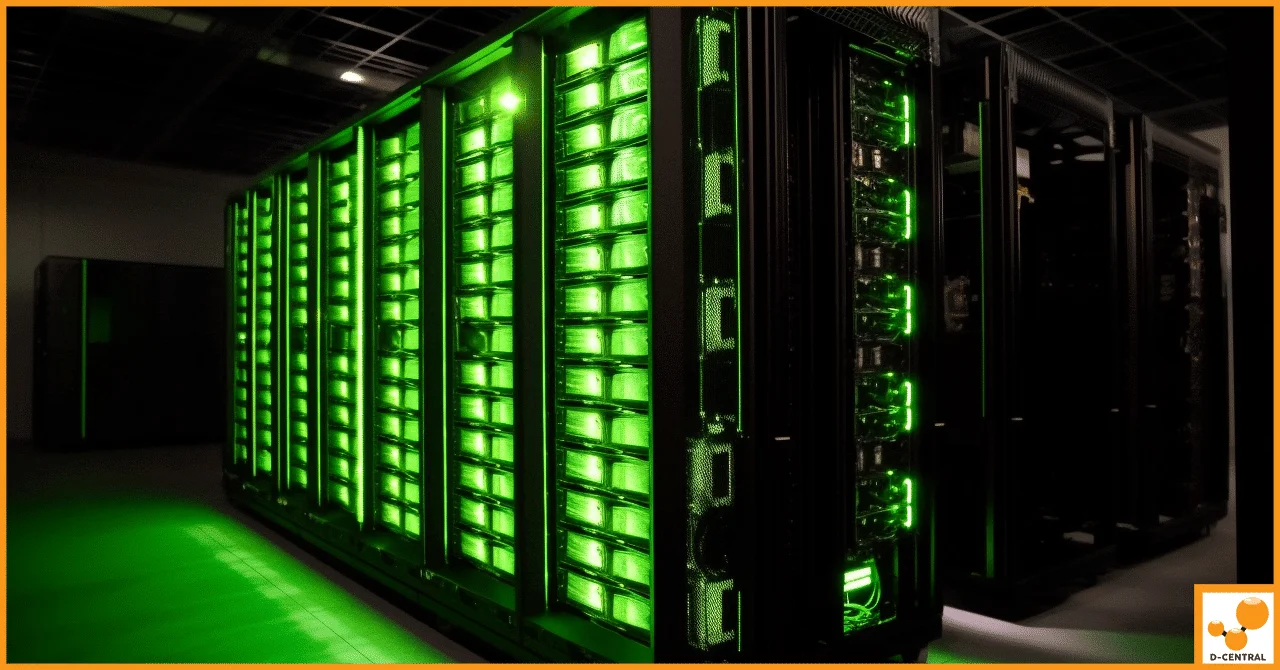
Every few months, the tech press erupts over a new GPU supercomputer that will supposedly change everything. NVIDIA’s DGX GH200, powered by the Grace Hopper superchip, made headlines with its 1 exaflop of AI performance and 144 terabytes of shared memory. Impressive numbers. But here is the question no one in those press releases bothers to ask: what does any of this mean for Bitcoin mining?
The honest answer is: not much — and understanding why reveals something fundamental about how Bitcoin works, why ASICs exist, and why the decentralization of mining hardware matters more than ever.
At D-Central Technologies, we have been in the trenches of Bitcoin mining since 2016. We repair ASICs, build custom mining solutions, and manufacture open-source miners like the Bitaxe. We are not spectators commenting on hardware specs from the sidelines — we are the Bitcoin Mining Hackers who take institutional-grade technology and make it accessible to home miners across Canada and beyond.
Let us break down why GPU supercomputers and Bitcoin mining are fundamentally different beasts, what is actually happening at the intersection of AI and mining infrastructure, and where the real opportunities lie for sovereign, decentralized mining.
Why GPU Supercomputers Cannot Mine Bitcoin Efficiently
Bitcoin mining runs on SHA-256, a cryptographic hashing algorithm that is ruthlessly simple in its computational demands. It does not need floating-point precision, tensor operations, or massive memory pools. It needs one thing: raw, repetitive hashing at maximum speed per watt.
This is exactly what Application-Specific Integrated Circuits (ASICs) are built to do. An ASIC miner like the Antminer S21 can deliver over 200 TH/s while consuming around 3,500 watts. Every transistor on that chip is dedicated to SHA-256. There is zero wasted silicon.
A GPU, by contrast, is a general-purpose parallel processor. It excels at the matrix multiplications that power neural networks, ray tracing, and scientific simulations. But for SHA-256 hashing, a GPU wastes enormous amounts of die area on capabilities Bitcoin mining never uses — floating-point units, texture mapping hardware, video decode engines, and display outputs.
| Metric | NVIDIA H100 GPU | Antminer S21 (ASIC) | Bitaxe Ultra (Open-Source) |
|---|---|---|---|
| Primary Purpose | AI / ML Training | SHA-256 Hashing | Solo SHA-256 Hashing |
| SHA-256 Hashrate | ~1-2 GH/s | 200 TH/s | ~500 GH/s |
| Power Consumption | ~700W | ~3,500W | ~15W |
| Efficiency (J/TH) | ~350,000 | ~17.5 | ~30 |
| Unit Cost | ~$30,000 USD | ~$5,000 USD | ~$200 USD |
| Power Input | PCIe / SXM5 | C13/C14 AC | 5V DC barrel jack (5.5×2.1mm) |
The efficiency gap is not a rounding error — it is roughly 20,000x. A single Antminer S21 outperforms an entire rack of H100 GPUs at Bitcoin mining while consuming a fraction of the power. This is precisely why GPU mining died for Bitcoin years ago, and why no amount of GPU innovation will reverse that reality.
The Real Relationship Between AI Infrastructure and Mining
So if GPU supercomputers are not mining competitors, why should Bitcoin miners care about AI at all? Because the infrastructure story is where things get interesting.
Shared Infrastructure Demands
AI data centers and Bitcoin mining operations share strikingly similar infrastructure requirements:
- Power density: Both need massive, reliable electrical capacity — megawatts of it
- Cooling systems: High heat output requires engineered thermal management
- Location economics: Both benefit from cheap electricity and cold climates (hello, Canada)
- 24/7 uptime: Neither workload tolerates downtime
- Hardware maintenance: Specialized repair and diagnostics skills transfer between ASIC and GPU hardware
This infrastructure overlap is creating real economic dynamics. In some regions, AI data center demand is competing with miners for power capacity and facility space. In others, mining operations are pivoting to offer AI compute hosting alongside their Bitcoin operations — or at least preparing the infrastructure to do so.
The Repair Skills Crossover
Here is something that does not get discussed enough: the board-level repair skills that D-Central has built over eight years of ASIC repair translate directly to GPU server maintenance. Diagnosing failed VRMs, reflowing BGA chips, troubleshooting power delivery — the fundamentals are the same whether you are working on a hashboard or a GPU compute node. Our technicians handle 38+ ASIC models. That diagnostic expertise is hardware-agnostic at its core.
What Actually Matters: ASIC Innovation and Mining Decentralization
While the tech press fixates on GPU supercomputers, the innovations that genuinely matter for Bitcoin mining are happening in ASIC design and open-source hardware.
The ASIC Efficiency Race
The real frontier of Bitcoin mining hardware is the push toward lower joules-per-terahash. Every generation of ASIC chips squeezes more hashes out of every watt consumed. This is the metric that determines mining profitability — not raw hashrate alone, but how efficiently you convert electricity into proof-of-work.
| ASIC Generation | Example Model | Efficiency (J/TH) | Process Node |
|---|---|---|---|
| 2017-era | Antminer S9 | ~98 | 16nm |
| 2020-era | Antminer S19 | ~34 | 7nm |
| 2023-era | Antminer S21 | ~17.5 | 5nm |
| Open-Source | Bitaxe Ultra (BM1366) | ~30 | 5nm |
This efficiency trajectory is the real hardware story in Bitcoin mining. In six years, ASIC efficiency improved by roughly 5.5x. No GPU architecture can compete with that level of purpose-built optimization for SHA-256.
Open-Source Miners: The Decentralization Breakthrough
The most important hardware innovation in Bitcoin mining is not happening in NVIDIA’s labs or in Bitmain’s factories. It is happening in the open-source community — and D-Central has been a pioneer in this movement since the beginning.
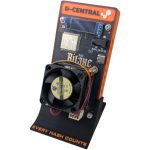
The Bitaxe represents a fundamental shift in how mining hardware is designed and manufactured. Instead of relying on a handful of opaque manufacturers who control the supply chain, open-source mining hardware puts the designs in the hands of the community. Anyone can build, modify, and improve the hardware. D-Central was among the first companies to manufacture the Bitaxe Mesh Stand and has developed leading solutions including heatsinks, custom cases, and accessories for the entire Bitaxe ecosystem.
Why does this matter? Because mining decentralization is Bitcoin’s immune system. When a small number of companies control all the hardware, they become centralization chokepoints. Open-source miners like the Bitaxe, NerdAxe, and NerdQAxe break that dependency.
A Bitaxe Ultra running solo mining on your desk, powered by a 5V DC barrel jack and consuming 15 watts, is more important to Bitcoin’s long-term health than a $200 million GPU supercomputer. Every hash contributes to network security and decentralization. Every hash counts.
AI Hype vs. Bitcoin Mining Reality
Let us be direct about the AI narrative as it relates to Bitcoin mining, because there is a lot of confusion being circulated:
Claim: “AI will optimize Bitcoin mining.”
Reality: There is limited scope for AI in mining operations. Pool selection, firmware tuning, and power management can benefit from data analysis, but the core operation — hashing — is deterministic. No amount of machine learning makes SHA-256 faster. The algorithm does not have patterns to learn.
Claim: “GPU mining will make a comeback.”
Reality: For Bitcoin, never. The ASIC advantage is insurmountable. GPUs are useful for altcoin mining (Ethereum moved to proof-of-stake, eliminating its largest GPU mining use case) and for AI training. Bitcoin’s SHA-256 belongs to ASICs permanently.
Claim: “Miners should pivot to AI hosting.”
Reality: Some large-scale miners with existing power infrastructure may find AI hosting profitable. But this is an infrastructure play, not a mining play. For home miners and pleb miners, the focus should remain on what matters: running your own hashrate, supporting network decentralization, and potentially heating your home in the process.
The Home Mining Advantage: Why Decentralized Hashrate Wins
While institutional players debate GPU supercomputers and AI data centers, the home mining revolution continues to gain ground. And this is where D-Central’s mission lives.
Bitcoin’s network hashrate currently exceeds 800 EH/s. The block reward sits at 3.125 BTC post-halving. At those numbers, the economics of home mining are not about competing with industrial farms on hashrate — they are about something more important:
- Sovereignty: Your miner, your hashrate, your contribution to network security. No custodial risk, no counterparty dependency.
- Heat recovery: In Canada’s climate, a Bitcoin space heater turns mining costs into heating savings. Your S9 or S19 warms your workshop while securing the Bitcoin network.
- Solo mining potential: Open-source miners like the Bitaxe enable true solo mining — every hash is your own lottery ticket for a full 3.125 BTC block reward.
- Network resilience: Thousands of home miners distributed across geographies make Bitcoin more resistant to regulatory attacks, natural disasters, and infrastructure failures.
No GPU supercomputer delivers these benefits. No AI data center strengthens Bitcoin’s censorship resistance. Only distributed, sovereign hashrate does that.
Where to Focus Your Mining Strategy
If you are a home miner or aspiring to become one, here is where your attention should actually be:
- Efficiency-first hardware selection: Choose ASICs with the lowest J/TH you can afford. For solo mining and education, explore the Bitaxe lineup.
- Power cost optimization: Your electricity rate is the single biggest variable in mining profitability. Canadian miners with hydro or off-peak rates have a structural advantage.
- Heat recovery: Dual-purpose mining transforms a cost center into a heating solution. Bitcoin space heaters turn 100% of consumed electricity into both hashrate and heat.
- Hardware maintenance: Keeping your ASICs running at peak efficiency extends their profitable lifespan. Learn basic diagnostics or work with a professional repair service.
- Decentralization: Run your own node, mine to your own address, support smaller pools. This is the cypherpunk way.
FAQ
Can GPU supercomputers like the DGX GH200 mine Bitcoin?
Technically, any processor can compute SHA-256 hashes. However, GPU supercomputers are roughly 20,000x less efficient at Bitcoin mining than purpose-built ASIC miners. The DGX GH200 is designed for AI workloads — matrix multiplications, neural network training, and large language models. These are fundamentally different computational tasks. Using a GPU supercomputer for Bitcoin mining would be like using a Formula 1 car to plow a field: technically possible, economically absurd.
Why did GPU mining stop being viable for Bitcoin?
GPU mining for Bitcoin effectively ended around 2013-2014 when ASIC miners became widely available. ASICs are custom silicon chips designed to do exactly one thing: compute SHA-256 hashes. Because they have zero wasted transistors on non-mining tasks, they deliver orders of magnitude better performance per watt. The efficiency gap between GPUs and ASICs for SHA-256 has only widened with each ASIC generation. This specialization is permanent — no GPU architecture will ever close this gap for SHA-256.
Should Bitcoin miners worry about AI data centers competing for power?
This is a real consideration in certain regions. AI data centers demand massive power capacity, and they can often pay premium rates for it. In areas with constrained grid capacity, this can push up power costs or limit availability for miners. However, this competition also validates the infrastructure model that miners have built. For home miners, the impact is minimal — residential power is a separate market from industrial data center contracts. Canadian home miners benefit from relatively low hydro rates regardless of AI data center expansion.
What is the most efficient way to mine Bitcoin at home?
The most efficient approach combines several strategies: select ASIC hardware with the lowest joules-per-terahash ratio you can afford, optimize your electricity costs (off-peak rates, renewable sources), and recover waste heat for home heating. For pure educational and solo mining purposes, open-source miners like the Bitaxe Ultra consume only about 15 watts via a 5V DC barrel jack and offer the experience of sovereign mining with a chance at a full 3.125 BTC block reward. For serious hashrate, current-generation ASICs like the S21 series deliver the best efficiency. D-Central stocks the full range from entry-level Bitaxe miners to full-scale ASICs.
Is AI going to make Bitcoin mining obsolete?
No. Bitcoin’s proof-of-work is a feature, not a bug. AI cannot “optimize away” the need for SHA-256 hashing because the computational work IS the security mechanism. Every hash that miners compute is a vote for the validity of Bitcoin’s transaction history. AI excels at pattern recognition and prediction — but SHA-256 is deliberately designed to have no exploitable patterns. The difficulty adjustment ensures that mining always requires real energy expenditure, regardless of how “smart” the hardware becomes. Mining will remain relevant as long as Bitcoin exists.
What hardware does D-Central recommend for someone starting out in Bitcoin mining?
For beginners who want to learn about mining and participate in solo mining, the Bitaxe lineup is the ideal starting point — low power consumption (5V barrel jack, ~15W), silent operation, open-source firmware, and a genuine chance at solo-mining a block. For miners looking to generate meaningful hashrate and heat recovery, Bitcoin space heaters (custom ASIC builds in heater enclosures) offer a dual-purpose solution. For maximum hashrate and efficiency, current-generation ASICs are the way to go. Visit the Bitaxe Hub for comprehensive guides on open-source mining, or explore the full product catalog at the D-Central shop.