The ASIC miner market is not a stock exchange. It is a hardware market governed by silicon fabrication cycles, Bitcoin’s difficulty adjustment algorithm, and the halving schedule. If you treat it like a financial instrument, you will overpay, buy at the wrong time, and end up with a machine that never earns back its purchase price in sats. If you understand the engineering and the cycles, you can acquire serious hashrate at a fraction of what institutions pay — and that is exactly the kind of hack we live for at D-Central.
This guide breaks down what actually drives ASIC miner pricing, when the buy windows open, what specs matter versus what is marketing fluff, and how to build a home mining operation that makes thermodynamic and economic sense. No hopium. No “number go up” speculation. Just the technical reality of acquiring mining hardware in 2025 and beyond.
How ASIC Miner Pricing Actually Works
Forget supply and demand in the abstract. ASIC miner pricing is driven by a very specific set of measurable inputs. Understanding them puts you ahead of 90% of buyers in this market.
| Price Driver | What It Means | Impact on Price |
|---|---|---|
| Joules per Terahash (J/TH) | Energy efficiency of the ASIC chip — the single most important spec | Lower J/TH = higher price. Sub-20 J/TH commands premium |
| Hashrate (TH/s) | Raw computational output | Higher TH/s = higher price, but efficiency matters more |
| Bitcoin Halving Cycle | Block reward drops 50% every ~210,000 blocks (last: April 2024 to 3.125 BTC) | Prices spike pre-halving, crash 6-12 months post-halving |
| Network Difficulty | Adjusts every 2,016 blocks based on total network hashrate (~800+ EH/s) | Rising difficulty makes older machines unprofitable faster |
| Chip Generation | Semiconductor node (5nm, 4nm, 3nm) and architecture design | New-gen chips create massive price drops for previous-gen |
| Market Sentiment | FOMO buying during bull runs, capitulation during bears | Emotional buyers pay 2-3x what patient buyers pay |
The golden rule: the best time to buy mining hardware is when nobody else wants to. Bear markets and post-halving capitulation periods are when experienced miners acquire their fleets. The hardware does not care about the BTC/USD price — it hashes the same regardless.
The Price-Efficiency Matrix: What You Should Actually Be Measuring
Most buyers fixate on the sticker price or the hashrate number. Both are misleading in isolation. The metric that determines whether a miner is worth buying is the cost per terahash per day adjusted for your electricity rate. Here is how the current generation stacks up:
| Miner Class | Efficiency Range | Typical Price Range | Best Use Case |
|---|---|---|---|
| Current-Gen Flagships (S21 XP, M66S+) | 13-17 J/TH | $5,000-$12,000+ | Industrial-scale or very cheap power (<$0.05/kWh) |
| Mid-Gen Workhorses (S19 XP, M50S+) | 20-25 J/TH | $1,500-$4,000 | Home mining with moderate power costs (<$0.08/kWh) |
| Previous-Gen Value (S19j Pro, M30S++) | 26-34 J/TH | $300-$1,200 | Heat recovery / space heater builds, cheap power |
| Legacy Units (S9, L3+) | 80-100+ J/TH | $50-$200 | Space heater conversions, heating-first mining |
| Open-Source Solo Miners (Bitaxe, NerdAxe) | Varies (lottery mining) | $50-$300 | Solo block hunting, education, decentralization |
Notice the sweet spot: previous-gen miners at rock-bottom prices, repurposed as Bitcoin Space Heaters. When your miner is also your home heating system, electricity is no longer a pure cost — it is a heating expense you were going to pay anyway, now subsidized by sats. This is the Mining Hacker philosophy in action.
The Halving Cycle and When to Buy
Bitcoin’s halving is the single most predictable event in the ASIC market. Every four years, the block reward drops by half. The April 2024 halving cut the reward from 6.25 to 3.125 BTC per block. This has a cascading effect on hardware economics:
Pre-halving (6-12 months before): Prices peak. Everyone scrambles to accumulate hashrate before the reward cut. Manufacturers raise prices. New models launch at premium pricing. This is the worst time to buy.
Post-halving adjustment (0-12 months after): Inefficient miners get unplugged. Mining revenue drops. Miners sell hardware to cover costs. The secondary market floods with used machines. Prices drop 30-60%.
Accumulation phase (12-24 months post-halving): The best buying window. Prices stabilize at lows. Patient buyers acquire hardware at pennies on the dollar compared to pre-halving peaks.
Recovery phase (24-36 months post-halving): Prices gradually climb as the next halving approaches. New-gen hardware launches. The cycle repeats.
We are now in the post-halving landscape. If you have been waiting for the right entry point, the window is wide open. The machines available today at discounted prices will be hashing for years to come.
Used vs. New: The Case for Refurbished Hardware
Institutional mining operations cycle hardware on aggressive depreciation schedules. A machine that has run for 18 months in a well-maintained facility still has years of productive life left. The ASIC chips themselves do not “wear out” in any meaningful way — fans, thermal paste, and connectors are the failure points, and those are all serviceable.
This is where having a relationship with a company that does ASIC repair and refurbishment matters. A properly inspected, cleaned, and tested used miner from a reputable source performs identically to a new one at 40-60% of the cost. At D-Central, we have repaired thousands of miners since 2016. We know exactly what to look for, what to replace, and what passes our standards.
Key checks when evaluating used hardware:
- Hashboard health: All chips reporting, no dead ASIC errors, stable hashrate within 5% of spec
- Fan condition: RPM within spec, no bearing noise, clean blades
- Thermal paste: Should be reapplied on any unit over 12 months old
- Power supply: Capacitor health, stable voltage output, no buzzing or clicking
- Firmware: Clean, manufacturer firmware or trusted custom firmware — no unknown modifications
- Physical inspection: No corrosion, water damage, bent pins, or burnt components
Buying used from unknown sellers without these checks is how you end up with a doorstop. Buying used from a repair shop that guarantees the hardware is how you build a fleet on a budget.
The Open-Source Alternative: Bitaxe and the Solo Mining Movement
Not every miner needs to chase terahash-per-dollar efficiency. The Bitaxe ecosystem represents a fundamentally different approach to mining: open-source hardware, solo mining against the network, and direct contribution to Bitcoin’s decentralization.
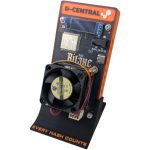
A Bitaxe Supra, Ultra, or Gamma runs on a 5V barrel jack (5.5×2.1mm DC — not USB-C, which is for firmware flashing only), draws a few watts, and solo mines SHA-256. The odds of hitting a block are long, but the 3.125 BTC reward if you do makes it the ultimate Bitcoin lottery ticket — and unlike actual lotteries, every hash you contribute strengthens the network’s decentralization.
D-Central has been in the Bitaxe ecosystem since the beginning. We created the original Bitaxe Mesh Stand, developed heatsink solutions for both the Bitaxe and Bitaxe Hex, and stock every variant: Supra, Ultra, Hex, Gamma, GT, plus the full Nerd lineup — NerdAxe, NerdNOS, Nerdminer, and NerdQAxe. When you are ready to explore open-source mining, we have the hardware and the expertise.
The Canadian Advantage in ASIC Acquisition
Mining hardware pricing is not location-neutral. Buying from a Canadian supplier as a Canadian miner offers real advantages:
- No cross-border duties: Importing from Chinese manufacturers or US resellers adds 5-15% in customs, brokerage, and shipping
- Warranty and repair access: Try sending a machine back to Shenzhen for warranty repair. Now try driving to Montreal, Quebec. The difference is months versus days
- Cold climate synergy: Canada’s heating season is 6-8 months long. ASIC heat output is a feature, not a bug. A miner that costs $0.12/kWh to run in Arizona costs effectively $0.04-0.06/kWh in Quebec when it replaces your electric baseboard heater
- Hydroelectric power: Quebec and British Columbia offer some of the cheapest electricity on the continent at $0.06-0.09/kWh residential
- Local expertise: D-Central has operated from Canada since 2016. We understand Canadian power infrastructure, electrical codes, and climate considerations — because we mine here ourselves
If you need help evaluating which hardware makes sense for your specific power rate, climate, and goals, our mining consulting service exists exactly for that conversation.
Red Flags: How to Avoid Overpaying or Getting Scammed
The ASIC market has its share of pitfalls. Here is what to watch for:
Price too good to be true: If someone is selling a current-gen miner at 50% below market, it is either stolen, broken, or does not exist. Full stop.
“Pre-order” from unknown sellers: Pre-order scams are rampant. Only pre-order from manufacturers directly or from established, reputable dealers with physical addresses and verifiable track records.
Hashrate inflation: Some sellers advertise overclocked hashrates as the default spec. Always verify against manufacturer specifications. A machine rated at 110 TH/s that runs at 130 TH/s in the listing is probably overclocked and will have a shorter lifespan and higher power draw.
Hidden shipping and import costs: A “$2,000 miner” from overseas can easily become $2,500+ after shipping, duties, brokerage fees, and taxes. Factor all-in cost when comparing prices.
No repair support: Buying from a vendor who cannot repair what they sell means any hardware failure turns into a total loss. This is one of D-Central’s core differentiators — we sell it, we repair it, we support it.
Building Your Acquisition Strategy
Whether you are setting up your first home miner or expanding an existing operation, here is a practical framework:
1. Define your electricity cost. This single number determines which hardware tiers are viable for you. Below $0.06/kWh, nearly any current-gen machine works. Above $0.10/kWh, you need heat recovery (space heater builds) or the most efficient new-gen hardware to stay positive.
2. Decide your mining philosophy. Are you accumulating sats for the long term regardless of short-term fiat profitability? Are you heating your home while mining? Are you solo mining with open-source hardware for the decentralization ethos? Each path leads to different hardware choices.
3. Time your purchase. Use the halving cycle as your macro guide. We are currently in a favorable acquisition window. Do not FOMO buy when Bitcoin price spikes.
4. Buy from a source that repairs. Hardware will eventually need service. Fans fail, thermal paste degrades, hashboards develop issues. Buying from a full-service operation like D-Central means your hardware has a support lifecycle, not just a delivery receipt.
5. Consider dual-purpose setups. A Bitcoin Space Heater built from a previous-gen miner can deliver 1,500-3,400W of heat output while mining. In Canada’s climate, that is 6+ months of reduced heating bills. The miner pays for itself faster when the heat has value.
6. Start and iterate. You do not need the most expensive machine on day one. Start with what fits your budget, learn the operations, and scale. Home mining is a skill you build over time.
Explore D-Central’s Full Hardware Lineup
We carry everything from sub-$100 Bitaxe solo miners to full-scale ASICs, plus all the parts, accessories, and custom builds in between. Every machine we sell is backed by our repair expertise — because we have been cracking open these cases and diagnosing boards since 2016.
Browse the full catalog and find the right hardware for your setup, your power rate, and your mining philosophy. If you need guidance, we are here. That is what Bitcoin Mining Hackers do.
Frequently Asked Questions
What is the most important spec when comparing ASIC miner prices?
Joules per terahash (J/TH) — the energy efficiency rating. A more efficient miner produces more hashrate per watt of electricity consumed. This directly determines your ongoing operational cost and is far more important than raw hashrate or sticker price alone. Two miners at the same price but different efficiency ratings will have dramatically different lifetime economics.
When is the best time to buy an ASIC miner?
The 12-24 months following a Bitcoin halving event typically offers the best pricing. The April 2024 halving cut the block reward to 3.125 BTC, causing a wave of hardware sell-offs from miners with higher electricity costs. This post-halving accumulation window is when patient buyers acquire hardware at the steepest discounts. Avoid buying during bull market FOMO when prices are inflated 2-3x above their cycle lows.
Are used ASIC miners worth buying?
Absolutely — when sourced from a reputable dealer who inspects and tests the hardware. ASIC chips themselves do not degrade meaningfully over time. The components that fail are fans, thermal paste, and connectors, all of which are serviceable. A properly refurbished miner from a repair shop like D-Central performs identically to a new unit at 40-60% of the price. The key is buying from a source that can verify hashboard health, replace worn components, and stand behind the sale.
How do I calculate if a miner is profitable at my electricity rate?
Calculate your daily electricity cost: (miner wattage / 1000) x 24 x your $/kWh rate. Compare that to the daily BTC revenue the machine generates at current difficulty (use a mining calculator). If you are using the miner for home heating, subtract the heating cost you would have paid anyway — this can flip “unprofitable” miners into positive territory. In Canada, where heating season is 6-8 months, this dual-purpose approach dramatically improves the economics.
What is the difference between solo mining with a Bitaxe and pool mining with a full ASIC?
Pool mining with a full ASIC (e.g., Antminer S19, S21) gives you a steady, proportional share of block rewards based on your contributed hashrate. Solo mining with a Bitaxe means you are mining independently against the entire network — the odds of finding a block are very low, but if you do, the entire 3.125 BTC reward is yours. Bitaxe mining is about decentralization, education, and the thrill of the hunt. Full ASIC pool mining is about consistent sat accumulation. Many miners do both.
Why buy from a Canadian supplier instead of ordering directly from manufacturers?
Ordering from overseas manufacturers means dealing with international shipping delays (4-8 weeks), customs duties (5-15%), brokerage fees, and zero local repair support. Buying from D-Central in Canada means faster delivery, no cross-border complications, and direct access to our repair facility in Montreal, Quebec — the same team that has been servicing ASIC hardware since 2016. When something goes wrong, you are days from a fix, not months.
Can I really use an ASIC miner as a space heater?
Yes. An ASIC miner converts virtually 100% of its electrical input into heat. A 3,400W miner produces 3,400W of heat — equivalent to a large electric space heater. The difference is that while it heats your space, it is also mining Bitcoin. D-Central builds purpose-designed Bitcoin Space Heaters with noise management and airflow optimization built in. In Canada’s 6-8 month heating season, this dual-purpose approach can cut your effective mining electricity cost in half or more.