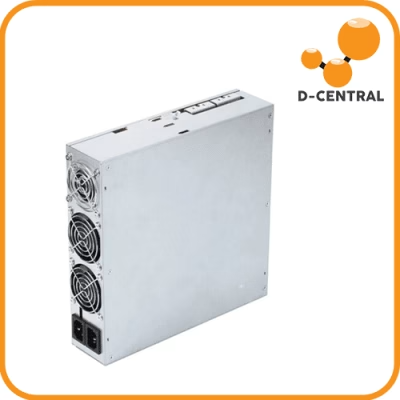
An Antminer S19 idles at roughly 75 decibels. That’s not “a bit noisy” — that’s a loud vacuum cleaner running in your house, forever, at 3 a.m. Most people who quit home mining don’t quit because of profitability. They quit because of the sound. The good news: noise is an engineering problem, and engineering problems have solutions. The bad news: most of the advice online is generic acoustic-foam filler that doesn’t survive contact with an actual 6,000 RPM industrial fan. This is the practical version.
Last updated: May 2026. This article focuses on quieting full-size industrial ASICs. For the complete pillar coverage including enclosure builds and measurement methodology, see the ASIC Noise Reduction Guide.
First, understand what you’re actually fighting
“ASIC noise” is three separate problems wearing one coat. Solve them in the wrong order and you waste money. In order of how much they matter:
- Fan noise (the big one). Industrial ASIC fans move enormous volumes of air at very high RPM. That broadband “roar” is the dominant sound, and it’s the hardest to kill because the fans have to move that air or the miner cooks itself.
- Vibration / structural noise. The miner’s chassis vibrates, that vibration couples into whatever it’s sitting on, and your floor or shelf becomes a speaker. This one is cheap to fix and people ignore it.
- Electrical whine. A high-pitched coil-whine from the PSU and power stages. Lower in volume but psychologically grating because the human ear is tuned to high frequencies.
A worn or failing fan makes all of this dramatically worse. If your miner suddenly got louder, that’s not “aging” — that’s a fault. A grinding or rattling fan is a documented failure mode; see Antminer S19 fan grinding noise and S9 fan bearing failure. Replace the fan before you spend a dollar on soundproofing — you cannot soundproof your way out of a broken bearing.
The decibel scale is not linear — and that changes your strategy
This is the single most important thing to internalize. Decibels are logarithmic. A reduction of 10 dB sounds roughly half as loud to a human. So the goal isn’t “make it silent” — that’s not happening with a 3,250 W machine. The goal is to claw back 15–25 dB, which is the difference between “unbearable” and “background noise behind a closed door.”
| Sound level | Real-world equivalent | Mining context |
|---|---|---|
| ~75 dB | Loud vacuum cleaner | Stock Antminer S19 / S19 Pro / S21 |
| ~65 dB | Loud conversation | D-Central Antminer Slim Edition |
| ~60 dB | Normal conversation | D-Central Antminer Pivotal Edition |
| ~55 dB | Quiet office / refrigerator hum | D-Central Antminer Loki Edition |
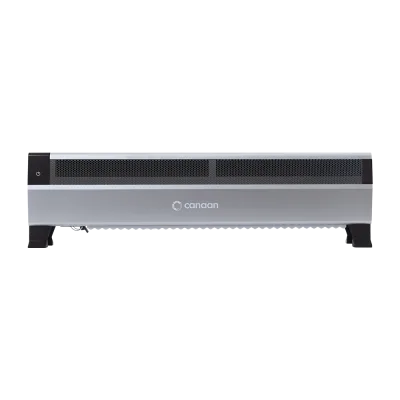
| ~50 dB | Quiet suburb at night | Bitcoin Space Heater S9 Edition |
| ~35 dB | Library / whisper | Bitaxe Ultra / Supra (single-board solo miner) |
Read that table again. Going from a stock S19 at 75 dB to a Loki Edition at 55 dB is a 20 dB drop — perceptually, about a quarter of the loudness. That’s the realistic target. And notice the bottom row: a Bitaxe Ultra at ~35 dB is quieter than a refrigerator, because it’s a 15-watt single-board solo miner with a tiny fan, not an industrial ASIC. If silence is your hard requirement and you don’t need 100+ TH/s, the quietest “noise reduction solution” is choosing a different class of machine entirely.
Tier 1: Free and cheap fixes (do these first, always)
- Decouple the miner from the structure. Put it on a slab of rubber, a stack of mouse pads, anti-vibration pads — anything that breaks the mechanical path between chassis and floor. This kills the structural-noise component and costs almost nothing. Skipping this is the most common mistake.
- Move it. Distance and walls are free attenuation. A miner in a basement utility room with the door closed is a fundamentally different experience than one in a hallway. Exterior walls and concrete absorb more than drywall.
- Tune the firmware. Underclocking or running a low-power profile drops the heat the fans have to move, which drops the RPM, which drops the noise. You lose some hashrate — but a miner you can actually live with at 80% output beats one you unplug at 100%. Custom firmware like the ones covered on our DCENT_OS page exposes these power profiles directly.
- Point the exhaust out a window. A simple shroud and duct sending the hot, loud exhaust air outside removes a huge fraction of the perceived noise from the room. This is the highest return-per-dollar fix that exists.
Tier 2: Hardware changes
If Tier 1 isn’t enough, you start changing the machine itself.
- Aftermarket quiet fans. Stock ASIC fans are chosen for static pressure and cost, not acoustics. Higher-quality fans with fluid-dynamic bearings can shave several dB. The catch: the replacement fan must match or exceed the stock airflow, or you trade noise for an overheating temperature-too-high fault. This is not the place to guess.
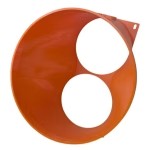
- Custom shrouds and ducting. A shroud channels exhaust into a single managed path you can duct, muffle, or send outside. D-Central’s universal ASIC shrouds and Antminer-specific shrouds exist for exactly this.
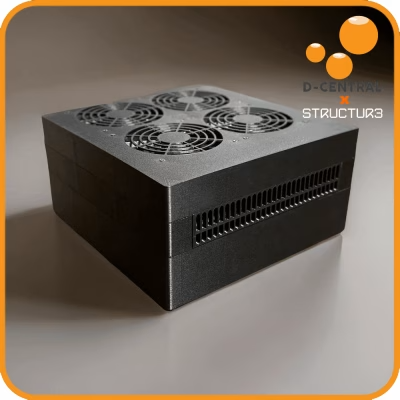
- A factory-quiet build. Honestly, this is where most home miners should land. D-Central’s custom editions are stock industrial cores re-engineered for living space — and the noise figures in the table above are the result. The Antminer Loki Edition pairs enhanced acoustic dampening with a custom shroud for ~55 dB on a full 14 TH/s S9 core. The Antminer Slim Edition runs 2 of 3 hashboards for ~65 dB at 12 TH/s on a standard 120 V outlet. You’re buying the soundproofing engineering instead of doing it yourself.
Tier 3: Enclosures and immersion
The heavy artillery — and where most DIY noise builds go wrong.
- Soundproof enclosures. A sealed box lined with mass-loaded vinyl and acoustic absorber can knock down a lot of noise. But a sealed box is also a thermal trap. A noise enclosure that doesn’t solve airflow — managed intake, managed exhaust, enough volume of air moved — just turns a noise problem into an overheating problem. Build the airflow path first, then line it for sound. And use fire-rated materials; you are enclosing a 3,000-watt heat source.
- Immersion cooling. Submerging the miner in dielectric fluid removes the fans entirely — and the fans are the main noise source. It’s the most effective acoustic solution there is, but it’s also the most expensive and involved. See our cooling solutions guide for whether immersion makes sense for a home setup (for most people, it doesn’t — yet).
Don’t forget the neighbors — and your own ears
Two things that aren’t engineering but matter. First: prolonged exposure to 75 dB is genuinely a hearing-health issue. If you work in the same room as an unmodified ASIC, wear protection — that’s not paranoia, it’s the same logic as a workshop. Second: if you share walls, structural noise travels. The Tier 1 decoupling step isn’t just for your comfort; it’s what keeps a noise complaint from ending your operation. Cheap rubber pads are cheaper than a dispute with a landlord.
Frequently asked questions
How loud is an Antminer S19?
Roughly 75 dB stock — comparable to a loud vacuum cleaner running continuously. The S19, S19 Pro, and S21 are all in the same range. That’s normal for industrial ASICs; they’re designed for warehouses, not bedrooms.
Can you make an ASIC miner truly silent?
Not a full-size industrial ASIC — air-cooled, it always needs fans, and fans make noise. You can realistically drop a 75 dB miner to ~55 dB with the right combination of decoupling, ducting, quiet fans, and an enclosure, which sounds about a quarter as loud. Immersion cooling gets closer to silent because it removes the fans. If you need genuinely quiet (~35 dB), a single-board Bitaxe solo miner is a different class of machine that’s quiet by design.
What’s the cheapest way to reduce ASIC noise?
Decouple the miner from the floor with rubber pads or anti-vibration mounts, and duct the exhaust out a window. Both are cheap, and together they handle the structural noise and a big share of the perceived fan noise before you spend anything on enclosures or fans.
My miner suddenly got louder — what happened?
That’s almost always a failing fan — a worn bearing, a cracked blade, or debris. It’s a fault, not normal aging. Diagnose it against our fan grinding noise and fan blade damage noise references, and replace the fan before doing anything else. Soundproofing a broken fan just muffles a machine that’s heading toward an overheat shutdown.
The quiet route, decided for you
If you want to DIY it: decouple, duct, tune firmware, then enclose. If you’d rather buy the engineering already done, D-Central’s quiet custom editions exist for exactly that reason. Either way, this article is part of our How to Mine Bitcoin at Home guide — and the full enclosure-build methodology lives in the ASIC Noise Reduction Guide. Browse the shop for quiet editions and shrouds, or run the numbers on whether a quieter, lower-output build still pencils out in the mining profitability calculator.