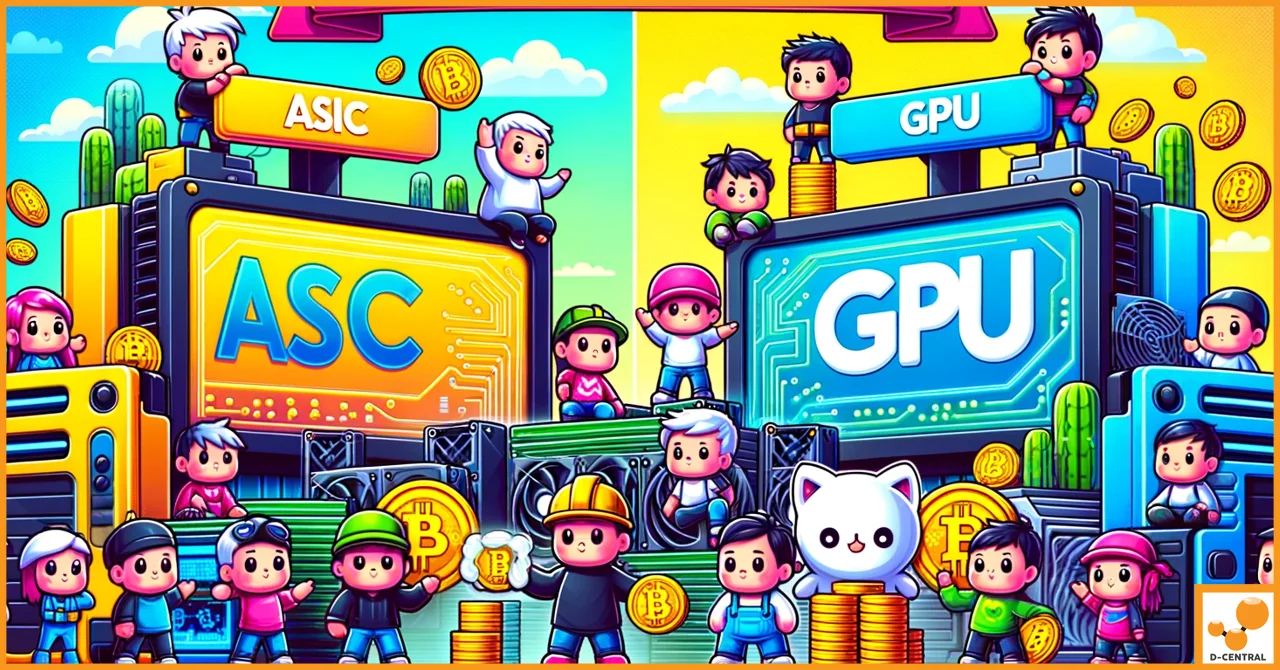
The debate between ASIC and GPU mining has raged for over a decade. But in 2026, with Bitcoin’s network hashrate surging past 800 EH/s and mining difficulty exceeding 110 trillion, the answer is no longer ambiguous. If you are mining Bitcoin, ASICs dominate. Period. GPUs had their moment in Bitcoin’s early history, and they still serve a purpose in certain altcoin ecosystems, but for securing the most important monetary network ever built, purpose-built silicon wins every time.
This is not just about raw performance numbers. It is about understanding what mining actually does, why it matters for decentralization, and how the right hardware choice connects to the broader mission of distributing hashrate across the globe. At D-Central Technologies, we have been in the trenches since 2016, repairing, modifying, and deploying ASIC miners for home miners and operations of every size. We are Bitcoin Mining Hackers, and this is our breakdown of the real differences between ASIC and GPU mining.
What Is ASIC Mining?
ASIC stands for Application-Specific Integrated Circuit. Unlike general-purpose processors, an ASIC chip is designed from the transistor level up to perform one task and one task only. In Bitcoin mining, that task is computing SHA-256 hashes as fast and as efficiently as physically possible.
Modern Bitcoin ASICs like the Antminer S21 series and Whatsminer M60 series pack billions of transistors into custom silicon that achieves efficiency figures below 20 J/TH. Compare that to the early days when CPU mining measured performance in megahashes per second. Today’s ASICs operate in the hundreds of terahashes per second range, a performance gap of roughly ten million to one versus CPUs and several hundred thousand to one versus GPUs.
How ASICs Achieve Their Dominance
The secret is specialization. A GPU contains thousands of general-purpose cores designed to handle diverse workloads from rendering video games to training neural networks. An ASIC strips away everything that is not essential to SHA-256 computation. No floating-point units, no texture mapping pipelines, no general-purpose register files. Every transistor serves the hash.
This laser focus translates directly into energy efficiency. When every watt of power consumed goes toward producing hashes rather than supporting unused circuitry, you get dramatically more work per kilowatt-hour. In a network where electricity is the primary ongoing cost, efficiency is everything.
The ASIC Landscape in 2026
The current generation of Bitcoin ASICs represents remarkable engineering. Machines like the Antminer S21 Pro achieve around 234 TH/s at roughly 15 J/TH. These are industrial-grade machines built for serious operations. But the ASIC ecosystem has evolved far beyond datacenter-scale hardware.
The open-source mining movement has produced machines like the Bitaxe, a single-chip solo miner that puts SHA-256 ASIC technology in the hands of individual Bitcoiners. The Bitaxe Supra, Ultra, Gamma, and other variants use actual ASIC chips from Bitmain (BM1366, BM1368, BM1370) in a compact, open-source form factor. They connect via WiFi, draw around 15 watts from a 5V barrel jack power supply, and let anyone participate in solo mining from their desk.
D-Central has been a pioneer in the Bitaxe ecosystem since the beginning, manufacturing the original Bitaxe Mesh Stand and developing heatsinks, cases, and accessories for the entire Bitaxe and Bitaxe Hex lineup. We stock every variant and accessory because we believe open-source mining hardware is critical to Bitcoin’s decentralization mission.
What Is GPU Mining?
GPU mining uses Graphics Processing Units, the same chips that power gaming PCs and AI workstations, to perform mining computations. GPUs contain thousands of parallel processing cores that can handle many calculations simultaneously, which made them effective for cryptocurrency mining in Bitcoin’s early years and for various altcoin algorithms.
In Bitcoin’s first few years (2009-2013), GPU mining was a legitimate way to earn BTC. Miners would build rigs with multiple graphics cards, each contributing hashpower to the network. But as the first Bitcoin ASICs appeared around 2013, GPUs became obsolete for Bitcoin mining almost overnight. The efficiency gap was simply too large to bridge.
Where GPUs Still Have a Role
GPUs remain relevant for mining certain altcoins that use memory-hard or ASIC-resistant algorithms. Coins like Monero (RandomX), Ravencoin (KawPow), and various other proof-of-work altcoins are specifically designed to resist ASIC optimization, keeping GPU miners competitive.
However, the GPU mining landscape took a massive hit in September 2022 when Ethereum transitioned from proof-of-work to proof-of-stake in an event known as “The Merge.” Ethereum was by far the most profitable GPU-mineable coin, and its departure from proof-of-work left millions of GPUs scrambling for alternative coins. The resulting hashrate floods into remaining GPU-mineable coins cratered profitability across the board.
For Bitcoiners, this is largely irrelevant. Bitcoin’s proof-of-work is permanent and non-negotiable. There will never be a “merge” for Bitcoin. The network’s security model depends on real-world energy expenditure, and that means ASICs.
ASIC vs GPU: The Real Comparison
Raw Performance
The numbers tell the story. A single modern ASIC like the Antminer S21 produces approximately 200 TH/s of SHA-256 hashpower. The most powerful consumer GPU available in 2026 might achieve around 1-2 GH/s mining SHA-256. That means one ASIC equals roughly 100,000 to 200,000 GPUs in Bitcoin mining output. There is no competition.
Even in joules per terahash, the gap is staggering. A modern ASIC operates at 15-20 J/TH while a GPU mining SHA-256 would measure in the millions of joules per terahash. You would spend more on electricity than you could ever earn in Bitcoin.
Energy Efficiency
Energy efficiency is not just an economic concern. It is an environmental and strategic one. Bitcoin mining’s energy consumption is often criticized, but what critics miss is that ASICs have driven enormous efficiency improvements. The network produces vastly more security per kilowatt-hour today than it did five years ago.
For home miners, efficiency directly translates to whether mining makes economic sense. A machine running at 15 J/TH in a Canadian home with $0.07/kWh electricity is in a fundamentally different economic position than a GPU rig burning ten times the power for a fraction of the output.
Initial Cost and ROI
ASIC miners range widely in price. A new-generation flagship like the S21 Pro can cost several thousand dollars. But the market also includes previous-generation machines at steep discounts, refurbished units, and open-source options. A Bitaxe solo miner, for example, costs under $200 and lets you participate in Bitcoin mining with minimal investment.
GPU mining rigs require multiple cards, a motherboard, CPU, RAM, storage, power supply, and frame. A competitive rig can easily cost $2,000-5,000+ and will never match even a budget ASIC for Bitcoin mining.
The ROI calculation is straightforward: for Bitcoin mining, ASICs pay for themselves faster, produce more BTC per dollar invested, and consume less electricity per hash. For altcoin mining, GPUs offer flexibility but face uncertain long-term returns as coins change algorithms or move away from proof-of-work.
Noise and Heat
Both ASICs and GPU rigs generate heat and noise, but the character is different. Industrial ASICs like the S19 or S21 series are genuinely loud, typically 70-80+ dB, comparable to a vacuum cleaner running continuously. This makes them impractical for living spaces without modification.
This is exactly where innovation happens. D-Central’s Bitcoin Space Heaters turn the heat problem into a feature. By repurposing ASIC miners as home heating units, the waste heat becomes productive heat that replaces your electric heater or supplements your heating system. In Canadian winters, this dual-purpose approach means your miner’s electricity cost is offset by heating savings. You are mining Bitcoin and heating your home with the same watts.
GPU rigs are generally quieter per unit but produce less useful heat relative to their mining output. They also require more physical space for equivalent hashpower, which is essentially zero for Bitcoin mining anyway.
Flexibility vs Specialization
The classic argument for GPUs is flexibility: if one coin becomes unprofitable, switch to another. If mining stops making sense entirely, sell the GPUs to gamers or AI researchers.
This argument has weakened significantly. After Ethereum’s Merge, the “just switch to another coin” strategy proved hollow for many miners. The remaining GPU-mineable coins could not absorb the hashrate, and profitability collapsed. Meanwhile, the AI boom has created its own GPU market dynamics, but buying mining GPUs specifically as an AI hedge is not a sound investment thesis.
ASICs are specialized, yes. A SHA-256 ASIC mines Bitcoin and Bitcoin only. But Bitcoin is the network you want to secure. It is the most robust, decentralized, and valuable proof-of-work chain. Specializing in Bitcoin mining is not a limitation; it is a feature.
And if your ASIC eventually becomes less profitable for mining? It still has value. D-Central’s ASIC repair services extend the life of older hardware, and creative repurposing as space heaters gives machines a productive second life long after they have been outpaced by newer silicon.
The Decentralization Angle
Here is where the conversation gets deeper than specs and ROI calculations. Bitcoin’s security model depends on widely distributed hashrate. Mining centralization, whether by geography, hardware manufacturer, or pool operator, is an existential threat to Bitcoin’s censorship resistance.
Why Home Mining Matters
Every hash generated by a home miner contributes to network decentralization. It does not matter if your Bitaxe is producing 500 GH/s while industrial farms run at hundreds of petahashes. Your hash is a vote for decentralization. Your miner, sitting on your desk or mounted on your wall, is a node in the physical security layer of the Bitcoin network.
This is why the open-source ASIC movement matters so much. Devices like the Bitaxe, NerdAxe, NerdQAxe, and NerdNOS put mining capability into individual hands without requiring industrial infrastructure. They democratize access to the fundamental act of Bitcoin mining: converting energy into security.
Solo Mining: Every Hash Counts
Solo mining with small devices is sometimes called “lottery mining” because the odds of finding a block are low. With the current block reward of 3.125 BTC (after the April 2024 halving) and network difficulty above 110 trillion, a single Bitaxe might take decades to find a block statistically. But Bitaxe miners have found blocks. It happens. And when it does, the full 3.125 BTC reward goes to one miner.
More importantly, solo mining is a statement. It says: I am willing to expend my own energy to secure this network, regardless of expected financial return. That is the cypherpunk ethos in action. That is what D-Central means when we say “every hash counts.”
When GPUs Make Sense (and When They Do Not)
Let us be honest about when GPU mining is still a valid choice:
GPUs make sense if:
- You want to mine specific altcoins with ASIC-resistant algorithms
- You already own gaming hardware and want to mine casually when not gaming
- You are experimenting with mining as a learning exercise
- You need the GPU for other purposes (rendering, AI, gaming) and mining is secondary
GPUs do not make sense if:
- Your goal is to mine Bitcoin (use an ASIC, any ASIC)
- You are optimizing for efficiency and profitability
- You want to contribute meaningfully to Bitcoin network security
- Electricity costs are a primary concern
For Bitcoin mining at any scale, from a Bitaxe on your nightstand to a warehouse full of S21 Pros, ASICs are the only rational choice.
Getting Started with ASIC Mining in 2026
If you are ready to start mining Bitcoin, here is the practical path:
For Home Miners on a Budget
Start with a Bitaxe or similar open-source miner. These devices cost under $200, connect to your WiFi, draw minimal power from a 5V barrel jack PSU, and let you solo mine Bitcoin from day one. They are an excellent way to learn the fundamentals of mining while contributing to network decentralization. D-Central stocks all Bitaxe variants (Supra, Ultra, Hex, Gamma, GT) plus all accessories, heatsinks, and power supplies.
For Serious Home Miners
Consider a previous-generation ASIC like the S19 series, especially configured as a Bitcoin Space Heater. These machines are available at significant discounts compared to their original prices, and when used for home heating, the economics improve dramatically. D-Central offers custom Slim Edition, Pivotal Edition, and Loki Edition Antminers designed specifically for home deployment.
For Scaling Operations
Current-generation ASICs (S21 series, M60 series) offer the best efficiency for dedicated mining operations. If you need help sourcing hardware, planning your electrical setup, or finding a hosting facility, D-Central’s mining consulting services can guide you through every step. We also offer mining hosting in Quebec for miners who need professional infrastructure.
Maintaining Your ASIC Investment
Unlike GPUs, which can be maintained with basic PC knowledge, ASIC miners benefit from specialized repair expertise. Hashboard failures, control board issues, fan replacements, and firmware problems are all common over an ASIC’s lifetime.
D-Central operates Canada’s largest ASIC repair center with technicians experienced across every major manufacturer: Bitmain, MicroBT, Innosilicon, and Canaan. We have been repairing miners since 2016, handling everything from simple fan swaps to complex hashboard-level BGA rework. When your miner needs attention, having a trusted repair partner means less downtime and longer hardware life.
Frequently Asked Questions
Can I mine Bitcoin with a GPU in 2026?
Technically yes, but practically no. A modern GPU produces roughly 1-2 GH/s on SHA-256, while a single ASIC produces 200+ TH/s. The electricity cost of GPU mining Bitcoin would far exceed any BTC earned. GPUs are only viable for altcoins with ASIC-resistant algorithms.
What happened to Ethereum GPU mining?
Ethereum transitioned from proof-of-work to proof-of-stake in September 2022 (The Merge), permanently eliminating Ethereum mining. This displaced millions of GPUs and significantly reduced overall GPU mining profitability across the altcoin ecosystem.
Are Bitaxe miners ASICs or GPUs?
Bitaxe miners are ASICs. They use actual Bitmain ASIC chips (BM1366, BM1368, BM1370, etc.) in an open-source, compact form factor. They connect via WiFi, draw about 15W from a 5V barrel jack PSU, and solo mine Bitcoin using the SHA-256 algorithm. They are real ASIC miners, just miniaturized.
Is ASIC mining profitable in 2026?
Profitability depends on your electricity cost, hardware efficiency, and Bitcoin’s price. Current-generation ASICs below 20 J/TH are generally profitable at electricity rates under $0.08/kWh. Home miners using ASICs as space heaters can improve economics by offsetting heating costs. Use a mining profitability calculator with your specific variables.
What is the current Bitcoin block reward?
As of 2026, the Bitcoin block reward is 3.125 BTC per block, following the April 2024 halving. The next halving is expected around 2028, which will reduce the reward to 1.5625 BTC. Transaction fees are an increasingly important component of miner revenue.
Can I use an ASIC miner to heat my home?
Absolutely. ASIC miners convert virtually 100% of their electricity consumption into heat. D-Central’s Bitcoin Space Heaters are purpose-built for this dual use, replacing electric heaters while simultaneously mining Bitcoin. In cold climates like Canada, this approach makes the effective cost of mining much lower.
How loud are ASIC miners compared to GPU rigs?
Industrial ASICs (S19, S21 series) typically produce 70-80+ dB, roughly equivalent to a loud vacuum cleaner. GPU rigs are generally quieter at 40-55 dB. However, compact ASICs like the Bitaxe are nearly silent, and space heater builds with custom shrouds and fan modifications can reduce noise significantly.
What should I do with an old or broken ASIC miner?
Do not throw it away. D-Central’s ASIC repair center can diagnose and fix most issues, extending your miner’s productive life. Older miners that are no longer profitable for standard mining can be repurposed as Bitcoin Space Heaters. Even individual components like hashboards and control boards have repair and resale value.
The verdict on ASIC vs GPU mining for Bitcoin is clear and has been for years. ASICs win on every metric that matters: hashrate, efficiency, cost-effectiveness, and contribution to network security. The real question in 2026 is not which type of hardware to use, but how to deploy ASIC technology in a way that aligns with your goals, whether that is a Bitaxe on your desk for the love of decentralization or a fleet of S21 Pros in a professional facility.
Whatever your path, D-Central Technologies is here to help. Browse our full selection of mining hardware, from open-source Bitaxe miners to industrial ASICs, replacement parts, and accessories. We are Canada’s Bitcoin Mining Hackers, and we have been building this since 2016. Every hash counts.