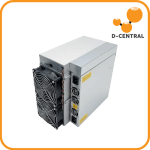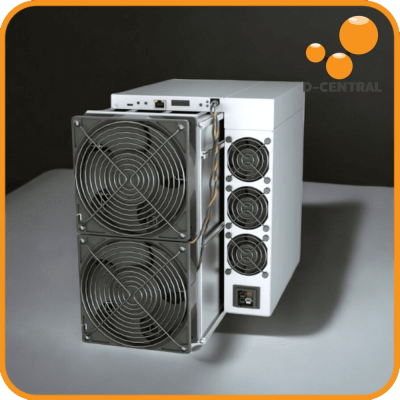
An ASIC evaluates candidate block headers; it is not itself a fully validating node. AC wall power becomes computation and heat. If a valid candidate enters the best-work chain, its coinbase may claim the permitted subsidy plus included fees and matures after 100 blocks, subject to any pool or service terms. Sustainable economics also depend on difficulty, fees, uptime, pool terms, capital and maintenance, not efficiency alone.
Network hashrate is estimated from accumulated work and elapsed block time over a selected block window; it and difficulty vary, and difficulty can rise or fall at retargets. Network electricity estimates require an explicit hardware-efficiency distribution and operating assumptions; EH/s alone is not watts or TWh. Miner economics depend on sustained measured hashrate, AC wall power, difficulty, fees, subsidy, uptime, pool terms, capital, maintenance, and market inputs. This guide separates device measurements from network estimates and labels every scenario assumption.
What Is Hashrate and Why Does It Matter?
Hashrate measures how many SHA-256 hash computations a mining device performs per second. It is the raw computational firepower of your machine. When your ASIC miner is running, it is cycling through billions of nonce values per second, hashing block header data and checking whether the result meets the current difficulty target. The more hashes per second your machine produces, the higher your statistical probability of finding a valid block.
Hashrate Units Explained
Hashrate scales across several orders of magnitude. Here is the unit hierarchy every miner should know:
| Unit | Symbol | Hashes per Second | Typical Context |
|---|---|---|---|
| Hash | H/s | 1 | Theoretical base unit |
| Kilohash | KH/s | 1,000 | CPU mining (obsolete) |
| Megahash | MH/s | 1,000,000 | GPU mining (obsolete for BTC) |
| Gigahash | GH/s | 1,000,000,000 | Open-source solo miners (Bitaxe, NerdAxe) |
| Terahash | TH/s | 1,000,000,000,000 | Individual ASIC miners (S19, S21) |
| Petahash | PH/s | 1015 | Mining farms, hosting facilities |
| Exahash | EH/s | 1018 | Total Bitcoin network hashrate |
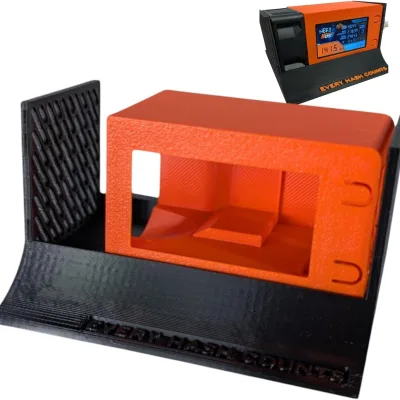
A Bitaxe Supra running at ~500 GH/s and an Antminer S21 running at 200 TH/s are both doing the same fundamental work — hashing block headers. The difference is scale: the S21 produces 400 times more hashes per second: 500 GH/s is 0.5 TH/s, and 200 ÷ 0.5 = 400. But both contribute to the same decentralized network, and both represent the same conversion of electrical energy into computational security. If you want to explore the open-source side of this spectrum, check out our Bitaxe Hub for a complete breakdown of every model and its specs.
The Physics: How Electricity Becomes Hashrate
At the silicon level, an ASIC chip is a purpose-built machine that does one thing extraordinarily well: compute the double SHA-256 hash function. Electricity flows through billions of transistors etched into the chip die, flipping logic gates in a precise sequence that implements the SHA-256 algorithm. Each complete cycle through the algorithm produces one hash — one candidate solution that gets checked against the difficulty target.
Joules per Terahash: The Efficiency Metric That Rules Everything
The single most important specification on any mining hardware is its energy efficiency, measured in joules per terahash (J/TH). At steady operation, divide measured AC wall power in watts by sustained hashrate in TH/s; because one watt is one joule per second, the result is joules per terahash. Lower is better. Always.
The formula is straightforward:
Efficiency (J/TH) = Power Consumption (W) / Hashrate (TH/s)
Here is how major ASIC generations compare:
| Miner | Hashrate | Power Draw | Efficiency (J/TH) | ASIC Node |
|---|---|---|---|---|
| Antminer S9 | 14 TH/s | 1,350 W | 96.4 J/TH | 16nm |
| Antminer S17 Pro | 56 TH/s | 2,212 W | 39.5 J/TH | 7nm |
| Antminer S19 Pro | 110 TH/s | 3,250 W | 29.5 J/TH | 7nm |
| Antminer S21 | 200 TH/s | 3,500 W | 17.5 J/TH | 5nm |
Look at the progression. From the S9 to the S21, efficiency improved by over 5x. The S9 burns 96 joules to do the same computational work that costs the S21 only 17.5 joules. That is not a marginal improvement — it is the difference between profitable mining and expensive space heating. Though, as we will discuss later, even that “expensive space heating” has value when you think about it correctly.
Why Efficiency Matters More Than Raw Hashrate
New miners often fixate on hashrate numbers. “This machine does 200 TH/s!” But hashrate without context is meaningless. What matters is the cost of producing that hashrate — both the capital expenditure (the price of the machine) and the operational expenditure (the ongoing electricity cost). A machine that does 200 TH/s at 17.5 J/TH is vastly more profitable than a hypothetical machine doing 300 TH/s at 40 J/TH, assuming the same electricity rate.
This is where the energy-to-hashrate dynamic becomes a survival equation. At height 840,000, the maximum block subsidy fell from 6.25 to 3.125 BTC; transaction fees did not halve. Revenue per hash also depends on difficulty, fees, pool luck and terms, uptime, and bitcoin price, so no hardware class had a universal profitability outcome.
How to Calculate Your Mining Costs: Step by Step
Knowing your numbers is non-negotiable. Here is exactly how to calculate the cost of running any mining operation, from a single home miner to a facility full of ASICs.
Step 1: Determine Your Miner’s Power Consumption
Check the manufacturer’s specifications for your miner’s wall power draw in watts (W). This is the number from the PSU’s AC input, not the DC output to the hashboards. For an Antminer S19 Pro, that number is approximately 3,250 W.
Step 2: Calculate Daily Energy Consumption
Multiply the power draw by 24 hours, then divide by 1,000 to convert watts to kilowatt-hours:
Daily kWh = (Power in Watts x 24) / 1,000
For the S19 Pro: (3,250 x 24) / 1,000 = 78 kWh per day
Step 3: Calculate Monthly Energy Consumption
Multiply daily consumption by 30.44 (average days per month):
78 kWh x 30.44 = 2,374 kWh per month
Step 4: Apply Your Electricity Rate
This is where geography becomes destiny. Multiply your monthly kWh by your cost per kWh:
| Electricity Rate | Monthly Cost (S19 Pro) | Typical Location |
|---|---|---|
| $0.04/kWh | $95/month | Quebec hydro (industrial) |
| $0.07/kWh | $166/month | Quebec hydro (residential) |
| $0.10/kWh | $237/month | Average North American residential |
| $0.15/kWh | $356/month | Higher-cost US states |
| $0.25/kWh | $594/month | European residential |
The difference between $0.04/kWh and $0.15/kWh is not marginal — it is nearly 4x the operating cost. This is precisely why D-Central’s hosting facility in Quebec exists: to give miners access to some of the cheapest and cleanest hydroelectric power on the continent.
Step 5: Factor in the Full Cost Picture
Electricity is your largest ongoing expense, but it is not the only one. A complete cost model includes:
- Hardware depreciation — ASICs lose value as newer, more efficient models launch
- Cooling costs — additional energy for fans, ducting, or immersion cooling
- Maintenance and repair — hashboard failures, fan replacements, thermal paste reapplication
- Internet and infrastructure — networking, shelving, electrical panel upgrades
- Downtime — every hour your machine is offline is hashrate you are not producing
This is where having a reliable ASIC repair service becomes critical. A dead hashboard does not just cost you the repair — it costs you every sat you would have mined while that board was down. D-Central has repaired thousands of ASIC miners since 2016, with model-specific expertise across Bitmain, MicroBT, Innosilicon, and Canaan hardware.
Energy Efficiency Across Mining Scales
The energy-to-hashrate equation plays out differently depending on your scale. Let us look at three real-world scenarios.
Home Mining: The Sovereign Approach
A home miner running a single Antminer S19j Pro (104 TH/s, ~3,100 W) in their basement is operating at the smallest practical scale for a full ASIC. At $0.10/kWh and 30.44 days per month, 3,100 W running continuously costs about $226.47 per month. Under an explicitly illustrative 800 EH/s network assumption, 104 TH/s represents about 0.000013%: share ≈ miner TH/s ÷ (network EH/s × 1,000,000). Update the network input before use; decentralization additionally depends on independent control choices.
But here is what the raw math misses: if that miner is in Canada and running their S19 during winter months, every watt of electricity the miner consumes becomes heat. A 3,100 W miner produces roughly 10,578 BTU/hour — equivalent to a decent space heater. If captured miner heat displaces equal resistance-heater output in the same space and period, its electricity can substitute for that heating load. Useful heat, controls, capital, maintenance, noise, exhaust losses, and alternatives such as heat pumps still affect net cost.
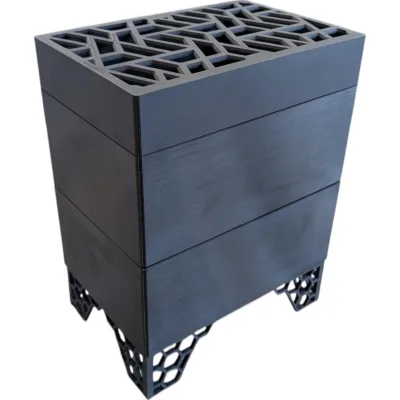
This is the dual-purpose mining thesis, and it is one of the most powerful economic arguments for home mining. Our Bitcoin Space Heaters are purpose-built for exactly this use case — turning ASIC miners into home heating appliances that pay you back in Bitcoin.
Mid-Scale Operation: 10 Miners
Scaling to 10 Antminer S19 Pro units changes the operational profile:
- Total hashrate: 1,100 TH/s (1.1 PH/s)
- Total power draw: 32,500 W (32.5 kW)
- Daily energy consumption: 780 kWh
- Monthly electricity at $0.07/kWh: $1,662.02 (32.5 kW × 24 × 30.44 × $0.07)
- Illustrative network share at 800 EH/s: ~0.000138% (replace 800 with a current estimate)
At this scale, dedicated electrical infrastructure may be required. Voltage, phase, continuous-load treatment, other loads, conductors, overcurrent protection, and local code determine service size; obtain a licensed electrical load calculation rather than assuming a universal 200A minimum. The noise alone (approximately 75 dB per unit) makes in-home operation impractical without serious sound isolation. Cooling becomes a real engineering challenge in summer months, though Canadian winters provide a natural advantage: free cold air intake.
Facility-Scale: 1,000 Miners
A 1,000-unit facility with Antminer S19 Pro machines operates at an entirely different level:
- Total hashrate: 110 PH/s
- Total power draw: 3.25 MW
- Daily energy consumption: 78,000 kWh
- Monthly electricity at $0.04/kWh: $94,972.80 (3,250 kW × 24 × 30.44 × $0.04)
- Illustrative network share at 800 EH/s: ~0.0138% (replace 800 with a current estimate)
Facility-scale operations deal with challenges that home miners never encounter: utility-grade power delivery, industrial cooling systems, 24/7 monitoring and maintenance staff, regulatory compliance, and significant capital deployment. The efficiency advantages of scale are real — better electricity rates, optimized airflow design, dedicated repair technicians — but so are the risks. A single facility concentrating 110 PH/s in one location is a centralization vector, while resilience depends on independent control of pools, templates, nodes, firmware, ownership, hosting, connectivity, and geography rather than an unobservable miner count.
Strategies to Maximize Your Joules-per-Terahash
Whether you are running one miner or one thousand, these strategies will help you extract maximum hashrate from every watt.
Choose the Right Hardware for Your Electricity Rate
This is counterintuitive for many new miners: the best machine for you is not necessarily the newest or most powerful. It is the machine that gives you the best return given your electricity cost.
- At $0.04/kWh: Older machines like the S19 Pro (29.5 J/TH) can still be profitable. The lower hardware cost can yield a better ROI than a brand-new S21.
- At $0.10/kWh: You need current-generation efficiency (sub-20 J/TH) to maintain positive margins post-halving.
- At $0.15/kWh+: Only the most efficient machines survive, and dual-purpose use (heating) becomes essential to offset the energy cost.
Optimize Your Operating Environment
ASIC miners are air-cooled machines running at full load 24/7. Their operating environment directly impacts performance:
- Ambient temperature: Lower intake air temperatures allow fans to spin slower, reducing parasitic power draw. Canadian climate is a structural advantage here.
- Airflow: Ensure unobstructed intake and exhaust. Recirculating hot air forces the machine to work harder to cool itself, wasting watts on fans instead of hashing.
- Clean air: Dust buildup on heatsinks and hashboards acts as insulation, trapping heat and reducing efficiency. Regular cleaning — or better, filtered intake air — pays for itself.
- Altitude: Higher altitudes mean thinner air and less effective cooling. Facilities above 1,500m may see measurable efficiency impacts.
Firmware Optimization
Stock firmware from manufacturers is designed for broad compatibility, not peak efficiency for your specific conditions. Aftermarket firmware options can:
- Allow underclocking to reduce power consumption disproportionately to hashrate loss (improving J/TH)
- Enable per-chip frequency tuning to optimize around weak ASIC chips
- Provide better fan curve control for noise and power optimization
- Unlock autotuning features that adapt to your power and thermal constraints
For home miners specifically, underclocking is one of the most powerful tools available. An S19 Pro underclocked from 110 TH/s to 80 TH/s might drop its power consumption from 3,250 W to 2,200 W, improving its efficiency from 29.5 J/TH to 27.5 J/TH while simultaneously reducing noise and heat output. The hashrate loss is real, but the efficiency gain and livability improvement can make the difference between a home mining setup that your family tolerates and one that gets unplugged.
Preventative Maintenance
A well-maintained miner holds its efficiency rating. A neglected one degrades:
- Thermal interfaces: Inspect temperatures and follow model-specific manufacturer or qualified service procedures. Do not apply a universal repaste interval; unnecessary disassembly can damage hardware or affect warranty coverage.
- Fan bearings: Fans are consumable parts. A failing fan bearing increases vibration and reduces airflow. Replace fans at the first sign of noise change.
- Board inspection: Look for signs of corrosion, swollen capacitors, or damaged components. Catching problems early prevents cascading failures.
- Power supply monitoring: A degrading PSU can deliver unstable voltage, causing the miner to crash, restart, and lose hashing time.
If maintenance and repair are not your strength, that is exactly why D-Central built a dedicated repair service with model-specific expertise spanning every major ASIC manufacturer. We have been repairing miners since 2016 — before most of our competitors even existed.
Leverage Dual-Purpose Heat Recovery
This is the home miner’s secret weapon. Nearly all ASIC electrical input eventually becomes heat within a defined system boundary, but useful captured heat depends on where the PSU, exhaust, duct losses, and equipment are located. For home miners in cold climates — and Canada has plenty of those — this changes the entire economic equation.
A 3,100 W ASIC ultimately produces about the same heat as 3,100 W of resistance heating within the same boundary. If miner heat displaces equal resistance heat at the same time and place, the electricity overlaps that heating load. Bitcoin revenue is not free: equipment, controls, maintenance, downtime, noise, useful-heat demand, and comparison with heat-pump efficiency remain relevant. Our Bitcoin Space Heater line is designed for controlled heat distribution.
The Decentralization Argument for Energy-Aware Mining
Here is something the corporate mining farms will never tell you: the most efficient allocation of hashrate for the network’s health is not maximum concentration in mega-facilities. It is maximum distribution across independent operators. An ASIC is not itself a validating node. Home mining can broaden geography and ownership when operators independently choose pools, templates, nodes, firmware, hosting, and connectivity; another device behind one coordinator does not remove that coordinator’s influence.
When you understand the energy-to-hashrate dynamic, you understand that a home miner paying $0.12/kWh is not “inefficient” compared to a facility paying $0.04/kWh. A home operator may value independence and useful heat differently from a facility, but no location or contribution is literally uncensorable or immune from disruption. State those non-financial preferences separately from profitability.
The protocol pays the coinbase of an accepted block; pools separately apply their payout rules. Under an explicitly illustrative 800 EH/s assumption, a 500 GH/s miner has an approximate per-block discovery share of 0.5 ÷ 800,000,000, while realized solo outcomes remain random. But some people do hit it — and the Bitaxe community celebrates every solo block win. It is not about expected value in a spreadsheet. It is about participating in the system you believe in, on your own terms, with your own electricity. Every hash counts.
Tools for Monitoring and Optimizing Your Energy-to-Hashrate Ratio
You cannot optimize what you do not measure. Here are the tools every miner should have in their arsenal:
Hardware Monitoring
- Kill-A-Watt or equivalent power meter: Plug your miner (or entire setup) into a power meter to get real-time, actual wall power consumption. Manufacturer specs are nominal — your actual draw depends on voltage, temperature, and firmware settings.
- Miner’s built-in dashboard: Every ASIC miner has a web interface showing real-time hashrate, chip temperatures, fan speeds, and accepted/rejected shares. Monitor these daily.
- Temperature sensors: Ambient temperature monitoring helps you correlate intake air temperature with miner performance and efficiency.
Profitability Calculators
Online calculators take your hashrate, power consumption, and electricity rate, then estimate daily/monthly/yearly earnings based on current network difficulty and Bitcoin price. Use them for directional guidance, but understand their limitations — they assume constant difficulty and price, which never holds true.
Network Monitoring
- Mempool.space: Real-time Bitcoin network visualization including hashrate, difficulty, block times, and fee market conditions.
- Clark Moody Dashboard: Comprehensive Bitcoin network statistics in a single view.
- Your pool’s dashboard: Track your actual hashrate contribution, shares submitted, and payout history versus theoretical expectations.
The Bottom Line: Energy Is the Input, Security Is the Output
Bitcoin mining is often framed as an environmental problem by people who do not understand (or choose to ignore) what the energy actually produces. It does not produce “just” digital coins. It produces the most robust, censorship-resistant, permissionless monetary network in human history. The energy consumed by Bitcoin mining is the thermodynamic cost of removing trusted third parties from money. That is a trade worth making.
As a miner, your job is to make that trade as efficiently as possible. Understand your J/TH ratio. Know your electricity costs down to the cent. Optimize your operating environment. Maintain your equipment. Consider dual-purpose heat recovery if you are in a climate that allows it. And if you are serious about mining from home, explore D-Central’s full range of mining hardware — from open-source Bitaxe solo miners for the sovereignty-minded pleb to full-scale ASIC rigs for those ready to commit serious hashpower to the network.
D-Central’s founder started this company in 2016 with a conviction that Bitcoin mining should not be the exclusive domain of institutions with megawatt-scale power contracts and millions in venture capital. The energy-to-hashrate dynamic does not care about your scale. It cares about your efficiency, your electricity cost, and your willingness to learn the fundamentals. Measure those inputs and model them transparently at any scale — from a single Bitaxe to a facility — without treating profitability as guaranteed.
Every hash counts. Every watt matters. Start mining.
Frequently Asked Questions
What is joules per terahash (J/TH) and why is it the most important mining metric?
Joules per terahash (J/TH) measures how much electrical energy a mining machine consumes to produce one terahash of computational work per second. It is calculated by dividing the miner’s power consumption in watts by its hashrate in TH/s. A lower J/TH number means higher efficiency — you get more hashing power for less electricity. After the 2024 halving cut the block reward to 3.125 BTC, this metric became the single most important factor determining whether a miner operates profitably or at a loss.
How do I calculate my monthly electricity cost for running a Bitcoin miner?
Multiply your miner’s power consumption in watts by 24 hours, divide by 1,000 to get daily kWh, then multiply by 30.44 (average days per month) for monthly kWh. Finally, multiply by your electricity rate per kWh. For example, an Antminer S19 Pro at 3,250 W: (3,250 x 24) / 1,000 = 78 kWh/day. Monthly: 78 x 30.44 = 2,374 kWh. At $0.10/kWh, that is $237/month in electricity alone.
How is Bitcoin network hashrate estimated?
Network hashrate is not directly measured. Bitcoin Core estimates average hashes per second from accumulated work and elapsed block time over a selected window; window choice and block-time variance affect the result. It does not directly reveal miner count, electricity, ownership, geography, decentralization, or absolute security.
Can Bitcoin mining actually heat my home?
A 3,100 W miner ultimately produces about 10,578 BTU/hour of heat, but useful capture depends on the system boundary, ducting, exhaust, controls, and demand. It can displace comparable resistance heat in the same place and period; it does not make bitcoin free, and a heat pump may deliver more useful heat per kWh. Purpose-built heat-reuse enclosures are designed for controlled distribution.
What is the difference between hashrate and efficiency?
Hashrate (measured in TH/s) tells you how fast a miner computes SHA-256 hashes. Efficiency (measured in J/TH) tells you how much energy it costs to produce that hashrate. A high-hashrate machine is not necessarily better than a lower-hashrate one if the high-hashrate machine has poor efficiency. For example, a machine doing 300 TH/s at 40 J/TH costs more to operate per hash than one doing 200 TH/s at 17.5 J/TH. Always evaluate both metrics together.
Why does electricity cost matter more than hardware cost for mining profitability?
Hardware is a one-time capital expense. Electricity is an ongoing operational expense that never stops as long as the miner is running. Over the typical 2-4 year lifespan of an ASIC miner, electricity costs will almost always exceed the initial hardware purchase price. A miner bought for $2,000 running at 3,250 W at $0.10/kWh will consume over $11,000 in electricity over four years. That is why your electricity rate — not your hardware price — is the primary determinant of profitability.
What determines whether home Bitcoin mining is profitable?
No efficiency or electricity-price threshold guarantees profit. Use current difficulty, fees, subsidy, price, uptime, pool terms, capital, maintenance, and curtailment assumptions in a timestamped calculator. Useful heat may offset some resistance-heating demand when time, place, and system boundaries align. Solo mining remains probabilistic; an accepted block’s coinbase may claim the permitted subsidy plus fees and matures after 100 blocks.
What services does D-Central Technologies offer for Bitcoin miners?
D-Central provides a full-lifecycle mining service: hardware sales (from open-source Bitaxe solo miners to full-scale ASICs and Bitcoin Space Heaters), ASIC repair with model-specific expertise across all major manufacturers, mining hosting at our facility in Quebec with access to low-cost hydroelectric power, mining consulting, and technical support. We have been operating since 2016 and are pioneers in the Bitaxe ecosystem, having created the original Bitaxe Mesh Stand and developed leading accessories for the platform.