
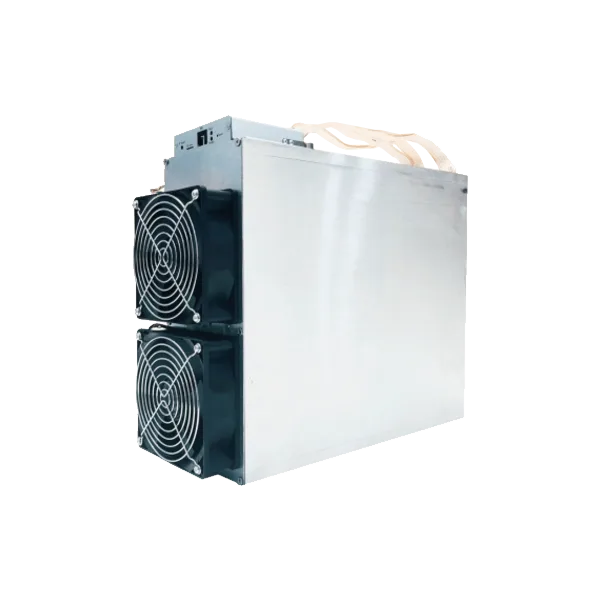
Bitmain Antminer E3 (180Mh)
Réponse rapide
The Bitmain Antminer E3 (180Mh) is a Etchash miner rated about 180 MH/s at roughly 800 W. An industrial-class unit — loud and power-hungry, best suited to a dedicated mining space, not living areas.
Heater-Class Miner
At 800W, this miner outputs approximately 2730 BTU/hr of heat — equivalent to a standard electric space heater. Every watt consumed by an ASIC miner is converted to heat with 100% efficiency, making it a space heater that also mines Bitcoin.
During heating season, miner heat can offset part of the heat a room would otherwise need from another electric heater. The economics depend on your electricity rate, room heat demand, BTC price, network difficulty, and noise constraints.
Calculateur de rentabilité
| Period | Revenue | Electricity Cost | Profit |
|---|---|---|---|
| Daily | $0.00 | $1.34 | $-1.34 |
| Weekly | $0.00 | $9.41 | $-9.41 |
| Monthly | $0.00 | $40.32 | $-40.32 |
| Yearly | $0.00 | $490.56 | $-490.56 |
Heating offset estimates the value of heat replacing an electric space heater during heating season (~6 months/year in Canada). Actual savings depend on your heating setup and climate.
Where to Buy the Bitmain Antminer E3 (180Mh)
D-Central Technologies is a Bitcoin-only company. For this miner, check out our trusted partner retailers below.
ASIC Miner Market
United StatesWide selection of new and used ASIC miners. US-based shipping.
MagasinerMinersDeals
United StatesCompetitive prices on new ASIC miners with coupon codes.
MagasinerPartner links may earn D-Central a commission at no extra cost to you. Have you considered Bitcoin mining instead? Explore Bitcoin miners →
Full Specifications
| Model | Bitmain Antminer E3 (180Mh) |
|---|---|
| Model Number | Antminer E3 (180Mh) |
| Manufacturer | Bitmain |
| Algorithme | Etchash |
| Coins Mined | Ethereum Classic (ETC) |
| Taux de hachage | 180 MH/s |
| Consommation électrique | 800 W |
| Efficiency | 4444444.4 J/TH |
| Weight | 13 |
| BTU Output | 2730 BTU/hr |
| Equivalent Heater | Half a standard space heater (2,730 BTU/hr) |
| Daily Power Cost | $1.34/day |
| Monthly Power Cost | $40.32/mo |
| Circuit Requirement | Standard 120V 15A |
| Release Date | 2018-07-01 |
| État | Active |
Home Mining Assessment
The Bitmain Antminer E3 is Bitmain’s first and only Ethash ASIC: a ~180 MH/s, ~800 W, memory-bound miner that shipped in July 2018. Built to mine Ethereum, it now runs only Ethash/Etchash coins such as Ethereum Classic after The Merge ended ETH mining. Today it is a legacy hobby and collector machine, not a profit tool.
What the Antminer E3 actually is
The E3 was Bitmain’s attempt to do for Ethash what the S9 did for SHA-256: bring application-specific silicon to an algorithm that had, until then, belonged to GPUs. It arrived in mid-2018, rated at 180 MH/s on the Dagger-Hashimoto (Ethash) algorithm that secured Ethereum and Ethereum Classic. That single design decision — an ASIC for a memory-hard algorithm — shaped everything about how this machine behaves, ages, and ultimately retires.
It is important to be honest about the historical framing. Ethereum itself transitioned to Proof-of-Stake in September 2022 (The Merge), permanently ending all Ethereum mining, GPU and ASIC alike. The E3 you might find today is not an Ethereum miner in any practical sense; it is an Ethereum Classic (ETC) / Etchash machine and a piece of mining history. We profile it here because completeness matters, and because owners still bring these units to the bench for service.
Chip & hashboard architecture
This is where the E3 diverges sharply from the SHA-256 Antminers most miners know. SHA-256 is compute-bound: an S9 or S19 is a dense array of tiny hashing cores chewing through double-SHA256, and performance scales with logic and power. Ethash is the opposite — it is memory-hard by design. Each hash requires pseudo-random reads from a large dataset called the DAG, so the bottleneck is memory capacity and bandwidth, not raw arithmetic. An Ethash ASIC, therefore, is far closer to a purpose-built memory board than to a logic-heavy hashing chip.
Bitmain never publicly disclosed a custom hashing-chip SKU for the E3 the way it has for its Bitcoin line (BM1387, BM1397, BM1366, and so on). Independent teardowns at the time concluded the board was built around banks of high-speed, graphics-grade memory paired with a controller — effectively a tuned, fixed-function memory engine in the familiar dual-fan, S9-generation aluminum chassis. Because the per-board chip layout was never authoritatively published and our own hardware reference library is SHA-256-focused, we will not quote a chains-by-chips figure we cannot verify. What matters far more for an owner is the memory ceiling, discussed next — on this machine, memory is the architecture.
The DAG ceiling: the defining limitation
Ethash’s DAG grows over time. Roughly every epoch (30,000 blocks on the original schedule, about five days), the dataset enlarges. The E3 shipped with a finite, reportedly ~4 GB-class pool of onboard memory, which set a hard upper bound on the DAG size — and therefore the coins and the calendar — it could ever address. This was the single most controversial fact about the device at launch: buyers correctly worried that a growing Ethereum DAG would render the unit unable to mine ETH within a couple of years, and that is broadly what happened around 2019–2020.
The E3’s second life came from Ethereum Classic. In late November 2020, ETC activated ECIP-1099, which doubled the Ethash epoch length and roughly halved DAG growth (the variant is commonly called Etchash). That change extended the useful life of ~3–4 GB-class hardware — legacy GPUs and the E3 included — on the ETC chain. That is precisely why this profile lists Ethereum Classic as the coin: it is the chain whose tokenomics deliberately kept the door open for memory-limited miners.
Real-world power & efficiency
The E3 draws roughly 800 W at the wall to produce its rated 180 MH/s. A quick note on units, because this profile’s database card historically rendered a nonsensical « J/TH » figure: J/TH (joules per terahash) is the correct yardstick for a SHA-256 Bitcoin miner, but it is the wrong yardstick for a memory-bound Ethash device measured in megahashes. Expressed honestly, the E3’s efficiency is about 4.4 J/MH (roughly 4.4 watts per MH/s). Treat any auto-computed terahash-based efficiency for this model as an artifact of the database, not a real spec.
Like other S9-era Bitmain units, the E3 has no internal power supply — it uses an external PSU, with the APW3++-generation Bitmain unit being the period-correct pairing. Expect S9-class acoustics, on the order of 75 dB under load, and meaningful heat output. Tuning headroom is minimal compared to modern hardware: there are no mature autotuning ecosystems for Ethash ASICs, so undervolting and curve optimization of the kind documented in our ASIC power profiles database simply do not apply here — that tooling targets current-generation SHA-256 machines where per-domain voltage control and runtime autotuners exist. On an E3 you essentially run it at stock and manage it thermally.
Quick specifications
| Specification | Antminer E3 |
|---|---|
| Manufacturer | Bitmain |
| Algorithm | Ethash / Etchash (Dagger-Hashimoto) |
| Released | July 2018 |
| Rated hashrate | ~180 MH/s |
| Wall power | ~800 W |
| Efficiency | ~4.4 J/MH (≈4.4 W per MH/s) |
| Memory ceiling | ~4 GB-class (reported) — caps DAG size and coin support |
| Power supply | External (APW3++-generation pairing) |
| Cooling | Dual-fan forced air, S9-generation chassis |
| Noise | ~75 dB (typical, under load) |
| Weight | ~13 kg |
| Networking | Ethernet |
| Coins today | Ethereum Classic (ETC); other small Ethash chains |
Firmware compatibility
The E3 runs Bitmain’s stock firmware — the same cgminer-derived web interface used across the S9-era lineup, configured for Ethash pools rather than SHA-256 Stratum. In practice, stock is your only realistic option. The well-known third-party Antminer firmwares — Braiins OS+, VNish, LuxOS — were all built for SHA-256 Bitcoin hardware (S9, S17, S19, S21 families) and have never supported the Ethash E3. Our own DCENT_OS work is likewise focused on SHA-256 machines, so it does not apply to this device either. If you are buying an E3, assume you will operate it exactly as Bitmain shipped it, pointing it at an Ethereum Classic pool with whatever Ethash Stratum dialect that pool requires.
Common faults & troubleshooting
An E3 is a memory-dense board that has, by now, run hot for years, so its failure profile is dominated by aging rather than design flaws. The most common bench presentations are:
- Dead or unstable board — reduced or zero accepted shares, often traceable to a failing memory bank or controller after long thermal cycling.
- Fan failure — the S9-generation fans are a wear item; a stalled fan triggers overheat protection and throttling or shutdown.
- PSU aging — the external supply degrades with age and can cause brown-out instability that mimics a board fault.
- Network / control issues — no web UI, no pool connection, or a unit that will not take an IP, usually a control-board or cabling problem rather than a hashing fault.
Because the E3 is an S9-generation machine, the same disciplined, signal-first diagnostic approach we use across legacy Antminers applies. Work the symptom logically before swapping parts: start with our ASIC fault finder to narrow a no-hash, low-hash, or no-boot symptom down to a likely subsystem before you open the lid.
Repair & longevity
D-Central has repaired Antminers at the board level since 2016, and a unit as old as the E3 falls squarely within legacy ASIC service: fan replacement, PSU service, connector and control-board work, and board-level diagnosis. We will be straight with you about the economics, though — this is the honest part of the job. Because the E3 is effectively retired from Ethereum and earns only on small Etchash chains, repair makes sense mainly when the machine has sentimental, educational, or collector value, or when the fix is a cheap consumable like a fan. We would rather tell you a board is not worth recapping than take money for a repair that will never pay itself back. If you do want a legacy unit assessed, our ASIC repair service can evaluate it and give you a candid verdict.
Who it is for & buying advice
Realistically, the E3 today suits three people: the hobbyist who wants a low-stakes Ethash/ETC tinker rig, the educator or collector who values a milestone piece of mining hardware, and the owner of an existing unit deciding whether to keep it running. It is not an investment, and we will not pretend otherwise — its efficiency, memory ceiling, and dead-end algorithm relative to Ethereum all argue against treating it as a profit center.
If your goal is to actually earn from mining, point your budget at current-generation Bitcoin hardware, where the efficiency, firmware ecosystem, and resale market are all an order of magnitude healthier. Browse the live, profitability-aware listings in our ASIC miner database, or talk to us through the D-Central shop about a machine matched to your power cost and goals. If you simply love the E3 for what it represents, keep it — just run it with clear eyes.
Generational context
The Antminer E3 occupies a peculiar, important place in mining history. Credit where it is due: Bitmain took a real engineering risk building application-specific silicon for a deliberately memory-hard algorithm, and the E3 proved it could be done. But it also crystallized the Ethereum community’s fear of ASIC centralization — a fear that fed proposals like ProgPoW — and it ran headlong into two walls that no firmware could move: a growing DAG that outpaced its fixed memory, and Ethereum’s eventual switch to Proof-of-Stake. ECIP-1099 and Ethereum Classic gave it a graceful second act, but the broader lesson stuck: memory-hard ASICs live and die by their memory budget.
| Same-era contrast | Antminer E3 (Ethash) | Antminer S9 (SHA-256) |
|---|---|---|
| Algorithm type | Memory-hard (Ethash) | Compute-bound (SHA-256) |
| Primary chain | Ethereum → Ethereum Classic | Bitcoin |
| Limiting factor | Onboard memory vs. growing DAG | Efficiency vs. difficulty/price |
| Aftermarket firmware | None of consequence | Braiins OS+, VNish, LuxOS, DCENT_OS |
| Status today | Retired from ETH; niche ETC/legacy | Obsolete for profit, but still serviced and run as a space heater |
Set beside its SHA-256 sibling, the E3’s story is a clean illustration of why Bitcoin’s compute-bound proof-of-work and Ethereum’s memory-hard design pulled their respective ASIC ecosystems in opposite directions — one toward a deep, still-living aftermarket, the other toward a short, memory-capped lifespan. For owners and historians alike, that context is the most valuable spec of all.
Broken miner? Get a real quote.
Tell us the symptom and get an instant repair-tier estimate ($95 / $145 / $195 CAD). Mail-in from across Canada, bench in Laval, Quebec.
Send it to D-Central — start a repair →Related Miners
Bitmain Antminer G2

iPollo V1 Mini Classic Plus
Jasminer X4 3U-Z
Innosilicon A10 ETHMaster (500Mh)
Comparer le Bitmain Antminer E3 (180Mh)
Foire aux questions
What are the current mining economics for the Bitmain Antminer E3 (180Mh)?
At $0.07/kWh, the Bitmain Antminer E3 (180Mh) currently shows an estimated daily net cost of $1.34 before pool fees and hardware cost. Lower electricity rates, network changes, BTC price changes, or useful heat recovery can change the result.
Can I mine Bitcoin at home with the Bitmain Antminer E3 (180Mh)?
The Bitmain Antminer E3 (180Mh) has a home mining score of 22/100. With 0 dB noise and 800W power draw, it may require a dedicated space like a garage, basement, or outdoor enclosure. Consider noise insulation and proper ventilation.
Can the Bitmain Antminer E3 (180Mh) heat my home?
The Bitmain Antminer E3 (180Mh) outputs approximately 2730 BTU/hr of heat. For reference, a typical space heater produces 5,000-5,500 BTU/hr. All electrical energy consumed by the miner is converted to heat, making it 100% efficient as a heater. D-Central offers Bitcoin Space Heater builds designed specifically for home heating integration.
What power supply does the Bitmain Antminer E3 (180Mh) need?
The Bitmain Antminer E3 (180Mh) draws 800W of power. You need a power supply rated for at least 880W with appropriate voltage (200-240V AC). D-Central stocks compatible power supplies in our shop. Always use a quality PSU from a reputable manufacturer to protect the miner and wiring.