In March 2023, three major US banks — Silvergate, Signature, and Silicon Valley Bank — collapsed in quick succession. The USDC stablecoin broke its dollar peg, dropping to $0.87. Regulators scrambled. Depositors panicked. And Bitcoin, the asset that the banking establishment spent years dismissing, quietly absorbed the flight capital and kept producing blocks every ten minutes.
Three years later, the lesson is clearer than ever: traditional banking is a house of fractional-reserve cards, and the only financial system that cannot be shut down, debased, or bailed out is the one secured by proof-of-work. As Bitcoin miners and hackers of institutional-grade mining technology, we at D-Central Technologies believe the banking crisis was not an anomaly — it was a preview. And the correct response is not to wait for the next one. It is to mine your own sovereignty.
What Actually Happened: A Timeline of Cascading Failure
The 2023 banking crisis did not emerge from nowhere. It was the inevitable consequence of centralized institutions making leveraged bets with depositor funds under a fractional-reserve model that depends entirely on confidence — the most fragile commodity in finance.
| Date | Event | Impact |
|---|---|---|
| Mar 1, 2023 | Silvergate Bank discloses insolvency risk in SEC filing | Bank run begins; stock collapses |
| Mar 8, 2023 | Silvergate announces voluntary liquidation | Crypto banking corridor narrows |
| Mar 10, 2023 | Silicon Valley Bank (SVB) seized by FDIC | Second-largest US bank failure in history |
| Mar 11, 2023 | USDC breaks peg, drops to $0.87 | $3.3B Circle reserves stuck in SVB |
| Mar 12, 2023 | Signature Bank closed by regulators | Another crypto-friendly bank gone |
| Mar 12, 2023 | Fed/FDIC/Treasury announce emergency backstop (BTFP) | Unlimited deposit guarantees — effectively a bailout |
| May 1, 2023 | First Republic Bank seized, sold to JPMorgan | Consolidation accelerates: the big get bigger |
Notice the pattern: every “solution” involved more centralization. The Federal Reserve’s Bank Term Funding Program (BTFP) offered banks loans at par value for underwater bonds — effectively papering over $600+ billion in unrealized losses with freshly printed dollars. The crisis was not resolved. It was deferred, and the bill was sent to every dollar-holder through inflation.
Fractional-Reserve Banking: The Bug, Not the Feature
Fractional-reserve banking means your bank does not actually hold your money. It lends most of it out, keeps a fraction on hand, and trusts that all depositors will not ask for their money back at the same time. When that trust breaks — as it did with SVB — the entire edifice crumbles in hours.
Bitcoin operates on the opposite principle: full-reserve, trustless verification. Every satoshi in existence is accounted for on a public ledger. There is no fractional lending. There is no counterparty risk. There is no CEO making leveraged interest-rate bets with your funds. The total supply is capped at 21 million BTC, enforced not by a central bank’s promise but by cryptographic mathematics and the energy expenditure of miners worldwide.
This is not a theoretical advantage. When SVB collapsed and USDC broke its peg, Bitcoin did not break. It could not break, because there is no single point of failure to attack. The network continued producing blocks. The difficulty adjustment continued calibrating. Miners continued hashing. The system worked exactly as designed.
Why Bitcoin Mining Is the Strongest Form of Financial Sovereignty
Holding Bitcoin is a step toward financial sovereignty. Mining Bitcoin is the full realization of it.
When you mine, you do not depend on an exchange, a bank, a custodian, or a stablecoin issuer. You convert electricity directly into non-custodial, censorship-resistant money. No KYC. No withdrawal limits. No bank holiday surprises. Your miner produces sats that go directly to your wallet — a wallet that no regulator can freeze and no bank can lose.
In 2026, with the Bitcoin network hashrate exceeding 800 EH/s and mining difficulty surpassing 110 trillion, the network has never been more secure. The current block reward of 3.125 BTC (post-April 2024 halving) means every block mined is worth a significant amount of value — value that is created through energy expenditure and mathematical proof, not through fractional-reserve leverage or central bank decree.
| Financial System | Trust Model | Supply Policy | Failure Mode |
|---|---|---|---|
| Traditional Banking | Trust the bank, trust the regulator | Unlimited (money printer goes brrr) | Bank run, bail-in, frozen accounts |
| Stablecoins (USDC, USDT) | Trust the issuer, trust the reserve auditor | Pegged to fiat (inherits fiat inflation) | Depeg, frozen addresses, regulatory seizure |
| Bitcoin (Self-Custody) | Verify, don’t trust (run a node) | 21 million cap, enforced by code | No single point of failure |
| Bitcoin Mining | You ARE the system | You produce new coins directly | Your miner, your keys, your sats |
The Bailout Economy: Why “Not Your Keys, Not Your Coins” Now Applies to Banks
The 2023 crisis revealed something the Bitcoin community has been saying for over a decade: if your wealth depends on a third party, you do not truly own it. SVB depositors with more than $250,000 were technically uninsured — and would have lost everything if the government had not intervened with an extraordinary, precedent-setting backstop.
But that backstop was not free. The BTFP injected billions into the banking system, effectively socializing the losses. When banks fail, the public pays through currency debasement. When the public holds Bitcoin, that debasement translates directly into purchasing power flowing from fiat holders to BTC holders.
This is not speculation or ideology. It is the mathematical consequence of a capped-supply asset existing alongside an unlimited-supply currency. Every dollar printed to bail out a failed bank makes every existing dollar worth slightly less — and every satoshi worth slightly more.
Home Mining: The Practical Path to Decentralized Finance
At D-Central, we do not just talk about decentralization — we build the tools that make it real. Home mining is the most tangible expression of financial sovereignty available to individuals in 2026. Here is what it looks like in practice:
Solo Mining with Bitaxe
The Bitaxe family of open-source solo miners represents everything the banking system is not: transparent, permissionless, and owned entirely by the user. Every Bitaxe runs open-source firmware. Every hash is verifiable. And every miner has a non-zero probability of finding a full block — currently worth 3.125 BTC.
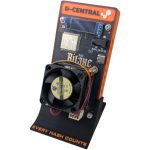
D-Central is a pioneer in the Bitaxe ecosystem, having created the original Bitaxe Mesh Stand and developed leading accessories including custom heatsinks for Bitaxe and Bitaxe Hex. We stock every variant: Supra, Ultra, Hex, Gamma, and GT. Solo mining with a Bitaxe is not about guaranteed returns — it is about participating directly in the Bitcoin network on your own terms. Every hash counts.
Dual-Purpose Mining: Heat Your Home, Stack Sats
Our Bitcoin Space Heaters turn the “mining uses too much energy” narrative on its head. An ASIC miner converts 100% of its electrical input into heat. In a Canadian winter — and we know Canadian winters — that heat is not waste. It is your heating system, subsidized by Bitcoin mining rewards.
While your bank charges you fees to hold your money and earns interest by lending it out, your space heater earns sats while keeping your family warm. That is not a marginal improvement over traditional finance. It is a fundamentally different relationship with energy and money.
Professional ASIC Mining
For those running larger operations, D-Central provides the full lifecycle: hardware sourcing from our extensive catalog, professional ASIC repair with 60+ model-specific service pages, mining hosting in Quebec powered by clean hydroelectric energy, and expert consulting for operation design and optimization.
What the Banking Crisis Changed — and What It Did Not
Three years after the 2023 crisis, the structural problems in traditional banking remain unresolved. The Federal Reserve has oscillated between rate hikes and cuts. Regional bank balance sheets still carry unrealized bond losses. The fundamental model — borrow short, lend long, and pray that confidence holds — has not changed one bit.
What has changed is public awareness. The 2023 crisis was covered in real-time on social media, with depositors livestreaming their bank runs and sharing screenshots of frozen accounts. A generation of people watched their “safe” bank deposits become temporarily inaccessible and asked the obvious question: why am I trusting a system that can fail like this?
Bitcoin adoption continues to accelerate precisely because the answer to that question keeps getting louder. With the network now securing over 800 EH/s of hashrate — the most computational security ever applied to any system in human history — Bitcoin has proven itself not as a speculative asset, but as critical infrastructure for a world that can no longer afford to trust centralized intermediaries.
From Depositor to Miner: A Practical Transition
If the banking crisis convinced you that the traditional financial system is fragile, here is how to start building your alternative:
| Step | Action | D-Central Resource |
|---|---|---|
| 1 | Learn about Bitcoin mining fundamentals | Bitaxe Hub — Complete Guide |
| 2 | Start solo mining with an open-source Bitaxe miner | D-Central Shop — Bitaxe Miners |
| 3 | Monetize your home heating with a Bitcoin Space Heater | Space Heater Collection |
| 4 | Scale up with professional ASIC hardware | Full Hardware Catalog |
| 5 | Get expert guidance on your mining operation | Mining Consulting |
| 6 | Host at scale with clean Quebec hydropower | Quebec Hosting |
The Deeper Lesson: Decentralize Everything
The 2023 banking crisis was not just a failure of three specific banks. It was a failure of the centralized model itself. Fractional reserves. Central bank dependency. Opaque balance sheets. Regulatory capture. Moral hazard from implicit bailout guarantees. These are not bugs in the banking system — they are the system.
Bitcoin mining represents the opposite architecture: transparent rules enforced by code, security provided by distributed energy expenditure, and monetary policy that no committee can alter. When you run a miner, you are not just earning sats. You are strengthening the most decentralized financial network ever built. You are making it harder for any government, corporation, or bank to control money.
At D-Central Technologies, this is our mission: the decentralization of every layer of Bitcoin mining. From the open-source Bitaxe firmware to the repaired hashboard to the Quebec-hosted container — every piece of infrastructure we provide exists to put the power of money creation back where it belongs: in the hands of individuals.
The banks had their chance. They failed. The alternative is here, and it runs on proof-of-work. Time to start hashing.
Frequently Asked Questions
What caused the 2023 banking crisis?
The 2023 banking crisis was triggered by a combination of aggressive Federal Reserve interest rate hikes (which caused massive unrealized losses on bank-held bonds), concentrated depositor bases (especially in tech and crypto sectors), and the inherent fragility of fractional-reserve banking. When confidence eroded, bank runs at Silvergate, SVB, and Signature Bank cascaded rapidly. The crisis ultimately required emergency government intervention — the Bank Term Funding Program — to prevent wider contagion.
How does Bitcoin protect against banking failures?
Bitcoin operates on a fundamentally different model than banks. It uses a fixed supply of 21 million coins (currently producing 3.125 BTC per block after the April 2024 halving), a decentralized network with no single point of failure, and a transparent public ledger that anyone can verify. There is no fractional reserve, no counterparty risk, and no CEO making leveraged bets. When you hold Bitcoin in self-custody, no bank failure, regulatory action, or bank holiday can prevent you from accessing or transacting with your funds.
What is Bitcoin mining and how does it relate to financial sovereignty?
Bitcoin mining is the process of using specialized hardware (ASIC miners) to perform cryptographic computations that secure the Bitcoin network and validate transactions. In return, miners receive newly created Bitcoin (block rewards) and transaction fees. Mining represents the ultimate form of financial sovereignty because you convert electricity directly into non-custodial Bitcoin — no bank, exchange, or intermediary required. The sats go straight from the network to your wallet.
Can I mine Bitcoin at home?
Absolutely. Home mining is more accessible than ever in 2026. Open-source solo miners like the Bitaxe plug into a standard outlet and run silently, giving you a chance at a full 3.125 BTC block reward. For practical returns, Bitcoin Space Heaters use ASIC mining hardware to heat your home while stacking sats — turning your energy bill into mining revenue. D-Central provides all the hardware, accessories, and expertise to get started.
Is Bitcoin really more stable than banks?
Bitcoin’s purchasing-power volatility is often cited as a concern, but it is important to distinguish between price volatility and systemic risk. Banks can and do fail — losing depositor funds entirely without government intervention. Bitcoin cannot “fail” in this way because there is no central entity to collapse. The network, secured by over 800 EH/s of hashrate and running continuously since January 3, 2009, has never experienced a single minute of downtime. Its monetary policy is mathematically fixed and cannot be altered by any committee or crisis response.
What is the cheapest way to start mining Bitcoin?
The most affordable entry point is a Bitaxe solo miner, which D-Central stocks in multiple variants (Supra, Ultra, Gamma, and more). These open-source devices are small, quiet, energy-efficient, and give you a legitimate shot at solo-mining a full Bitcoin block. Visit the D-Central shop to browse options, or check the Bitaxe Hub for detailed guides on getting started.