The silicon inside an ASIC miner is the most purpose-built hardware on the planet. Every transistor, every logic gate, every nanometer of die space exists for one reason: to compute SHA-256 hashes as fast and as efficiently as physically possible. No general-purpose processor comes close. No GPU, no FPGA, no cloud instance. ASIC chips are the reason Bitcoin’s network hashrate now exceeds 800 EH/s — and the reason home miners can still participate meaningfully in securing the most important monetary network ever built.
At D-Central Technologies, we have been repairing, building, and hacking ASIC miners since 2016. We have handled thousands of hashboards, diagnosed countless chip failures, and pushed these machines to their limits. This is not theoretical knowledge — this is workshop-tested, solder-iron-proven expertise from Canada’s Bitcoin Mining Hackers.
What Is an ASIC Chip, Exactly?
ASIC stands for Application-Specific Integrated Circuit. Unlike a CPU or GPU that can run any software thrown at it, an ASIC chip does one thing — and does it at speeds that make general-purpose hardware look like a pocket calculator by comparison.
In Bitcoin mining, that one thing is computing SHA-256 double hashes. The chip takes a block header candidate, runs it through the SHA-256 algorithm twice, and checks whether the resulting hash meets the current difficulty target. If it does, you have found a valid block. If not, increment the nonce and try again. Billions of times per second.
| Hardware Type | SHA-256 Hashrate | Power Draw | Efficiency (J/TH) |
|---|---|---|---|
| CPU (modern desktop) | ~50 MH/s | ~125 W | ~2,500,000 |
| GPU (high-end) | ~1.5 GH/s | ~300 W | ~200,000 |
| FPGA | ~5 GH/s | ~40 W | ~8,000 |
| Antminer S9 (BM1387) | ~14 TH/s | ~1,350 W | ~96 |
| Antminer S19 XP (BM1368) | ~140 TH/s | ~3,010 W | ~21.5 |
| Antminer S21 (BM1370) | ~200 TH/s | ~3,500 W | ~17.5 |
| Bitaxe Supra (BM1368) | ~0.5 TH/s | ~15 W | ~30 |
That table tells the whole story. The jump from GPU to ASIC is not incremental — it is a five-order-of-magnitude improvement in efficiency. This is why ASIC chips are not just better mining hardware; they are the only viable mining hardware for Bitcoin in 2025 and beyond.
The Evolution: From CPUs to Custom Silicon
Bitcoin mining started on CPUs in 2009. Satoshi mined the genesis block on a standard computer processor. Within a year, miners discovered that GPUs — with their massively parallel architectures designed for rendering pixels — could compute SHA-256 hashes far more efficiently. GPU mining dominated from 2010 to 2012.
FPGAs (Field-Programmable Gate Arrays) arrived next. These are chips with reconfigurable logic gates — not quite custom silicon, but closer. FPGAs offered better efficiency than GPUs but required serious electrical engineering knowledge to configure and operate. They were a bridge technology, a stepping stone.
Then in 2013, the first Bitcoin ASIC miners shipped. Companies like Canaan (Avalon), Bitmain (Antminer), and others began fabricating chips with one purpose: SHA-256 computation. The era of general-purpose Bitcoin mining was over.
Key ASIC chip generations in Bitcoin mining history:
| Era | Chip | Process Node | Notable Miner | Efficiency |
|---|---|---|---|---|
| 2013 | Avalon A3256 | 110 nm | Avalon 1 | ~8,700 J/TH |
| 2014 | BM1382 | 28 nm | Antminer S5 | ~510 J/TH |
| 2017 | BM1387 | 16 nm | Antminer S9 | ~96 J/TH |
| 2020 | BM1397 | 7 nm | Antminer S19 | ~34 J/TH |
| 2022 | BM1368 | 5 nm | Antminer S19 XP | ~21.5 J/TH |
| 2024 | BM1370 | 5 nm | Antminer S21 | ~17.5 J/TH |
From 8,700 J/TH to 17.5 J/TH in just over a decade. That is a 497x improvement in energy efficiency — a testament to the relentless engineering push in semiconductor fabrication applied to Bitcoin’s proof-of-work algorithm.
How ASIC Chips Actually Work
An ASIC chip designed for Bitcoin mining contains thousands of identical SHA-256 hashing cores etched into the silicon die. Each core can independently compute a complete double-SHA-256 hash. The chip takes a partially-filled block header template from the mining controller, distributes nonce ranges across its internal cores, and runs them all in parallel.
Here is the simplified workflow:
1. Block template arrives — The mining pool (or the miner’s own node if solo mining) provides a block template containing the previous block hash, a Merkle root of pending transactions, a timestamp, and the current difficulty target.
2. Nonce distribution — The ASIC controller firmware distributes nonce ranges to each chip on the hashboard. A modern hashboard contains dozens of ASIC chips, each with hundreds or thousands of cores.
3. Parallel hashing — Every core simultaneously computes SHA-256(SHA-256(block_header + nonce)). A single BM1370 chip can compute billions of these per second.
4. Difficulty check — If the resulting hash has enough leading zeros to meet the network difficulty target, the chip signals back to the controller. A valid block has been found.
5. Block submission — The controller submits the valid block (or share, in pooled mining) to the network. If accepted, the miner earns the 3.125 BTC block reward plus transaction fees.
The key engineering metrics that define an ASIC chip’s quality are:
- Hashrate per chip — How many TH/s a single chip produces. Higher is better.
- Joules per terahash (J/TH) — The energy cost per unit of hashing work. Lower is better. This is the single most important metric for mining economics.
- Process node — The semiconductor fabrication size (5 nm, 7 nm, etc.). Smaller nodes enable more transistors per mm² of silicon, improving both speed and efficiency.
- Voltage tolerance — How the chip performs under different voltage levels. Good chips allow undervolting for better efficiency or overclocking for more hashrate.
- Thermal envelope — Maximum operating temperature before throttling or failure. Proper cooling is essential for chip longevity.
Why ASIC Chips Are Critical for Bitcoin’s Security
Bitcoin’s security model depends on proof-of-work. The more total hashrate the network has, the more expensive it becomes to attack. With the network now exceeding 800 EH/s (800 quintillion hashes per second), executing a 51% attack would require manufacturing and deploying more ASIC hardware than all existing miners combined — a multi-billion-dollar endeavour that would also require securing the electricity to run it all.
ASIC chips make this possible. Their extreme specialization means that the hashrate secured by Bitcoin is not shared with any other computational workload. Every watt consumed by an ASIC miner goes directly into securing the Bitcoin network. No other use. No dual-purpose compute. Pure, dedicated security infrastructure.
This is why Bitcoin is the most secure computational network on Earth. And it is why every home miner running even a single Bitaxe solo miner contributes to that security. Every hash counts.
The Centralization Problem — And How Home Mining Fights Back
Here is the uncomfortable truth: ASIC mining has a centralization problem. Full-scale miners like the Antminer S21 produce 200 TH/s but consume 3,500 watts, generate significant noise (75+ dB), and require 240V power circuits. They are designed for industrial deployments — warehouses full of machines, not spare bedrooms.
This creates a natural gravity toward large mining operations. The miners with the cheapest power, the best cooling infrastructure, and the most capital can deploy the most hashrate. Over time, this concentrates mining power into fewer hands — the exact opposite of what Bitcoin’s decentralization ethos demands.
The home mining movement is the antidote.
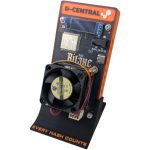
Open-source miners like the Bitaxe — which D-Central has been pioneering since the early days of the project — put a real ASIC chip (the same BM1366 or BM1368 used in industrial Antminers) into a palm-sized, whisper-quiet, 15-watt device that runs on a standard 5V barrel jack power supply. You can solo mine from your desk, your living room, or your workshop. No industrial infrastructure required.
Similarly, D-Central’s Bitcoin Space Heaters repurpose full ASIC miners into dual-purpose devices: they mine Bitcoin while heating your home. Every watt of electricity consumed by an ASIC miner is converted to heat — that is not waste, that is winter fuel. In Canada especially, where heating season lasts six months or more, this dual-purpose approach means your miner pays for part of your heating bill while simultaneously securing the Bitcoin network.
This is what we mean by “Mining Hackers.” We take institutional-grade ASIC technology and hack it into solutions that work for home miners, plebs, and sovereign individuals.
ASIC Chip Maintenance and Repair
ASIC chips are precision semiconductor devices, and they operate under intense thermal and electrical stress. Over time, chips can degrade or fail. Common failure modes include:
- Thermal damage — Chronic overheating from inadequate cooling or dust accumulation causes solder joint fatigue and chip degradation.
- Voltage spikes — Power supply instability or lightning-induced surges can damage chip circuitry.
- Manufacturing defects — Some chips ship with marginal tolerances that manifest as early failures.
- Corrosion — Humidity and poor environmental controls can cause oxidation of chip connections.
- Physical damage — Mishandling during transport or maintenance can crack chips or damage BGA solder balls.
When an ASIC chip fails on a hashboard, it typically takes down the entire hash chain it belongs to, reducing the board’s output. Sometimes one bad chip can make an entire hashboard non-functional. This is where professional ASIC repair becomes critical.
At D-Central, we have repaired thousands of hashboards across every major manufacturer — Bitmain, MicroBT, Canaan, and Innosilicon. Our technicians use thermal imaging, oscilloscopes, and BGA rework stations to identify and replace failed chips at the component level. We do not just swap boards — we fix them. That is the Mining Hacker way.
Choosing the Right ASIC Miner for Your Setup
Not every miner needs a 200 TH/s industrial machine. The right ASIC depends entirely on your situation:
| Use Case | Recommended Hardware | Power | Noise | Best For |
|---|---|---|---|---|
| Solo mining / learning | Bitaxe Supra / Ultra | ~15 W (5V DC) | Near silent | Desk setup, lottery mining, education |
| Home heating + mining | Bitcoin Space Heater | 800–3,500 W | Low (enclosed) | Canadian winters, dual-purpose |
| Serious home mining | Antminer S19/S21 series | 3,000–3,500 W | 75+ dB | Dedicated room, garage, shed |
| Open-source DIY | NerdAxe / NerdQAxe | ~15–60 W | Quiet | Makers, tinkerers, verification |
The important thing is not how much hashrate you produce — it is that you participate at all. Running your own miner means you are directly contributing to Bitcoin’s decentralized security model. You are not trusting a third party to mine honestly on your behalf. You are verifying and securing the network yourself, with your own hardware and your own electricity.
The Future of ASIC Technology
ASIC chip development is approaching physical limits. The current leading edge is 5 nm fabrication, with 3 nm chips in development. Each node shrink delivers improvements in efficiency, but the gains are getting smaller. We are approaching the thermodynamic limits of silicon computation.
This means the next frontier is not just smaller transistors — it is smarter system design. Better power delivery, improved thermal management, more efficient firmware, and innovative form factors. The open-source hardware movement — exemplified by projects like Bitaxe — is driving innovation at the system level while leveraging the same cutting-edge chips used by industrial miners.
For home miners, the trend is encouraging. As chips become more efficient, the power and cooling requirements per terahash decrease. What required a warehouse full of S9s in 2017 can now be achieved by a few S21s in a well-ventilated space. And what required an S9 to produce meaningful hashrate can now be done silently with a Bitaxe on your bookshelf.
The democratization of mining technology is happening. ASIC chips are the foundation, but the real revolution is in how we deploy them — at home, at scale, and in service of Bitcoin’s most fundamental principle: decentralization.
Frequently Asked Questions
What is an ASIC chip and why is it used for Bitcoin mining?
An ASIC (Application-Specific Integrated Circuit) chip is a semiconductor designed to perform one specific task — in this case, computing SHA-256 hashes for Bitcoin’s proof-of-work consensus. Unlike CPUs or GPUs that handle many different computations, an ASIC chip is hardwired for SHA-256, making it orders of magnitude more efficient. A modern Bitcoin ASIC achieves roughly 17-21 J/TH, while a GPU would need over 200,000 J/TH for the same work.
Can I mine Bitcoin at home with an ASIC chip?
Absolutely. Home mining is not only possible — it is one of the most important things you can do for Bitcoin’s decentralization. Options range from whisper-quiet devices like the Bitaxe (15W, runs on a 5V barrel jack power supply) for solo/lottery mining, to full-scale miners enclosed in Bitcoin Space Heaters that double as home heating. D-Central specializes in making ASIC technology accessible for home setups.
What is the difference between J/TH and TH/s?
TH/s (terahashes per second) measures raw speed — how many SHA-256 computations the chip performs each second. J/TH (joules per terahash) measures efficiency — how much energy is consumed per unit of work. For mining economics, J/TH is the more important metric because it directly determines your electricity cost per unit of hashrate produced.
How long do ASIC chips last before they need replacement?
With proper cooling, clean power, and regular maintenance (dust removal, thermal paste refresh), ASIC miners can run for 5+ years. The Antminer S9, released in 2017, still operates worldwide today. Chip failures do occur — from thermal stress, voltage spikes, or manufacturing defects — but individual chips can be replaced through professional ASIC repair services rather than scrapping the entire machine.
Why does D-Central call itself “Bitcoin Mining Hackers”?
Because we take institutional-grade ASIC technology — hardware designed for warehouse-scale deployments — and hack it into solutions that work for home miners. Slim Edition miners that fit in tight spaces. Space Heaters that turn mining waste heat into home heating. Open-source Bitaxe devices that put real ASIC chips on your desk. We are not just selling hardware; we are engineering the decentralization of Bitcoin mining, one home miner at a time.
What happens when an ASIC chip fails on a hashboard?
A failed chip typically disables the hash chain it belongs to, reducing the hashboard’s output. In some cases, a single dead chip can render an entire hashboard non-functional. Professional repair involves using thermal imaging and diagnostic tools to locate the failed chip, then using BGA rework equipment to desolder the defective chip and solder a replacement. D-Central’s repair team handles these repairs across all major manufacturers.
Is solo mining with a small ASIC like the Bitaxe realistic?
Realistic depends on your expectations. A Bitaxe producing 0.5 TH/s against an 800+ EH/s network has very long odds of finding a block — but the 3.125 BTC block reward makes the lottery worth playing for many Bitcoiners. Solo mining is about more than profitability: it is about running your own hardware, contributing to decentralization, and learning how Bitcoin works at the protocol level. Every hash counts.
What process node are modern Bitcoin ASIC chips manufactured on?
The current leading-edge Bitcoin ASIC chips use 5 nm fabrication technology, with 3 nm development underway. For comparison, the legendary Antminer S9 used 16 nm chips. Each node shrink brings improvements in both hashrate per watt and heat output, making newer chips more suitable for home mining environments where power and thermal constraints are tighter.