
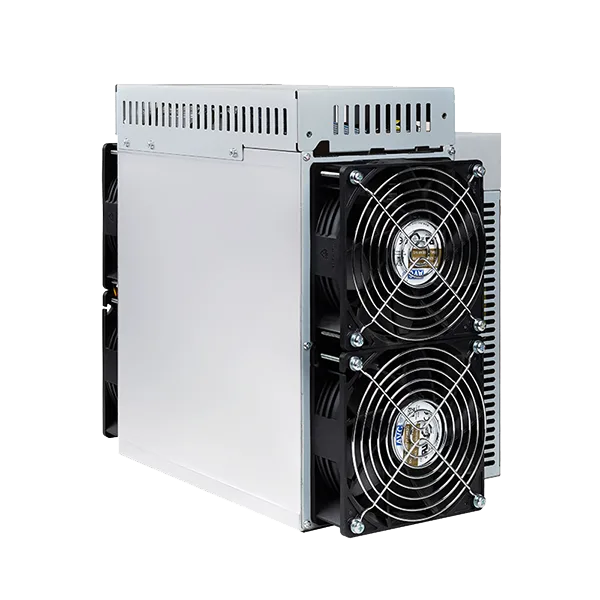
iBeLink BM-K3
Réponse rapide
The iBeLink BM-K3 is a Blake2s miner rated about 70 TH/s at roughly 3,300 W. An industrial-class unit — loud and power-hungry, best suited to a dedicated mining space, not living areas.
Professional-Grade Miner
This miner draws 3,300W and produces 75+ dB of noise — it is designed for dedicated mining environments, not living spaces. Professional-grade miners deliver the highest hashrate and revenue per unit but require proper infrastructure: a 240V circuit, adequate ventilation or exhaust ducting, and a space where noise is not a concern (garage, basement, warehouse, or outdoor enclosure).
For home miners looking for a quieter alternative, consider our Bitcoin Space Heater builds or explore open-source miners like the Bitaxe that are purpose-built for residential environments.
Heater-Class Miner
At 3,300W, this miner outputs approximately 11260 BTU/hr of heat — equivalent to a standard electric space heater. Every watt consumed by an ASIC miner is converted to heat with 100% efficiency, making it a space heater that also mines Bitcoin.
During heating season, miner heat can offset part of the heat a room would otherwise need from another electric heater. The economics depend on your electricity rate, room heat demand, BTC price, network difficulty, and noise constraints.
Calculateur de rentabilité
| Period | Revenue | Electricity Cost | Profit |
|---|---|---|---|
| Daily | $2.17 | $5.54 | $-3.38 |
| Weekly | $15.16 | $38.81 | $-23.65 |
| Monthly | $64.98 | $166.32 | $-101.34 |
| Yearly | $790.55 | $2,023.56 | $-1,233.01 |
Heating offset estimates the value of heat replacing an electric space heater during heating season (~6 months/year in Canada). Actual savings depend on your heating setup and climate.
Where to Buy the iBeLink BM-K3
D-Central Technologies is a Bitcoin-only company. For this miner, check out our trusted partner retailers below.
Partner links may earn D-Central a commission at no extra cost to you. Have you considered Bitcoin mining instead? Explore Bitcoin miners →
Full Specifications
| Model | iBeLink BM-K3 |
|---|---|
| Model Number | BM-K3 |
| Manufacturer | iBeLink |
| Algorithme | Blake2s |
| Coins Mined | Kadena (KDA) |
| Taux de hachage | 70 TH/s |
| Consommation électrique | 3,300 W |
| Efficiency | 47.14 J/TH |
| Dimensions | 300 x 200 x 290mm |
| BTU Output | 11260 BTU/hr |
| Equivalent Heater | Equal to a 3,300W space heater |
| Daily Power Cost | $5.54/day |
| Monthly Power Cost | $166.32/mo |
| Circuit Requirement | 240V circuit required |
| Release Date | 2022-12-01 |
| MSRP | $820.00 |
| État | Active |
Home Mining Assessment
The iBeLink BM-K3 is a Kadena (KDA) ASIC miner that hashes the Blake2S algorithm at roughly 70 TH/s while drawing about 3,300 W, for an efficiency near 47 J/TH. Released in December 2022, it is iBeLink’s highest-hashrate single-box Kadena unit, and it is built for a dedicated, ventilated mining space rather than a living room.
A short but important clarification first: the BM-K3 is a Kadena machine, not a Kaspa machine. The two are easy to confuse because iBeLink builds for both, but iBeLink’s Kaspa (kHeavyHash) hardware lives in the separate BM-KS series. The BM-K3 belongs to the BM-K line, which targets Kadena’s Chainweb proof-of-work and its Blake2s-256 hash. If your goal is Kaspa, this is the wrong model; if your goal is KDA, this is one of the highest-throughput single boxes ever built for it.
iBeLink BM-K3 at a glance
| Specification | iBeLink BM-K3 |
|---|---|
| Manufacturer | iBeLink |
| Coin / network | Kadena (KDA), Chainweb |
| Algorithm | Blake2S (Blake2s-256) |
| Hashrate | ~70 TH/s |
| Power draw (nameplate) | ~3,300 W |
| Efficiency | ~47.1 J/TH (Blake2S) |
| Cooling | Forced-air, dual axial fans |
| Dimensions | 300 x 200 x 290 mm |
| Heat output | ~11,260 BTU/h |
| Input voltage | 200-240 V single-phase (dedicated circuit) |
| Released | December 2022 |
Chip and hashboard architecture
The BM-K3 is a purpose-built Blake2S accelerator. Unlike a SHA-256 Bitcoin miner, its silicon does nothing for the Bitcoin network; it exists solely to compute the Blake2s-256 rounds that Kadena’s Chainweb consensus rewards. iBeLink designs and sources its own ASICs for this work, and the company does not publish the die size, foundry, process node, or per-board chip count for the BM-K3’s Blake2S chip. We will not invent those figures here. What we can say with confidence is that the unit follows the standard altcoin-ASIC layout: a controller board running the management stack, several hashboards populated with the Blake2S ASICs, and a power stage feeding them.
One architectural point worth borrowing from the broader ASIC world: voltage on these boards is regulated per power domain, not per individual chip. A domain is a small group of series-connected ASICs sharing one regulated rail, so when a single chip degrades it tends to drag its whole domain — and often the hashboard’s reported hashrate — down with it. That is true across virtually every modern mining ASIC, iBeLink included, and it is why « one bad chip » so often reads as a partial or fully dead board at the API.
Cooling is conventional forced air: high-static-pressure fans pull cool air through the hashboard fins front-to-back. The 300 x 200 x 290 mm chassis is compact for a 3,300 W machine, which means airflow is dense and the fans run hard. Plan for the same intake-filtration and exhaust-ducting discipline you would give any 3 kW ASIC; dust on Blake2S boards kills them the same way it kills SHA-256 boards.
Real-world power and efficiency
The 3,300 W figure is the nameplate. At the wall, once power-supply conversion losses are counted, expect roughly 3,400-3,550 W under a steady Kadena workload, with the exact number drifting with ambient temperature and grid voltage. At 70 TH/s that lands the BM-K3 near 47 J/TH on Blake2S.
That efficiency number deserves context, because it is easy to misread. J/TH is only meaningful within the same algorithm: a Blake2S terahash and a SHA-256 terahash are completely different units of work, so you cannot line the BM-K3’s 47 J/TH up against a Bitcoin miner’s 17 J/TH and conclude the iBeLink is « obsolete. » The honest comparison is against other Kadena ASICs, and within that small field the BM-K3’s raw throughput is high. Whether it earns depends almost entirely on KDA price and Kadena network difficulty on the day, not on a cross-algorithm efficiency chart.
Tuning headroom is modest and is the area where niche-algorithm hardware lags behind the Bitcoin ecosystem. The BM-K3 runs its factory operating point; there is no mature third-party autotuner that recalculates per-domain voltage and frequency at runtime for it the way the Antminer world enjoys. If you want to understand how runtime-calculated power profiles work on the machines that do support them — and why « preset » and « autotuned » are not the same thing — our ASIC power profiles database is the reference. For the BM-K3 specifically, the practical levers are airflow, ambient temperature, and clean input power, not firmware curve-fitting.
On electrical install: at 3,300 W the BM-K3 draws roughly 14-16 A continuous on a 208-240 V circuit, so it needs its own dedicated 20 A, 200-240 V feed. It is not a 120 V machine, and it is not something to share with other loads.
Firmware and software
The BM-K3 runs iBeLink’s own stock firmware — a CGMiner-derived mining stack behind a simple web interface, with a CGMiner-style API typically exposed on port 4028 for monitoring (hashrate, accepted/rejected shares, board temperatures, fan RPM). For day-to-day operation that stack is adequate: set your Kadena pool, watch the dashboard, and let it run.
Be honest about the third-party reality, though. The custom-firmware ecosystem that defines Bitcoin mining does not extend to iBeLink Kadena hardware. BraiinsOS+ — the one firmware that natively speaks Stratum V2 — is Antminer-only. VNish and LuxOS target Antminer and (for VNish) WhatsMiner, not iBeLink. Our own DCENT_OS work is focused on the SHA-256 families (Antminer, WhatsMiner, Avalon), so it does not target the BM-K3 either. In practice that means you operate this miner on the firmware it shipped with, keep it patched from iBeLink when updates appear, and isolate it on a management VLAN with no inbound internet exposure — the same network hygiene we recommend for any ASIC whose stock firmware you cannot replace.
Common faults and troubleshooting
Blake2S boxes fail in the same handful of ways every air-cooled ASIC does, and most of them are diagnosable before you ever open the case:
- A hashboard or chain drops out. Total hashrate falls by a clean fraction (a third, a half) and the API flags a board with zero or reduced chips. Usually a failed ASIC dragging its domain down, a cold/cracked solder joint, or a power-stage fault on that board.
- Fan faults and thermal trips. A dying fan, a clogged heatsink, or hot intake air pushes board temperatures past their limit and the controller throttles or shuts down to protect the silicon. In a compact 3.3 kW chassis this is the single most common preventable failure.
- Controller / connectivity issues. No web UI, no API response, or the unit dropping off the network — often a controller-board fault, corrupted firmware/storage, or a flaky data ribbon between controller and hashboards.
- Power-supply problems. No power, random reboots under load, or a unit that will not reach full hashrate. A 3,300 W supply running for years in a hot room is a wear item.
- Degraded hashrate without an outright fault. Accumulated dust, drying thermal interface material, and aging chips quietly erode performance over time.
Work the cheap, reversible checks first — input voltage and circuit, intake/exhaust temperatures, fan RPM, a full power-cycle and a clean firmware reflash — before condemning a board. Our ASIC fault finder walks the same symptom-to-cause logic D-Central’s bench uses; the airflow, power, and hashboard fundamentals it teaches apply directly to the BM-K3 even though its error strings are iBeLink’s rather than Bitmain’s.
Repair and longevity
D-Central has run an in-house ASIC repair bench in Laval since 2016, and the discipline that keeps Bitcoin miners alive — board-level diagnosis, domain isolation, PSU and fan service, controller swaps, reflow and rework — transfers to niche-algorithm hardware like the BM-K3. The component-level faults (failed fans, tired power supplies, controller boards, ribbon cables, connectivity) are squarely repairable, and a clean, well-cooled, dust-managed unit will outlast a neglected one by years.
We will be straight about the harder cases, because that is the only kind of advice worth giving: chip-level repair on a proprietary Blake2S ASIC is constrained by parts availability. Replacement iBeLink ASICs are not stocked the way BM1387/BM1397-class Bitcoin chips are, so a board that needs a specific dead chip replaced may be limited by what donor hardware exists. That is a function of the niche, not the workmanship. The honest move is to diagnose first: many « dead » boards are actually a power-stage, solder-joint, or domain problem that is fixable without sourcing a new ASIC at all. If your BM-K3 is down, our ASIC repair service can tell you which category you are in before you write the machine off.
Who the BM-K3 is for
The BM-K3 makes sense for one specific operator: someone who wants meaningful Kadena hashrate in a single box and has the infrastructure to run a loud 3.3 kW machine properly — a dedicated 240 V circuit, real ventilation, and tolerance for ASIC-grade noise. It is not a home-office or living-room miner; with around 11,260 BTU/h of waste heat it throws genuine warmth, and while that heat can be ducted into a workshop or garage in winter, the noise and the Kadena-specific economics mean it belongs in a mining space, not beside a desk.
If you are KDA-focused and weighing your options, browse the full ASIC miner catalog to compare the BM-K3 against other Kadena and altcoin hardware, and run the numbers against current KDA price and difficulty before buying — single-coin ASICs live and die by their network’s economics, and a machine that prints today can idle tomorrow if difficulty climbs or price falls. New-old-stock and secondary-market BM-K3 prices have fallen sharply from the unit’s 2022 launch level, which can make the math work for a low-cost-power operator even when it would not for someone paying retail rates.
Where the BM-K3 fits
iBeLink’s first-generation Kadena line scaled up through the smaller BM-K1 and BM-K1+ to the BM-K3 as its flagship, and at ~70 TH/s the K3 sits at the top of that family by raw throughput. The other notable name in Kadena ASICs is Goldshell’s KD series, which took a more home-friendly, lower-power approach to the same algorithm — credit where it is due, those machines made KDA mining accessible to a lot of people. The BM-K3’s pitch was different: maximum Kadena hashrate per chassis for operators who could feed and cool it.
Three-plus years on, the BM-K3 is mature hardware. It is no longer the efficiency leader its launch numbers once made it, the Kadena ASIC market remains small, and KDA mining economics have cycled hard since 2022. But for the right operator — cheap power, proper ventilation, a clear-eyed view of single-coin risk, and a unit bought at today’s depreciated price rather than yesterday’s launch price — a well-maintained BM-K3 is still a serious piece of Kadena mining iron. And if it ever stops hashing the way it should, it is a machine that can be diagnosed and, in most cases, brought back to the bench rather than thrown out.
Broken miner? Get a real quote.
Tell us the symptom and get an instant repair-tier estimate ($95 / $145 / $195 CAD). Mail-in from across Canada, bench in Laval, Quebec.
Send it to D-Central — start a repair →Related Miners

Goldshell KD Max
Goldshell KD Lite
Bitmain Antminer KA3 (166Th)
Goldshell KD-BOX
Foire aux questions
What are the current mining economics for the iBeLink BM-K3?
At $0.07/kWh, the iBeLink BM-K3 currently shows an estimated daily net cost of $3.38 before pool fees and hardware cost. Lower electricity rates, network changes, BTC price changes, or useful heat recovery can change the result.
Can I mine Bitcoin at home with the iBeLink BM-K3?
The iBeLink BM-K3 has a home mining score of 8/100. With 0 dB noise and 3,300W power draw, it may require a dedicated space like a garage, basement, or outdoor enclosure. Consider noise insulation and proper ventilation.
Can the iBeLink BM-K3 heat my home?
The iBeLink BM-K3 outputs approximately 11260 BTU/hr of heat. For reference, a typical space heater produces 5,000-5,500 BTU/hr. All electrical energy consumed by the miner is converted to heat, making it 100% efficient as a heater. D-Central offers Bitcoin Space Heater builds designed specifically for home heating integration.
What power supply does the iBeLink BM-K3 need?
The iBeLink BM-K3 draws 3,300W of power. You need a power supply rated for at least 3,630W with appropriate voltage (200-240V AC). D-Central stocks compatible power supplies in our shop. Always use a quality PSU from a reputable manufacturer to protect the miner and wiring.