
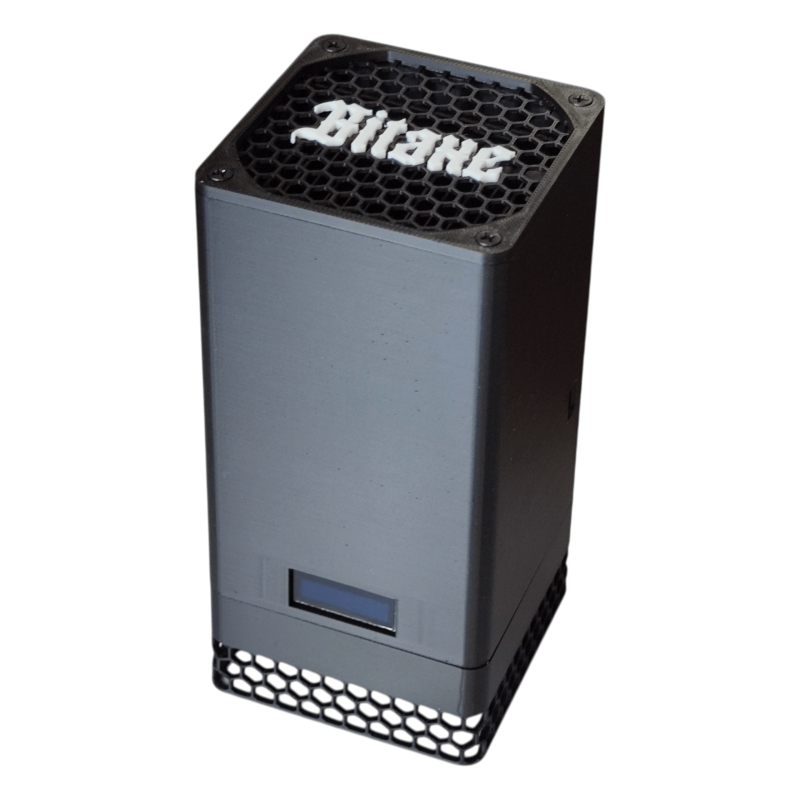
Bitaxe GT vs Bitaxe Hex
Side-by-side specs, profitability, and home mining comparison.
Quick verdict
For most buyers the Bitaxe Hex is the stronger pick — Six-chip architecture delivers substantially higher total hashrate for serious solo miners. The Bitaxe GT runs 2.2 TH/s at 20.0 J/TH; the Bitaxe Hex runs 3.0 TH/s at 30.0 J/TH.
Specs verified against the D-Central Mining Bible \xc2\xb7 July 2026
Specifications Comparison
| Bitaxe GT | Specification | Bitaxe Hex |
|---|---|---|
| 2.2 TH/s | Taux de hachage | 3.0 TH/s |
| 43 W | Consommation électrique | 90 W |
| 20.0 J/TH | Efficiency | 30.0 J/TH |
| 42 dB | Niveau de bruit | 45 dB |
| 0.4 kg | Weight | 0.5 kg |
| 147 BTU/hr | BTU Output | 307 BTU/hr |
| 89/100 | Home Mining Score | 89/100 |
| — | Release Year | — |
| SHA-256 | Algorithme | SHA-256 |
| Bitaxe | Manufacturer | Bitaxe |
Profitability Comparison
Bitaxe GT
Bitaxe Hex
Based on BTC price of $62,502 and current network difficulty as of Jul 14, 2026. Actual results vary.
Verdict
The Bitaxe GT and Bitaxe Hex represent two different scaling approaches in open-source mining. The GT packs more hashrate into a single unit, while the Hex uses six chips for even greater total output.
The Bitaxe Hex delivers significantly more hashrate but costs more and draws more power. The GT offers the best hashrate-per-dollar among single-board Bitaxe designs. Choose the GT for value or the Hex for maximum open-source hashrate.
Spec Deltas
Stripped to the numbers, this is how far apart the Bitaxe GT and Bitaxe Hex sit on each measurable spec:
- Bitaxe Hex 40% more hashrate (2.2 vs 3.0 TH/s)
- Bitaxe GT 52% better power draw (43.0 vs 90.0 W)
- Bitaxe GT 33% better efficacité (20.0 vs 30.0 J/TH)
- Bitaxe GT 7% better noise (42.0 vs 45.0 dB)
- Bitaxe GT 20% better weight (0.4 vs 0.5 kg)
- Bitaxe Hex 109% more heat output (147 vs 307 BTU/hr)
Cost & ROI Over Time
Hardware cost is only half the story — here is how each miner's upfront price plays out against cumulative profit at a $0.10/kWh rate.
| Bitaxe GT | Metric | Bitaxe Hex |
|---|---|---|
| $499 | Upfront cost (MSRP) | $399 |
| -$0.04 | Daily net profit | -$0.12 |
| -$512 | Net after 1 year | -$444 |
| -$526 | Net after 2 years | -$489 |
| -$539 | Net after 3 years | -$534 |
| Does not pay back at current rates (negative daily profit) | Payback period | Does not pay back at current rates (negative daily profit) |
Projections assume continuous operation, a flat $0.10/kWh rate, and no hardware degradation, pool fees, or BTC price change. Real-world ROI varies.
Best For...
Best for Profitability
TieBoth miners produce similar daily profit.
Best for Home Mining
TieBoth miners are equally suitable for home use.
Best for Efficiency
Bitaxe GT20.0 J/TH — lower electricity cost per unit of hashrate.
Foire aux questions
Which has a better chance of finding a block, the GT or Bitaxe Hex?
The Bitaxe Hex has a better chance proportional to its higher hashrate. However, both still represent tiny fractions of network hashrate — solo mining with either is a lottery proposition.
Do the GT and Bitaxe Hex use the same power supply?
Both use 12V DC XT30 connectors, but the Hex requires a higher amperage PSU due to its greater power draw from six chips. Always check the specific PSU requirements.