The Bitaxe is the world’s first fully open-source Bitcoin ASIC miner — and it has already changed the game. Born from the cypherpunk conviction that Bitcoin mining should not be locked behind corporate walls, the Bitaxe puts a real SHA-256 ASIC chip in your hands. No data center required. No permission needed. Just plug it in, point it at a solo mining pool, and every hash you generate is a vote for decentralization.
But here is where it gets interesting: there is no longer just one Bitaxe. The open-source ecosystem has evolved into multiple models — the Supra, Ultra, Gamma, Hex, and GT — each built around different Bitmain ASIC chips, with different hashrates, power draws, and price points. If you are new to solo mining, the number of options can feel overwhelming.
This guide cuts through the noise. We will compare every Bitaxe model side by side, break down which chip does what, match each model to your priorities, cover the essential accessories you need, and set honest expectations about solo mining. Whether you are a first-time miner or adding to a fleet of open-source miners, this is the only buying guide you need.
A quick note on who is writing this: D-Central Technologies has been part of the Bitaxe ecosystem since its earliest days. We manufactured the original Bitaxe Mesh Stand — the first company to do so. We developed custom heatsinks for both the standard Bitaxe and the Hex. We stock every variant, every accessory, every power supply. We do not just sell these devices; we helped build the ecosystem around them. That hands-on experience informs every recommendation in this guide.
All Bitaxe Models Compared
The Bitaxe family currently spans five distinct models. Each one uses a genuine Bitmain ASIC chip — the same silicon found inside industrial miners like the Antminer S19 and S21 — but mounted on a compact, open-source PCB with WiFi connectivity and an OLED display. The differences come down to which chip is used, how many chips are on the board, and the resulting hashrate and efficiency.
Here is the full lineup at a glance:
| Model | ASIC Chip | Hashrate | Power (W) | Efficiency (J/TH) | Noise | WiFi | Price (CAD) | Best For |
|---|---|---|---|---|---|---|---|---|
| Bitaxe Ultra 205 | BM1366 (1x) | ~500 GH/s | ~12W | ~24 | Silent (fanless) | Yes | $189.99 | Budget entry, learning |
| Bitaxe Supra 401 | BM1366 (1x) | ~500 GH/s | ~12W | ~24 | Silent (fanless) | Yes | $245.00 | Refined single-chip design |
| Bitaxe Gamma 601 | BM1370 (1x) | ~1.2 TH/s | ~15W | ~12.5 | Silent (fanless) | Yes | $229.99 | Best value, best efficiency |
| Bitaxe GT 801 | BM1370 (1x) | ~1.5 TH/s | ~18W | ~12 | Silent (fanless) | Yes | $319.99 | Latest and greatest single-chip |
| Bitaxe Hex 601 | 6x BM1366 | ~3 TH/s | ~70W | ~23 | Quiet (active fan) | Yes | $499.99 | Maximum hashrate |
A few things stand out immediately. The Gamma and GT use the newer BM1370 chip, which is roughly twice as efficient as the BM1366 used in the Ultra, Supra, and Hex. That means more hashrate per watt — a critical metric when you are running a device 24/7. The Hex compensates for using the older chip by mounting six of them, brute-forcing its way to the highest total hashrate in the lineup. The GT pushes the BM1370 harder than the Gamma, delivering ~1.5 TH/s in the same compact, fanless form factor.
Every model connects via WiFi, runs the open-source AxeOS firmware, and displays real-time stats on a built-in OLED screen. Every model can be overclocked through the web interface. And every model can be pointed at a solo mining pool like Public Pool or Solo CKPool to take your shot at a full block reward.
If you are completely new to all of this, start with our Bitaxe Hub for the full ecosystem overview, then come back here to pick your model.
Decision Matrix: Which Bitaxe Is Right for You?
Choosing the right Bitaxe depends entirely on what you value most. There is no single “best” model — only the best model for you. Use this matrix to find your match.
| Your Priority | Best Model | Why |
|---|---|---|
| Lowest price entry point | Bitaxe Ultra 205 | At $189.99 CAD, it is the most affordable path to owning a real Bitcoin ASIC miner. A genuine BM1366 chip — the same silicon architecture used in the Antminer S19 XP. Perfect for testing the waters. |
| Best efficiency (J/TH) | Bitaxe GT 801 | ~12 J/TH — the same BM1370 chip that powers the Antminer S21. Lowest power cost per hash in the Bitaxe family. ~1.5 TH/s at just 18 watts. |
| Best value (hashrate per dollar) | Bitaxe Gamma 601 | ~1.2 TH/s for $229.99 CAD. The sweet spot — next-gen BM1370 chip at a mid-range price. More than double the hashrate of the Supra/Ultra at a lower price point. |
| Maximum hashrate | Bitaxe Hex 601 | ~3 TH/s from six BM1366 chips. If you want the best solo mining odds from a single Bitaxe device, this is it. Six independent chips hashing in parallel. |
| Completely silent operation | Supra, Gamma, or GT | All three are fanless designs — completely silent. Put them on your desk, bookshelf, or nightstand without a second thought. Zero noise, zero disruption. |
| Learning and tinkering | Any single-chip model | Single-chip Bitaxe models are simpler to understand, modify, and overclock. Start with one to learn stratum protocol, nonce scanning, difficulty targets, and the fundamentals of Bitcoin mining. |
| Latest technology | Bitaxe GT 801 | The newest Bitaxe revision, pushing the BM1370 to its limits. Cutting edge of open-source mining in a fanless, compact form factor. |
| Gift for a Bitcoiner | Bitaxe Gamma 601 | Compact, silent, visually impressive with the OLED display. The kind of thing every Bitcoiner wants sitting on their desk. Pair it with a Mesh Stand for the complete package. |
Our recommendation for most people: If you are buying your first Bitaxe, the Gamma 601 is the sweet spot. It delivers more than double the hashrate of the BM1366 models, runs the efficient BM1370 chip, stays completely silent, and costs $229.99 CAD. If budget is tight, the Ultra at $189.99 gets you into the game. If you want the absolute best single-chip performance and do not mind paying more, the GT at $319.99 is the top of the line.
If you are serious about maximizing your solo mining odds and want the most hashrate possible from a single open-source device, the Hex at $499.99 is the answer — but know that it draws more power and requires active cooling (a small, quiet fan).
Understanding the ASIC Chips: BM1366 vs BM1370
The chip inside your Bitaxe is the single most important component. Everything — hashrate, power consumption, heat output, efficiency — flows from the silicon. The Bitaxe lineup uses two Bitmain ASIC chips, and understanding the difference between them is key to making the right choice.
BM1366: The Proven Workhorse
The BM1366 is the chip Bitmain designed for the Antminer S19 XP series — machines that dominated industrial mining. It is a 5nm chip that delivers excellent performance for its generation. In the Bitaxe, a single BM1366 produces roughly 500 GH/s at ~12W, yielding an efficiency of about 24 J/TH.
The BM1366 powers the Ultra 205, Supra 401, and (six of them) the Hex 601. It is thoroughly proven, well-understood, and has been overclocked and tuned by the open-source community for years. Many users push BM1366-based Bitaxes to 600-700 GH/s with proper cooling. If you are buying a Supra, Ultra, or Hex, you are getting battle-tested silicon.
BM1370: The Next Generation
The BM1370 is Bitmain’s latest generation chip, designed for the Antminer S21 series. It is manufactured on a more advanced process node and delivers a dramatic efficiency improvement: roughly 12-12.5 J/TH compared to the BM1366’s ~24 J/TH. That means you get roughly double the hashrate for the same power consumption — or the same hashrate at half the wattage.
The BM1370 powers the Gamma 601 (~1.2 TH/s at ~15W) and the GT 801 (~1.5 TH/s at ~18W). The overclocking community has pushed individual BM1370 chips above 1.5 TH/s with aftermarket cooling. These models represent the cutting edge of open-source mining efficiency.
Why Chip Choice Matters
For a device you intend to run continuously for months or years, the ASIC chip determines three critical parameters:
- Lower operating costs — At typical North American residential rates (~$0.10-0.15/kWh), a single-chip Bitaxe costs pennies per day to run regardless of chip. But when running multiple units or overclocking aggressively, the BM1370’s efficiency advantage compounds. A Gamma at 12.5 J/TH costs roughly half as much to operate per terahash as a Supra at 24 J/TH.
- Less heat — Lower wattage means less heat to dissipate, which means more stable operation and the ability to push higher clock speeds without thermal throttling.
- More hashrate at the same power — If you are running your Bitaxe off solar, battery, or any power-constrained setup, the BM1370 gives you more hashes per watt. This matters for off-grid setups and anyone optimizing their energy budget.
The BM1366 is not obsolete — it remains an excellent chip, and the Hex proves that six of them together deliver serious hashrate. But if you are buying a single-chip Bitaxe today and efficiency matters to you, the BM1370-based models (Gamma, GT) are the clear choice.
For a deeper dive into pushing these chips to their limits, read our Definitive Bitaxe Overclocking Manual. For the full history of Bitcoin ASIC chip evolution from the BM1385 to the BM1370, see our ASIC Chip Evolution Guide.
Essential Bitaxe Accessories
A Bitaxe arrives ready to mine — but the right accessories make the difference between a miner that runs okay and one that runs at peak performance for years. Here is what you need and what is worth considering.
Power Supply (Required)
Single-chip Bitaxe models (Supra, Ultra, Gamma, GT) use a 5V DC barrel jack (5.5×2.1mm) connection. You need a power supply that delivers at least 5V at 3A (15W) for standard operation, though 5V 6A is recommended if you plan to overclock. D-Central’s Bitaxe Power Supply ($15.00 CAD) is purpose-built for the job — reliable, properly rated, and tested with every Bitaxe model.
The Hex has different power requirements due to its six-chip design — it draws up to 70W and uses a 12V power input. Make sure you use the correct power supply for the Hex; a standard 5V Bitaxe PSU will not work.
Important: Do not cheap out on the power supply. An underpowered or poorly regulated PSU causes instability, random reboots, and can damage your miner over time. This is a real ASIC chip — it deserves a real power supply.
Heatsink (Highly Recommended)
Fanless Bitaxe models rely entirely on passive cooling. The stock cooling solution works, but a proper heatsink unlocks two major benefits: lower operating temperatures (longer chip life) and higher stable overclock speeds (more hashrate).
D-Central developed custom heatsinks specifically for the Bitaxe:
- Premium Bitaxe Heatsink ($14.90 CAD) — High-performance aluminum cooler compatible with Gamma, Supra, Ultra, and NerdAxe. Designed for silent operation with stable overclocking performance.
- Bitaxe Hex Heatsink ($19.99 CAD) — Purpose-built for the Hex’s multi-chip layout, ensuring even heat distribution across all six ASIC chips.
Mesh Stand (Highly Recommended)
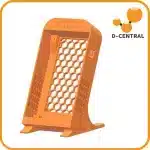
D-Central created the original Bitaxe Mesh Stand — the first stand ever manufactured for the Bitaxe. The mesh design is not just aesthetic; it provides optimal airflow for passive cooling by allowing convective air movement around the heatsink and PCB. For fanless models, proper airflow is critical to maintaining stable temperatures under continuous 24/7 operation.
The Bitaxe Mesh Stand ($14.99 CAD) is 3D-printed in Canada with universal Bitaxe compatibility.
Cases and Enclosures (Optional)
Cases are purely optional — many miners prefer the open-board aesthetic. But if you want protection or a specific look, options include:
- Bitaxe Mini Miner DIY Kit — Enclosure and cooling upgrade in one package
- Bitaxe Hex Case — Purpose-built for the larger Hex form factor
- Bitaxe Argon THRML Noctua Socket — Premium cooling socket with Noctua-grade thermal management
- Infinity Case (2-pack) — Modular, clippable cases for building an expandable mining rack
For the complete breakdown of every available accessory — power supplies, heatsinks, stands, cases, sockets, and more — read our Complete Bitaxe Accessories Guide.
Solo Mining Expectations: Honest Numbers
Here is where we tell you the truth that most sellers will not. Solo mining with a Bitaxe is lottery mining. It is not about daily profitability — it is about the thrill of possibility, the principle of decentralization, and the conviction that every hash counts.
The Math
Bitcoin’s total network hashrate currently exceeds 700 EH/s (700,000,000 TH/s). A Bitaxe Supra produces ~0.0005 TH/s (500 GH/s). Let us put that in perspective:
| Model | Hashrate | Share of Network | Expected Time to Solo Block | Daily Power Cost* |
|---|---|---|---|---|
| Supra / Ultra | ~500 GH/s | ~0.0000000007% | ~2,700+ years | ~$0.03 |
| Gamma | ~1.2 TH/s | ~0.0000000017% | ~1,100+ years | ~$0.04 |
| GT | ~1.5 TH/s | ~0.0000000021% | ~900+ years | ~$0.05 |
| Hex | ~3 TH/s | ~0.0000000043% | ~450+ years | ~$0.20 |
| 10x Gamma fleet | ~12 TH/s | ~0.0000000017% | ~110+ years | ~$0.43 |
*Estimated at $0.12 CAD/kWh average Canadian residential rate.
Those numbers look daunting — and they should. But here is what they do not tell you:
- Mining is probabilistic, not sequential. You do not have to wait 2,700 years. Every single hash has the same chance of being the winning hash. Block finding follows a Poisson distribution: you could find one tomorrow, or never. A Bitaxe with 500 GH/s has the same chance of finding the next block as it does of finding the block ten years from now. Each hash is an independent roll of the dice.
- The current block reward is 3.125 BTC. At today’s prices, that is roughly $280,000-$310,000 CAD. One block. One hash. That is the bet.
- The cost to play is negligible. At $0.03-$0.20 per day, a Bitaxe costs less than a cup of coffee per month to operate. There are few lotteries in the world where the ticket costs this little and the prize pool is this large.
- You are mining for more than money. Every hash your Bitaxe produces is a hash that did not come from a corporate data center. You are contributing to Bitcoin’s decentralization — the entire reason this technology exists. This is about technology, sovereignty, and participation in the most decentralized monetary network ever created.
- It has been done. Solo Bitaxe miners have found blocks. It is not theoretical. The historic first pleb block mined by a Bitaxe proved that these machines can and do produce winning hashes.
Every hash counts.
For a comprehensive deep dive into solo mining strategy, probability math, and the philosophy behind lottery mining, read our Complete Guide to Solo Bitcoin Mining.
Where to Buy Your Bitaxe
Bitaxe is open-source hardware — anyone can manufacture it. So where you buy matters. You want a supplier who actually understands these devices, tests them, supports them, and has been part of the ecosystem from the beginning.
D-Central Technologies: Canada’s Bitaxe Pioneer
D-Central Technologies has been building, selling, and supporting Bitaxe miners since the project’s early days. We are not resellers who jumped on a trend. We are pioneers who helped shape the ecosystem:
- Created the original Bitaxe Mesh Stand — the first stand ever manufactured for the Bitaxe, now widely imitated across the ecosystem
- Developed custom heatsinks for both the standard Bitaxe and the Hex — engineered from hands-on thermal testing in our workshop
- Stock every Bitaxe variant — Ultra, Supra, Gamma, Hex, GT, plus every accessory, power supply, case, and stand
- Also carry the full open-source lineup — NerdAxe, NerdNOS, Nerdminer, NerdQAxe++, and more
- Canadian warehouse in Laval, Quebec — fast shipping across North America, no cross-border surprises for Canadian buyers
- Expert support — our team uses, tests, overclocks, and repairs these devices daily. When you have a question, you are talking to people who know the hardware inside and out
- ASIC repair expertise — as Canada’s leading Bitcoin ASIC repair shop with 8+ years of experience since 2016, we bring hardware knowledge that pure resellers simply do not have
Shop the Bitaxe lineup:
| Model | Price (CAD) | Link |
|---|---|---|
| The Bitaxe (Ultra) | $189.99 | Shop Now |
| BitSupra 1368 (Supra) | $245.00 | Shop Now |
| The Modern Minibit Gamma | $229.99 | Shop Now |
| The Bitaxe GT | $319.99 | Shop Now |
| The Bitaxe Hex | $499.99 | Shop Now |
| Bitaxe DIY Kit | $120.00 | Shop Now |
Setup Quick-Start: Get Mining in Minutes
Setting up a Bitaxe is refreshingly simple compared to traditional ASIC miners. No ethernet cables, no custom firmware flashing, no noise isolation — just power, WiFi, and a solo mining pool. Here is the quick version:
- Connect power — Plug in your 5V power supply (12V for the Hex). The OLED display lights up immediately.
- Connect to WiFi — The Bitaxe creates its own WiFi access point on first boot (named something like “Bitaxe_XXXX”). Connect to it from your phone or laptop, then enter your home WiFi credentials through the setup page.
- Configure AxeOS — Once connected to your home network, open the Bitaxe’s web interface in any browser (its IP address is shown on the OLED display). Enter your Bitcoin address, select a solo mining pool (public-pool.io is the most popular — free, no registration required), and configure your desired clock speed.
- Start mining — Hit save and restart. Watch the OLED display light up with your hashrate, temperature, best share difficulty, and uptime counter. You are now a solo Bitcoin miner.
Total setup time: 5-10 minutes. No technical expertise required.
For detailed, model-specific setup walkthroughs with screenshots, advanced configuration options, and optimal overclocking settings, follow the appropriate guide:
- Bitaxe Supra Setup Guide — Complete BM1366 solo miner configuration
- Bitaxe Ultra Setup Guide — Complete BM1366 solo miner configuration
- Bitaxe Gamma Setup Guide — Complete BM1370 solo miner configuration
- Bitaxe Hex Setup Guide — 6-chip BM1366 solo miner configuration
- Bitaxe GT Setup Guide — BM1370 solo miner configuration
Once you are up and running, explore overclocking to squeeze more hashrate from your chip, bookmark our troubleshooting guide for any issues that come up, and keep your firmware current with our firmware update guide.
Frequently Asked Questions
Is Bitaxe solo mining profitable?
Not in the traditional, predictable-income sense. Solo mining with a Bitaxe is lottery mining — the probability of finding a block with any individual unit is extremely low. However, the operating cost is negligible (pennies per day), and the potential reward for finding a block is 3.125 BTC (currently worth roughly $280,000-$310,000 CAD). Think of it less as a business and more as the cheapest lottery ticket with the best odds-to-payout ratio you will find anywhere. Beyond economics, you are actively participating in Bitcoin’s decentralization — and that has value that cannot be measured in satoshis. This is about technology and sovereignty, not investment returns.
Which Bitaxe model has the best chance of finding a block?
The Bitaxe Hex at ~3 TH/s has roughly 6x the chance of any single-chip BM1366 model. But “best chance” is relative — all Bitaxe models have extremely low probabilities against the global network hashrate. If maximizing solo mining odds is your goal, running multiple units increases your total hashrate and therefore your probability linearly. Two Gammas (~2.4 TH/s combined) are cheaper than a Hex (~3 TH/s) and nearly as effective. The math is simple: more total hashrate equals better odds, regardless of how many devices produce it.
Can I mine altcoins with Bitaxe?
No. The Bitaxe uses Bitmain’s SHA-256 ASIC chips (BM1366 or BM1370), which are hardwired to perform SHA-256 computations only. This means the Bitaxe can only mine Bitcoin (and other SHA-256 coins, though there is no good reason to mine anything other than Bitcoin). You cannot mine Litecoin, Ethereum, Monero, or any coin that uses a different hashing algorithm. This is a Bitcoin-only device — which, frankly, is a feature, not a limitation.
How much electricity does a Bitaxe use?
Very little. Single-chip models (Supra, Ultra, Gamma, GT) draw between 12-18 watts — roughly the same as an LED light bulb. At typical Canadian electricity rates ($0.12/kWh), that is about $0.03-$0.05 per day, or roughly $1-$1.50 per month. The Hex draws ~70W due to its six chips, costing about $0.20/day or ~$6/month. For comparison, a full-size Antminer S19 draws 3,250W and costs over $9/day. A Bitaxe is a rounding error on your power bill.
Is the Bitaxe loud?
Single-chip models (Supra, Ultra, Gamma, GT) are completely silent — they use passive cooling with no fans at all. You can run them on your desk, in your bedroom, or anywhere in your home without any noise whatsoever. The Hex has a small active fan that produces a quiet hum — noticeable in a silent room but far quieter than a laptop fan. None of the Bitaxe models are remotely comparable to the jet-engine roar of industrial ASIC miners like the Antminer S19 or S21.
Can I run multiple Bitaxe units at the same time?
Absolutely. Many serious solo miners run racks of Bitaxe units to increase their total hashrate. Each unit operates independently on your WiFi network with its own power supply, pointed at the same solo mining pool with the same Bitcoin address. There is no limit to how many you can run — your only constraints are power outlets and WiFi bandwidth (which is minimal per device). Some miners run 10, 20, even 50+ units. The Infinity Case system is designed specifically for building multi-unit racks.
What is AxeOS?
AxeOS is the open-source firmware that runs on every Bitaxe. It provides a web-based interface (accessible from any browser on your local network) where you configure your WiFi, mining pool, Bitcoin address, clock speed, and voltage settings. It also displays real-time stats including hashrate, temperature, share count, best difficulty share, and uptime. AxeOS is actively developed by the open-source community and receives regular updates with new features and performance improvements. You can update it over-the-air (OTA) directly from the web interface — no cables or special tools required. For detailed instructions, see our Bitaxe Firmware Update Guide.
How does Bitaxe compare to NerdAxe?
Both are open-source solo Bitcoin miners, but they target different niches. The Bitaxe uses Bitmain’s latest ASIC chips (BM1366/BM1370) and delivers significantly higher hashrate — 500 GH/s to 3 TH/s depending on model. The NerdAxe uses a BM1397 chip and produces lower hashrate at lower power, making it more of an educational and hobbyist device. For serious solo mining, the Bitaxe is the stronger choice. For a detailed head-to-head breakdown covering specs, performance, community support, and use cases, read our Bitaxe vs NerdAxe Comparison Guide.
Does D-Central manufacture Bitaxe?
D-Central is a Bitaxe pioneer and manufacturer, involved in the ecosystem since its earliest days. The Bitaxe is open-source hardware — the schematics and PCB designs are publicly available for anyone to manufacture. D-Central has been among the first to build Bitaxe units and has also developed original accessories that have become standard in the ecosystem — including the original Mesh Stand and custom heatsinks for both the standard Bitaxe and the Hex. We also created the BitSupra 1368, a custom Bitaxe Supra configuration. We are not just sellers — we are builders who helped shape the ecosystem from the ground up.
Can I overclock my Bitaxe?
Yes, and it is one of the best parts of owning one. AxeOS gives you direct control over the ASIC chip’s core voltage and clock frequency. By increasing these values, you can push your Bitaxe beyond stock hashrate — a Supra/Ultra can go from ~500 GH/s to 600-700+ GH/s with proper cooling, and a Gamma can push well beyond 1.2 TH/s. The key is adequate cooling: this is where D-Central’s Premium Heatsink and the Mesh Stand earn their keep. Start conservative, increase incrementally, monitor temperatures, and never exceed thermal limits. Our Definitive Overclocking Manual covers every model with specific settings, frequencies, voltages, and thermal guidance.
What pool should I use for solo mining?
The most popular solo mining pool for Bitaxe is public-pool.io (web.public-pool.io). It is completely free, requires no registration — just point your Bitaxe at it with your Bitcoin address and start mining. Another solid option is Solo CKPool (solo.ckpool.org), which charges a 2% fee only if you find a block. The beauty of solo mining is simplicity: you are not splitting rewards with anyone. If your Bitaxe finds a block, the entire 3.125 BTC reward goes to your address.
Is the Bitaxe DIY Kit a good option for beginners?
The Bitaxe DIY Kit ($120.00 CAD) is an excellent option if you enjoy building things and want to understand your miner at the component level. It comes with all the parts needed to assemble a working Bitaxe. However, if you just want to start mining quickly without soldering, a pre-assembled unit is the way to go. The DIY kit is best suited for makers, electronics hobbyists, and anyone who wants the satisfaction of building their own Bitcoin miner from parts.
Start Mining Today
The Bitaxe is more than a piece of hardware. It is a statement. It says that Bitcoin mining does not belong exclusively to corporations with megawatt power contracts and warehouse-scale operations. It says that open-source hardware can carry the same chips that power the most advanced commercial miners in the world. It says that every hash counts — whether it comes from a 200-megawatt data center or a silent board sitting on your desk next to your coffee mug.
D-Central Technologies has been part of this movement since the beginning. We were among the first to stock Bitaxe, the first to manufacture the Mesh Stand, and the first to develop custom heatsinks engineered specifically for these machines. When you buy from D-Central, you are buying from people who believe in what this technology represents — the decentralization of every layer of Bitcoin mining.
Pick your model. Plug it in. Point it at a pool. Every hash you generate is one more hash that did not come from a corporate mining farm. And one of those hashes — maybe the next one — might just be worth 3.125 BTC.
Explore the full Bitaxe lineup at D-Central Technologies
Need help choosing? Explore the Bitaxe Hub for the complete ecosystem guide, or visit our Getting Started page. We are Bitcoin Mining Hackers, and we are here to help you join the decentralization revolution.
Is Bitaxe solo mining profitable?
Not in the traditional, predictable-income sense. Solo mining with a Bitaxe is lottery mining — the probability of finding a block with any individual unit is extremely low. However, the operating cost is negligible (pennies per day), and the potential reward for finding a block is 3.125 BTC (currently worth roughly $280,000-$310,000 CAD). Think of it less as a business and more as the cheapest lottery ticket with the best odds-to-payout ratio you will find anywhere. Beyond economics, you…
Which Bitaxe model has the best chance of finding a block?
The Bitaxe Hex at ~3 TH/s has roughly 6x the chance of any single-chip BM1366 model. But “best chance” is relative — all Bitaxe models have extremely low probabilities against the global network hashrate. If maximizing solo mining odds is your goal, running multiple units increases your total hashrate and therefore your probability linearly. Two Gammas (~2.4 TH/s combined) are cheaper than a Hex (~3 TH/s) and nearly as effective. The math is simple: more total hashrate equals better odds,…
Can I mine altcoins with Bitaxe?
No. The Bitaxe uses Bitmain’s SHA-256 ASIC chips (BM1366 or BM1370), which are hardwired to perform SHA-256 computations only. This means the Bitaxe can only mine Bitcoin (and other SHA-256 coins, though there is no good reason to mine anything other than Bitcoin). You cannot mine Litecoin, Ethereum, Monero, or any coin that uses a different hashing algorithm. This is a Bitcoin-only device — which, frankly, is a feature, not a limitation.
How much electricity does a Bitaxe use?
Very little. Single-chip models (Supra, Ultra, Gamma, GT) draw between 12-18 watts — roughly the same as an LED light bulb. At typical Canadian electricity rates ($0.12/kWh), that is about $0.03-$0.05 per day, or roughly $1-$1.50 per month. The Hex draws ~70W due to its six chips, costing about $0.20/day or ~$6/month. For comparison, a full-size Antminer S19 draws 3,250W and costs over $9/day. A Bitaxe is a rounding error on your power bill.
Is the Bitaxe loud?
Single-chip models (Supra, Ultra, Gamma, GT) are completely silent — they use passive cooling with no fans at all. You can run them on your desk, in your bedroom, or anywhere in your home without any noise whatsoever. The Hex has a small active fan that produces a quiet hum — noticeable in a silent room but far quieter than a laptop fan. None of the Bitaxe models are remotely comparable to the jet-engine roar of industrial ASIC miners like the Antminer S19 or S21.
Can I run multiple Bitaxe units at the same time?
Absolutely. Many serious solo miners run racks of Bitaxe units to increase their total hashrate. Each unit operates independently on your WiFi network with its own power supply, pointed at the same solo mining pool with the same Bitcoin address. There is no limit to how many you can run — your only constraints are power outlets and WiFi bandwidth (which is minimal per device). Some miners run 10, 20, even 50+ units. The Infinity Case system is designed specifically for building multi-unit…
What is AxeOS?
AxeOS is the open-source firmware that runs on every Bitaxe. It provides a web-based interface (accessible from any browser on your local network) where you configure your WiFi, mining pool, Bitcoin address, clock speed, and voltage settings. It also displays real-time stats including hashrate, temperature, share count, best difficulty share, and uptime. AxeOS is actively developed by the open-source community and receives regular updates with new features and performance improvements. You…
How does Bitaxe compare to NerdAxe?
Both are open-source solo Bitcoin miners, but they target different niches. The Bitaxe uses Bitmain’s latest ASIC chips (BM1366/BM1370) and delivers significantly higher hashrate — 500 GH/s to 3 TH/s depending on model. The NerdAxe uses a BM1397 chip and produces lower hashrate at lower power, making it more of an educational and hobbyist device. For serious solo mining, the Bitaxe is the stronger choice. For a detailed head-to-head breakdown covering specs, performance, community support,…
Does D-Central manufacture Bitaxe?
D-Central is a Bitaxe pioneer and manufacturer, involved in the ecosystem since its earliest days. The Bitaxe is open-source hardware — the schematics and PCB designs are publicly available for anyone to manufacture. D-Central has been among the first to build Bitaxe units and has also developed original accessories that have become standard in the ecosystem — including the original Mesh Stand and custom heatsinks for both the standard Bitaxe and the Hex. We also created the BitSupra…
Can I overclock my Bitaxe?
Yes, and it is one of the best parts of owning one. AxeOS gives you direct control over the ASIC chip’s core voltage and clock frequency. By increasing these values, you can push your Bitaxe beyond stock hashrate — a Supra/Ultra can go from ~500 GH/s to 600-700+ GH/s with proper cooling, and a Gamma can push well beyond 1.2 TH/s. The key is adequate cooling: this is where D-Central’s Premium Heatsink and the Mesh Stand earn their keep. Start conservative, increase incrementally, monitor…
What pool should I use for solo mining?
The most popular solo mining pool for Bitaxe is public-pool.io (web.public-pool.io). It is completely free, requires no registration — just point your Bitaxe at it with your Bitcoin address and start mining. Another solid option is Solo CKPool (solo.ckpool.org), which charges a 2% fee only if you find a block. The beauty of solo mining is simplicity: you are not splitting rewards with anyone. If your Bitaxe finds a block, the entire 3.125 BTC reward goes to your address.
Is the Bitaxe DIY Kit a good option for beginners?
The Bitaxe DIY Kit ($120.00 CAD) is an excellent option if you enjoy building things and want to understand your miner at the component level. It comes with all the parts needed to assemble a working Bitaxe. However, if you just want to start mining quickly without soldering, a pre-assembled unit is the way to go. The DIY kit is best suited for makers, electronics hobbyists, and anyone who wants the satisfaction of building their own Bitcoin miner from parts.