

Bitmain Antminer X5
Réponse rapide
The Bitmain Antminer X5 is a Randomx miner rated about 212 KH/s at roughly 1,350 W. An industrial-class unit — loud and power-hungry, best suited to a dedicated mining space, not living areas.
Heater-Class Miner
At 1,350W, this miner outputs approximately 4606 BTU/hr of heat — equivalent to a standard electric space heater. Every watt consumed by an ASIC miner is converted to heat with 100% efficiency, making it a space heater that also mines Bitcoin.
During heating season, miner heat can offset part of the heat a room would otherwise need from another electric heater. The economics depend on your electricity rate, room heat demand, BTC price, network difficulty, and noise constraints.
Calculateur de rentabilité
| Period | Revenue | Electricity Cost | Profit |
|---|---|---|---|
| Daily | $0.00 | $2.27 | $-2.27 |
| Weekly | $0.00 | $15.88 | $-15.88 |
| Monthly | $0.00 | $68.04 | $-68.04 |
| Yearly | $0.00 | $827.82 | $-827.82 |
Heating offset estimates the value of heat replacing an electric space heater during heating season (~6 months/year in Canada). Actual savings depend on your heating setup and climate.
Where to Buy the Bitmain Antminer X5
D-Central Technologies is a Bitcoin-only company. For this miner, check out our trusted partner retailers below.
ASIC Miner Market
United StatesWide selection of new and used ASIC miners. US-based shipping.
MagasinerMinersDeals
United StatesCompetitive prices on new ASIC miners with coupon codes.
MagasinerPartner links may earn D-Central a commission at no extra cost to you. Have you considered Bitcoin mining instead? Explore Bitcoin miners →
Full Specifications
| Model | Bitmain Antminer X5 |
|---|---|
| Model Number | Antminer X5 |
| Manufacturer | Bitmain |
| Algorithme | Randomx |
| Coins Mined | Monero (XMR) |
| Taux de hachage | 212 KH/s |
| Consommation électrique | 1,350 W |
| Efficiency | 6.37 J/KH |
| Dimensions | 597*317*427mm |
| BTU Output | 4606 BTU/hr |
| Equivalent Heater | Half a standard space heater (4,606 BTU/hr) |
| Daily Power Cost | $2.27/day |
| Monthly Power Cost | $68.04/mo |
| Circuit Requirement | Standard 120V 15A |
| Release Date | 2023-09-01 |
| MSRP | $2,200.00 |
| État | Active |
Home Mining Assessment
The Antminer X5 is Bitmain’s purpose-built RandomX miner for Monero (XMR), rated at roughly 212 KH/s while pulling about 1,350 W at the wall. It is one of the very few ASIC-class machines aimed at an algorithm that was explicitly designed to resist them — powerful, niche, and worth understanding fully before you buy.
What makes the X5 different: a RandomX ASIC, not a hashboard
Almost every Antminer in our database is a SHA-256 machine: a Bitmain control board feeding a string of fixed-function hashing chips on one or more hashboards. The X5 belongs to a separate lineage entirely. It targets RandomX, the proof-of-work that Monero adopted in 2019 specifically to keep mining on commodity CPUs and out of reach of specialized hardware. That single design choice changes everything about how the X5 has to be built.
RandomX is deliberately memory-hard and CPU-oriented. Rather than running one tight, repeatable hashing pipeline, it executes randomized programs against a large dataset held in fast memory, leaning on integer and floating-point math, AES rounds, and frequent random memory access. A fixed SHA-256 datapath cannot do any of that. So where a SHA-256 hashboard is a row of identical hashing engines, a RandomX miner has to behave more like a dense array of small, programmable processors paired with substantial high-speed memory and a wide memory bus. In practical terms the X5 is closer to a purpose-built parallel processor than to the classic Antminer hashboard, and its larger 597 × 317 × 427 mm chassis reflects the extra silicon, memory, and cooling that approach demands.
Because the underlying silicon and memory layout are not published by Bitmain and are not in our component teardown library, we deliberately keep the chip-level claims qualitative here. We would rather tell you exactly what we know and where the public record stops than print a fabricated chip count or process node. What we can say with confidence is architectural: this is a Bitmain-controlled, closed platform built around the memory-hard demands of RandomX, and it shares the broad control-board / power-supply / thermal-stack pattern common to Bitmain hardware that we service every day.
Real-world power and efficiency
The X5’s nameplate is about 1,350 W, and that is close to what you should expect at the wall for a unit running stock at room temperature. Heat output follows directly: roughly 4,600 BTU/h, enough to warm a small room and a genuine consideration for siting the machine.
Efficiency is where the X5 needs to be read carefully. Hash-per-watt only means something when the units match the algorithm, and RandomX hashrate is measured in kilohashes per second (KH/s), not terahashes. The honest figure is power divided by hashrate:
- ~1,350 W ÷ ~212 KH/s ≈ 6.4 watts per KH/s, i.e. about 6.4 J/KH.
Any « J/TH » number attached to a RandomX device is a unit artifact — terahash efficiency simply doesn’t describe a Monero miner, so judge the X5 in J/KH and against the thing it actually replaces: a stack of CPUs.
| RandomX mining | Antminer X5 (one unit) | High-end desktop CPU (typical) |
|---|---|---|
| Hashrate | ~212 KH/s | roughly 10–15 KH/s |
| Power draw | ~1,350 W | ~100–200 W (whole system) |
| Footprint | single appliance | a full PC each |
| Flexibility | RandomX only | general-purpose computer |
On those numbers, one X5 does the work of roughly a dozen or more high-end CPUs in a single box, which is the entire reason the machine exists and the entire reason it is controversial (more on that below). As with any miner, the headline draw is not fixed in stone: stock firmware leaves some room to trade hashrate against power and heat. We catalogue achievable operating points and tuning behaviour across the Antminer range on our ASIC power profiles reference — the X5’s stock controls are narrower than the deep autotuning you get on third-party SHA-256 firmware, so treat its tuning headroom as modest rather than generous.
Firmware compatibility — the honest picture
This is the part most listings gloss over. The X5 runs Bitmain’s stock firmware and, realistically, nothing else. The vibrant aftermarket firmware ecosystem — the BraiinsOS+, VNish and LuxOS world — is built for SHA-256 Antminers (with a little Scrypt coverage). None of it targets RandomX hardware. The features people associate with custom firmware on an S19 or S21 — aggressive per-domain voltage tuning, runtime autotuners, advanced pool handling, Stratum V2 on BraiinsOS+ — have no equivalent build for the X5.
Our own work, including the DCENT_OS firmware project, is likewise focused on the SHA-256 Antminer platforms we have reverse-engineered in depth; the X5 is not a DCENT_OS target. We mention this so you go in with accurate expectations: if open firmware, custom autotuning, or Stratum V2 are decisive for you, the X5 is not the machine, and we will tell you so. For Monero, the X5 mines to standard RandomX pools through its stock software stack, configured the same way you would point any pooled miner at a Monero pool.
Common faults and troubleshooting
The X5 is a different beast internally, but its failure surface is the familiar Bitmain pattern, and the same disciplined diagnostic order applies:
- Power supply — at ~1,350 W continuous, the PSU runs hard and is a frequent first suspect for dead units, random reboots, or a machine that won’t start under load.
- Compute/board faults — a board that drops offline, under-performs, or fails its self-check. On a SHA-256 miner this is a « missing ASICs » symptom; on the X5 it shows as lost or degraded hashrate from an affected board.
- Thermal and fan issues — memory-heavy silicon and 1,350 W of heat make airflow critical. Choked intakes, failed fans, or dust will push the unit into throttling or protective shutdown.
- Control board and network — no web UI, no IP report, or a unit that won’t take a pool config usually points at the control board, its storage, or the network path rather than the hashing hardware.
Work the problem in that order — power, then thermals, then board, then control/network — before you condemn any expensive component. Our interactive ASIC fault finder walks Bitmain symptoms (no hashrate, won’t power on, reboots, overheating, network-unreachable) down to likely causes and is the fastest way to triage an X5 that is misbehaving.
Repair and longevity
D-Central has repaired Bitmain hardware at the component level since 2016, and the skills transfer directly to the X5: PSU diagnosis and rebuild, board-level fault tracing, thermal restoration, fan and connector work, and control-board recovery. That matters more for a niche machine than for a mainstream S19. Spares and swap-units for a low-volume RandomX product are simply harder to source than for the millions of SHA-256 Antminers in the field, which makes proper diagnosis and repair — rather than wholesale board replacement — the realistic path to keeping an X5 productive over the long haul.
If your X5 (or any Bitmain unit) is down, our ASIC repair service can assess it, and an honest assessment is part of the deal: there are cases where a memory-hard, single-purpose machine is no longer worth restoring, and we would rather say so than bill you for a rebuild that doesn’t pay back. We have a lot of respect for what Bitmain pulled off in productizing RandomX in silicon at all — building any of this is hard — and our goal is to keep the hardware that already exists running as long as it sensibly can.
Who the X5 is for — and the catch worth knowing
The X5 makes sense for a fairly specific operator: someone who wants meaningful Monero hashrate without running and cooling a rack of CPUs, who can use roughly 4,600 BTU/h of waste heat productively, or who values direct XMR exposure through proof-of-work rather than buying coins. With a home-mining profile around the middle of the pack, it is happiest in a dedicated, ventilated space rather than a living room.
The catch is structural and you should weigh it honestly. RandomX was created to keep Monero mining decentralized and CPU-friendly, and much of the Monero community regards purpose-built ASICs as a centralizing threat to exactly that goal. Monero has a track record of periodic protocol tweaks, and a future RandomX adjustment could blunt or even neutralize a specialized machine’s advantage in a way it never could for SHA-256 hardware. That tail risk doesn’t make the X5 a bad machine — it makes it a machine to size to a payback horizon you are comfortable with, not an open-ended asset like a Bitcoin miner. If you want to compare it against the rest of the field or talk through whether it fits your setup, browse the D-Central catalog or reach out before you commit.
Generational context
The X5 represents Bitmain pushing ASIC design into territory long considered off-limits. For years RandomX, alongside a handful of other « ASIC-resistant » algorithms, was held up as proof that some coins could stay CPU-egalitarian. The X5 is a concrete counter-example: with enough engineering and enough memory on the board, even a deliberately memory-hard, CPU-oriented algorithm can be accelerated in custom hardware. It sits in the same broader story as ASICs arriving for other once-« resistant » algorithms — a reminder that « ASIC-proof » is usually « ASIC-not-yet, » and that the economics of decentralization are decided as much by who controls the hardware as by the math in the proof-of-work. For D-Central, that is the through-line: understand the machine honestly, keep it running, and never lose sight of why the decentralization debate around it matters.
Broken miner? Get a real quote.
Tell us the symptom and get an instant repair-tier estimate ($95 / $145 / $195 CAD). Mail-in from across Canada, bench in Laval, Quebec.
Send it to D-Central — start a repair →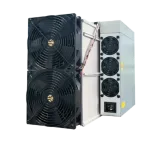
Comparer le Bitmain Antminer X5
Foire aux questions
What are the current mining economics for the Bitmain Antminer X5?
At $0.07/kWh, the Bitmain Antminer X5 currently shows an estimated daily net cost of $2.27 before pool fees and hardware cost. Lower electricity rates, network changes, BTC price changes, or useful heat recovery can change the result.
Can I mine Bitcoin at home with the Bitmain Antminer X5?
The Bitmain Antminer X5 has a home mining score of 22/100. With 0 dB noise and 1,350W power draw, it may require a dedicated space like a garage, basement, or outdoor enclosure. Consider noise insulation and proper ventilation.
Can the Bitmain Antminer X5 heat my home?
The Bitmain Antminer X5 outputs approximately 4606 BTU/hr of heat. For reference, a typical space heater produces 5,000-5,500 BTU/hr. All electrical energy consumed by the miner is converted to heat, making it 100% efficient as a heater. D-Central offers Bitcoin Space Heater builds designed specifically for home heating integration.
What power supply does the Bitmain Antminer X5 need?
The Bitmain Antminer X5 draws 1,350W of power. You need a power supply rated for at least 1,485W with appropriate voltage (200-240V AC). D-Central stocks compatible power supplies in our shop. Always use a quality PSU from a reputable manufacturer to protect the miner and wiring.