
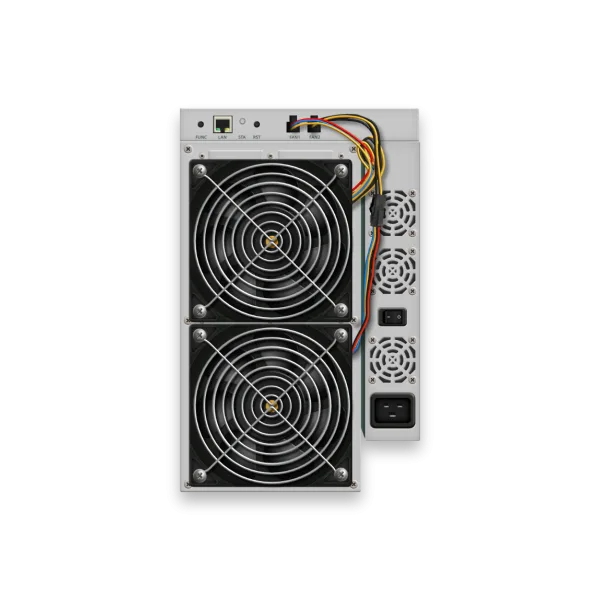
Avalon A1246
Older-gen Canaan miner, affordable entry to institutional mining hardware
Réponse rapide
The Avalon A1246 is a Bitcoin miner rated about 90 TH/s at roughly 3,420 W (about 38 J/TH), built on the A1246 ASIC. An industrial-class unit — loud and power-hungry, best suited to a dedicated mining space, not living areas.
Professional-Grade Miner
This miner draws 3,420W and produces 75 dB of noise — it is designed for dedicated mining environments, not living spaces. Professional-grade miners deliver the highest hashrate and revenue per unit but require proper infrastructure: a 240V circuit, adequate ventilation or exhaust ducting, and a space where noise is not a concern (garage, basement, warehouse, or outdoor enclosure).
For home miners looking for a quieter alternative, consider our Bitcoin Space Heater builds or explore open-source miners like the Bitaxe that are purpose-built for residential environments.
Heater-Class Miner
At 3,420W, this miner outputs approximately 11669 BTU/hr of heat — equivalent to a standard electric space heater. Every watt consumed by an ASIC miner is converted to heat with 100% efficiency, making it a space heater that also mines Bitcoin.
During heating season, miner heat can offset part of the heat a room would otherwise need from another electric heater. The economics depend on your electricity rate, room heat demand, BTC price, network difficulty, and noise constraints.
Calculateur de rentabilité
| Period | Revenue | Electricity Cost | Profit |
|---|---|---|---|
| Daily | $2.78 | $5.75 | $-2.96 |
| Weekly | $19.49 | $40.22 | $-20.73 |
| Monthly | $83.54 | $172.37 | $-88.83 |
| Yearly | $1,016.42 | $2,097.14 | $-1,080.73 |
Heating offset estimates the value of heat replacing an electric space heater during heating season (~6 months/year in Canada). Actual savings depend on your heating setup and climate.
Where to Buy the Avalon A1246
D-Central Technologies
CanadaBitcoin Mining Hackers since 2016. Ships from Laval, Quebec.
magasiner le materiel de minage BitcoinASIC Miner Market
United StatesWide selection of new and used ASIC miners. US-based shipping.
MagasinerMinersDeals
United StatesCompetitive prices on new ASIC miners with coupon codes.
MagasinerFull Specifications
| Model | Avalon A1246 |
|---|---|
| Model Number | A1246 |
| Manufacturer | Canaan |
| Algorithme | SHA-256 |
| Coins Mined | Bitcoin (BTC) |
| Taux de hachage | 90 TH/s |
| Consommation électrique | 3,420 W |
| Efficiency | 38 J/TH |
| Niveau de bruit | 75 dB |
| Chip Model | A1246 |
| Cooling | Air |
| Voltage Range | 200-240V AC |
| Operating Temperature | 5-40°C |
| Dimensions | 331x195x292 |
| Weight | 12.3 |
| Interface | Ethernet |
| BTU Output | 11669 BTU/hr |
| Equivalent Heater | Equal to a 3,420W space heater |
| Daily Power Cost | $5.75/day |
| Monthly Power Cost | $172.37/mo |
| Circuit Requirement | 240V circuit required |
| Release Date | 2021-03-01 |
| MSRP | $1,800.00 |
| État | Active |
Home Mining Assessment
Older-gen Canaan miner, affordable entry to institutional mining hardware
The Avalon A1246 is Canaan’s 2021 air-cooled SHA-256 workhorse, rated at 90 TH/s for about 3,420 W (roughly 38 J/TH). Built on the 12th-generation Avalon ASIC and a RISC-V Kendryte K210 control board, it is a previous-generation industrial miner that still earns its keep on cheap power or as a heat source.
Chip and hashboard architecture
The A1246 belongs to Canaan’s A12 series (12th generation, 2021). Canaan designs its SHA-256 silicon in-house — a lineage that traces directly back to the Avalon 1 of 2013, the first Bitcoin ASIC ever shipped — and the A1246 runs the A3200-family chip used across the A11/A12 platform. Canaan has never published the exact process geometry for this part, so we will not guess at a node figure: what matters in practice is that it sits a couple of generations behind the TSMC 5 nm silicon Canaan later moved to in the A15/A16 chips, which is why its efficiency reads « older-gen. »
Each hash board carries 120 chips arranged in 40 groups of three in parallel, wired as series chains across the board. The A1246 delivers its 90 TH/s across Canaan’s standard three-board A12 chassis. This series-chain topology is worth understanding before you ever open the lid: because the chips in a group sit in an electrical chain, a single failed die can take its whole group — and sometimes a larger sub-chain — offline, which is why a dead chip on an Avalon often shows up as a step-down in board hashrate or a low ASIC count rather than a clean single-chip fault.
The Kendryte K210 control board
Where Antminers run an ARM Cortex-A9 on a Xilinx Zynq SoC, the A1246 is driven by Canaan’s own Kendryte K210 — a dual-core 64-bit RISC-V SoC on TSMC 28 nm, clocked up to 400 MHz with roughly 8 MB of on-chip SRAM (6 MB general + 2 MB AI) and no external DDR. That tiny memory footprint means the control board runs FreeRTOS bare-metal, not Linux, and there is no SSH shell in stock firmware. Communication to the hash boards is direct SoC-to-board over SPI; there is no FPGA sitting between controller and chips, and there is no PIC microcontroller on the hash boards the way there is on an Antminer.
Power on each board is split into separate voltage domains — a variable Vcore plus fixed VTOP (~0.75 V) and VDDIO (~1.8 V) rails — with 12 V from the PSU boosted to around 17.7 V internally on the board. Voltage is controlled per domain, directly by the SoC over SPI, not per individual chip and not through a PIC. Each board also carries two 10K NTC thermistors (TH1/TH2) for thermal monitoring. The practical upshot is a control architecture that is genuinely simpler than an Antminer’s at the protocol level, but far more locked down at the firmware level.
Real-world power and efficiency
The 3,420 W nameplate is measured at the board; at the wall you should budget a few percent more for PSU conversion loss, so plan for roughly 3,600 W on a dedicated 200–240 V circuit (the A1246 will not run on standard North American 120 V). At 38 J/TH, the A1246 lands squarely in the previous-generation efficiency tier — competitive against the Antminer S19 and Whatsminer M30S era of 2020–2021, but well behind anything 5 nm. That math is the whole story for this miner: it makes sense where electricity is cheap, or where the roughly 11,669 BTU/h of waste heat is doing double duty warming a space.
Tuning headroom is modest and honest. The stock firmware exposes a workmode setting (normal versus performance) that trades a little more power for a little more hashrate, and Canaan’s privileged API can nudge frequency and voltage — but none of this turns a 38 J/TH machine into an efficient one, and aggressive settings void Canaan’s warranty. For where the realistic tuning envelope sits on this class of hardware, see our ASIC power profiles database. Treat the A1246 as a fixed-efficiency machine you site around cheap energy, not one you tune your way to profitability.
Firmware compatibility
Out of the box the A1246 runs Canaan’s stock MM (Miner Manager) firmware with a CGMiner 4.11.1 fork underneath. You get a web dashboard on port 80 (config-mode default IP 192.168.168.168), the standard CGMiner JSON API on port 4028 for monitoring and pool control, and a Windows-based AvalonMiner upgrade tool for firmware. Monitoring stacks such as pyasic and most ASIC management toolboxes speak to it over that same port-4028 API.
The honest third-party reality is short: there is no aftermarket firmware for the A1246. BraiinsOS+, VNish, LuxOS and ePIC all target Antminer (and in some cases Whatsminer) hardware — none of them support Avalon. The K210’s bare-metal FreeRTOS environment, with no Linux and no shell, is a fundamentally different and much harder target than an ARM-Linux Antminer, which is why no custom-firmware community has formed around the industrial K210 Avalons. Our own DCENT_OS firmware work centres on Antminer-class hardware; the K210 industrial Avalons remain research territory, not a supported flash target, and we would rather tell you that plainly than oversell it. If you want to tune an A1246, you are working within Canaan’s stock workmode and privileged API — nothing more.
Common faults and troubleshooting
The A1246’s failure modes track its architecture. The most common is reduced or zero hashrate from a hash board: because the chips run in series groups, one dead die drops a whole group, so the symptom is usually a board reporting a low ASIC count or a chunk of missing terahash rather than a clean single-chip error. Other frequent calls are thermal and fan faults (the dual-fan, 75 dB cooling system is the first thing to check when boards throttle or shut down), PSU faults, and a hash board that fails to be detected at boot.
Work through symptoms methodically with our ASIC fault finder, which maps observed behaviour to likely root cause, and cross-reference any on-screen or API status text against our error-code library. Many « dead miner » cases on this platform are a single failed group, a tired fan, or a thermistor reading out of range — not a write-off.
Repair and longevity
D-Central has been repairing ASICs in-house in Laval since 2016, and the A1246 is firmly in our wheelhouse — we maintain published repair documentation for the closely related AvalonMiner 1146, and that A11/A12-family knowledge carries straight across. Board-level work on the A1246 includes diagnosing and reflowing or replacing failed chips in a series group, testing the Vcore/VTOP/VDDIO domains and the internal boost stage against their test points, and chasing fan, thermistor and PSU faults. Because the control board has no PIC and no FPGA, much of the diagnostic complexity that bogs down Antminer repairs simply isn’t present here — the hard part is chip-level board work, which is exactly what a proper repair bench is for.
An A1246 that is kept clean, cool and on a healthy PSU has years of useful life left as a low-cost or heat-reuse machine. If yours has dropped a board or stopped hashing, see our ASIC repair service before retiring it.
Who the A1246 is for
This is a machine for operators with genuinely cheap power, for heat-reuse setups where the ~11,669 BTU/h is a feature rather than a cost, and for hobbyists who want a real industrial miner on a secondhand budget. It is not the right pick if you are chasing efficiency — at 38 J/TH it will be outrun on any normal power tariff by newer hardware. If efficiency is your priority, compare it against current-generation models in our miner comparison tool and browse the full ASIC miner database. And if what actually draws you to the A1246 is the idea of hacking on open mining hardware, a Bitaxe-class open-source miner is a far better tinkering platform than a locked-down K210 Avalon. Units and current pricing live in our shop.
Generational context
Canaan occupies a respected place in mining history: the Avalon 1 was the first Bitcoin ASIC to ship, and the company has designed its own SHA-256 silicon ever since. The A1246 was the 2021 flagship of the air-cooled A12 line, going head-to-head with the Antminer S19 and Whatsminer M30S. Canaan has since iterated steadily — the table below shows how the A1246 sits against the generations that followed, culminating in the 5 nm A15 silicon that finally closed much of the efficiency gap to Bitmain.
| Model | Generation | Hashrate | Power | Efficiency | Year |
|---|---|---|---|---|---|
| Avalon A1246 | A12 | 90 TH/s | 3,420 W | 38 J/TH | 2021 |
| Avalon A1346 | A13 | 110 TH/s | 3,300 W | 30 J/TH | 2022 |
| Avalon A1366 | A13 | 130 TH/s | 3,250 W | 25 J/TH | 2022 |
| Avalon A1466 | A14 | 150 TH/s | 3,230 W | 21.5 J/TH | 2023 |
| Avalon A1566 | A15 (5 nm) | 185 TH/s | 3,420 W | 18.5 J/TH | 2024 |
Avalon A1246 specifications at a glance
| Specification | Value |
|---|---|
| Algorithm | SHA-256 (Bitcoin) |
| Hashrate | 90 TH/s |
| Power consumption | 3,420 W (nameplate) |
| Efficiency | 38 J/TH |
| ASIC chip | A12-series (A3200 family), Canaan in-house |
| Hash board layout | 120 chips/board, 40 groups of 3 in series chains |
| Control board | Kendryte K210 (dual-core RISC-V, FreeRTOS) |
| Cooling | Air, dual fan |
| Noise level | 75 dB |
| Input voltage | 200–240 V AC |
| Operating temperature | 5–40 °C |
| Network interface | Ethernet |
| Heat output | ~11,669 BTU/h |
| Weight | 12.3 kg |
| Dimensions | 331 × 195 × 292 mm |
| Released | 2021 |
Specifications and architecture details above are cross-checked against D-Central’s internal Bitcoin mining hardware reference. For live profitability math and side-by-side comparisons, use the calculators on this page and our comparison tool.
Broken miner? Get a real quote.
Tell us the symptom and get an instant repair-tier estimate ($95 / $145 / $195 CAD). Mail-in from across Canada, bench in Laval, Quebec.
Send it to D-Central — start a repair →Related Miners
MicroBT WhatsMiner M79S
Antminer S21
Antminer S19 Pro
Ebang Ebit E12+
Foire aux questions
What are the current mining economics for the Avalon A1246?
At $0.07/kWh, the Avalon A1246 currently shows an estimated daily net cost of $2.96 before pool fees and hardware cost. Lower electricity rates, network changes, BTC price changes, or useful heat recovery can change the result.
Can I mine Bitcoin at home with the Avalon A1246?
The Avalon A1246 has a home mining score of 8/100. With 75 dB noise and 3,420W power draw, it may require a dedicated space like a garage, basement, or outdoor enclosure. Consider noise insulation and proper ventilation.
Can the Avalon A1246 heat my home?
The Avalon A1246 outputs approximately 11669 BTU/hr of heat. For reference, a typical space heater produces 5,000-5,500 BTU/hr. All electrical energy consumed by the miner is converted to heat, making it 100% efficient as a heater. D-Central offers Bitcoin Space Heater builds designed specifically for home heating integration.
Does D-Central repair the Avalon A1246?
Yes, D-Central provides professional repair services for the Avalon A1246. Services include hashboard repair, control board diagnostics, fan replacement, and full refurbishment. Ship your miner to our Laval, Quebec facility for diagnosis and repair.
What power supply does the Avalon A1246 need?
The Avalon A1246 draws 3,420W of power. You need a power supply rated for at least 3,762W with appropriate voltage (200-240V AC). D-Central stocks compatible power supplies in our shop. Always use a quality PSU from a reputable manufacturer to protect the miner and wiring.