
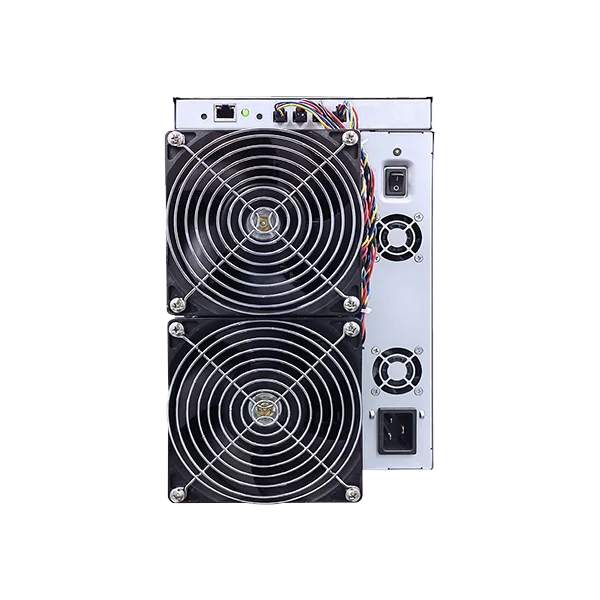
Avalon A1366
Solid mid-range Canaan offering, good availability on secondary market
Réponse rapide
The Avalon A1366 is a Bitcoin miner rated about 130 TH/s at roughly 3,250 W (about 25 J/TH), built on the A1366 ASIC. An industrial-class unit — loud and power-hungry, best suited to a dedicated mining space, not living areas.
Professional-Grade Miner
This miner draws 3,250W and produces 75 dB of noise — it is designed for dedicated mining environments, not living spaces. Professional-grade miners deliver the highest hashrate and revenue per unit but require proper infrastructure: a 240V circuit, adequate ventilation or exhaust ducting, and a space where noise is not a concern (garage, basement, warehouse, or outdoor enclosure).
For home miners looking for a quieter alternative, consider our Bitcoin Space Heater builds or explore open-source miners like the Bitaxe that are purpose-built for residential environments.
Heater-Class Miner
At 3,250W, this miner outputs approximately 11089 BTU/hr of heat — equivalent to a standard electric space heater. Every watt consumed by an ASIC miner is converted to heat with 100% efficiency, making it a space heater that also mines Bitcoin.
During heating season, miner heat can offset part of the heat a room would otherwise need from another electric heater. The economics depend on your electricity rate, room heat demand, BTC price, network difficulty, and noise constraints.
Calculateur de rentabilité
| Period | Revenue | Electricity Cost | Profit |
|---|---|---|---|
| Daily | $4.02 | $5.46 | $-1.44 |
| Weekly | $28.13 | $38.22 | $-10.09 |
| Monthly | $120.54 | $163.80 | $-43.26 |
| Yearly | $1,466.56 | $1,992.90 | $-526.34 |
Heating offset estimates the value of heat replacing an electric space heater during heating season (~6 months/year in Canada). Actual savings depend on your heating setup and climate.
Where to Buy the Avalon A1366
D-Central Technologies
CanadaBitcoin Mining Hackers since 2016. Ships from Laval, Quebec.
magasiner le materiel de minage BitcoinASIC Miner Market
United StatesWide selection of new and used ASIC miners. US-based shipping.
MagasinerMinersDeals
United StatesCompetitive prices on new ASIC miners with coupon codes.
MagasinerFull Specifications
| Model | Avalon A1366 |
|---|---|
| Model Number | A1366 |
| Manufacturer | Canaan |
| Algorithme | SHA-256 |
| Coins Mined | Bitcoin (BTC) |
| Taux de hachage | 130 TH/s |
| Consommation électrique | 3,250 W |
| Efficiency | 25 J/TH |
| Niveau de bruit | 75 dB |
| Chip Model | A1366 |
| Cooling | Air |
| Voltage Range | 200-240V AC |
| Operating Temperature | 5-40°C |
| Dimensions | 360x170x282 |
| Weight | 12.6 |
| Interface | Ethernet |
| BTU Output | 11089 BTU/hr |
| Equivalent Heater | Equal to a 3,250W space heater |
| Daily Power Cost | $5.46/day |
| Monthly Power Cost | $163.80/mo |
| Circuit Requirement | 240V circuit required |
| Release Date | 2023-06-01 |
| MSRP | $3,500.00 |
| État | Active |
Home Mining Assessment
Solid mid-range Canaan offering, good availability on secondary market
The Avalon A1366 is Canaan’s air-cooled SHA-256 Bitcoin miner rated at 130 TH/s for about 3,250 W, or roughly 25 J/TH. Part of the A13-series industrial line built on a Kendryte K210 controller and A3200-family silicon, it suits dedicated mining spaces where cheap power, or reusable heat, offsets its mid-generation efficiency.
Chip and hashboard architecture
The A1366 belongs to Canaan’s second-generation integrated-controller era. Where Bitmain’s Antminers pair a hashboard PIC microcontroller with a Xilinx Zynq FPGA, the Avalon takes a deliberately simpler route: a single Kendryte K210 system-on-chip drives the hashboards directly. The K210 is a dual-core 64-bit RISC-V processor clocked up to 400 MHz on a TSMC 28 nm node, with roughly 8 MB of on-chip SRAM and no external DDR. That means it runs Canaan’s bare-metal FreeRTOS firmware rather than a full Linux userspace — a smaller attack surface, but also far fewer hooks for tinkering. The same MM-series control board is shared across the A1346, A1366, A1446, A1466 and A1566, so board-level parts and diagnostics carry across the family.
Hashing is done by Canaan’s A3200-family ASIC (the A13 line uses A3200/A3200C-Plus-class silicon, the higher-binned sibling of the chip in the 110 TH/s-class A1346). Canaan has never published a public datasheet for this part, so its exact process node is not officially documented — independent estimates place it in the 7 nm-class range, and we treat any tighter figure as unverified. Inside each hashboard the chips are wired as daisy-chained serial groups — clock (CKin/CKout), control (Cin/Cout), reset (Rin/Rout) and data (Din/Dout) lines pass through the chain, with a 4 MHz working clock and a ~6.1 MHz transmission clock. Canaan does not publish the per-board chip count for the A13 series; for reference, the earlier A1146 carried 72 A3206 chips in a 12×6 grid, while the A11/A12 boards ran 120 chips in 40 series groups. The practical takeaway is the same: because the chips sit in series, a single failed ASIC can drop an entire chain or board offline, which is exactly what board-level repair is built to chase down.
Each hashboard exposes several power domains — a variable Vcore plus fixed VTOP (0.75 V) and VDDIO (1.8 V) rails — fed from 12 V DC and boosted internally (to roughly 17.7 V on some boards). Voltage is regulated per power domain by the K210 controller, not per individual chip, and there is genuinely no PIC microcontroller on the board — frequency and voltage are set directly by the SoC over the MM/SPI link. Two NTC 10K thermistors per board (TH1/TH2) feed temperature back to the controller, and a 2×7-pin (14-pin) connector carries data and power between each board and the control board.
Real-world power and efficiency
The A1366’s nameplate is 130 TH/s at 3,250 W, which works out to the advertised 25 J/TH. As with every ASIC, treat those as factory figures: real wall draw varies with ambient temperature, PSU efficiency, AC voltage, and the inevitable hashrate variance between individual chips. Plan your circuit and PDU budget around a measured wall figure with headroom above 3,250 W rather than the nameplate, especially in a warm room where the fans spin harder and the silicon leaks more current. The unit expects a 200–240 V AC supply and an operating range of 5–40 °C; pushing intake temperatures toward the top of that band is the fastest way to lose efficiency and stability.
Tuning headroom on a stock A1366 is modest. Canaan’s firmware exposes a coarse work-mode toggle (a normal and a higher-output « performance » mode) rather than the fine-grained autotuning curves miners expect on Antminers. There is a lightly documented privileged API that can nudge frequency and voltage, but it is poorly described, easy to get wrong, and will void your warranty. Because tuning is per-domain and set at runtime by the controller, the most reliable gains come from the basics: clean power, cool dense intake air, good board-to-board thermal balance, and firmware kept current. For the full picture on how voltage/frequency tuning behaves across ASIC platforms, see our ASIC power profiles database.
Firmware compatibility
Stock, the A1366 runs Canaan’s MM firmware with a CGMiner-derived mining stack. You manage it through a web dashboard on port 80 (default config-mode address 192.168.168.168) and a CGMiner API on port 4028; there is no SSH and no Linux shell, because the K210 simply isn’t running Linux. Pool connectivity is Stratum V1 — among today’s firmwares, only Braiins OS+ natively speaks Stratum V2, and that firmware does not run on Avalon hardware.
Third-party firmware reality for this machine is blunt: there is effectively none. Braiins OS+, and the other popular Antminer/WhatsMiner aftermarket builds, do not support Canaan Avalons. The open-source and jailbreak activity in the Avalon world targets the newer K230-based home units (the Nano 3S, Mini 3 and Q), not the K210 industrial boards inside the A1366. Our own custom-firmware work follows the same line — it focuses on platforms where a Linux control plane and a real toolchain exist, so this K210 industrial Avalon is not a target. In practice you keep an A1366 on well-maintained stock firmware and manage fleets through the CGMiner API or a compatible monitoring tool. That’s not a knock on Canaan — they remain the most open of the major manufacturers, publishing CGMiner drivers, FPGA sources and recent K230 firmware — it’s simply where this particular generation sits.
Common faults and troubleshooting
Most A1366 problems present at the hashboard. The classic symptom is a board reading zero or reduced hashrate, an ASIC count mismatch, or a chain that fails detection — usually one dead or marginal chip breaking the series daisy-chain. Temperature faults from a failed or drifting NTC thermistor, fan errors, and PSU sag under load are the next most common culprits. Start by pulling estats from the CGMiner API, which reports per-chip temperatures, voltages, frequencies and fan speeds; a single board running cold (no heat, no hash) versus hot-and-stalled tells you very different stories.
Work through the obvious first: confirm clean 200–240 V power, reseat the 2×7-pin data/power connectors, verify both fans spin and that intake air is genuinely cool, and check for dust packing the heatsinks. If a single board is dark while the others hash, the fault is almost always on that board, not the controller. For a guided, symptom-first diagnostic path, run the machine through our ASIC fault finder, which maps error patterns to likely board-, PSU- and controller-level causes.
Repair and longevity
Daisy-chained ASICs are exactly why a 25 J/TH machine like the A1366 stays economically alive: one bad chip shouldn’t condemn a whole board. D-Central has run an in-house ASIC repair bench since 2016, and we service Canaan Avalon hashboards — chip-level fault isolation, reflow and chip replacement, voltage-domain and thermistor diagnosis, connector and boost-converter repair. Because the A1366 shares its MM control board with the rest of the A13/A14/A15 family, control-board spares and know-how are well established. Keeping a unit in service — rather than scrapping a board over a single failed chip — is the difference between a miner that pays for itself and e-waste. See ASIC repair for the hashboard repair process and turnaround.
Who it’s for and buying
The A1366 is an industrial machine, not a living-room device. At roughly 75 dB it is loud, and it air-cools through high-static-pressure fans that demand real airflow, so it belongs in a dedicated mining space, garage, shop or shed on a 240 V circuit. Its ~3,250 W of draw becomes roughly 11,089 BTU/h of heat — genuinely useful if you can duct it into a workshop or outbuilding through the colder months, turning a heating bill into hashrate. It earns its keep where electricity is cheap, where you can reuse the heat, or where you want hashrate-per-dollar on the secondary market rather than the lowest possible J/TH.
If your priority is a quiet, low-wattage machine for a home or learning setup, this isn’t it — look instead at small open-source units or a home-class miner; if you’re buying at fleet scale and want maximum efficiency, a newer-generation machine will draw less per terahash. To compare the A1366 against current and past hardware on live numbers, use our ASIC miner database, and our shop for what we currently have built or can build to order. We’re not Amazon — units are hand-prepped and bench-tested before they ship, so treat lead times as a quality estimate, not a same-day promise.
Generational context
The A1366 sits in the middle of Canaan’s A-series arc. It is the high-bin sibling of the ~110 TH/s A1346, a step up from the 120-chip A11/A12 generation, and a step below the A1466 and the 5 nm-class A1566 that followed. Released around mid-2023, its 25 J/TH put it competitively between Bitmain’s S19j Pro (~29.5 J/TH) and S19 XP (~21.5 J/TH) — a respectable mid-cycle figure for its day. It has since been superseded at the top of the efficiency charts by sub-20 J/TH machines, which is why it now reads as a value play rather than a flagship.
| Model | ASIC | Hashrate (nameplate) | Wall power | Efficiency (≈) | Cooling |
|---|---|---|---|---|---|
| Avalon A1246 | A3200-family | ~90 TH/s | ~3,420 W | ~38 J/TH | Air |
| Avalon A1346 | A3200C-Plus | ~110 TH/s | ~3,300 W | ~30 J/TH | Air |
| Avalon A1366 | A3200-family | 130 TH/s | 3,250 W | 25 J/TH | Air |
| Avalon A1466 | A3198 | ~150 TH/s | ~3,230 W | ~22 J/TH | Air |
| Avalon A1566 | A3197 (5 nm) | ~185 TH/s | ~3,420 W | ~18–19 J/TH | Air |
Figures are manufacturer nameplate or close approximations and vary by bin, firmware and ambient conditions; only the A1366’s own 130 TH/s / 3,250 W / 25 J/TH line is treated as exact here. For real-time profitability, full specifications and side-by-side comparisons, see the Avalon A1366 entry in our ASIC miner database.
Broken miner? Get a real quote.
Tell us the symptom and get an instant repair-tier estimate ($95 / $145 / $195 CAD). Mail-in from across Canada, bench in Laval, Quebec.
Send it to D-Central — start a repair →Related Miners
MicroBT WhatsMiner M73S+
Bitmain Antminer S19j (90Th)
Bitmain Antminer S19 (95Th)
Bitmain Antminer S11 (20.5Th)
Foire aux questions
What are the current mining economics for the Avalon A1366?
At $0.07/kWh, the Avalon A1366 currently shows an estimated daily net cost of $1.44 before pool fees and hardware cost. Lower electricity rates, network changes, BTC price changes, or useful heat recovery can change the result.
Can I mine Bitcoin at home with the Avalon A1366?
The Avalon A1366 has a home mining score of 8/100. With 75 dB noise and 3,250W power draw, it may require a dedicated space like a garage, basement, or outdoor enclosure. Consider noise insulation and proper ventilation.
Can the Avalon A1366 heat my home?
The Avalon A1366 outputs approximately 11089 BTU/hr of heat. For reference, a typical space heater produces 5,000-5,500 BTU/hr. All electrical energy consumed by the miner is converted to heat, making it 100% efficient as a heater. D-Central offers Bitcoin Space Heater builds designed specifically for home heating integration.
Does D-Central repair the Avalon A1366?
Yes, D-Central provides professional repair services for the Avalon A1366. Services include hashboard repair, control board diagnostics, fan replacement, and full refurbishment. Ship your miner to our Laval, Quebec facility for diagnosis and repair.
What power supply does the Avalon A1366 need?
The Avalon A1366 draws 3,250W of power. You need a power supply rated for at least 3,575W with appropriate voltage (200-240V AC). D-Central stocks compatible power supplies in our shop. Always use a quality PSU from a reputable manufacturer to protect the miner and wiring.