
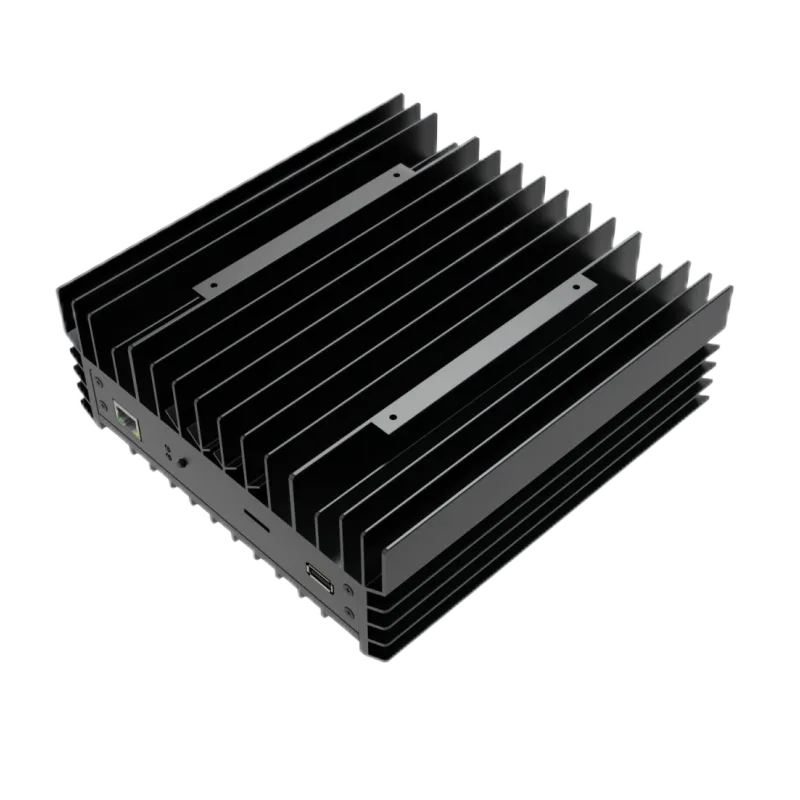
Iceriver RXD RX0
Réponse rapide
The Iceriver RXD RX0 is a Sha512256d miner rated about 260 GH/s at roughly 100 W. Quiet and efficient enough for home or desktop solo mining.
Calculateur de rentabilité
| Period | Revenue | Electricity Cost | Profit |
|---|---|---|---|
| Daily | $0.01 | $0.17 | $-0.16 |
| Weekly | $0.06 | $1.18 | $-1.12 |
| Monthly | $0.24 | $5.04 | $-4.80 |
| Yearly | $2.94 | $61.32 | $-58.38 |
Heating offset estimates the value of heat replacing an electric space heater during heating season (~6 months/year in Canada). Actual savings depend on your heating setup and climate.
Where to Buy the Iceriver RXD RX0
D-Central Technologies is a Bitcoin-only company. For this miner, check out our trusted partner retailers below.
ASIC Miner Market
United StatesWide selection of new and used ASIC miners. US-based shipping.
MagasinerMinersDeals
United StatesCompetitive prices on new ASIC miners with coupon codes.
MagasinerPartner links may earn D-Central a commission at no extra cost to you. Have you considered Bitcoin mining instead? Explore Bitcoin miners →
Full Specifications
| Model | Iceriver RXD RX0 |
|---|---|
| Model Number | RXD RX0 |
| Manufacturer | IceRiver |
| Algorithme | Sha512256d |
| Coins Mined | Radiant (RXD) |
| Taux de hachage | 260 GH/s |
| Consommation électrique | 100 W |
| Efficiency | 0.38 J/GH |
| Niveau de bruit | 10 dB |
| Dimensions | 200*194*74mm |
| Weight | 2.5 |
| BTU Output | 341 BTU/hr |
| Equivalent Heater | Small personal heater (341 BTU/hr) |
| Daily Power Cost | $0.17/day |
| Monthly Power Cost | $5.04/mo |
| Circuit Requirement | Standard 120V 15A |
| Release Date | 2024-09-01 |
| MSRP | $395.00 |
| État | Active |
Home Mining Assessment
The IceRiver RXD RX0 is a compact, near-silent ASIC built for one job: mining Radiant (RXD) on the SHA512/256d algorithm. It delivers roughly 260 GH/s for about 100 W at the wall — an entry-level, low-draw home unit released in September 2024 at a ~$395 MSRP, aimed at hobbyists and network supporters rather than profit-chasers.
At a glance: the RXD RX0 spec sheet
Before going deeper, here is the verified nameplate data for the RX0. The figures below are the manufacturer’s rated values; real-world numbers vary with ambient temperature, your power supply, and pool luck.
| Specification | IceRiver RXD RX0 |
|---|---|
| Algorithm | SHA512/256d |
| Coin mined | Radiant (RXD) |
| Hashrate (nominal) | 260 GH/s |
| Power draw (nameplate) | 100 W |
| Efficiency | ~0.385 J/GH (≈385 J/TH on Radiant’s hash) |
| Rated noise | ~10 dB (effectively silent) |
| Weight | 2.5 kg |
| Dimensions | 200 × 194 × 74 mm |
| Heat output | ~341 BTU/h |
| Released | September 2024 |
| MSRP | ~$395 USD |
| Manufacturer | IceRiver |
A quick accuracy note: this is not a RandomX miner
Radiant is occasionally lumped in with CPU-mined RandomX coins, but that is a misconception worth clearing up. RandomX is deliberately ASIC-resistant and runs on CPUs; Radiant’s proof-of-work is SHA512/256d — a double-pass SHA-512/256 hash that is a perfect fit for purpose-built silicon. The RX0 exists precisely because Radiant’s algorithm can be accelerated in hardware. If a listing tells you this box mines RandomX, the listing is wrong.
Chip and hashboard architecture
IceRiver designs and fabricates its hashing silicon in-house and, like most altcoin-ASIC makers, does not publish chip SKUs, the process node, or per-board chip counts. We will not invent those numbers. What we can describe is how a small single-board miner like this is built and how that shapes its behaviour on the bench.
The RX0 is a self-contained unit: a control board (networking, the web interface, and the hashboard controller), a single hashboard carrying IceRiver’s SHA512/256d ASICs, an integrated or external power stage, and a small fan, all in a compact 200 × 194 × 74 mm chassis. There is no array of redundant boards to fall back on — when one hashboard underperforms, the whole miner’s hashrate drops with it.
One architectural principle is universal across modern mining ASICs, and it is worth understanding before you ever open the case: the chips are wired in series strings and grouped into voltage domains. Each domain shares a single regulated supply across a cluster of chips, so the firmware controls voltage per domain, not per individual chip. That is why a single weak or shorted chip can pull down an entire domain, and why board-level diagnostics start at the domain boundary rather than the chip. The exact domain count on the RX0’s board is not documented by IceRiver — but the principle is the same one our bench applies to every ASIC we open.
Real-world power and efficiency
The 100 W nameplate is the headline number; at the wall you should plan for a little more once you account for power-supply conversion losses and a warm room. Even so, this is a genuinely low-draw device — it sips roughly what a bright incandescent bulb would, and it can run on an ordinary household outlet with no special circuit.
Efficiency deserves a careful caveat. The RX0 works out to about 0.385 joules per gigahash (expressed as ~385 J/TH on Radiant’s own hash). Do not compare that J/TH figure to a Bitcoin S21 or any SHA-256 miner. A « terahash » of SHA512/256d is not the same unit of work as a terahash of SHA-256 or kHeavyHash — the algorithms are different, so cross-algorithm efficiency comparisons are meaningless. Judge the RX0 against other Radiant hardware, never against Bitcoin ASICs.
Tuning headroom on a unit this small is modest. Stock IceRiver firmware exposes little of the runtime autotuning surface that defines high-end Bitcoin miners, so there is not much to « profile » here. If you have arrived from our ASIC power profiles database, note that those undervolt/overclock curves are built for SHA-256 Antminer-class hardware and do not transfer to this device — the RX0 is essentially a run-it-as-shipped appliance.
Firmware and software
Out of the box the RX0 runs IceRiver’s stock firmware with a browser-based dashboard for pool configuration, status, and basic monitoring. For most owners that is the whole story.
On third-party firmware, honesty matters. The mature aftermarket ecosystem people associate with mining — BraiinsOS+, VNish, LuxOS — was written for Bitcoin SHA-256 Antminers and Whatsminers, not for niche Radiant ASICs. There is no equivalent drop-in alternative firmware for the RX0, and you should treat any claim otherwise with suspicion. The same applies to advanced protocol support: among the common firmwares, only BraiinsOS+ natively speaks Stratum V2, and that is a Bitcoin-world capability that simply does not reach this hardware. Our own DCENT_OS work likewise targets SHA-256 Antminers — it is not a fit for this miner, and we would rather tell you that plainly than pretend otherwise.
Common faults and troubleshooting
Small single-board ASICs tend to fail in predictable places. In order of how often we see them across compact home miners:
- Power stage / brick: the most common point of failure on low-wattage units — a dead supply presents as a miner that won’t power on.
- Fan failure: a stalled or noisy fan leads to thermal throttling or shutdown; on a single-fan design this is a single point of failure worth checking first.
- Control-board / network faults: no web interface, no DHCP lease, or a unit that hashes but won’t report — usually a control-board or connectivity issue rather than a hashing one.
- Hashboard degradation: a gradual hashrate drop or rising hardware-error rate points to a weak voltage domain or an aging chip in the series string.
- Heat and dust: even a near-silent 100 W box needs clear airflow; choked intakes are a slow killer.
For a structured walkthrough, our ASIC fault finder maps symptoms to likely causes. It is written primarily around Antminer and Whatsminer behaviour, but the diagnostic logic — isolate power, then thermals, then the hashboard, then the controller — transfers cleanly to a unit like the RX0.
Repair and longevity
D-Central has run an in-house ASIC repair bench in Laval since 2016, and the discipline we apply to a hashboard — domain-by-domain voltage checks, thermal imaging, reflow and component-level rework — is hardware-agnostic in principle. The honest qualifier is that our deepest parts inventory and tooling are built around Bitcoin SHA-256 hardware; niche altcoin ASICs like the RX0 are a smaller part of the repair world, and component availability differs.
If your RX0 has gone dark, the pragmatic path is the same: confirm the power stage, rule out the fan and controller, and only then suspect the hashboard. If it does come down to board-level work, talk to us about ASIC repair before you write the unit off — we would rather check whether a fix is realistic than see working silicon land in a drawer. For a model this specialised, reach out to confirm coverage rather than assuming it; we will be straight with you about what we can and can’t economically repair.
Who it’s for, and buying
The RX0 is not a profit machine, and it would be dishonest to sell it as one. Its real appeal is in three things: it is quiet (rated near-silent), it is low-power (100 W runs anywhere), and it lets you point real hashrate at the Radiant network from home. That makes it a fit for hobbyists, learners who want hands-on time with an ASIC, and Radiant supporters who value contributing to the chain over chasing a payback period.
A word on the « space heater » angle, since it gets oversold on small miners: at ~341 BTU/h, the RX0 produces about a tenth of the heat of a single 1,000 W Bitcoin miner. It will not warm a room — its low draw is a feature for silent, always-on operation, not a heating strategy. Set expectations accordingly.
If you are comparing it against other hardware, browse the full ASIC miner database, and see our shop for what we currently stock and build. If your goal is the Bitcoin equivalent — a low-power, learn-by-doing home miner — the same catalog will point you toward SHA-256 options better suited to that chain.
Generational and ecosystem context
IceRiver made its name as one of the first vendors to ship accessible Kaspa (kHeavyHash) ASICs, then broadened into a range of single-algorithm altcoin miners. The RXD RX0, launched in September 2024, slots in at the entry level of that lineup as a purpose-built Radiant unit — credit where it’s due, IceRiver put usable, plug-in hardware in the hands of a small community that previously had few options.
There is a tension worth naming. Purpose-built ASICs concentrate a small network’s hashrate among whoever can buy and run them, which is a centralizing pressure on a young chain. The counterweight is distribution: the more independent operators run their own boxes from their own homes, the more decentralized the network’s hashpower becomes. A miner like the RX0, sitting silently on a shelf and pointed at a pool you chose, is one more layer of that decentralization — and that, more than any profitability spreadsheet, is the honest case for owning one.
Broken miner? Get a real quote.
Tell us the symptom and get an instant repair-tier estimate ($95 / $145 / $195 CAD). Mail-in from across Canada, bench in Laval, Quebec.
Send it to D-Central — start a repair →
Foire aux questions
What are the current mining economics for the Iceriver RXD RX0?
At $0.07/kWh, the Iceriver RXD RX0 currently shows an estimated daily net cost of $0.16 before pool fees and hardware cost. Lower electricity rates, network changes, BTC price changes, or useful heat recovery can change the result.
Can I mine Bitcoin at home with the Iceriver RXD RX0?
Yes, the Iceriver RXD RX0 scores 100/100 for home mining viability. It produces 10 dB of noise and draws 100W. It is suitable for home environments with appropriate placement considerations.
Can the Iceriver RXD RX0 heat my home?
The Iceriver RXD RX0 outputs approximately 341 BTU/hr of heat. For reference, a typical space heater produces 5,000-5,500 BTU/hr. All electrical energy consumed by the miner is converted to heat, making it 100% efficient as a heater. D-Central offers Bitcoin Space Heater builds designed specifically for home heating integration.
What power supply does the Iceriver RXD RX0 need?
The Iceriver RXD RX0 draws 100W of power. You need a power supply rated for at least 110W with appropriate voltage (200-240V AC). D-Central stocks compatible power supplies in our shop. Always use a quality PSU from a reputable manufacturer to protect the miner and wiring.