
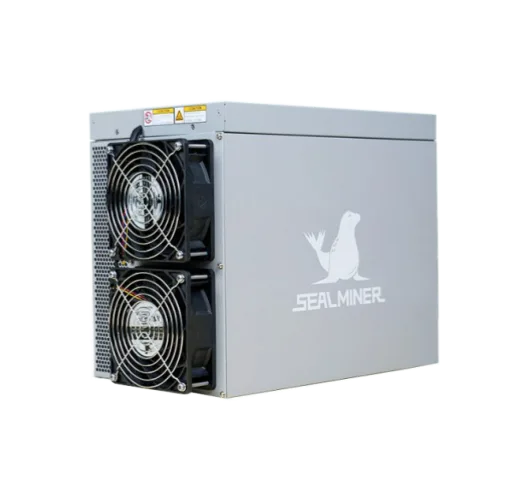
Bitdeer SealMiner A2 Pro Air
Réponse rapide
The Bitdeer SealMiner A2 Pro Air is a Bitcoin miner rated about 255 TH/s at roughly 3,790 W (about 14.9 J/TH). An industrial-class unit — loud and power-hungry, best suited to a dedicated mining space, not living areas.
Professional-Grade Miner
This miner draws 3,790W and produces 75 dB of noise — it is designed for dedicated mining environments, not living spaces. Professional-grade miners deliver the highest hashrate and revenue per unit but require proper infrastructure: a 240V circuit, adequate ventilation or exhaust ducting, and a space where noise is not a concern (garage, basement, warehouse, or outdoor enclosure).
For home miners looking for a quieter alternative, consider our Bitcoin Space Heater builds or explore open-source miners like the Bitaxe that are purpose-built for residential environments.
Calculateur de rentabilité
| Period | Revenue | Electricity Cost | Profit |
|---|---|---|---|
| Daily | $8.10 | $6.37 | $1.73 |
| Weekly | $56.69 | $44.57 | $12.12 |
| Monthly | $242.97 | $191.02 | $51.95 |
| Yearly | $2,956.09 | $2,324.03 | $632.06 |
Heating offset estimates the value of heat replacing an electric space heater during heating season (~6 months/year in Canada). Actual savings depend on your heating setup and climate.
Where to Buy the Bitdeer SealMiner A2 Pro Air
D-Central Technologies
CanadaBitcoin Mining Hackers since 2016. Ships from Laval, Quebec.
magasiner le materiel de minage BitcoinASIC Miner Market
United StatesWide selection of new and used ASIC miners. US-based shipping.
MagasinerMinersDeals
United StatesCompetitive prices on new ASIC miners with coupon codes.
MagasinerFull Specifications
| Model | Bitdeer SealMiner A2 Pro Air |
|---|---|
| Model Number | SealMiner A2 Pro Air |
| Manufacturer | Bitdeer |
| Algorithme | SHA-256 |
| Coins Mined | Bitcoin (BTC) |
| Taux de hachage | 255 TH/s |
| Consommation électrique | 3,790 W |
| Efficiency | 14.9 J/TH |
| Niveau de bruit | 75 dB |
| Dimensions | 197*365*292mm |
| Weight | 15.5 |
| BTU Output | 12931 BTU/hr |
| Equivalent Heater | Equal to a 3,790W space heater |
| Daily Power Cost | $6.37/day |
| Monthly Power Cost | $191.02/mo |
| Circuit Requirement | 240V circuit required |
| Release Date | 2025-03-01 |
| MSRP | $4,000.00 |
| État | Active |
Home Mining Assessment
The Bitdeer SealMiner A2 Pro Air is an air-cooled SHA-256 Bitcoin miner built on Bitdeer’s in-house SEAL02 ASIC. It delivers a nameplate 255 TH/s at 3,790 W — roughly 14.9 J/TH — putting air-cooled efficiency into territory that, a generation ago, demanded a liquid loop. It launched in March 2025 at an MSRP near US$4,000.
What makes the A2 Pro Air notable is not the spec sheet alone but who built the silicon. For years, serious Bitcoin hashrate meant Bitmain, MicroBT, or Canaan. With the SEAL chip family, Bitdeer joined that short list of companies designing their own SHA-256 ASICs rather than buying or rebadging someone else’s. This page covers what is under the lid, how the machine behaves on a real circuit, the honest firmware situation, and how D-Central keeps these units hashing for the long haul.
Chip and hashboard architecture
The A2 Pro Air runs on the SEAL02, the second generation of Bitdeer’s proprietary SHA-256 ASIC line. The SEAL family follows the same logic every modern ASIC designer uses: pack as many hashing cores as the process node allows onto a die, then wire many of those dies into series strings across a hash board. D-Central’s silicon research tracks the SEAL roadmap closely — we can confirm the later SEAL03 (in the A3 Pro Air) is a 4 nm part — which places the earlier SEAL02 a node behind it. We do not publish a verified process-node figure for the SEAL02 itself, so we leave that qualitative rather than guess; the practical takeaway is that this is mature, field-proven Bitdeer silicon one step below the company’s current flagship die.
Architecturally, the A2 Pro Air follows the topology shared by essentially every air-cooled SHA-256 machine: a Linux control board orchestrates the run, talks to the hash boards over flat ribbon cabling, and drives the fans, while the hash boards carry the ASICs and the power-delivery network. Two points matter for anyone planning to own or service one:
- Voltage is controlled per domain, not per chip. The ASICs are grouped into series-string voltage domains, and the regulator sets a voltage for the whole domain at once. There is no individual per-chip voltage knob on this hardware — a detail that decides how the machine is tuned and how it fails. When one chip in a string degrades, it drags its entire domain, which is why a single weak ASIC can knock out a measurable slice of a board’s hashrate rather than just its own contribution.
- Chips are wired in chains across the boards. A break anywhere in a chain — a cracked solder joint, a dead chip, a damaged data trace — stops communication for everything downstream of the fault. That is the single most common reason a board reports a partial or zero hashrate.
We deliberately do not publish a hard per-board chip count for the A2 Pro Air. Manufacturers revise board layouts across production runs, and D-Central only states counts we have confirmed on the bench. What is universal is the series-string domain structure above — and that is what governs both tuning headroom and repairability.
Real-world power and efficiency
The 14.9 J/TH on the box is a nameplate figure: hashrate divided by rated draw under good conditions. At the wall you should plan for a little more, because PSU conversion losses, fan power, and a warm intake all push real consumption above the rating. Budget around 3,790 W of continuous draw and size the circuit accordingly. At that wattage the A2 Pro Air is a 200–240 V machine in practice — on 240 V it pulls roughly 16 A, comfortably inside a 20 A circuit, whereas on standard 120 V it would demand over 30 A, which no ordinary household receptacle supports.
To put 14.9 J/TH in context, here is where the A2 Pro Air sits against the SEAL line and the mainstream Antminer reference point, using D-Central’s firmware-profile research for the comparison figures:
| Miner | Chip | Cooling | Hashrate | Power | Efficiency |
|---|---|---|---|---|---|
| Bitdeer SealMiner A2 Pro Air | SEAL02 | Air | 255 TH/s | 3,790 W | ~14.9 J/TH |
| Antminer S21 (reference) | BM1368 | Air | ~200 TH/s | ~3,500 W | ~17.5–18 J/TH |
| Bitdeer SealMiner A3 Pro Air | SEAL03 (4 nm) | Air | — | — | ~11 J/TH |
| Bitdeer SealMiner A4 Ultra Hydro | SEAL04 | Hydro | — | — | ~9.45 J/TH |
A2 Pro Air figures are manufacturer nameplate; comparison efficiencies draw on D-Central’s firmware and chip research. Hashrate/power cells are left blank where we do not publish a verified nameplate.
The honest read: at 14.9 J/TH on air, the A2 Pro Air is meaningfully more efficient than a mainstream air-cooled S21, and it reaches a figure that the previous Antminer generation generally needed liquid cooling to hit. It is not as efficient as Bitdeer’s own newer 4 nm A3 Pro Air or the hydro A4 — that is simply generational progress, not a knock on this machine.
On tuning headroom: modern SHA-256 firmware uses power-targeting autotuners, where you pick a watt or hashrate target and the firmware calculates the frequency and voltage to hit it at runtime. Those values are computed live for your specific unit’s silicon quality — they are not fixed presets baked into a table, and two « identical » machines will land on slightly different voltages for the same target. If you want to see how efficiency curves bend as you trade hashrate for watts across the broader ASIC field, our ASIC power profiles database lays out the underclock/overclock behavior model by model.
Firmware compatibility
The A2 Pro Air ships with and runs Bitdeer’s stock firmware, and for this machine that is realistically the only firmware option today. The popular aftermarket firmwares — BraiinsOS+, VNish, LuxOS — were built around Bitmain (and in some cases MicroBT) control platforms and chip protocols. They do not target Bitdeer’s SEAL hardware. If native Stratum V2 matters to your operation, note that BraiinsOS+ is the firmware that natively supports it, and it does not run on this machine; the A2 Pro Air reaches V2 pools only through proxy arrangements, not on-box.
D-Central’s own DCENT_OS firmware effort is real but deliberately scoped. It is a beta, GPL-3.0 project (public beta open since 9 July 2026) focused on the control platforms we have reverse-engineered in depth — primarily the Amlogic-based Antminer line. We are not going to claim SealMiner support we have not shipped. The honest position is straightforward: today, an A2 Pro Air is a stock-firmware machine, and that is fine — Bitdeer’s firmware runs the autotuner, exposes the pool config, and reports per-board status well enough to operate and to diagnose.
Common faults and troubleshooting
SEAL silicon is new, but the failure physics of an air-cooled SHA-256 miner are not. The fault patterns we see on the bench are the same ones that have plagued every generation of hashing hardware:
- Board drops to partial or zero hashrate — usually a broken chain: a dead ASIC, a cracked solder ball under thermal cycling, or a damaged data line. Because chips run in series strings, the fault stops everything downstream of it, not just the bad chip.
- One domain reads low — a degrading chip dragging its whole voltage domain, the direct consequence of per-domain (not per-chip) regulation.
- Thermal throttling and shutdowns — clogged fins, a failing fan, dried thermal interface material, or simply too-warm intake air. The A2 Pro Air moves a lot of heat (around 12,900 BTU/h) and needs real airflow.
- PSU and power faults — undervoltage, a marginal circuit, or a tired supply that can’t hold the rail under full draw.
- Control-board and network issues — the unit hashes but won’t report, or won’t take a pool config; often a network, config, or control-board problem rather than a hash-board one.
Before pulling anything apart, work the symptom logically. Our ASIC fault finder walks you from the symptom — no hashrate, low hashrate, won’t boot, overheating — toward the likely root cause, so you can tell a fan problem from a hash-board problem before you reach for a screwdriver.
Repair and longevity
D-Central has been doing chip-level ASIC repair in-house since 2016, out of Laval, Québec. A SealMiner is newer to the repair channel than a decade of Antminers, and parts availability is genuinely the harder constraint with any recent in-house chip — but the work itself is the same craft. Isolating a failed domain, reflowing or reballing a hash board, finding the broken chip in a chain, bench-testing a suspect PSU, replacing fans and thermal interface: none of that changes because the logo on the chip changed. The series-string domain architecture that makes a single bad chip take down a board is exactly the structure our diagnostic process is built around.
A miner kept clean, kept cool, and repaired at the board level instead of being thrown away is a miner that earns for years longer than one run hard and discarded at the first dead board. If your A2 Pro Air — or any SHA-256 ASIC — drops a board or starts throttling, talk to us about ASIC repair before you write it off.
Who it is for, and buying
The A2 Pro Air is built for people who already have, or are building, a dedicated mining space. At 75 dB it is loud — this is not a machine for a living room or a shared office. It needs a 200–240 V circuit and good airflow, and it throws off serious heat. That heat is an asset if you can use it: roughly 12,900 BTU/h is enough to genuinely warm a workshop, garage, or outbuilding, turning money you’d otherwise spend on heating into hashrate. For a small home-mining operator or a serious hobbyist with the electrical and acoustic situation to support it, the air-cooled SEAL02 efficiency is a strong value proposition.
If you are shopping the wider field, our ASIC miner catalog lets you compare the A2 Pro Air against current Antminer, Whatsminer, and other SealMiner models on hashrate, efficiency, and heat output. And if a 3,790 W industrial machine is more than you want in your home, that is exactly the gap the open-source Bitaxe fills — a single-chip, plug-it-in-anywhere solo miner for learning, lottery mining, and sovereignty, without the noise, the heat, or the 240 V circuit.
Generational context
The A2 Pro Air is one rung on a ladder Bitdeer has been climbing fast. The SEAL line began with the first-generation SEAL chip, matured with the SEAL02 that powers this A2 family, advanced to the 4 nm SEAL03 in the A3 Pro Air at roughly 11 J/TH, and continues into the announced SEAL04 A4 Ultra Hydro at around 9.45 J/TH. The A2 line itself spans both air- and hydro-cooled variants; the Pro Air is the high-spec air-cooled SKU, trading the absolute efficiency of a liquid loop for the simplicity of fans.
It is worth giving credit where it is due. The architecture every one of these machines uses — series-string voltage domains, a Linux control board driving hash boards over ribbon cable, power-targeting autotuners — was defined and refined by the companies that built this industry, Bitmain chief among them. Bitdeer did not reinvent that; it earned its seat at the table the hard way, by taping out its own competitive SHA-256 silicon and shipping it in volume. The A2 Pro Air is the machine where that in-house silicon went from promising to genuinely field-proven, and that is why it remains a sensible, efficient air-cooled choice well into 2026.
Broken miner? Get a real quote.
Tell us the symptom and get an instant repair-tier estimate ($95 / $145 / $195 CAD). Mail-in from across Canada, bench in Laval, Quebec.
Send it to D-Central — start a repair →Related Miners
Whatsminer M50S++
Bitmain S19k Pro
Innosilicon T2 Turbo 29T/30T
Auradine Teraflux AH3880
Comparer le Bitdeer SealMiner A2 Pro Air
Foire aux questions
What are the current mining economics for the Bitdeer SealMiner A2 Pro Air?
At $0.07/kWh electricity, the Bitdeer SealMiner A2 Pro Air currently shows an estimated $1.73 daily net result before pool fees and hardware cost. Results depend on your electricity rate and Bitcoin network conditions. Use the calculator above with your actual electricity rate.
Can I mine Bitcoin at home with the Bitdeer SealMiner A2 Pro Air?
The Bitdeer SealMiner A2 Pro Air has a home mining score of 8/100. With 75 dB noise and 3,790W power draw, it may require a dedicated space like a garage, basement, or outdoor enclosure. Consider noise insulation and proper ventilation.
Can the Bitdeer SealMiner A2 Pro Air heat my home?
The Bitdeer SealMiner A2 Pro Air outputs approximately 12931 BTU/hr of heat. For reference, a typical space heater produces 5,000-5,500 BTU/hr. All electrical energy consumed by the miner is converted to heat, making it 100% efficient as a heater. D-Central offers Bitcoin Space Heater builds designed specifically for home heating integration.
What power supply does the Bitdeer SealMiner A2 Pro Air need?
The Bitdeer SealMiner A2 Pro Air draws 3,790W of power. You need a power supply rated for at least 4,169W with appropriate voltage (200-240V AC). D-Central stocks compatible power supplies in our shop. Always use a quality PSU from a reputable manufacturer to protect the miner and wiring.