
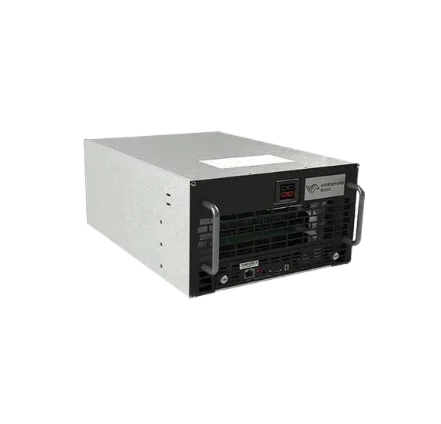
Whatsminer M66S
Next-gen immersion miner from MicroBT with 298 TH/s. Successor to M56 series with improved efficiency.
Réponse rapide
The Whatsminer M66S is a Bitcoin miner rated about 298 TH/s at roughly 5,518 W (about 18.52 J/TH), built on the WM3810 ASIC. An industrial-class unit — loud and power-hungry, best suited to a dedicated mining space, not living areas.
Immersion-Cooled Miner
This miner is designed to operate fully submerged in a dielectric (non-conductive) cooling fluid. Unlike hydro miners that circulate liquid through internal channels, immersion miners have their entire board and chips bathed in engineered coolant inside a specialized tank.
Immersion cooling is the most effective thermal management available for ASIC miners. It eliminates all fan noise (completely silent operation), removes dust and humidity as failure factors, enables maximum overclocking potential, and dramatically extends hardware lifespan by maintaining perfectly even chip temperatures.
The trade-off is infrastructure: immersion requires a tank, dielectric fluid (typically engineered hydrocarbon or synthetic), and a heat exchanger. It is the gold standard for professional mining farms and serious home miners who want maximum performance with zero noise.
Professional-Grade Miner
This miner draws 5,518W and produces 50 dB of noise — it is designed for dedicated mining environments, not living spaces. Professional-grade miners deliver the highest hashrate and revenue per unit but require proper infrastructure: a 240V circuit, adequate ventilation or exhaust ducting, and a space where noise is not a concern (garage, basement, warehouse, or outdoor enclosure).
For home miners looking for a quieter alternative, consider our Bitcoin Space Heater builds or explore open-source miners like the Bitaxe that are purpose-built for residential environments.
Calculateur de rentabilité
| Period | Revenue | Electricity Cost | Profit |
|---|---|---|---|
| Daily | $9.22 | $9.27 | $-0.06 |
| Weekly | $64.51 | $64.89 | $-0.39 |
| Monthly | $276.45 | $278.11 | $-1.65 |
| Yearly | $3,363.53 | $3,383.64 | $-20.11 |
Heating offset estimates the value of heat replacing an electric space heater during heating season (~6 months/year in Canada). Actual savings depend on your heating setup and climate.
Where to Buy the Whatsminer M66S
D-Central Technologies
CanadaBitcoin Mining Hackers since 2016. Ships from Laval, Quebec.
magasiner le materiel de minage BitcoinASIC Miner Market
United StatesWide selection of new and used ASIC miners. US-based shipping.
MagasinerMinersDeals
United StatesCompetitive prices on new ASIC miners with coupon codes.
MagasinerFull Specifications
| Model | Whatsminer M66S |
|---|---|
| Model Number | M66S |
| Manufacturer | MicroBT |
| Algorithme | SHA-256 |
| Coins Mined | Bitcoin (BTC) |
| Taux de hachage | 298 TH/s |
| Consommation électrique | 5,518 W |
| Efficiency | 18.5 J/TH |
| Niveau de bruit | 50 dB |
| Chip Model | WM3810 |
| Cooling | Immersion |
| Voltage Range | 380-480V 3-phase |
| Operating Temperature | 5-45°C |
| Dimensions | 267x147x401 |
| Weight | 13.5 |
| Interface | Ethernet |
| BTU Output | 18827.4 BTU/hr |
| Equivalent Heater | Equal to a 5,518W space heater |
| Daily Power Cost | $9.27/day |
| Monthly Power Cost | $278.11/mo |
| Circuit Requirement | 240V circuit required |
| Release Date | 2024-09-01 |
| MSRP | $8,000.00 |
| État | Active |
Home Mining Assessment
Next-gen immersion miner from MicroBT with 298 TH/s. Successor to M56 series with improved efficiency.
The Whatsminer M66S is MicroBT’s immersion-cooled, M6x-generation Bitcoin (SHA-256) miner: roughly 298 TH/s for about 5,518 W, or 18.52 J/TH. Built around MicroBT’s in-house ASIC on an Allwinner H616 control board, it is an industrial-class unit meant for a dielectric-fluid tank, not a plug-and-play home heater.
M66S at a glance
| Specification | Value |
|---|---|
| Manufacturer | MicroBT (Whatsminer) |
| Algorithm / coin | SHA-256 — Bitcoin (BTC) |
| Hashrate (nameplate) | 298 TH/s |
| Power draw | ~5,518 W |
| Efficiency | 18.52 J/TH |
| Cooling | Single-tank immersion (dielectric fluid) |
| Control board / SoC | CB6-class, Allwinner H616 (ARM Cortex-A53, quad-core 64-bit) |
| Hashboards | 3 slots, MicroBT K-series SHA-256 ASICs |
| Input | 380–480 V three-phase |
| Heat output | ~18,827 BTU/h (recovered via the fluid loop) |
| Dimensions / weight | 267 × 147 × 401 mm · 13.5 kg |
| Released | 2024 (M6x generation) |
Chip and hashboard architecture
The M66S runs MicroBT’s own SHA-256 ASIC — the M6x-generation die cataloged here under the WM3810 designation. MicroBT does not publish a per-chip datasheet the way Bitmain does, and the silicon you actually find on the boards tells a more honest story. On a bench teardown of a sibling M6x unit, the three hashboards carried different ASIC silkscreen part numbers (K-series parts such as K32A317, K88A318 and K55A312), which are speed-binned cuts of the same die. That is why two physically identical-looking boards can post different factory hashrates: they are sorted into bins at the foundry, not all built to one fixed spec.
Each M66S carries three hashboard slots, driven from a single control board built on the Allwinner H616 — an ARM Cortex-A53 quad-core, 64-bit SoC. This is a key architectural difference from Bitmain: there is no FPGA. Where an Antminer uses a Xilinx Zynq (ARM + FPGA) to run a midstate engine and talk to the chips, the Whatsminer’s ARM SoC drives the ASIC strings directly over SPI/UART. It is neither the FPGA path Bitmain uses nor the I²C signalling found on some other hardware.
Voltage on these boards is regulated per domain, not per chip. The ASICs sit in series strings, and tuning shifts the frequency/voltage curve for a domain of chips at a time — there is no individual-die voltage knob. That detail matters when you read tuning data or diagnose a board: a fault often presents as a whole domain dropping out rather than one isolated chip. Power is delivered through an integrated PSU (P221B-class controller) that speaks its own command protocol to the control board and reports its own temperature, current and fan telemetry.
Real-world power and efficiency
MicroBT ships the M66S in hashrate bins, so published figures cluster around 290–298 TH/s and ~5,365–5,518 W. Treat the spec-card number as the target, not a guarantee for every serial. At the wall, draw usually sits a touch above the hashboard nameplate once PSU conversion losses and the external pump/dry-cooler loop are counted — budget headroom on your circuit accordingly.
At 18.52 J/TH the M66S lands solidly in the current-generation efficiency tier (modern SHA-256 runs roughly 13–19 J/TH). It is a clear step ahead of the M56S immersion unit it succeeds (~22–26 J/TH), and a step behind the newest M7x parts and Bitmain’s S21-class immersion/hydro (~13–15 J/TH). For an operator running 2024-vintage immersion at scale, that is a respectable, serviceable efficiency point rather than a record-setter.
Immersion’s real payoff is thermal headroom. With the dies submerged in dielectric fluid instead of hanging in a hot air stream, the unit can hold higher sustained frequency/voltage profiles without throttling. Tuning is done through the stock power-mode and target-frequency controls (and third-party autotuners where they are supported). Worth underlining: autotuner targets are calculated at runtime from live board telemetry — they are not a preset table you select once. For tuning curves across SHA-256 hardware, see our ASIC power profiles database.
Comparison: where the M66S sits
| Model | Hashrate | Power | Efficiency | Cooling | Gen |
|---|---|---|---|---|---|
| M56S | 212 TH/s | ~5,550 W | 26.2 J/TH | Immersion | M5x (2023) |
| M60S | 186 TH/s | ~3,441 W | 18.5 J/TH | Air | M6x (2023) |
| M66S | 298 TH/s | ~5,518 W | 18.52 J/TH | Immersion | M6x (2024) |
| M76S | 406 TH/s | ~5,480 W | 13.5 J/TH | Immersion | M7x (2025) |
Read down the M_6 column and the naming logic becomes clear: the M60S is the air-cooled unit, and the M66S is its immersion counterpart, trading plug-and-play simplicity for far higher density in a tank.
Firmware compatibility
Stock firmware is MicroBT’s OpenWrt build running the proprietary btminer daemon, exposed through the BTMiner API (V2 on TCP 4028, the newer V3 on 4433). This is one of the most hardened stacks in mining: full-disk dm-crypt encryption, key storage behind OP-TEE / ARM TrustZone, a custom ipfilter firewall, no SSH/dropbear shipped, and fully encrypted firmware images. The stock pool protocol is Stratum V1.
Honest third-party reality: the older M2x–M5x Whatsminers have a mature aftermarket, but the M6x immersion units are newer and custom-firmware coverage is thinner and still maturing. Stock-derived mods exist for the M6x family. Two things to keep straight, because the marketing online blurs them:
- BraiinsOS+ does not run on any Whatsminer — it is Antminer-only. Since BraiinsOS+ is the only firmware that natively speaks Stratum V2, a stock M66S is a Stratum V1 machine.
- Replacement control boards that cover older M3x/M5x units do not extend to the M6x board, so don’t assume an aftermarket controller you used on an M50 will drop into an M66S.
Treat any « supports M66S » claim skeptically and confirm the exact board revision before flashing anything. The encrypted, TEE-backed firmware makes a bad flash genuinely hard to recover without SD-card or UART rescue — there is no casual rollback. D-Central’s own firmware work for Whatsminer hardware (DCENT_OS) is in active development and currently public beta under GPL-3.0; we treat the platform’s security model as something to build with, not around.
Common faults and troubleshooting
Most M66S downtime traces back to one of three buckets. First, hashboard / chip-string faults: when the SoC can’t enumerate a board’s ASIC string you’ll see chip-ID read errors (codes in the 541/542 family) or a hashboard boot-fail (e.g., 5491). Because there are exactly three slots, a single failed board lops roughly a third off total hashrate — a useful diagnostic shortcut when your dashboard reads ~2/3 of nameplate. Second, immersion-specific failures that air units simply can’t have: degraded or contaminated dielectric fluid, pump and flow-sensor faults, and any ingress into the fluid loop. Third, PSU and integrity errors: P221B communication faults, and checksum/integrity errors (code 802) after a failed or mismatched firmware flash.
Work the codes methodically rather than swapping parts at random. Our ASIC fault finder maps Whatsminer error codes to likely causes and the boards/components they implicate, so you can isolate a bad domain or a flow problem before you pull a unit from the tank.
Repair and longevity
D-Central has repaired ASIC hardware in-house since 2016, and Whatsminer hashboard and control-board work is part of that. Board-level repair on the M66S includes K-series ASIC reflow and replacement, voltage-domain and power-rail diagnosis, PSU repair, and H616 control-board service or replacement. Immersion boards need careful cleaning and inspection on the bench — residual fluid and any contamination have to come off before chip-level work. A note that saves people money: hashboards swap only within the same model. Whatsminer boards are not interchangeable with Antminer (different SoC, different ASIC comms, different EEPROM and connectors), and even across Whatsminer generations the boards are not cross-compatible. When a board is genuinely dead, repair or a same-model replacement is the path — not a cross-vendor transplant.
D-Central’s in-house technicians repair the Whatsminer M66S. See our ASIC repair service for board-level diagnostics and turnaround.
Who the M66S is for
This is an operator’s machine, not a home unit. Running one means committing to immersion infrastructure: a tank, dielectric fluid, a circulation pump, a heat exchanger or dry cooler, and three-phase service. In return you get high hash density in a near-silent, dust-free package — submerged, the boards make no fan noise; the audible hum comes from the external pump and cooling loop.
One correction worth making, because it shows up everywhere: you do not « duct the warm air » from an immersion miner the way you would an air-cooled S19. The M66S rejects its ~18,827 BTU/h into the fluid, and that heat is recovered through a liquid heat exchanger. That makes it well suited to hydronic heat reuse — feeding a water/glycol loop into radiant floors, hot water, or a hashcenter heat-recovery system — but it is not a space heater you set in a spare room. If quiet home heating or first-time mining is the goal, a small air-cooled unit or a Bitaxe-class board is the honest recommendation; the M66S earns its keep at farm and hashcenter scale. Browse the full lineup in our ASIC miner database.
Generational context
The M66S is the immersion member of MicroBT’s M6x family, where the trailing digit signals cooling: M60/M60S are air-cooled, the M63 line is hydro, and the M66 line is immersion. It is the direct heir to the M5x immersion units (M56S / M56S++), carrying efficiency down from the mid-20s J/TH into the 18s. Its closest Bitmain analogues are the S21-series immersion and hydro machines. Newer silicon — MicroBT’s own M7x parts and Bitmain’s S21 XP class — pushes efficiency lower still, but that does not retire the M66S so much as place it as a proven, repairable workhorse from the generation that made sub-19 J/TH immersion mainstream. Credit where it’s due: MicroBT’s relentless iteration on the Whatsminer line is a big part of why immersion mining is a practical option at all, and the M66S is a clean expression of that engineering.
Broken miner? Get a real quote.
Tell us the symptom and get an instant repair-tier estimate ($95 / $145 / $195 CAD). Mail-in from across Canada, bench in Laval, Quebec.
Send it to D-Central — start a repair →Related Miners
Bitmain Antminer T17+ (64Th)
Bitmain Antminer S21 Immersion (227Th)
Bitmain Bitcoin Miner S19j XP
Bitmain Antminer S19 XP+ Hyd (293Th)
Foire aux questions
What are the current mining economics for the Whatsminer M66S?
At $0.07/kWh, the Whatsminer M66S currently shows an estimated daily net cost of $0.06 before pool fees and hardware cost. Lower electricity rates, network changes, BTC price changes, or useful heat recovery can change the result.
Can I mine Bitcoin at home with the Whatsminer M66S?
The Whatsminer M66S has a home mining score of 32/100. With 50 dB noise and 5,518W power draw, it may require a dedicated space like a garage, basement, or outdoor enclosure. Consider noise insulation and proper ventilation.
Can the Whatsminer M66S heat my home?
The Whatsminer M66S outputs approximately 18827.4 BTU/hr of heat. For reference, a typical space heater produces 5,000-5,500 BTU/hr. All electrical energy consumed by the miner is converted to heat, making it 100% efficient as a heater. D-Central offers Bitcoin Space Heater builds designed specifically for home heating integration.
Does D-Central repair the Whatsminer M66S?
Yes, D-Central provides professional repair services for the Whatsminer M66S. Services include hashboard repair, control board diagnostics, fan replacement, and full refurbishment. Ship your miner to our Laval, Quebec facility for diagnosis and repair.
What power supply does the Whatsminer M66S need?
The Whatsminer M66S draws 5,518W of power. You need a power supply rated for at least 6,070W with appropriate voltage (380-480V 3-phase). D-Central stocks compatible power supplies in our shop. Always use a quality PSU from a reputable manufacturer to protect the miner and wiring.