
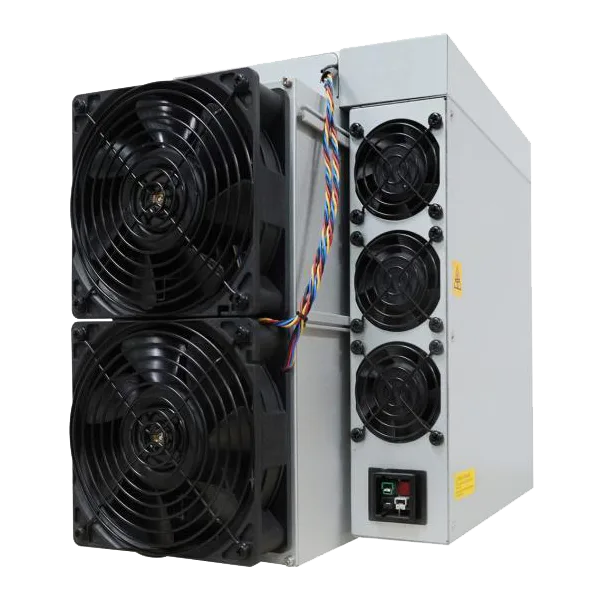
Antminer AL1
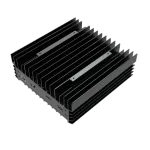
Blake3 algorithm ASIC for mining Alephium. Industrial miner with standard Bitmain form factor.
Réponse rapide
The Antminer AL1 is a Blake3 miner rated about 16 TH/s at roughly 3,360 W, built on the Custom ASIC ASIC. An industrial-class unit — loud and power-hungry, best suited to a dedicated mining space, not living areas.
Professional-Grade Miner
This miner draws 3,360W and produces 75 dB of noise — it is designed for dedicated mining environments, not living spaces. Professional-grade miners deliver the highest hashrate and revenue per unit but require proper infrastructure: a 240V circuit, adequate ventilation or exhaust ducting, and a space where noise is not a concern (garage, basement, warehouse, or outdoor enclosure).
For home miners looking for a quieter alternative, consider our Bitcoin Space Heater builds or explore open-source miners like the Bitaxe that are purpose-built for residential environments.
Heater-Class Miner
At 3,360W, this miner outputs approximately 11464.3 BTU/hr of heat — equivalent to a standard electric space heater. Every watt consumed by an ASIC miner is converted to heat with 100% efficiency, making it a space heater that also mines Bitcoin.
During heating season, miner heat can offset part of the heat a room would otherwise need from another electric heater. The economics depend on your electricity rate, room heat demand, BTC price, network difficulty, and noise constraints.
Calculateur de rentabilité
| Period | Revenue | Electricity Cost | Profit |
|---|---|---|---|
| Daily | $0.49 | $5.64 | $-5.15 |
| Weekly | $3.46 | $39.51 | $-36.05 |
| Monthly | $14.84 | $169.34 | $-154.51 |
| Yearly | $180.50 | $2,060.35 | $-1,879.85 |
Heating offset estimates the value of heat replacing an electric space heater during heating season (~6 months/year in Canada). Actual savings depend on your heating setup and climate.
Where to Buy the Antminer AL1
D-Central Technologies is a Bitcoin-only company. For this miner, check out our trusted partner retailers below.
ASIC Miner Market
United StatesWide selection of new and used ASIC miners. US-based shipping.
MagasinerMinersDeals
United StatesCompetitive prices on new ASIC miners with coupon codes.
MagasinerPartner links may earn D-Central a commission at no extra cost to you. Have you considered Bitcoin mining instead? Explore Bitcoin miners →
Full Specifications
| Model | Antminer AL1 |
|---|---|
| Model Number | AL1 |
| Manufacturer | Bitmain |
| Algorithme | Blake3 |
| Coins Mined | Alephium (ALPH) |
| Taux de hachage | 16 TH/s |
| Consommation électrique | 3,360 W |
| Efficiency | 210 J/TH |
| Niveau de bruit | 75 dB |
| Chip Model | Custom ASIC |
| Cooling | Air |
| Voltage Range | 200-240V AC |
| Operating Temperature | 5-40°C |
| Dimensions | 400x195x290 |
| Weight | 14.5 |
| Interface | Ethernet |
| BTU Output | 11464.3 BTU/hr |
| Equivalent Heater | Equal to a 3,360W space heater |
| Daily Power Cost | $5.64/day |
| Monthly Power Cost | $169.34/mo |
| Circuit Requirement | 240V circuit required |
| Release Date | 2024-08-01 |
| MSRP | $10,000.00 |
| État | Active |
Home Mining Assessment
Blake3 algorithm ASIC for mining Alephium. Industrial miner with standard Bitmain form factor.
The Antminer AL1 is Bitmain’s air-cooled ASIC for mining Alephium (ALPH) on the Blake3 proof-of-work algorithm. It is rated at roughly 16 TH/s for about 3,360 W (~210 J/TH nameplate), and it shares its chassis, PSU and Cvitek control-board platform with Bitmain’s recent Bitcoin and altcoin miners.
Chip and hashboard architecture
Unlike the SHA-256 Antminers most miners know, the AL1 is a single-algorithm machine: its silicon is hard-wired for the Blake3 hashing scheme that secures Alephium. Bitmain has not published a public chip SKU or process node for the AL1’s Blake3 die, and we will not invent one — what we can verify is the platform it is built on, because that is what determines how the unit boots, tunes and fails in the field.
Mechanically the AL1 follows Bitmain’s now-standard three-hashboard layout inside the familiar X-series aluminium chassis. As with every Bitmain hashboard, the ASICs are wired in series strings that form voltage domains: the controller regulates voltage per domain, not per individual chip. That distinction matters for diagnosis — a single failed chip pulls down its entire domain, which is why a dead AL1 hashboard typically shows a whole string of chips dropping out rather than one isolated die.
The brain of the unit is a Cvitek CV1835 control board (the chip is silk-screened « CVITEK » on the PCB). This is the same control-board family Bitmain uses across the S19j Pro CV, S19k Pro, S21/T21 CV, KS3, KS5, L9 and the AL1 Pro — board revisions are designated C88, CB8 and CB4. Practically, that means: an external SD-card slot beside the Ethernet port (firmware recovery without opening the case), no micro-USB OTG port, and no FPGA — the control board talks to the hashboards over software UART. Because the AL1 reuses this widely-deployed platform, replacement control boards and spares are commodity items rather than exotic, which is good news for repairability.
Real-world power and efficiency
The 210 J/TH figure is a nameplate number derived from the 3,360 W / 16 TH/s rating. Measured at the wall, expect to draw meaningfully more once PSU conversion losses and fans are included — budget toward ~3,500 W on a dedicated 240 V circuit, and size breakers and PDUs for that, not the spec-sheet figure. The AL1 expects 200–240 V AC; it is not a 120 V machine.
One critical caveat about « J/TH » on this miner: efficiency in joules-per-terahash is not comparable across algorithms. A terahash of Blake3 is completely different computational work from a terahash of SHA-256, so 210 J/TH here says nothing about how the AL1 stacks up against a Bitcoin ASIC. The only honest benchmark is against other Alephium miners. On that basis the AL1 is a current-generation industrial ALPH machine — not a « legacy » unit, despite what a Bitcoin-centric efficiency table might suggest. Treat any cross-algorithm efficiency score for this model with skepticism.
Like other Bitmain ASICs, the AL1 ships with a stock autotuner that calculates frequency and voltage targets at runtime from the hashboard’s sensor feedback — these are not fixed presets baked into a table. There is real but bounded headroom: running cooler intake air, clean power and good airflow lets the autotuner hold higher sustained frequencies, while undervolting trades hashrate for lower J/TH. Our general approach to that trade-off, and the tooling for it, lives on the ASIC power profiles reference.
At roughly 11,400 BTU/h, the AL1 dumps real heat and runs near 75 dB — genuinely loud. That waste heat can be ducted and reused, but this is an industrial miner, not a quiet appliance; it belongs in a garage, shed, shop or dedicated mining space, not a living room.
| Specification | Antminer AL1 |
|---|---|
| Manufacturer | Bitmain |
| Algorithm / coin | Blake3 / Alephium (ALPH) |
| Hashrate (nameplate) | ~16 TH/s |
| Power (nameplate) | ~3,360 W (budget ~3,500 W at the wall) |
| Efficiency | ~210 J/TH (Blake3 — not comparable to SHA-256) |
| Cooling | Air (dual-fan, front-to-back) |
| Noise | ~75 dB |
| Input voltage | 200–240 V AC |
| Control board | Cvitek CV1835 (CVITEK; C88 / CB8 / CB4 revisions) |
| Network | Ethernet |
| Dimensions | 400 × 195 × 290 mm |
| Weight | 14.5 kg |
| Operating temp | 5–40 °C |
| Heat output | ~11,400 BTU/h |
Firmware compatibility and a locked-down control board
The AL1 runs Bitmain’s stock firmware, and for this model that is realistically the only firmware. The CV1835 control board implements Cvitek’s secure-boot chain: a one-time-programmable eFuse holds a SHA-256 hash of an RSA-2048 public key plus an AES-128 decryption key, and the boot ROM verifies (and on some configurations decrypts) the firmware image before it will run. In plain terms, the board only boots Bitmain-signed images.
That is why the rich third-party firmware ecosystem that exists for SHA-256 Antminers — the autotuning and efficiency firmwares miners reach for on an S19 or S21 — is effectively absent for the AL1. There is no mature open-firmware path for it today, and you should be wary of any seller claiming otherwise. We are equally honest about our own work: DCENT_OS targets SHA-256 Bitcoin ASICs, so it does not apply to the Alephium AL1. If you are buying an AL1, plan around stock firmware as a permanent condition rather than a temporary one.
Common faults and troubleshooting
Because the AL1 reuses Bitmain’s standard chassis, PSU and control-board architecture, its failure modes — and the way you diagnose them — mirror the rest of the air-cooled Antminer line:
- Dead or low hashboard / chain: a chip or domain failure drops a whole series string. Watch for a chain reporting zero or a fraction of expected hashrate, or asic-chip counts coming up short on the status page.
- Thermal shutdowns: dust-clogged heatsinks, failed thermal pads or high intake temperature trip the firmware’s over-temperature protection. The AL1’s 5–40 °C window is real — hot, dusty rooms cause intermittent restarts.
- Fan faults: a fan reading out of range will halt mining as a safety measure; check both fans and their connectors first when a unit refuses to ramp.
- PSU / power faults: insufficient circuit voltage, a marginal PDU, or a failing internal PSU rail shows up as boot loops or boards that never reach target frequency.
- Control-board / network issues: no IP, no web UI, or a unit that won’t take firmware often traces back to the CV1835 board or its SD card — recoverable via the external SD slot.
For a structured walk-through that turns these symptoms into a root cause, use our ASIC fault finder. The same domain-aware logic we use on Bitcoin miners applies here: isolate the failing string before condemning a whole board.
Repair and longevity
D-Central has run an in-house ASIC repair bench since 2016, and the AL1 is squarely in our wheelhouse precisely because it is built on hardware we already service every day. Hashboard work — chip-level reballing and replacement, domain isolation, voltage-rail testing — uses the same techniques and the same test gear as the S19/S21 line. Control boards are interchangeable CV1835 units, so a bricked or damaged board is a swap rather than a write-off, and PSU repairs follow Bitmain’s familiar topology.
The honest longevity story for a single-coin miner like the AL1 is less about the hardware wearing out and more about the coin: well-maintained, dust-managed and thermally sane, these boards last years. Keep the airflow clean, keep intake temperature down, and the AL1 will outlive most miners’ patience for one algorithm. If a board does fail, send it in — see ASIC repair for what we cover and how to ship.
Who the AL1 is for — and what to buy
The AL1 is an industrial machine for miners who specifically want exposure to Alephium and have the infrastructure for it: a 240 V circuit, real ventilation, and tolerance for ~75 dB of noise. It is not a home or bedroom miner, and its single-algorithm nature means your economics are tied entirely to ALPH price, network difficulty and the ongoing competitiveness of Blake3 ASICs — a narrower bet than a Bitcoin SHA-256 miner.
If you are shopping the Alephium category, weigh the AL1 against its higher-tier sibling, the Antminer AL1 Pro, and against alternatives like the Goldshell E-AL1M. The AL1 Pro pushes more hashrate (and more power) from the same platform; the Goldshell sits in a different size and noise class. For Bitcoiners who want a low-power machine to learn on rather than an altcoin rig, an open-source Bitaxe is a better entry point than any of these.
Generational context
Alephium’s move to ASIC-friendly Blake3 mining opened a small but real hardware market, and Bitmain answered it with the AL1 and the AL1 Pro — reusing the company’s proven control-board and chassis engineering rather than designing from scratch. Credit where it is due: that reuse is exactly why the AL1 is serviceable and why spare parts exist. The trade-off, as always with a coin-specific miner, is concentration risk: a Blake3 ASIC mines Blake3 and nothing else, so its useful life is bound to one chain’s trajectory. Buy it because you believe in Alephium and you can run it properly — not because a cross-algorithm efficiency number flattered it.
Broken miner? Get a real quote.
Tell us the symptom and get an instant repair-tier estimate ($95 / $145 / $195 CAD). Mail-in from across Canada, bench in Laval, Quebec.
Send it to D-Central — start a repair →Related Miners
Goldshell AL MAX
Goldshell E-AL1M
Goldshell AL-BOX II Plus
Iceriver ALPH AL0
Foire aux questions
What are the current mining economics for the Antminer AL1?
At $0.07/kWh, the Antminer AL1 currently shows an estimated daily net cost of $5.15 before pool fees and hardware cost. Lower electricity rates, network changes, BTC price changes, or useful heat recovery can change the result.
Can I mine Bitcoin at home with the Antminer AL1?
The Antminer AL1 has a home mining score of 8/100. With 75 dB noise and 3,360W power draw, it may require a dedicated space like a garage, basement, or outdoor enclosure. Consider noise insulation and proper ventilation.
Can the Antminer AL1 heat my home?
The Antminer AL1 outputs approximately 11464.3 BTU/hr of heat. For reference, a typical space heater produces 5,000-5,500 BTU/hr. All electrical energy consumed by the miner is converted to heat, making it 100% efficient as a heater. D-Central offers Bitcoin Space Heater builds designed specifically for home heating integration.
Does D-Central repair the Antminer AL1?
Yes, D-Central provides professional repair services for the Antminer AL1. Services include hashboard repair, control board diagnostics, fan replacement, and full refurbishment. Ship your miner to our Laval, Quebec facility for diagnosis and repair.
What power supply does the Antminer AL1 need?
The Antminer AL1 draws 3,360W of power. You need a power supply rated for at least 3,696W with appropriate voltage (200-240V AC). D-Central stocks compatible power supplies in our shop. Always use a quality PSU from a reputable manufacturer to protect the miner and wiring.