
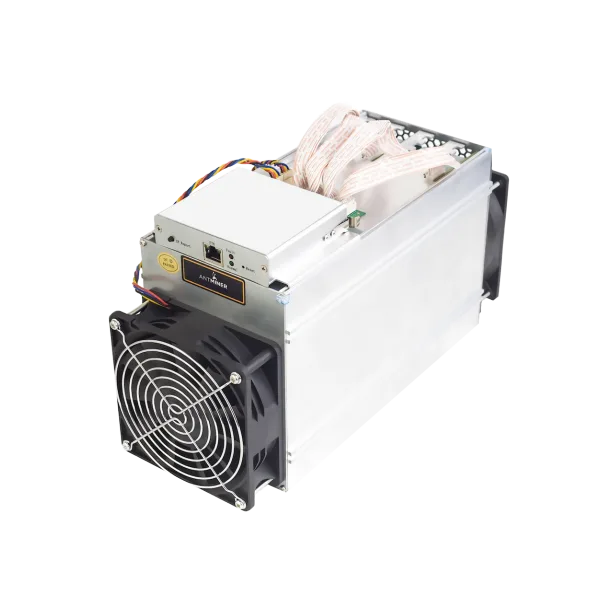
Bitmain Antminer D3 (15Gh)
Réponse rapide
The Bitmain Antminer D3 (15Gh) is a X11 miner rated about 15 GH/s at roughly 1,200 W. An industrial-class unit — loud and power-hungry, best suited to a dedicated mining space, not living areas.
Heater-Class Miner
At 1,200W, this miner outputs approximately 4094 BTU/hr of heat — equivalent to a standard electric space heater. Every watt consumed by an ASIC miner is converted to heat with 100% efficiency, making it a space heater that also mines Bitcoin.
During heating season, miner heat can offset part of the heat a room would otherwise need from another electric heater. The economics depend on your electricity rate, room heat demand, BTC price, network difficulty, and noise constraints.
Calculateur de rentabilité
| Period | Revenue | Electricity Cost | Profit |
|---|---|---|---|
| Daily | $0.00 | $2.02 | $-2.02 |
| Weekly | $0.00 | $14.11 | $-14.11 |
| Monthly | $0.01 | $60.48 | $-60.47 |
| Yearly | $0.17 | $735.84 | $-735.67 |
Heating offset estimates the value of heat replacing an electric space heater during heating season (~6 months/year in Canada). Actual savings depend on your heating setup and climate.
Where to Buy the Bitmain Antminer D3 (15Gh)
D-Central Technologies is a Bitcoin-only company. For this miner, check out our trusted partner retailers below.
ASIC Miner Market
United StatesWide selection of new and used ASIC miners. US-based shipping.
MagasinerMinersDeals
United StatesCompetitive prices on new ASIC miners with coupon codes.
MagasinerPartner links may earn D-Central a commission at no extra cost to you. Have you considered Bitcoin mining instead? Explore Bitcoin miners →
Full Specifications
| Model | Bitmain Antminer D3 (15Gh) |
|---|---|
| Model Number | Antminer D3 (15Gh) |
| Manufacturer | Bitmain |
| Algorithme | X11 |
| Coins Mined | Dash (DASH) |
| Taux de hachage | 15 GH/s |
| Consommation électrique | 1,200 W |
| Efficiency | 80 J/GH |
| Dimensions | 130 x 190 x 320mm |
| Weight | 5.5 |
| BTU Output | 4094 BTU/hr |
| Equivalent Heater | Half a standard space heater (4,094 BTU/hr) |
| Daily Power Cost | $2.02/day |
| Monthly Power Cost | $60.48/mo |
| Circuit Requirement | Standard 120V 15A |
| Release Date | 2017-09-01 |
| État | Active |
Home Mining Assessment
The Antminer D3 is Bitmain’s classic X11 ASIC miner, launched in September 2017 to mine Dash. It is rated at 15 GH/s for 1,200 W — roughly 80 joules per GH/s. Once a sold-out cash machine, today it is a legacy unit: a repairable space heater and a piece of mining history rather than a profit engine.
Chip and hashboard architecture
The D3 is an X11 miner, not a Bitcoin miner. X11 is a chained proof-of-work that runs eleven distinct hashing functions (BLAKE, BMW, Groestl, JH, Keccak, Skein, Luffa, CubeHash, SHAvite, SIMD and Echo) in sequence, the algorithm popularised by Dash. That matters because none of the SHA-256 silicon, firmware or efficiency benchmarks you will read for an Antminer S9 or S19 transfer to this machine — the D3’s hash engine is a purpose-built X11 ASIC that does one job and only that job.
Mechanically, though, the D3 is pure 2017-era Bitmain. It is a three-hashboard chassis in the same classic enclosure Bitmain used across that generation — the S9 (16 nm BM1387) and the L3+ Scrypt miner (28 nm BM1485) share the identical 130 × 190 × 320 mm shell, dual-fan tunnel cooling and APW-series PSU. Each board carries a long daisy chain of X11 ASIC dies (the part the repair community has long catalogued as the BM1760) wired in series and fed by a boost-and-domain power tree. Bitmain never published a verified process node or per-die core count for that chip, so we will not quote one — what is documented is the platform it lives on, and that platform is well understood.
Every Antminer hash board of this era follows the same fundamental design, and the D3 is no exception: the PSU feeds a boost converter, the boosted rail is split into voltage domains, and each domain steps down to the precise core voltage its cluster of chips needs through an LDO or buck stage. A key point that trips people up: voltage is regulated per domain, not per chip. The chips inside a domain sit in series so that the domain voltage equals the per-chip voltage multiplied by the number of chips in that group; there is no per-chip voltage trim on this hardware, whatever later marketing language might imply. A PIC microcontroller on the control board commands the DC-DC stage, and an 18-pin signal ribbon carries 3.3 V logic, ground, reset, the UART command/response chain and the I²C temperature-sensor lines between the control board and each hash board.
Real-world power and efficiency
The 15 GH/s / 1,200 W nameplate works out to about 80 J per GH/s. Our database normalises every miner to joules-per-terahash for sorting, which is why you will see the D3 listed at roughly 80,000 J/TH — but read that number with care. You cannot compare an X11 J/TH figure against a SHA-256 J/TH figure; the algorithms do different amounts of work per hash, so the only honest comparison is D3-against-D3 or D3 against other X11 hardware. Against its own kind, the original 15 GH/s revision was a strong machine in its day and is firmly legacy now.
At the wall, expect a little more than the 1,200 W nameplate once you account for PSU conversion loss, and expect efficiency to drift as intake temperatures climb. The « (15Gh) » in the model name reflects the first production batch; Bitmain later shipped higher-clocked revisions rated closer to 17–19 GH/s at correspondingly higher power draw, so a given second-hand D3 may not match this exact spec sheet — always confirm against the unit’s own dashboard. Plan on a 200–240 V circuit with headroom above the rated draw.
Tuning headroom is minimal and worth being blunt about. The D3 has no runtime autotuner and no aftermarket efficiency-firmware ecosystem — the kind of calculated, per-board frequency-and-voltage optimisation you get on a modern Antminer simply does not exist for this platform. What you have is the stock firmware’s clock setting, which trades hashrate for heat in the obvious direction and nothing more. For where this machine sits relative to the rest of the fleet, and how genuine power profiles work on hardware that supports them, see our ASIC power profiles reference.
One number is dependable: every watt the D3 draws leaves as heat — about 4,094 BTU/h, comparable to a small electric space heater. Ducted into a workshop, garage or grow space, that waste heat turns an electricity bill into something useful, which for many owners is now the D3’s most rational job. Our guide to the best miners for heating covers the duct-and-dampen approach, and the same airflow and noise principles apply to an X11 unit.
Firmware compatibility
The D3 runs Bitmain’s stock firmware — a cgminer/bmminer-based image with the familiar Antminer web interface and the standard cgminer API on port 4028 for monitoring. That stock image is what nearly every surviving D3 is running today, and for most owners it is the only realistic option.
On third-party firmware, the honest answer is that there effectively is none. The well-known aftermarket projects — BraiinsOS+, VNish, LuxOS — are built for SHA-256 Antminers and WhatsMiners (with a couple extending to Scrypt models like the L7); none of them target the X11 D3. The economic reason is simple: when ROI on a machine collapses, nobody invests engineering effort in custom firmware for it, and the D3’s profitability collapsed years ago. So unlike an S19, you cannot flash a tuning OS onto a D3 to claw back efficiency — what shipped from Bitmain is what you have.
D-Central’s own firmware work, DCENT_OS, is focused on the SHA-256 Bitcoin fleet — the Linux-class Antminer control boards we research and repair every day. The D3 is an X11 altcoin miner and falls outside that scope, and we would rather say so plainly than imply a flash that does not exist. Credit where it is due: Bitmain’s decision to base the D3 on an openly inspectable cgminer derivative is part of why the broader Antminer ecosystem became so hackable in the first place.
Common faults and troubleshooting
Because the D3 shares its chassis, PSU and control architecture with the S9 and L3+, it fails in the same well-documented patterns:
- A hash board drops offline or shows a broken chain. The ASICs are daisy-chained, so a single dead chip stops forwarding the clock, command and response signals — every chip downstream of the fault goes invisible to the control board and the board reports a reduced or zero chip count. Reseat the signal ribbon and power connectors before assuming chip death.
- Abnormal domain voltage. If the voltage across one voltage domain reads wrong, the whole board typically refuses to hash. The usual culprit is a shorted chip or a failed power-management component in that domain, which is a board-level diagnosis and repair, not a swap.
- PSU and power-rail faults. The APW-series supply and the on-board boost converter are common failure points on aging units, with symptoms ranging from a dead no-start to a board that powers but never ramps to full hashrate.
- Fan errors and thermal cut-outs. The D3’s dual fans are famously loud and famously failure-prone; a stalled fan or a dust-clogged heatsink will throw a fan error or pull the firmware into thermal protection. Clean the airflow path and verify both fans first.
Work through symptoms methodically with our ASIC fault finder and the symptom-based repair guide, which walk the same chain-break, domain and PSU logic above in diagnostic order.
Repair and longevity
The D3 is genuinely repairable, and that is its real argument for staying alive. Because it is the same classic Antminer platform we have serviced since 2016, the skills and parts transfer directly: hashboard diagnostics, voltage-domain and rail testing, chip and component-level rework, fan replacement and PSU repair are all bread-and-butter work for our Laval technicians. There is no exotic SoC or sealed boot image standing between a fault and a fix.
We will be straight about the economics, though. With X11 mining revenue what it is, a D3 is rarely worth a costly repair for profit alone — the honest reasons to keep one running are heat reuse, learning, or simple attachment to a landmark machine. If that describes you, a diagnosis is usually worth it before you scrap a unit; if it does not, it may be time to retire it. See ASIC repair and our repair-vs-replace breakdown to make that call with clear eyes.
Who it is for and buying
Let us be honest about who should own a D3 in the current market: collectors, X11 hobbyists, and people who want a cheap, repairable heat source with a story attached. The D3’s history is a cautionary classic — it sold out instantly at launch in late 2017, then X11 network difficulty climbed steeply as those same machines came online, and ROI evaporated for buyers who paid premium prices. Anyone shopping for one today should price it as a space heater and a museum piece, not as an investment, and size their expectations accordingly. Its home-mining score reflects that reality.
If your goal is to actually learn how mining hardware works and to tinker with something current and supported, an open-source Bitaxe-class device is a far better starting point than a legacy D3. To compare any model against the rest of the field, use our ASIC miner database and miner comparison tools, and weigh condition and price with our refurbished-vs-new guide.
Spec snapshot and generational context
| Specification | Antminer D3 (15Gh) |
|---|---|
| Manufacturer | Bitmain |
| Algorithm | X11 (Dash) |
| Nameplate hashrate | 15 GH/s |
| Power (nameplate) | 1,200 W |
| Efficiency | ~80 J/GH (listed as ~80,000 J/TH; not comparable to SHA-256) |
| ASIC chip | Bitmain X11 ASIC (community-catalogued BM1760) |
| Hashboards | 3 (air-cooled, dual fan) |
| Control / voltage | Bitmain control board, PIC-managed DC-DC voltage domains |
| Heat output | ~4,094 BTU/h |
| Network | Ethernet |
| Dimensions | 130 × 190 × 320 mm |
| Weight | ~5.5 kg (shipping) |
| Release | September 2017 |
The D3 belongs to Bitmain’s landmark 2017 cohort — the same year and the same chassis family as the SHA-256 Antminer S9 and the Scrypt Antminer L3+. Bitmain’s playbook across that generation was consistent: design a dedicated single-algorithm ASIC, drop three daisy-chained hash boards into a shared dual-fan tunnel, and drive them from a common Linux control board with PIC-managed voltage domains. The D3 was the X11 entry in that lineup. It is also a lasting lesson in ASIC economics — that a machine which prints money on day one can be underwater within months once the network absorbs the hashrate it helped create. As a repairable, honest piece of mining history, it still has a place; as a profit engine, that chapter closed years ago.
Broken miner? Get a real quote.
Tell us the symptom and get an instant repair-tier estimate ($95 / $145 / $195 CAD). Mail-in from across Canada, bench in Laval, Quebec.
Send it to D-Central — start a repair →Related Miners
Baikal Giant+ A2000
iBeLink DM11G
Baikal Miner Cube
FusionSilicon X7 Miner
Comparer le Bitmain Antminer D3 (15Gh)
Foire aux questions
What are the current mining economics for the Bitmain Antminer D3 (15Gh)?
At $0.07/kWh, the Bitmain Antminer D3 (15Gh) currently shows an estimated daily net cost of $2.02 before pool fees and hardware cost. Lower electricity rates, network changes, BTC price changes, or useful heat recovery can change the result.
Can I mine Bitcoin at home with the Bitmain Antminer D3 (15Gh)?
The Bitmain Antminer D3 (15Gh) has a home mining score of 22/100. With 0 dB noise and 1,200W power draw, it may require a dedicated space like a garage, basement, or outdoor enclosure. Consider noise insulation and proper ventilation.
Can the Bitmain Antminer D3 (15Gh) heat my home?
The Bitmain Antminer D3 (15Gh) outputs approximately 4094 BTU/hr of heat. For reference, a typical space heater produces 5,000-5,500 BTU/hr. All electrical energy consumed by the miner is converted to heat, making it 100% efficient as a heater. D-Central offers Bitcoin Space Heater builds designed specifically for home heating integration.
What power supply does the Bitmain Antminer D3 (15Gh) need?
The Bitmain Antminer D3 (15Gh) draws 1,200W of power. You need a power supply rated for at least 1,320W with appropriate voltage (200-240V AC). D-Central stocks compatible power supplies in our shop. Always use a quality PSU from a reputable manufacturer to protect the miner and wiring.