
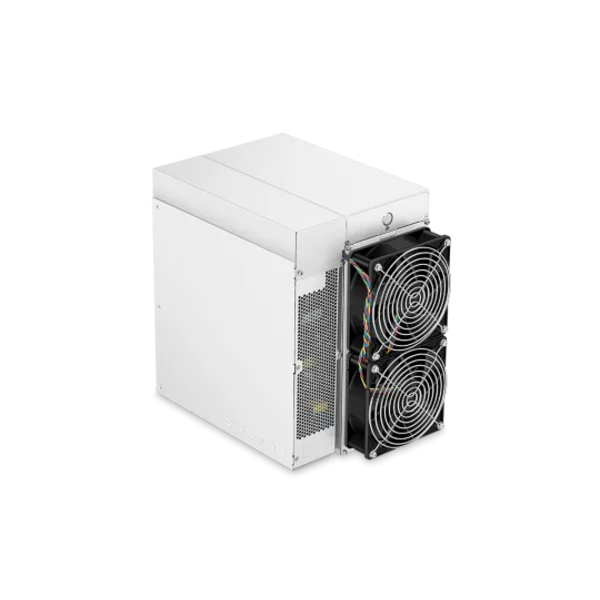
Antminer D7
X11 algorithm ASIC for mining Dash. 1286 GH/s at 3148W. Previous generation with lower efficiency than D9.
Réponse rapide
The Antminer D7 is a X11 miner rated about 1286 GH/s at roughly 3,148 W, built on the Custom ASIC ASIC. An industrial-class unit — loud and power-hungry, best suited to a dedicated mining space, not living areas.
Professional-Grade Miner
This miner draws 3,148W and produces 70 dB of noise — it is designed for dedicated mining environments, not living spaces. Professional-grade miners deliver the highest hashrate and revenue per unit but require proper infrastructure: a 240V circuit, adequate ventilation or exhaust ducting, and a space where noise is not a concern (garage, basement, warehouse, or outdoor enclosure).
For home miners looking for a quieter alternative, consider our Bitcoin Space Heater builds or explore open-source miners like the Bitaxe that are purpose-built for residential environments.
Heater-Class Miner
At 3,148W, this miner outputs approximately 10741 BTU/hr of heat — equivalent to a standard electric space heater. Every watt consumed by an ASIC miner is converted to heat with 100% efficiency, making it a space heater that also mines Bitcoin.
During heating season, miner heat can offset part of the heat a room would otherwise need from another electric heater. The economics depend on your electricity rate, room heat demand, BTC price, network difficulty, and noise constraints.
Calculateur de rentabilité
| Period | Revenue | Electricity Cost | Profit |
|---|---|---|---|
| Daily | $0.04 | $5.29 | $-5.25 |
| Weekly | $0.28 | $37.02 | $-36.74 |
| Monthly | $1.19 | $158.66 | $-157.47 |
| Yearly | $14.42 | $1,930.35 | $-1,915.94 |
Heating offset estimates the value of heat replacing an electric space heater during heating season (~6 months/year in Canada). Actual savings depend on your heating setup and climate.
Where to Buy the Antminer D7
D-Central Technologies is a Bitcoin-only company. For this miner, check out our trusted partner retailers below.
ASIC Miner Market
United StatesWide selection of new and used ASIC miners. US-based shipping.
MagasinerMinersDeals
United StatesCompetitive prices on new ASIC miners with coupon codes.
MagasinerPartner links may earn D-Central a commission at no extra cost to you. Have you considered Bitcoin mining instead? Explore Bitcoin miners →
Full Specifications
| Model | Antminer D7 |
|---|---|
| Model Number | D7 |
| Manufacturer | Bitmain |
| Algorithme | X11 |
| Coins Mined | Dash (DASH) |
| Taux de hachage | 1286 GH/s |
| Consommation électrique | 3,148 W |
| Efficiency | 2.45 J/GH |
| Niveau de bruit | 70 dB |
| Chip Model | Custom ASIC |
| Cooling | Air |
| Voltage Range | 200-240V AC |
| Operating Temperature | 0-40°C |
| Dimensions | 400x195x290 |
| Weight | 14.4 |
| Interface | Ethernet |
| BTU Output | 10741 BTU/hr |
| Equivalent Heater | Equal to a 3,148W space heater |
| Daily Power Cost | $5.29/day |
| Monthly Power Cost | $158.66/mo |
| Circuit Requirement | 240V circuit required |
| Release Date | 2022-06-01 |
| MSRP | $2,500.00 |
| État | Active |
Home Mining Assessment
X11 algorithm ASIC for mining Dash. 1286 GH/s at 3148W. Previous generation with lower efficiency than D9.
The Antminer D7 is Bitmain’s high-throughput X11 ASIC, built to mine Dash (DASH). It is rated at 1,286 GH/s while pulling about 3,148 W from the wall, an efficiency near 2.45 J/GH (2,447.9 J/TH). Introduced in the 2021–2022 wave, it is still a capable Dash workhorse, though newer X11 hardware now mines the algorithm more efficiently.
Antminer D7 at a glance
| Specification | Antminer D7 |
|---|---|
| Algorithm | X11 |
| Primary coin | Dash (DASH) |
| Hashrate | 1,286 GH/s (1.286 TH/s) |
| Wall power | ~3,148 W |
| Efficiency | ~2.45 J/GH (2,447.9 J/TH) |
| Cooling | Dual-fan forced air |
| Noise | ~70 dB |
| Operating temperature | 0–40 °C |
| Input voltage | 200–240 V AC |
| Dimensions | 400 × 195 × 290 mm |
| Weight | 14.4 kg |
| Network | Ethernet (RJ45) |
| Heat output | ~10,741 BTU/h |
| Generation | 2021–2022 |
| Status | Active / legacy efficiency tier |
Chip and hashboard architecture
The D7 is one of the relatively few ASICs Bitmain ever built for the X11 algorithm rather than SHA-256. X11 chains eleven distinct hash functions in sequence (blake, bmw, groestl, jh, keccak, skein, luffa, cubehash, shavite, simd and echo), so the silicon is purpose-designed for that pipeline and cannot mine Bitcoin, Litecoin or any other algorithm. Bitmain has never published a part number or datasheet for the D7’s hashing chip, so we describe it honestly: it is a custom X11 ASIC, and any specific die area, core count or process-node figure circulating online for it is unverified.
What we can speak to with confidence is the chassis topology, because every Antminer of this era shares the same fundamental design. The D7 splits into a small control board and a stack of hashboards housed in Bitmain’s standard three-board server case. The control board is a Linux system-on-chip that handles networking, the web interface and pool communication, while the time-critical job of streaming work to the hashing chips and collecting nonces is done over a UART daisy-chain — each ASIC passes commands down the line to the next and returns results back up. This is the same communication backbone documented across the S9, S17, S19 and L7 families.
One architectural detail is worth getting right, because it is widely misstated for every Bitmain miner: voltage is regulated per power domain, not per chip. The chips on a hashboard are wired into series voltage domains, and a board-level controller sets the voltage for each domain — multiple chips share a single regulation point. There is no per-chip voltage knob on the D7 or on any of its stablemates. The chassis is fed by an external Bitmain APW-series power supply delivering the bulk 12 V rail, and two high-static-pressure fans pull air across the boards front-to-back. That cooling design is why the unit registers around 70 dB at the wall — loud enough that it belongs in a dedicated space rather than a living area.
Real-world power and efficiency
The D7’s nameplate of roughly 3,148 W is a wall figure, and like any air-cooled ASIC the real draw drifts with input voltage, ambient temperature and power-supply efficiency — expect a few percent of variance either side of nominal across a fleet. It needs a 200–240 V circuit; on a 120 V supply it will either refuse to reach full power or derate heavily, the same physics that affects every high-wattage miner (we cover that in our 220 V vs 110 V power-derating guide).
At about 2.45 J/GH (2,447.9 J/TH), the D7 sits squarely in the legacy efficiency tier. When it launched, that number was strong for X11; today its successor mines the same algorithm at a meaningfully lower joules-per-gigahash, so on pure electricity cost the D7 is best understood as hobby, learning or heat-reuse hardware rather than a margin-optimised production machine. The flip side of that power budget is heat: the D7 converts essentially all of its ~3,148 W into roughly 10,741 BTU/h of usable warmth, which can be ducted into a workshop or garage so the electricity does double duty.
A practical caveat on tuning: our ASIC power-profiles database is built around SHA-256 miners that run autotuning firmware, where frequency and voltage are calculated at runtime to hit a chosen efficiency target. The D7 has no equivalent. Because no mainstream third-party firmware exists for X11 hardware, the D7 runs at its factory operating point with only the limited adjustments the stock interface exposes. Treat its efficiency as fixed, not as a starting point you can autotune down the way you would an S19.
Firmware compatibility
The D7 runs Bitmain’s stock firmware — a cgminer-derived stack with the familiar web dashboard for pool configuration, status and basic controls. That is effectively the whole story for this machine, and it is important to be straight about why.
The third-party firmware ecosystem — BraiinsOS+, VNish, LuxOS — was written for SHA-256 Bitcoin miners, with a handful of builds extending to Scrypt (Litecoin) hardware. None of them target X11. There is no autotuning aftermarket firmware for the D7, which means no Stratum V2 support, no calculated power profiles, and no efficiency presets of the kind those firmwares bring to an S19 or S21. The same applies to our own work: D-Central’s DCENT_OS effort is focused on the SHA-256 Bitcoin fleet, so it is not a fit for X11 silicon either. If a listing or forum post claims a « custom firmware » for the D7, scrutinise it closely — for this device, stock is the realistic and supported path.
Common faults and troubleshooting
Because the D7 shares Bitmain’s chassis architecture, its failure modes look familiar to anyone who has serviced an S-series miner. The most common ones we see on the bench:
- Hashboard not detected (0 ASIC). The control board enumerates fewer than three boards, or a board reports zero chips. It usually traces to a broken link in the UART daisy-chain, a damaged ribbon connector, or a chip-level fault. The diagnostic path mirrors our hashboard-not-detected walkthrough.
- Low hashrate / missing chips. The unit runs but lands well below 1,286 GH/s, which points to dead or under-performing chips on one of the chains. See our guide to low hashrate from missing ASIC chips for the isolation method.
- Over-temperature. X11 miners run hot, and clogged heatsinks, degraded thermal paste or a weak fan will trip thermal protection. The approach is the same one we document for its successor in Antminer D9 — temperature too high.
- Fan and PSU faults. Bearing wear, blade damage or a stalled fan will throw speed errors, and APW-series supplies have their own ageing failure modes after years of duty.
For a structured, symptom-first diagnosis, start with our ASIC fault finder, which routes you from the error you are seeing to the most likely cause and fix.
Repair and longevity
An older X11 miner like the D7 is exactly the kind of hardware worth repairing rather than retiring. The chassis is robust, the chips are not running on the bleeding edge, and most failures are board-level — a dead domain, a cracked solder joint, a failed regulator or a tired fan — rather than total losses. D-Central has been doing in-house ASIC repair in Laval, Quebec since 2016, and we work the D7 the same way we work the rest of the Antminer line: chain-level fault isolation, component-level board repair, and full bench testing before a unit goes back to service. Bitmain built a durable machine here; keeping a working D7 in service is usually cheaper and more sovereign than replacing it. If yours has dropped a board or is hashing low, our ASIC repair service can assess it.
Who the D7 is for
This is not a quiet, set-and-forget home appliance — at ~70 dB and 3,148 W it earns its home-mining score of 36/100, and it wants a dedicated, ventilated space on a proper 240 V circuit. It makes the most sense for three kinds of operator: people who specifically want to mine Dash and value the D7’s high raw hashrate, hobbyists and learners who want a real industrial X11 machine without paying for the latest generation, and anyone reusing mining heat, where ~10,741 BTU/h of warmth offsets a heating bill that would otherwise be pure cost. If your goal is maximum efficiency on X11, look at the newer D-series; if your goal is capable, repairable Dash hashing at a sensible price, the D7 holds up. You can compare it against the rest of the field in our ASIC miner database.
Where the D7 sits in the X11 lineage
Bitmain’s X11 line traces a clear arc. The original Antminer D3 (2017) was the machine that effectively ended GPU profitability on X11; the D5 followed with a large jump in throughput; the D7 then pushed hashrate into the terahash neighbourhood at 1.286 TH/s; and the later Antminer D9 refined the formula again with higher throughput and better joules-per-gigahash. Credit where it is due — Bitmain did the hard engineering to make X11 ASIC mining viable at scale, and the D7 was a strong link in that chain. For most buyers today the choice on X11 comes down to budget and electricity price: the D9 wins on efficiency, while a well-maintained D7 remains a sensible, serviceable way to mine Dash, especially when its heat is being put to work.
Broken miner? Get a real quote.
Tell us the symptom and get an instant repair-tier estimate ($95 / $145 / $195 CAD). Mail-in from across Canada, bench in Laval, Quebec.
Send it to D-Central — start a repair →Related Miners
Baikal Quadruple Mini Miner
Antminer D9
iBeLink DM22G
Bitmain Antminer D9 (1770Gh)
Foire aux questions
What are the current mining economics for the Antminer D7?
At $0.07/kWh, the Antminer D7 currently shows an estimated daily net cost of $5.25 before pool fees and hardware cost. Lower electricity rates, network changes, BTC price changes, or useful heat recovery can change the result.
Can I mine Bitcoin at home with the Antminer D7?
The Antminer D7 has a home mining score of 13/100. With 70 dB noise and 3,148W power draw, it may require a dedicated space like a garage, basement, or outdoor enclosure. Consider noise insulation and proper ventilation.
Can the Antminer D7 heat my home?
The Antminer D7 outputs approximately 10741 BTU/hr of heat. For reference, a typical space heater produces 5,000-5,500 BTU/hr. All electrical energy consumed by the miner is converted to heat, making it 100% efficient as a heater. D-Central offers Bitcoin Space Heater builds designed specifically for home heating integration.
Does D-Central repair the Antminer D7?
Yes, D-Central provides professional repair services for the Antminer D7. Services include hashboard repair, control board diagnostics, fan replacement, and full refurbishment. Ship your miner to our Laval, Quebec facility for diagnosis and repair.
What power supply does the Antminer D7 need?
The Antminer D7 draws 3,148W of power. You need a power supply rated for at least 3,463W with appropriate voltage (200-240V AC). D-Central stocks compatible power supplies in our shop. Always use a quality PSU from a reputable manufacturer to protect the miner and wiring.