
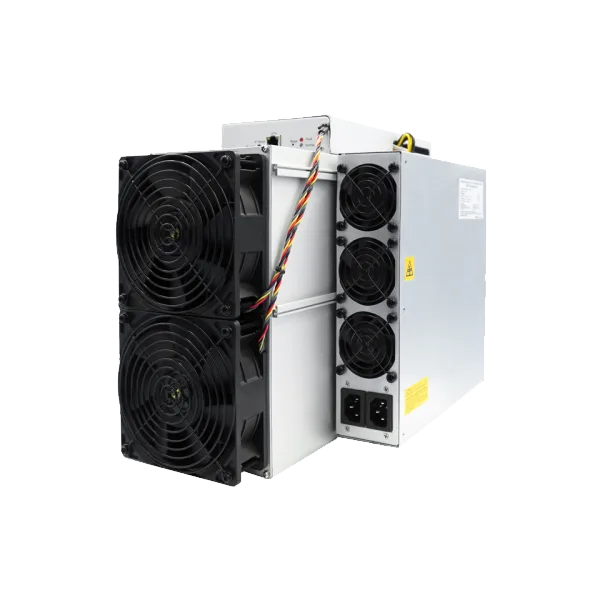
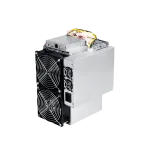
Bitmain Antminer D9 (1770Gh)
Réponse rapide
The Bitmain Antminer D9 (1770Gh) is a X11 miner rated about 1770 GH/s at roughly 2,839 W. An industrial-class unit — loud and power-hungry, best suited to a dedicated mining space, not living areas.
Professional-Grade Miner
This miner draws 2,839W and produces 75+ dB of noise — it is designed for dedicated mining environments, not living spaces. Professional-grade miners deliver the highest hashrate and revenue per unit but require proper infrastructure: a 240V circuit, adequate ventilation or exhaust ducting, and a space where noise is not a concern (garage, basement, warehouse, or outdoor enclosure).
For home miners looking for a quieter alternative, consider our Bitcoin Space Heater builds or explore open-source miners like the Bitaxe that are purpose-built for residential environments.
Heater-Class Miner
At 2,839W, this miner outputs approximately 9687 BTU/hr of heat — equivalent to a standard electric space heater. Every watt consumed by an ASIC miner is converted to heat with 100% efficiency, making it a space heater that also mines Bitcoin.
During heating season, miner heat can offset part of the heat a room would otherwise need from another electric heater. The economics depend on your electricity rate, room heat demand, BTC price, network difficulty, and noise constraints.
Calculateur de rentabilité
| Period | Revenue | Electricity Cost | Profit |
|---|---|---|---|
| Daily | $0.06 | $4.77 | $-4.71 |
| Weekly | $0.39 | $33.39 | $-33.00 |
| Monthly | $1.68 | $143.09 | $-141.41 |
| Yearly | $20.40 | $1,740.87 | $-1,720.47 |
Heating offset estimates the value of heat replacing an electric space heater during heating season (~6 months/year in Canada). Actual savings depend on your heating setup and climate.
Where to Buy the Bitmain Antminer D9 (1770Gh)
D-Central Technologies is a Bitcoin-only company. For this miner, check out our trusted partner retailers below.
ASIC Miner Market
United StatesWide selection of new and used ASIC miners. US-based shipping.
MagasinerMinersDeals
United StatesCompetitive prices on new ASIC miners with coupon codes.
MagasinerPartner links may earn D-Central a commission at no extra cost to you. Have you considered Bitcoin mining instead? Explore Bitcoin miners →
Full Specifications
| Model | Bitmain Antminer D9 (1770Gh) |
|---|---|
| Model Number | Antminer D9 (1770Gh) |
| Manufacturer | Bitmain |
| Algorithme | X11 |
| Coins Mined | Dash (DASH) |
| Taux de hachage | 1770 GH/s |
| Consommation électrique | 2,839 W |
| Efficiency | 1.6 J/GH |
| Dimensions | 430 x 195.5 x 290mm |
| Weight | 16.1 |
| BTU Output | 9687 BTU/hr |
| Equivalent Heater | Equal to a 2,839W space heater |
| Daily Power Cost | $4.77/day |
| Monthly Power Cost | $143.09/mo |
| Circuit Requirement | 240V circuit required |
| Release Date | 2023-02-01 |
| MSRP | $1,030.00 |
| État | Active |
Home Mining Assessment
The Bitmain Antminer D9 is a dedicated X11 ASIC built to hash the Dash (DASH) network, rated at 1,770 GH/s while drawing roughly 2,839 W at the wall — about 1,604 J/TH. Released in February 2023, it is the most powerful X11 Antminer Bitmain has shipped, aimed at Dash mining and heat reuse rather than Bitcoin.
Antminer D9 specifications at a glance
| Specification | Antminer D9 (1770Gh) |
|---|---|
| Algorithm | X11 |
| Primary coin | Dash (DASH) |
| Hashrate | 1,770 GH/s (1.77 TH/s) |
| Wall power | 2,839 W |
| Efficiency | 1,604 J/TH (~1.6 J/GH) |
| Heat output | ~9,687 BTU/h |
| Cooling | Forced air, dual fan |
| Weight | 16.1 kg |
| Dimensions | 430 × 195.5 × 290 mm |
| Released | February 2023 |
| Launch MSRP | ~US$1,030 |
Chip and hashboard architecture
The D9 is not a Bitcoin miner. Where Bitmain’s S-series runs SHA-256 silicon, the D9 carries a purpose-built X11 hashing ASIC — a chip family designed specifically to chain the eleven hash functions that make up the X11 algorithm (Blake, BMW, Grøstl, JH, Keccak, Skein, Luffa, CubeHash, SHAvite, SIMD and Echo). That is a fundamentally different datapath from a SHA-256 engine, which is why a D9 can mine Dash but nothing in the Bitcoin family.
Mechanically, though, the D9 sits on Bitmain’s mature Antminer platform — the same architecture our bench has torn down chip-by-chip across the S17 and S19 generations. A single control board talks to the hashboards over 18-pin ribbon cables that carry power, a UART command/response chain, and an I²C bus for temperature sensors and the EEPROM. On the established Antminer control board of this era, the brains are a Xilinx Zynq-class SoC pairing a dual ARM Cortex-A9 (667 MHz) with on-die FPGA fabric. The FPGA — not the CPU — handles the time-critical work: it streams jobs to the ASIC chain through hardware UART FIFOs, collects returned nonces, drives the VID voltage lines, and runs the fan PWM.
On each board the ASICs are daisy-chained and organised into voltage domains. This is the single most misunderstood point about Antminer hardware, so it is worth stating plainly: voltage is regulated per domain, never per chip. A domain is a cluster of chips wired in series off one regulated rail, so the domain voltage equals the per-chip core voltage multiplied by the number of chips in that domain. A boost converter lifts the 12 V supply, and per-domain LDOs step it back down to the precise core and I/O rails each chip group needs. Detailed per-domain counts for the D9’s X11 silicon sit outside our verified SHA-256/Scrypt teardown corpus, so we describe its internals at the architecture level rather than quoting chip dimensions we have not confirmed on the bench — but the power-distribution topology is the proven Antminer pattern.
Real-world power and efficiency
At a nameplate 2,839 W for 1,770 GH/s, the D9 lands at 1,604 J/TH. Treat that as the wall figure, not a chip figure: it already includes PSU conversion loss, fan draw and control-board overhead, and real consumption drifts with ambient temperature, mains voltage and the silicon lottery of an individual unit. Expect a few percent of variance unit-to-unit.
By 2026 standards 1,604 J/TH is a legacy efficiency tier. There is little tuning headroom to recover here — the X11 platform never developed the deep aftermarket autotuning ecosystem that SHA-256 Antminers enjoy, and on modern firmware a tuner calculates voltage and frequency at runtime rather than reading fixed presets, so gains depend on chip quality you cannot see in advance. Our ASIC power-profiles database catalogues hundreds of tuned watt/hashrate presets across the SHA-256 and Scrypt fleet; the D9’s stock X11 firmware offers only coarse control by comparison. The practical takeaway is that the D9 earns its keep as a Dash hasher and a space heater, not as an efficiency play — its roughly 9,687 BTU/h of waste heat is genuinely useful ducted into a cold room.
Firmware compatibility
The D9 ships with Bitmain’s stock firmware: a cgminer-derived mining daemon behind the familiar AntMiner web UI, talking to pools over Stratum V1. That last point matters — only BraiinsOS+ natively negotiates Stratum V2, and the major aftermarket firmwares (BraiinsOS+, LuxOS, VNish) are built for SHA-256 Antminers, with limited Scrypt coverage. None of them target X11 hardware. In honest terms, there is effectively no mature third-party firmware ecosystem for the D9, so you should plan to run it on stock.
The same boundary applies to our own work. DCENT_OS, D-Central’s open firmware program, is focused on Bitmain SHA-256 and Scrypt platforms where we have full silicon drivers; the D9’s X11 chip is outside that scope today. We would rather tell you that up front than imply a flash path that does not exist.
Common faults and troubleshooting
Because the D9 reuses the standard Antminer board topology, it fails in the same well-understood ways, and the same diagnostic logic applies:
- A chain reporting fewer chips than expected. The ASICs are a series chain — a single dead chip breaks the UART link, and every chip downstream of it goes invisible. The « asic count » on a board drops to wherever the break is.
- Zero hashrate on one board. Often a voltage-domain fault: a shorted chip or LDO pulls a domain low and can current-limit the whole board, while an open domain reads abnormally high. If domain voltages diverge by more than ~100 mV from their neighbours, suspect that domain.
- Thermal shutdowns and temp-sensor errors. The I²C temperature sensors and their isolation ICs are a common failure point; a board that cannot read its own temperature will refuse to ramp or will throttle.
- Fan errors and PSU faults. Dual-fan units fault out fast if a fan stalls, and an aging integrated supply can sag under load and drop boards intermittently.
If you are chasing a fault code or a dead chain, our ASIC fault finder walks the symptom-to-cause tree the same way our bench technicians do, and points you at the relevant error pages.
Repair and longevity
An X11 ASIC is still an ASIC, and the failure physics — cracked BGA joints, blown power-stage components, dead chips mid-chain, failed regulators — are exactly what D-Central has been repairing at the component level since 2016. A board that has lost a chain is rarely scrap; chip-level rework can bring it back. Given that a working D9 is most valuable as a heater or a hobby Dash node, repairing one you already own is almost always cheaper than replacing it. See our ASIC repair service for hashboard-level diagnosis and rework.
Who the D9 is for
This is a niche machine, and we will not pretend otherwise. With a home-mining score of 22/100, the D9 is loud, hot and power-hungry — it belongs in a dedicated mining space, a garage, or a heat-reuse setup, not a bedroom. It makes sense if you specifically want to mine Dash, if you already hold one and want to keep it productive, or if you can put 2.8 kW of waste heat to work. If your goal is to mine Bitcoin at home, the D9 is the wrong tool entirely — an open-source single-chip Bitaxe or a current-generation SHA-256 ASIC is the right starting point. Browse the full ASIC miner catalog to compare options across algorithms.
Generational context
Credit where it is due: Bitmain effectively built the X11 ASIC category. The lineage runs from the original Antminer D3 in 2017 (a roughly 15 GH/s machine, by Bitmain’s own figures) through the D7 in 2021 (near 1.3 TH/s) to this D9, which pushes the line to 1.77 TH/s — the most powerful X11 Antminer to date. Each step pulled more of the Dash network onto purpose-built silicon, the same way SHA-256 ASICs displaced GPUs on Bitcoin a decade ago. The D9 represents the mature end of that arc: a capable, well-understood X11 hasher whose best years for raw profitability are behind it, but which remains a solid, repairable workhorse for Dash mining and heat reuse.
Broken miner? Get a real quote.
Tell us the symptom and get an instant repair-tier estimate ($95 / $145 / $195 CAD). Mail-in from across Canada, bench in Laval, Quebec.
Send it to D-Central — start a repair →Related Miners
FusionSilicon X7 Miner
iBeLink DM11G
Bitmain Antminer D3 (17.5Gh)
Bitmain Antminer D5 (119Gh)
Comparer le Bitmain Antminer D9 (1770Gh)
Foire aux questions
What are the current mining economics for the Bitmain Antminer D9 (1770Gh)?
At $0.07/kWh, the Bitmain Antminer D9 (1770Gh) currently shows an estimated daily net cost of $4.71 before pool fees and hardware cost. Lower electricity rates, network changes, BTC price changes, or useful heat recovery can change the result.
Can I mine Bitcoin at home with the Bitmain Antminer D9 (1770Gh)?
The Bitmain Antminer D9 (1770Gh) has a home mining score of 8/100. With 0 dB noise and 2,839W power draw, it may require a dedicated space like a garage, basement, or outdoor enclosure. Consider noise insulation and proper ventilation.
Can the Bitmain Antminer D9 (1770Gh) heat my home?
The Bitmain Antminer D9 (1770Gh) outputs approximately 9687 BTU/hr of heat. For reference, a typical space heater produces 5,000-5,500 BTU/hr. All electrical energy consumed by the miner is converted to heat, making it 100% efficient as a heater. D-Central offers Bitcoin Space Heater builds designed specifically for home heating integration.
What power supply does the Bitmain Antminer D9 (1770Gh) need?
The Bitmain Antminer D9 (1770Gh) draws 2,839W of power. You need a power supply rated for at least 3,123W with appropriate voltage (200-240V AC). D-Central stocks compatible power supplies in our shop. Always use a quality PSU from a reputable manufacturer to protect the miner and wiring.