
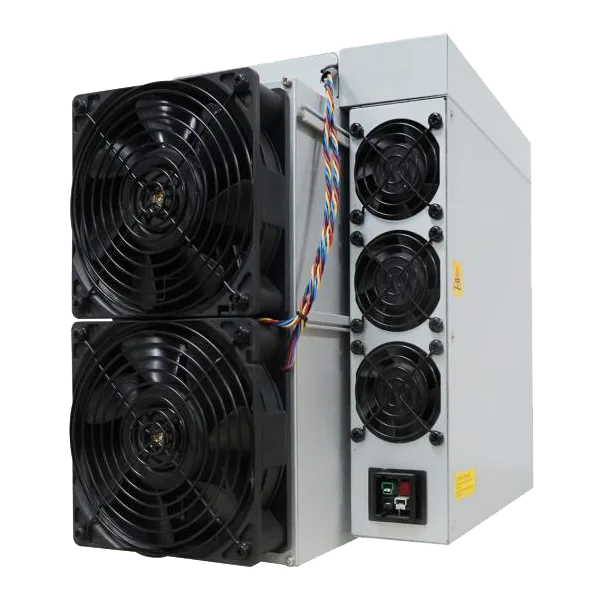
Antminer KS5 Pro
Top-tier Kaspa miner from Bitmain, extremely high demand and price premium
Réponse rapide
The Antminer KS5 Pro is a KHeavyHash miner rated about 21 TH/s at roughly 3,150 W, built on the BM1502 ASIC. An industrial-class unit — loud and power-hungry, best suited to a dedicated mining space, not living areas.
Professional-Grade Miner
This miner draws 3,150W and produces 75 dB of noise — it is designed for dedicated mining environments, not living spaces. Professional-grade miners deliver the highest hashrate and revenue per unit but require proper infrastructure: a 240V circuit, adequate ventilation or exhaust ducting, and a space where noise is not a concern (garage, basement, warehouse, or outdoor enclosure).
For home miners looking for a quieter alternative, consider our Bitcoin Space Heater builds or explore open-source miners like the Bitaxe that are purpose-built for residential environments.
Heater-Class Miner
At 3,150W, this miner outputs approximately 10747.8 BTU/hr of heat — equivalent to a standard electric space heater. Every watt consumed by an ASIC miner is converted to heat with 100% efficiency, making it a space heater that also mines Bitcoin.
During heating season, miner heat can offset part of the heat a room would otherwise need from another electric heater. The economics depend on your electricity rate, room heat demand, BTC price, network difficulty, and noise constraints.
Calculateur de rentabilité
| Period | Revenue | Electricity Cost | Profit |
|---|---|---|---|
| Daily | $0.65 | $5.29 | $-4.64 |
| Weekly | $4.55 | $37.04 | $-32.49 |
| Monthly | $19.51 | $158.76 | $-139.25 |
| Yearly | $237.34 | $1,931.58 | $-1,694.24 |
Heating offset estimates the value of heat replacing an electric space heater during heating season (~6 months/year in Canada). Actual savings depend on your heating setup and climate.
Where to Buy the Antminer KS5 Pro
D-Central Technologies is a Bitcoin-only company. For this miner, check out our trusted partner retailers below.
ASIC Miner Market
United StatesWide selection of new and used ASIC miners. US-based shipping.
MagasinerMinersDeals
United StatesCompetitive prices on new ASIC miners with coupon codes.
MagasinerPartner links may earn D-Central a commission at no extra cost to you. Have you considered Bitcoin mining instead? Explore Bitcoin miners →
Full Specifications
| Model | Antminer KS5 Pro |
|---|---|
| Model Number | KS5 Pro |
| Manufacturer | Bitmain |
| Algorithme | KHeavyHash |
| Coins Mined | Kaspa (KAS) |
| Taux de hachage | 21 TH/s |
| Consommation électrique | 3,150 W |
| Efficiency | 150 J/TH |
| Niveau de bruit | 75 dB |
| Chip Model | BM1502 |
| Cooling | Air |
| Voltage Range | 200-240V AC |
| Operating Temperature | 5-40°C |
| Dimensions | 400x195x290 |
| Weight | 14.5 |
| Interface | Ethernet |
| BTU Output | 10747.8 BTU/hr |
| Equivalent Heater | Equal to a 3,150W space heater |
| Daily Power Cost | $5.29/day |
| Monthly Power Cost | $158.76/mo |
| Circuit Requirement | 240V circuit required |
| Release Date | 2024-06-01 |
| MSRP | $15,000.00 |
| État | Active |
Home Mining Assessment
Top-tier Kaspa miner from Bitmain, extremely high demand and price premium
The Antminer KS5 Pro is Bitmain’s flagship Kaspa miner: about 21 TH/s on the kHeavyHash algorithm for roughly 3,150 W at the wall, or 150 J/TH. Built on the BM1502 ASIC across three air-cooled hash boards, it sat at the top of Bitmain’s KS5 line as a purpose-built Kaspa machine — not a Bitcoin miner.
Chip and hashboard architecture
The KS5 Pro is powered by Bitmain’s BM1502 ASIC, a chip designed specifically for kHeavyHash — the matrix-multiplication proof-of-work that secures the Kaspa (KAS) BlockDAG. That matters before any spec is read: a kHeavyHash ASIC computes a completely different function than a SHA-256 Bitcoin miner, so the KS5 Pro can only mine Kaspa and the small group of coins that share its algorithm. It cannot mine Bitcoin, and its hashrate is not comparable to a Bitcoin miner’s.
Mechanically, though, the machine follows the same proven Antminer blueprint as Bitmain’s SHA-256 line. Inside the chassis are three hash boards, each carrying a string of BM1502 dies wired in series and fed from the PSU’s high-voltage rail, then stepped down on-board. The single most important thing to understand for tuning or repair is that voltage is regulated per voltage domain, not per individual chip: each board is divided into a handful of domains, an on-board boost converter raises the incoming rail, and per-domain buck/LDO stages drop it to the core and signalling voltages the ASICs need. Because the chips sit in series, one dead die pulls its whole domain — and effectively the whole board’s chain — down, so the controller reports a hash board as missing rather than limping along at reduced output.
The control board runs embedded Linux and talks to each hash board over an 18-pin ribbon cable carrying power, ground, the UART command/response chain, reset, clock and an I2C temperature-sensor bus. A small EEPROM on every board stores its identity and calibration data, and the firmware reads each board’s serial and frequency table from it at boot. We deliberately do not publish a chip-per-board count or a process node for the BM1502 here, because Bitmain has not documented those for the KS5 Pro and we would rather leave a number blank than print a guess — the architecture above is what actually governs how the machine behaves and how it fails.
Real-world power and efficiency
Bitmain rates the KS5 Pro at 21 TH/s and 3,150 W, which works out to 150 J/TH on kHeavyHash. That nameplate is a wall figure — it already includes PSU conversion loss — so size your circuit around the full ~3.15 kW draw rather than a silicon-only number. The KS5 Pro is a 200–240 V AC machine (it is not designed for North American 120 V), and on a 240 V single-phase circuit that load is roughly 14–15 A continuous, so it wants its own dedicated breaker with real headroom.
A word on that 150 J/TH figure, because the internet routinely gets it wrong: you cannot compare J/TH across hash algorithms. A modern Bitcoin SHA-256 miner lands near 15 J/TH, but a « TH » of kHeavyHash work is a different computation entirely, so 150 J/TH does not make the KS5 Pro a « legacy » or inefficient machine. On its own network it was the opposite — at launch it was the most efficient and highest-output Kaspa ASIC Bitmain shipped, which is exactly why it carried a steep price premium and long lead times. Judge it against other Kaspa miners, never against a Bitcoin rig.
Power is delivered by an integrated APW17-class supply, the same PSU family Bitmain uses on the S21 generation. It accepts a wide 220–277 V AC input, outputs an adjustable 12–15 V DC rail at up to ~3,600 W, runs around 94% efficient, and uses the C20-inlet / P13-style DC connector shared with the S21 line — so spares and known-good replacements are relatively easy to source. The stock firmware’s tuning is calculated at runtime rather than fixed: it ramps the clock and trims domain voltage to find a stable operating point, which means the 150 J/TH headline is a starting point and an operator can trade hashrate for a lower J/TH or push harder for more KAS. We catalogue documented wattage/hashrate/efficiency points for this class of machine in our ASIC power profiles database so you can see where the efficiency knee sits before committing to a tuning plan.
At 3,150 W the KS5 Pro also throws off roughly 10,748 BTU/h of heat. In a cold climate — and we are in Laval, Quebec, so we mean it — that exhaust is a resource, not a nuisance: ducted into a workshop or basement, the machine doubles as a space heater that happens to earn sats-equivalent in KAS. That is a bonus on top of mining, however, not the reason to buy a $15,000-class machine.
| Specification | Antminer KS5 Pro |
|---|---|
| Algorithm / coin | kHeavyHash — Kaspa (KAS) |
| ASIC | Bitmain BM1502 |
| Hashrate | 21 TH/s (kHeavyHash) |
| Wall power | ~3,150 W |
| Efficiency | 150 J/TH (kHeavyHash — not comparable to SHA-256) |
| Cooling / noise | Air, ~75 dB |
| Input voltage | 200–240 V AC (PSU rated 220–277 V) |
| Heat output | ~10,748 BTU/h |
| Dimensions / weight | 400 × 195 × 290 mm / 14.5 kg |
| Interface | Ethernet |
Firmware compatibility
Out of the box the KS5 Pro runs Bitmain’s stock firmware. It is stable and safe, but its tuning presets are locked and its monitoring is basic — fine for a single unit, limiting for a serious Kaspa fleet. The honest reality on third-party firmware is the part most buyers get wrong: the mature aftermarket images — the autotuning firmwares that dominate the Bitcoin world — are overwhelmingly built for SHA-256 Antminers, with some coverage of Scrypt machines. Support for kHeavyHash KS-series hardware is far thinner, so the practical answer for most operators is that the KS5 Pro runs stock, and fleet visibility comes from external monitoring tools that speak the CGMiner JSON API over the network rather than from reflashing the firmware.
We will be just as straight about our own software: DCENT_OS, D-Central’s open firmware program, is focused on SHA-256 Bitcoin hardware, so it is not a target for the KS5 Pro today. We would rather tell you that plainly than imply a compatibility that does not exist. If your priority is running open, auditable firmware on your own hardware, that path currently lives on the Bitcoin side of the fleet, not on Kaspa ASICs.
Common faults and troubleshooting
KS5 Pro field failures map cleanly onto the architecture above, and they look much like any other modern Antminer:
- A hash board reads as missing or « 0 ASIC. » Because each board is one series-wired string, a single failed chip, a cracked solder joint, a broken trace or a dead voltage domain takes the entire board offline — the controller sees nothing on that chain, not « most of it. »
- Abnormal domain voltage. If the voltage across the domains on a board is uneven, the board will not hash. This is usually a failed chip or a failed power-management/LDO stage in one domain, and it is diagnosed by measuring each domain test point against a known-good baseline.
- Temperature-sensor errors. Sensors are read over an I2C bus; a flaky sensor or switch trips the firmware’s thermal safety logic and can look like overheating when the silicon is fine.
- Fan errors. Lose a fan or drop below its minimum RPM and the machine will throttle hard or refuse to mine — a deliberate protection, not a defect.
- Low or unstable hashrate. Typically weak chips being throttled by the autotuner, marginal PSU output, or degraded thermal interface between dies and heatsinks.
Our ASIC fault finder walks these symptoms — dead chains, domain-voltage faults, sensor and fan errors, PSU problems and the matching Antminer error codes — down to a probable root cause before you open the case.
Repair and longevity
D-Central has repaired Bitmain hardware in-house since 2016, and the KS5 Pro is squarely in scope. Because the BM1502 dies sit in series, board-level repair is genuinely worth it: finding and replacing the one bad chip, LDO or power stage in a string restores a board that would otherwise be scrap, instead of writing off an expensive machine. That is real component-level work — chip-level diagnosis, per-domain voltage measurement and BGA rework — not board-swapping, and it is exactly the kind of repair the throwaway side of the industry will not do.
A well-kept KS5 Pro — clean filters, fresh thermal paste, a clean power feed and sane tuning — is a multi-year machine, and given what these cost, keeping one alive matters more than it would on a cheap unit. When a board does fail, sending it for repair is almost always cheaper than replacing the miner. See our ASIC repair service for what we diagnose and turn around on the KS-series.
Who it is for, and buying
The KS5 Pro is built for one job: efficient, high-output Kaspa mining at scale. At ~75 dB and ~3.15 kW it is not a living-room device — it wants a dedicated 240 V circuit and a space where noise and a constant stream of warm exhaust are acceptable, such as a garage, workshop, heated outbuilding or hosted deployment. If you can capture and reuse that heat, the effective running cost drops meaningfully.
Be clear-eyed about the coin, though. This is an altcoin machine: if your goal is to stack Bitcoin, the KS5 Pro is the wrong tool — a SHA-256 miner does that, and a quiet open-source board like a Bitaxe is the saner entry point for a Bitcoin hobbyist. The KS5 Pro makes sense only if you specifically want to mine Kaspa and you have done the math on KAS price, network difficulty and your power rate. If that is your plan, D-Central can source and bench-test the hardware and stands behind it on repair — browse the current ASIC lineup through the D-Central shop, and because we build and test to order rather than drop-ship from a warehouse, every unit is checked before it leaves us.
Generational context
The KS5 Pro is a 2024 machine and the top rung of Bitmain’s KS5 line. It sits one step above the base KS5 — same BM1502 platform and same 150 J/TH efficiency, but binned and tuned for a little more output — and well above the earlier KS3 generation that opened Bitmain’s Kaspa lineup at single-digit terahash. Bitmain has since moved on to the next-generation KS7, which pushes Kaspa hashrate and efficiency further, so the KS5 Pro now reads as the mature, well-understood workhorse of the KS5 era rather than the bleeding edge — which, for a machine our techs can fully diagnose and repair, is a good place for it to be.
| Model | ASIC | Hashrate (kHeavyHash) | Power | Efficiency |
|---|---|---|---|---|
| Antminer KS3 | Bitmain | ~8.3–9.4 TH/s | — | Earlier Kaspa generation |
| Antminer KS5 | BM1502 | ~20 TH/s | ~3,000 W | ~150 J/TH |
| Antminer KS5 Pro | BM1502 | 21 TH/s | ~3,150 W | 150 J/TH |
| Antminer KS7 | Next-gen | Higher | — | Successor line |
For full specifications, live profitability and side-by-side comparisons, view the Antminer KS5 Pro in our ASIC miner database, and pair it with our power-profile data before you finalize a tuning and circuit plan.
Broken miner? Get a real quote.
Tell us the symptom and get an instant repair-tier estimate ($95 / $145 / $195 CAD). Mail-in from across Canada, bench in Laval, Quebec.
Send it to D-Central — start a repair →Related Miners
Iceriver KAS KS2 LITE
Thewindminer K9
Iceriver KAS KS0 Pro
IceRiver KS0
Foire aux questions
What are the current mining economics for the Antminer KS5 Pro?
At $0.07/kWh, the Antminer KS5 Pro currently shows an estimated daily net cost of $4.64 before pool fees and hardware cost. Lower electricity rates, network changes, BTC price changes, or useful heat recovery can change the result.
Can I mine Bitcoin at home with the Antminer KS5 Pro?
The Antminer KS5 Pro has a home mining score of 8/100. With 75 dB noise and 3,150W power draw, it may require a dedicated space like a garage, basement, or outdoor enclosure. Consider noise insulation and proper ventilation.
Can the Antminer KS5 Pro heat my home?
The Antminer KS5 Pro outputs approximately 10747.8 BTU/hr of heat. For reference, a typical space heater produces 5,000-5,500 BTU/hr. All electrical energy consumed by the miner is converted to heat, making it 100% efficient as a heater. D-Central offers Bitcoin Space Heater builds designed specifically for home heating integration.
Does D-Central repair the Antminer KS5 Pro?
Yes, D-Central provides professional repair services for the Antminer KS5 Pro. Services include hashboard repair, control board diagnostics, fan replacement, and full refurbishment. Ship your miner to our Laval, Quebec facility for diagnosis and repair.
What power supply does the Antminer KS5 Pro need?
The Antminer KS5 Pro draws 3,150W of power. You need a power supply rated for at least 3,465W with appropriate voltage (200-240V AC). D-Central stocks compatible power supplies in our shop. Always use a quality PSU from a reputable manufacturer to protect the miner and wiring.