
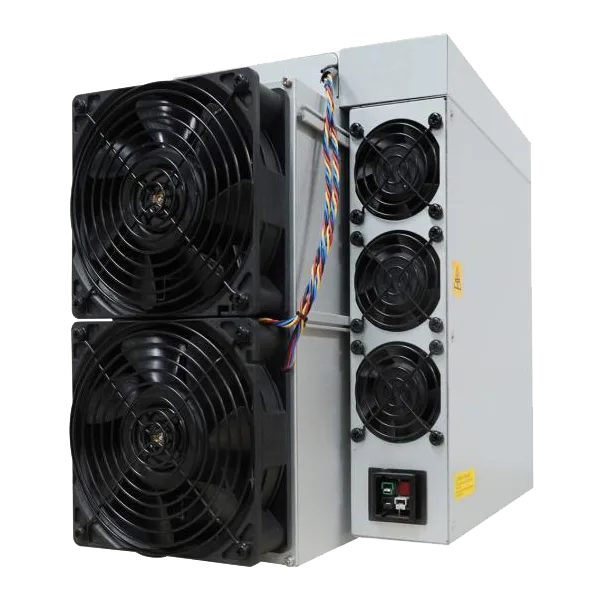
Antminer KS5
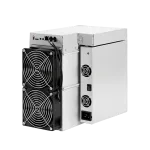
Bitmain next-gen Kaspa miner at 20 TH/s. Massively improved efficiency at 150 J/TH versus KS3. Standard Antminer chassis.
Réponse rapide
The Antminer KS5 is a KHeavyHash miner rated about 20 TH/s at roughly 3,000 W, built on the BM1502 ASIC. An industrial-class unit — loud and power-hungry, best suited to a dedicated mining space, not living areas.
Professional-Grade Miner
This miner draws 3,000W and produces 76 dB of noise — it is designed for dedicated mining environments, not living spaces. Professional-grade miners deliver the highest hashrate and revenue per unit but require proper infrastructure: a 240V circuit, adequate ventilation or exhaust ducting, and a space where noise is not a concern (garage, basement, warehouse, or outdoor enclosure).
For home miners looking for a quieter alternative, consider our Bitcoin Space Heater builds or explore open-source miners like the Bitaxe that are purpose-built for residential environments.
Heater-Class Miner
At 3,000W, this miner outputs approximately 10236 BTU/hr of heat — equivalent to a standard electric space heater. Every watt consumed by an ASIC miner is converted to heat with 100% efficiency, making it a space heater that also mines Bitcoin.
During heating season, miner heat can offset part of the heat a room would otherwise need from another electric heater. The economics depend on your electricity rate, room heat demand, BTC price, network difficulty, and noise constraints.
Calculateur de rentabilité
| Period | Revenue | Electricity Cost | Profit |
|---|---|---|---|
| Daily | $0.62 | $5.04 | $-4.42 |
| Weekly | $4.33 | $35.28 | $-30.95 |
| Monthly | $18.58 | $151.20 | $-132.62 |
| Yearly | $226.04 | $1,839.60 | $-1,613.56 |
Heating offset estimates the value of heat replacing an electric space heater during heating season (~6 months/year in Canada). Actual savings depend on your heating setup and climate.
Where to Buy the Antminer KS5
D-Central Technologies is a Bitcoin-only company. For this miner, check out our trusted partner retailers below.
ASIC Miner Market
United StatesWide selection of new and used ASIC miners. US-based shipping.
MagasinerMinersDeals
United StatesCompetitive prices on new ASIC miners with coupon codes.
MagasinerPartner links may earn D-Central a commission at no extra cost to you. Have you considered Bitcoin mining instead? Explore Bitcoin miners →
Full Specifications
| Model | Antminer KS5 |
|---|---|
| Model Number | KS5 |
| Manufacturer | Bitmain |
| Algorithme | KHeavyHash |
| Coins Mined | Kaspa (KAS) |
| Taux de hachage | 20 TH/s |
| Consommation électrique | 3,000 W |
| Efficiency | 150 J/TH |
| Niveau de bruit | 76 dB |
| Chip Model | BM1502 |
| Cooling | Air |
| Voltage Range | 200-240V AC |
| Operating Temperature | 0-40°C |
| Dimensions | 430x195x290 |
| Weight | 15.8 |
| Interface | Ethernet |
| BTU Output | 10236 BTU/hr |
| Equivalent Heater | Equal to a 3,000W space heater |
| Daily Power Cost | $5.04/day |
| Monthly Power Cost | $151.20/mo |
| Circuit Requirement | 240V circuit required |
| Release Date | 2024-03-01 |
| MSRP | $12,000.00 |
| État | Active |
Home Mining Assessment
Bitmain next-gen Kaspa miner at 20 TH/s. Massively improved efficiency at 150 J/TH versus KS3. Standard Antminer chassis.
The Antminer KS5 is Bitmain’s air-cooled Kaspa miner, built for the kHeavyHash algorithm and rated at 20 TH/s for roughly 3,000 W — about 150 J/TH, or 0.15 J/GH. Released in early 2024, it pairs Bitmain’s proven S21-era chassis and power platform with a dedicated kHeavyHash hashboard, making it one of the more efficient KAS machines you can run at home or in a small hashcenter.
Chip and hashboard architecture
kHeavyHash is the proof-of-work that secures Kaspa (KAS). It combines a matrix-multiplication step with Keccak hashing, which makes it highly ASIC-friendly — GPUs and CPUs are no longer competitive against purpose-built silicon like the KS5. The KS5 is a single-algorithm machine: it mines Kaspa and Kaspa-compatible kHeavyHash coins only, and it cannot mine Bitcoin or any SHA-256 chain.
At the board level, the KS5 runs on Bitmain’s CB8 control board, built around a CVitek CV1835 system-on-chip — the same control platform Bitmain uses on the S19 XP and T21. You can identify it by the “CVITEK” marking on the main SoC, an external SD-card slot beside the Ethernet port, and the absence of a USB-OTG port. There is no on-board FPGA; the control board talks to the hashboards over software-driven UART, and it uses the 2×2-pin fan-header layout shared with the S19j XP and T21.
The kHeavyHash compute lives on the KS5’s hashboards, which carry Bitmain’s custom Kaspa ASIC (the spec sheet catalogs it as the BM1502-class die). As on every Antminer hashboard, the chips are wired in series strings and powered per voltage domain, not per individual chip. That architecture detail matters at repair time: a single weak or dead ASIC drags down the entire domain it sits in, so symptoms present at the board or chain level rather than as one isolated chip. For a deeper look at how Antminer-class silicon is organized, see our ASIC chip reference.
Real-world power and efficiency
The KS5’s 3,000 W nameplate against 20 TH/s works out to 150 J/TH (0.15 J/GH). That figure is measured at the DC side of the hashboards; at the wall you should budget for a few percent more once power-supply conversion losses and fans are included. Plan for roughly 3,100–3,200 W draw on a dedicated 240 V circuit (20 A or larger), and use 200–240 V input — like the rest of the S21-era lineup, the KS5 is not designed for 120 V operation.
Its integrated power supply is built on Bitmain’s APW17 platform (the 1215 series): a 12–15 V DC rail rated to about 267 A and 3,600 W of headroom at 220 V, with a wide 220–277 V input range and roughly 94% conversion efficiency. This is the same PSU family used in the S21, S21 Pro, S21 XP and S19j XP, which is good news for serviceability — spares and replacement units are widely available and interchangeable across that generation.
On tuning: be realistic. Unlike SHA-256 Antminers, which enjoy a rich ecosystem of third-party autotuning firmware, the KS5’s locked stock platform exposes only a small set of fixed power modes (normal and low-power). There is no runtime autotuner that will undervolt it to S21-class efficiency, so treat 150 J/TH as the practical floor rather than a starting point. For the broader picture of how power profiles and J/TH curves vary across the ASIC landscape, browse our ASIC power profiles database.
At full load the KS5 rejects roughly 10,236 BTU/h of heat. That is enough to warm a workshop, garage or basement, which is why many owners run it as a dual-purpose heater — see best miners for heating for how to duct that waste heat productively.
Firmware compatibility
The KS5 ships with Bitmain’s stock Kaspa firmware, which provides the web dashboard, pool configuration and the handful of power modes described above. For the vast majority of operators that is the firmware you will run for the life of the machine.
It is worth being honest about the third-party reality, because it differs sharply from Bitcoin hardware. The CB8 / CV1835 control board enforces a hardware secure-boot chain: an eFuse-locked RSA-2048 signature check (optionally combined with AES-128 decryption) gates the bootloader. In practice this means stock firmware always boots after a power cycle, and custom images written to the board do not persist — they revert on reboot. There is no mature, persistent custom-firmware ecosystem for the KS5 the way there is for the S19 and S21 SHA-256 line. Our own firmware work, including DCENT_OS, targets Bitcoin SHA-256 Antminers; it is not a Kaspa-platform product, and we will not pretend it runs on your KS5. If a vendor claims a permanent custom-firmware unlock for this hardware, treat it with caution.
For pool connectivity the KS5 uses standard Kaspa stratum, configured directly in the stock interface — point it at your chosen KAS pool, set worker credentials, and it begins submitting shares.
Common faults and troubleshooting
The KS5 fails in the same patterns as the rest of the air-cooled Antminer family. The most common issues we see in the shop are:
- Dead or low hashboard / dropped chain — hashrate falls by roughly a third when one board drops out. Because power is domain-regulated, the trigger is usually a single failed ASIC, a heat-sink that has lost contact, or a sagging voltage rail rather than a whole-board failure.
- Power-supply faults — the APW17 not energizing, tripping, or reporting voltage out of range, often after a brownout or a marginal circuit.
- Fan errors — a stalled or failed fan on the 2×2-pin headers triggers a protective shutdown to prevent thermal runaway.
- Control-board / SD-card corruption — the CV1835 boots from its external SD card, so a corrupt card leaves you with no web UI even though the hashboards are healthy.
- Overheat and throttling — ambient above 40°C, clogged fins, or restricted airflow cause the firmware to down-clock or stop.
Work symptom-to-cause with our ASIC fault finder, decode panel signals with the status LED and blink-code guide, and for board-level diagnosis see the hashboard repair guide.
Repair and longevity
D-Central has repaired Antminers in-house in Quebec since 2016, and the KS5 is fully serviceable. CB8 control boards are an available swap part, commercial hashboard testers support both the KS5 and the KS5 Pro, and chip-, PSU- and component-level work is routine on this platform. Because the hashboards regulate voltage per domain, a single failed chip is frequently a targeted reball or replacement rather than a whole-board write-off — the difference between a modest repair bill and replacing an entire hashboard.
Sharing its chassis, PSU and control-board lineage with the S21 generation also means the KS5 inherits a mature, well-stocked spares ecosystem, so it can be kept running well past its warranty. If something has failed, start with our ASIC repair service or get a ballpark from the repair cost estimator before deciding whether to fix or replace.
Who it is for and buying advice
The KS5 is for miners who want exposure to Kaspa specifically — whether for algorithm diversification away from SHA-256, conviction in the KAS network, or simply to point efficient hardware at a coin with a different emission curve than Bitcoin. Its ~10,236 BTU/h output also makes it a credible supplemental heater for a workshop or garage during cold Canadian winters.
What it is not is a Bitcoin miner: if SHA-256 hashrate is your goal, the S21 family is the right tool, not the KS5. To compare the KS5 against other models side by side, use our miner comparison tool and the full ASIC miner database. When you are ready to buy, see order miners, and weigh new-versus-refurbished economics carefully against where KAS difficulty and price sit at the time.
Generational context
Within Bitmain’s Kaspa line the KS5 sits between the older KS3 and the step-up KS5 Pro. The headline story from KS3 to KS5 was efficiency: the KS5’s 150 J/TH represents a large improvement in joules per terahash over the earlier generation, which is what moved Kaspa ASICs from pure-novelty hardware toward something that can pencil out at residential power rates. The KS5 Pro pushes hashrate and power slightly higher at broadly similar efficiency for operators who want more throughput per box.
Credit where it is due: Bitmain’s decision to reuse the S21-era CV1835 control board, APW17 power platform and standard chassis on its Kaspa hardware is exactly what gives the KS5 its serviceability advantage. It is a Kaspa miner riding on a battle-tested Bitcoin-mining foundation — and that shared DNA is why D-Central can keep these machines hashing long after launch.
Broken miner? Get a real quote.
Tell us the symptom and get an instant repair-tier estimate ($95 / $145 / $195 CAD). Mail-in from across Canada, bench in Laval, Quebec.
Send it to D-Central — start a repair →Related Miners
Iceriver KAS KS7 Lite
Bitmain Antminer KS5 (20Th)
Iceriver KS0
Dragonball KS6 Pro Plus
Foire aux questions
What are the current mining economics for the Antminer KS5?
At $0.07/kWh, the Antminer KS5 currently shows an estimated daily net cost of $4.42 before pool fees and hardware cost. Lower electricity rates, network changes, BTC price changes, or useful heat recovery can change the result.
Can I mine Bitcoin at home with the Antminer KS5?
The Antminer KS5 has a home mining score of 8/100. With 76 dB noise and 3,000W power draw, it may require a dedicated space like a garage, basement, or outdoor enclosure. Consider noise insulation and proper ventilation.
Can the Antminer KS5 heat my home?
The Antminer KS5 outputs approximately 10236 BTU/hr of heat. For reference, a typical space heater produces 5,000-5,500 BTU/hr. All electrical energy consumed by the miner is converted to heat, making it 100% efficient as a heater. D-Central offers Bitcoin Space Heater builds designed specifically for home heating integration.
Does D-Central repair the Antminer KS5?
Yes, D-Central provides professional repair services for the Antminer KS5. Services include hashboard repair, control board diagnostics, fan replacement, and full refurbishment. Ship your miner to our Laval, Quebec facility for diagnosis and repair.
What power supply does the Antminer KS5 need?
The Antminer KS5 draws 3,000W of power. You need a power supply rated for at least 3,300W with appropriate voltage (200-240V AC). D-Central stocks compatible power supplies in our shop. Always use a quality PSU from a reputable manufacturer to protect the miner and wiring.