
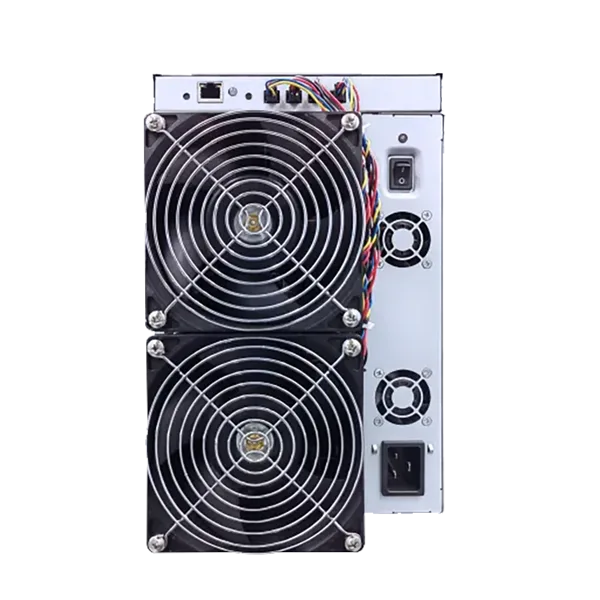
Avalon A1466
Canaan top-tier miner, competitive with S21 series on efficiency
Réponse rapide
The Avalon A1466 is a Bitcoin miner rated about 150 TH/s at roughly 3,230 W (about 21.53 J/TH), built on the A1466 ASIC. An industrial-class unit — loud and power-hungry, best suited to a dedicated mining space, not living areas.
Professional-Grade Miner
This miner draws 3,230W and produces 75 dB of noise — it is designed for dedicated mining environments, not living spaces. Professional-grade miners deliver the highest hashrate and revenue per unit but require proper infrastructure: a 240V circuit, adequate ventilation or exhaust ducting, and a space where noise is not a concern (garage, basement, warehouse, or outdoor enclosure).
For home miners looking for a quieter alternative, consider our Bitcoin Space Heater builds or explore open-source miners like the Bitaxe that are purpose-built for residential environments.
Heater-Class Miner
At 3,230W, this miner outputs approximately 11020.8 BTU/hr of heat — equivalent to a standard electric space heater. Every watt consumed by an ASIC miner is converted to heat with 100% efficiency, making it a space heater that also mines Bitcoin.
During heating season, miner heat can offset part of the heat a room would otherwise need from another electric heater. The economics depend on your electricity rate, room heat demand, BTC price, network difficulty, and noise constraints.
Calculateur de rentabilité
| Period | Revenue | Electricity Cost | Profit |
|---|---|---|---|
| Daily | $4.64 | $5.43 | $-0.79 |
| Weekly | $32.45 | $37.98 | $-5.53 |
| Monthly | $139.08 | $162.79 | $-23.71 |
| Yearly | $1,692.19 | $1,980.64 | $-288.45 |
Heating offset estimates the value of heat replacing an electric space heater during heating season (~6 months/year in Canada). Actual savings depend on your heating setup and climate.
Where to Buy the Avalon A1466
D-Central Technologies
CanadaBitcoin Mining Hackers since 2016. Ships from Laval, Quebec.
magasiner le materiel de minage BitcoinASIC Miner Market
United StatesWide selection of new and used ASIC miners. US-based shipping.
MagasinerMinersDeals
United StatesCompetitive prices on new ASIC miners with coupon codes.
MagasinerFull Specifications
| Model | Avalon A1466 |
|---|---|
| Model Number | A1466 |
| Manufacturer | Canaan |
| Algorithme | SHA-256 |
| Coins Mined | Bitcoin (BTC) |
| Taux de hachage | 150 TH/s |
| Consommation électrique | 3,230 W |
| Efficiency | 21.5 J/TH |
| Niveau de bruit | 75 dB |
| Chip Model | A1466 |
| Cooling | Air |
| Voltage Range | 200-240V AC |
| Operating Temperature | 5-40°C |
| Dimensions | 360x170x282 |
| Weight | 12.8 |
| Interface | Ethernet |
| BTU Output | 11020.8 BTU/hr |
| Equivalent Heater | Equal to a 3,230W space heater |
| Daily Power Cost | $5.43/day |
| Monthly Power Cost | $162.79/mo |
| Circuit Requirement | 240V circuit required |
| Release Date | 2024-01-01 |
| MSRP | $4,200.00 |
| État | Active |
Home Mining Assessment
Canaan top-tier miner, competitive with S21 series on efficiency
The Avalon A1466 is Canaan’s air-cooled SHA-256 Bitcoin miner from the A14 generation, rated at 150 TH/s for roughly 3,230 W — about 21.5 J/TH at the wall. Built on the in-house A3198 ASIC and a RISC-V Kendryte K210 control board, it is a workhorse: efficient enough to run, durable enough to repair.
Chip and hashboard architecture
The A1466 is built around Canaan’s A3198 ASIC (internally tagged A3198S in the factory firmware), the engine behind the entire A14 family. Unlike Bitmain and MicroBT, who buy serial-chained ASICs, Canaan designs its hash chips in-house and drives them with its own proprietary multi-core architecture — each die carries multiple hashing cores with their own PLL configuration and on-die PVT (process-voltage-temperature) sensing, rather than the long daisy-chain of single-core chips you find in an Antminer.
The machine is a three-hashboard chassis. Canaan does not publish a per-board chip count, but analysis of the A14-series firmware points to roughly 78 A3198 dies per board — about 50 TH/s per board across three boards to reach the 150 TH/s nameplate, or near 0.64 TH/s per chip. Canaan has likewise never published the A3198’s process node; it is a refined node positioned a half-step behind the 5nm-class A3197 that powers the newer A1566, so treat any « Nnm » figure you see quoted elsewhere as unverified marketing rather than fact.
The control board is where the Avalon platform diverges most sharply from an Antminer. There is no FPGA and no PIC microcontroller anywhere in the machine. A single Kendryte K210 system-on-chip — a RISC-V dual-core 64-bit part on a 28nm process, with only about 8 MB of on-chip SRAM and no external DRAM — runs the whole show as bare-metal firmware (FreeRTOS, not Linux). The K210 talks directly to the hashboards over SPI at 1 MHz using 40-byte, CRC16-checked command frames. That direct-drive design eliminates the FPGA bitstream and the PIC-bootloader headaches that dominate Antminer repair work, at the cost of running all work dispatch and nonce validation in software on a very small SoC.
One point that trips up a lot of tuners: on the Avalon platform, voltage and frequency are set per voltage domain, not per chip. Each hashboard exposes a variable core rail (Vcore) plus fixed auxiliary rails — roughly VTOP at ~0.75 V and VDDIO at ~1.8 V — and the K210 commands those domains directly. There is no per-chip voltage trim the way some firmware marketing implies. Two NTC 10K thermistors per board (TH1/TH2) feed temperature back to the controller, and the 12 V board supply is boosted internally for the core domain.
Real-world power and efficiency
The 21.53 J/TH headline is a nameplate figure measured at the rated 150 TH/s. In a real deployment, wall draw sits a little above the 3,230 W nameplate once you account for PSU conversion loss and ambient heat, and efficiency degrades as intake temperatures climb — the A14 firmware targets a roughly 70 °C operating envelope, and a hot room will pull the J/TH the wrong way. Plan on 200–240 V single-phase service and a circuit sized with headroom above 3,230 W.
Tuning headroom on the A1466 is honest but modest, and it is important to set expectations correctly. The K210/FreeRTOS platform does not have a runtime autotuner the way an aftermarket Antminer firmware does. What it offers is Canaan’s built-in work modes — a normal mode and a higher-output performance mode — plus a privileged API that can set frequency (a 100–400 MHz range in discrete steps, 200 MHz default) and core voltage within bounded limits. Pushing frequency and voltage manually raises both hashrate and heat and generally voids the warranty, so it is a path for operators who understand the thermal trade-off, not a free lunch. For where this machine sits against the rest of the fleet, see our ASIC power profiles and most efficient Bitcoin miners references.
That ~21.5 J/TH lands the A1466 in the same efficiency band as Bitmain’s Antminer S19 XP — respectable, but a clear step behind the 5nm-class generation (Antminer S21 and Canaan’s own A1566) that pushed efficiency toward 17–18 J/TH. In practice that makes the A1466 a strong fit where power is cheap, or where you actively want the heat.
Heat output as a feature
Every watt this miner draws leaves as heat — about 11,020 BTU/h at the wall, comparable to a mid-size electric space heater. Ducted into a workshop, garage, or grow space, that waste heat turns an expense into hashrate. At 75 dB it is a data-center-class machine, not a bedroom appliance, so heat-recovery setups want a basement, an enclosure, or ducting between the noise and the living space. Our guide to the best Bitcoin miners for heating covers the duct-and-dampen approach in detail.
Firmware compatibility
Here the A1466 demands an honest answer. It runs Canaan’s stock MM firmware on the K210, managed through a web interface on port 80 and the standard CGMiner API on port 4028 (default config-mode IP 192.168.168.168). There is no SSH and no Linux shell on the stock industrial firmware — the K210 simply does not have the memory to host one.
The reality for third-party firmware is stark: there is none. BraiinsOS+, VNish, LuxOS, and ePIC are Antminer/WhatsMiner projects and do not support any Avalon. The K210’s boot image is encrypted at rest with a key fused into the chip’s OTP, which blocks static modification, and the bare-metal RTOS environment is a fundamentally different target from the Linux-based control boards those firmwares run on. So unlike an S19, you cannot simply flash a tuning firmware onto an A1466 today — what you have is Canaan’s own work modes and privileged API.
D-Central’s firmware research has mapped this platform end to end as part of our DCENT_OS work, and we are candid about the difficulty: the K210 industrial line is a much harder firmware target than the Linux-class boards we start from, and Canaan’s newer K230-based home machines are the more natural near-term home for open firmware. We would rather tell you that plainly than overpromise a flash that does not exist. Canaan deserves real credit here — it remains the most open-source-friendly of the major manufacturers, publishing CGMiner drivers and reference firmware that make this kind of analysis possible at all.
Common faults and troubleshooting
The A1466 fails in the same patterns as any high-density SHA-256 miner, with a few Avalon-specific quirks:
- Board not detected / fewer than three boards online. Because the K210 reaches each board over a single SPI link, a dead or intermittent board often shows as a missing hashboard in the API rather than a per-chip error. Reseat the signal and power connectors before assuming chip death.
- Low hashrate or hashboard derating. Usually thermal: dust-clogged heatsinks, a failing fan, or a high intake temperature pulling the firmware into protection. Clean airflow paths and verify both fans first.
- Asic/core failures within a board. A weak or open core in Canaan’s multi-core dies drops the board’s effective hashrate and can raise rejects. The two onboard thermistors and the API’s extended stats help localize the trouble.
- PSU and power-rail faults. The integrated 200–240 V supply and the internal boost converter are common failure points on aging units; symptoms range from no-start to a board that powers but never ramps.
Work through symptoms systematically with our ASIC fault finder and the symptom-based repair guide. For chip-level architecture and signal-chain detail, the ASIC chip reference covers Canaan’s hash-chip family.
Repair and longevity
An A1466 is a machine worth keeping alive. The absence of an FPGA and PIC actually simplifies board-level repair: there is no PIC bootloader to coax back to life and no bitstream to match — faults are concentrated in the hashboards, the PSU, and the power domains, which are all component-level repairable. D-Central has been repairing Avalon hardware in-house in Laval since 2016, and our technicians service the A1466: hashboard diagnostics, domain and rail testing, chip and component-level rework, and PSU repair. Before you replace a unit, it is usually worth a diagnosis — see ASIC repair and our repair-vs-replace breakdown. With clean power, good airflow, and the occasional board repair, an A1466 has years of productive life left.
Who it is for and buying
The A1466 suits the operator who wants modern hashrate density without paying the premium for the latest 5nm flagships — small farms, heat-recovery setups, and home miners with a dedicated, sound-isolated space and cheap or self-generated power. With a 75 dB profile it is not a living-room machine, and its home-mining score reflects that: it is a workhorse for a basement, garage, or shed, not a desk.
Compare it head-to-head against other models in our ASIC miner database and miner comparison tools, and weigh new against refurbished with our refurbished-vs-new guide. New and refurbished hardware is available through the D-Central shop. If your goal is to learn and tinker rather than to maximize TH/s, an open-source Bitaxe-class device is a better first step — but if you want real hashrate you can service yourself, the A1466 is a sensible pick.
Spec snapshot and generational context
| Specification | Avalon A1466 |
|---|---|
| Manufacturer | Canaan Creative |
| Algorithm | SHA-256 (Bitcoin) |
| Nameplate hashrate | 150 TH/s |
| Power (nameplate) | 3,230 W |
| Efficiency | ~21.5 J/TH |
| ASIC chip | Canaan A3198 (A3198S) |
| Hashboards | 3 (air-cooled) |
| Chips per board (firmware-derived) | ~78 |
| Control board / SoC | Kendryte K210 (RISC-V, 28nm, FreeRTOS) |
| Cooling | Air (dual fan) |
| Noise | ~75 dB |
| Input voltage | 200–240 V AC |
| Network | Ethernet |
| Heat output | ~11,020 BTU/h |
| Dimensions / weight | 360 × 170 × 282 mm / 12.8 kg |
| Release | 2024 |
The A1466 sits squarely in the middle of Canaan’s modern lineup. It follows the A13-series A1366 (130 TH/s on the A3200-family silicon) and precedes the A15-series A1566 (185 TH/s on the genuinely 5nm-class A3197). All three share the same K210 control-board lineage and the same direct-SPI, no-FPGA, no-PIC design philosophy — Canaan iterates the hash chip and the voltage/frequency tables while keeping the controller largely constant. Against the wider market, the A1466’s efficiency tier maps to Bitmain’s Antminer S19 XP era: a generation behind the S21 and the A1566, but still a capable, repairable miner that earns its keep wherever power is cheap or the heat is welcome.
Broken miner? Get a real quote.
Tell us the symptom and get an instant repair-tier estimate ($95 / $145 / $195 CAD). Mail-in from across Canada, bench in Laval, Quebec.
Send it to D-Central — start a repair →Related Miners
Antminer S19 Hydro
Innosilicon T2 Turbo 25T
Bitdeer SealMiner A2
Antminer Slim Edition (S17)
Foire aux questions
What are the current mining economics for the Avalon A1466?
At $0.07/kWh, the Avalon A1466 currently shows an estimated daily net cost of $0.79 before pool fees and hardware cost. Lower electricity rates, network changes, BTC price changes, or useful heat recovery can change the result.
Can I mine Bitcoin at home with the Avalon A1466?
The Avalon A1466 has a home mining score of 8/100. With 75 dB noise and 3,230W power draw, it may require a dedicated space like a garage, basement, or outdoor enclosure. Consider noise insulation and proper ventilation.
Can the Avalon A1466 heat my home?
The Avalon A1466 outputs approximately 11020.8 BTU/hr of heat. For reference, a typical space heater produces 5,000-5,500 BTU/hr. All electrical energy consumed by the miner is converted to heat, making it 100% efficient as a heater. D-Central offers Bitcoin Space Heater builds designed specifically for home heating integration.
Does D-Central repair the Avalon A1466?
Yes, D-Central provides professional repair services for the Avalon A1466. Services include hashboard repair, control board diagnostics, fan replacement, and full refurbishment. Ship your miner to our Laval, Quebec facility for diagnosis and repair.
What power supply does the Avalon A1466 need?
The Avalon A1466 draws 3,230W of power. You need a power supply rated for at least 3,553W with appropriate voltage (200-240V AC). D-Central stocks compatible power supplies in our shop. Always use a quality PSU from a reputable manufacturer to protect the miner and wiring.