
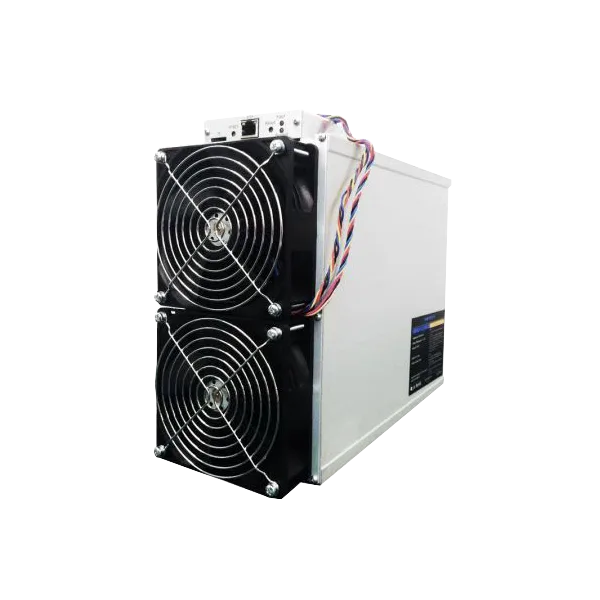
Innosilicon A11 Pro
High-performance EtHash miner from Innosilicon. 2 GH/s at 2500W. Large form factor primarily for Ethereum Classic mining.
Réponse rapide
The Innosilicon A11 Pro is a EtHash miner rated about 2000 MH/s at roughly 2,500 W, built on the Custom ASIC ASIC. An industrial-class unit — loud and power-hungry, best suited to a dedicated mining space, not living areas.
Professional-Grade Miner
This miner draws 2,500W and produces 75 dB of noise — it is designed for dedicated mining environments, not living spaces. Professional-grade miners deliver the highest hashrate and revenue per unit but require proper infrastructure: a 240V circuit, adequate ventilation or exhaust ducting, and a space where noise is not a concern (garage, basement, warehouse, or outdoor enclosure).
For home miners looking for a quieter alternative, consider our Bitcoin Space Heater builds or explore open-source miners like the Bitaxe that are purpose-built for residential environments.
Heater-Class Miner
At 2,500W, this miner outputs approximately 8530 BTU/hr of heat — equivalent to a standard electric space heater. Every watt consumed by an ASIC miner is converted to heat with 100% efficiency, making it a space heater that also mines Bitcoin.
During heating season, miner heat can offset part of the heat a room would otherwise need from another electric heater. The economics depend on your electricity rate, room heat demand, BTC price, network difficulty, and noise constraints.
Calculateur de rentabilité
| Period | Revenue | Electricity Cost | Profit |
|---|---|---|---|
| Daily | $0.00 | $4.20 | $-4.20 |
| Weekly | $0.00 | $29.40 | $-29.40 |
| Monthly | $0.00 | $126.00 | $-126.00 |
| Yearly | $0.02 | $1,533.00 | $-1,532.98 |
Heating offset estimates the value of heat replacing an electric space heater during heating season (~6 months/year in Canada). Actual savings depend on your heating setup and climate.
Where to Buy the Innosilicon A11 Pro
D-Central Technologies is a Bitcoin-only company. For this miner, check out our trusted partner retailers below.
ASIC Miner Market
United StatesWide selection of new and used ASIC miners. US-based shipping.
MagasinerPartner links may earn D-Central a commission at no extra cost to you. Have you considered Bitcoin mining instead? Explore Bitcoin miners →
Full Specifications
| Model | Innosilicon A11 Pro |
|---|---|
| Model Number | A11 Pro |
| Manufacturer | Innosilicon |
| Algorithme | EtHash |
| Coins Mined | Ethereum Classic (ETC) |
| Taux de hachage | 2000 MH/s |
| Consommation électrique | 2,500 W |
| Efficiency | 1.25 J/MH |
| Niveau de bruit | 75 dB |
| Chip Model | Custom ASIC |
| Cooling | Air |
| Voltage Range | 200-240V AC |
| Operating Temperature | 5-40°C |
| Dimensions | 570x316x430 |
| Weight | 22 |
| Interface | Ethernet |
| BTU Output | 8530 BTU/hr |
| Equivalent Heater | Equal to a 2,500W space heater |
| Daily Power Cost | $4.20/day |
| Monthly Power Cost | $126.00/mo |
| Circuit Requirement | 240V circuit required |
| Release Date | 2021-10-01 |
| MSRP | $4,000.00 |
| État | Active |
Home Mining Assessment
High-performance EtHash miner from Innosilicon. 2 GH/s at 2500W. Large form factor primarily for Ethereum Classic mining.
The Innosilicon A11 Pro is an air-cooled EtHash ASIC miner built for the Ethereum family of coins, rated at 2,000 MH/s (2 GH/s) for roughly 2,500 W at the wall — about 1.25 joules per megahash. Released in late 2021, it is now a legacy device best understood through the lens of Ethereum Classic, heat reuse, and long-term repairability.
Innosilicon A11 Pro at a glance
| Specification | Value |
|---|---|
| Algorithm | EtHash / ETChash (Ethereum family) |
| Primary coin today | Ethereum Classic (ETC) |
| Nameplate hashrate | 2,000 MH/s (2 GH/s) |
| Rated power | ~2,500 W |
| Efficiency (native) | ~1.25 J/MH (1.25 W per MH/s) |
| Cooling | Air (internal fans) |
| Noise | ~75 dB |
| Input | 200–240 V AC |
| Operating temperature | 5–40 °C |
| Dimensions | 570 × 316 × 430 mm |
| Weight | ~22 kg |
| Heat output | ~8,530 BTU/h |
| Released | Q4 2021 |
Chip and hashboard architecture
The A11 Pro is fundamentally different from a Bitcoin SHA-256 machine, and that difference is the single most important thing to understand about it. EtHash is a memory-hard algorithm: it was deliberately designed to resist ASICs by forcing every hashing element to make pseudo-random reads against a large, ever-growing dataset called the DAG. A SHA-256 ASIC wins by packing as many tiny hashing cores onto silicon as possible; an EtHash ASIC wins instead by pairing custom Keccak and mixing logic with high-bandwidth memory placed as close to that logic as the board will allow. On the A11 Pro the limiting resource is therefore memory bandwidth and on-board memory capacity, not raw gate count.
Innosilicon never publicly published the die SKU or process node for the A11-generation EtHash ASIC, and we will not invent one — what matters in practice is the integrated memory-plus-compute module rather than a chip part number. Like Innosilicon’s other custom-SoC miners, voltage and clock are managed per power domain (VID string), not per individual chip; there is no per-chip voltage rail. That is why tuning on these units happens at the domain and preset level rather than chip-by-chip, and why a single weak domain shows up as a clean step-down in hashrate rather than a scattered fault.
Real-world power and efficiency
The 2,500 W nameplate is a useful planning figure, but wall draw moves with PSU conversion losses, input voltage, and ambient temperature. Run on a proper 200–240 V circuit, a healthy unit lands near its rated draw; on a hot rack or a marginal PSU it will pull more for the same work. The honest efficiency figure for an EtHash machine is about 1.25 J/MH (equivalently 1.25 W per MH/s). You will sometimes see a « J/TH » number on cross-algorithm spec cards — that is a SHA-256-style normalization and it does not map cleanly onto a memory-hard miner, so treat joules-per-megahash as the number that actually describes this device.
There is modest tuning headroom. Innosilicon’s firmware exposes preset power modes (efficiency, balanced and performance behaviour), and the universal physics still applies: dropping voltage and frequency improves J/MH at the cost of raw hashrate, while pushing them does the reverse. Our ASIC power-profiles database is deepest for SHA-256 Antminers, but the tuning principle is identical here — if you are running an A11 Pro for heat or for marginal-cost ETC, biasing toward the efficiency preset is almost always the right call.
Firmware compatibility — the honest version
Stock A11 Pro units run Innosilicon’s factory firmware: a cgminer-derived mining stack behind a web UI, with the preset-based tuning described above. That is the supported, warranty-safe path, and for most owners it is the right one.
Third-party firmware reality is far thinner here than on the Bitmain SHA-256 side. The well-known alternative firmwares — the kind that add advanced autotuning or native Stratum V2 — are written for Bitcoin ASICs and will not run on an EtHash machine at all, so there is no Stratum V2 path on this hardware. A small number of community and vendor builds have circulated for Innosilicon EtHash units over the years, but support is narrow, version-specific, can void your warranty, and many factory units shipped with locked NAND that resists reflashing. If you go that route, go in with eyes open and a recovery plan.
For completeness: D-Central’s own firmware work (DCENT_OS) targets SHA-256 Bitcoin ASICs, so it does not apply to the A11 Pro. We mention that only so you do not go looking for a D-Central firmware that was never meant for this class of machine. We credit Innosilicon’s engineers for shipping a capable EtHash design in a tough, ASIC-hostile algorithm — this is a longevity and economics question now, not a firmware one.
Common faults and troubleshooting
The failure modes on a dense, 2,500 W air-cooled box are predictable:
- Dead or degraded domains/chains — a failed power domain drops a visible chunk of hashrate in one clean step, since the unit hashes in strings rather than as one monolith.
- Memory faults — because EtHash is memory-bound, failing memory tends to surface as DAG/verification errors, rising rejected shares, or a hashrate that sags below nameplate even though the chips report present. This is a class of fault you simply do not see on a SHA-256 miner.
- PSU and fan failures — the usual suspects: a tired power supply that can’t hold rail voltage under load, or a seized fan that triggers thermal protection. At ~75 dB and ~8,500 BTU/h, this machine lives and dies by its airflow.
- Thermal throttling — inadequate intake temperature or dust-clogged fins will pull clocks down before anything actually breaks.
Innosilicon’s status and error semantics differ from Bitmain’s, so don’t try to read them as Antminer codes. Work the symptom instead: our ASIC fault finder walks a symptom-led diagnosis (no hashrate, low hashrate, won’t boot, overheating) that applies regardless of vendor.
Repair and longevity
D-Central has repaired mining hardware in-house since 2016 from our Laval, Québec shop, and the A11 Pro is repairable at the board and component level — power supplies, fans, power stages, connectors, and control hardware are all serviceable rather than disposable. If your unit has thrown a domain or won’t hold its rated hashrate, it is usually a fixable fault, not a write-off. You can start a repair through our ASIC repair service.
There is one longevity twist unique to EtHash machines that no soldering iron can fix. The DAG grows over time, and an EtHash ASIC only mines a coin for as long as that coin’s DAG fits in the miner’s on-board memory. When the DAG outgrows the hardware, the miner stops — regardless of how healthy the boards are. So repair keeps an A11 Pro earning only while its target coin’s dataset stays within reach. That is an economic and protocol limit, not a hardware defect, and it is the right frame for deciding whether to service a given unit.
Who it’s for and buying guidance
Post-Merge, the A11 Pro is a niche, legacy device, and we’ll be straight about that. With a home-mining score of 40/100 it is a poor fit for quiet residential mining — it is loud, hot, and built for ETC or other EtHash coins rather than Bitcoin. Where it still makes sense is narrow but real: a marginal-cost Ethereum Classic miner where power is cheap or free, a learning rig for understanding memory-hard mining, or a deliberate space heater. Its ~8,530 BTU/h of waste heat is genuine output you can duct into a room, turning heating spend into hashrate.
These are secondary-market units now — resale values collapsed after Ethereum moved off mining — so buy and price accordingly, and have any candidate unit’s hashboards and PSU checked before you commit. If pure Bitcoin profit is the goal, an EtHash miner is the wrong tool and a modern SHA-256 ASIC is the right one. If you already own an A11 Pro or want one serviced or sourced, D-Central can help on the repair and refurbishment side.
Generational context
The A11 Pro belongs to Innosilicon’s A10/A11 EtHash line, which launched into the 2021 Ethereum bull market and GPU shortage, when EtHash ASICs commanded enormous premiums. That era ended abruptly: Ethereum’s transition to proof-of-stake — « The Merge, » on 15 September 2022 — eliminated EtHash mining on Ethereum mainnet overnight, and the device’s primary reason for existing evaporated with it. What survives is Ethereum Classic (which uses the ETChash variant) and a handful of smaller EtHash coins.
The contrast with Bitcoin hardware is instructive. SHA-256 is permanent — a Bitcoin ASIC’s algorithm will never be voted away — which is a structural reason SHA-256 miners hold value and remain serviceable for many years. An EtHash ASIC, by design and by Ethereum’s own roadmap, was always living on borrowed time. None of that is a knock on Innosilicon’s engineering; it is simply the difference between mining a coin whose proof-of-work is forever and one whose community chose to retire it. Understanding that difference is the most useful thing the A11 Pro can teach a new miner.
Broken miner? Get a real quote.
Tell us the symptom and get an instant repair-tier estimate ($95 / $145 / $195 CAD). Mail-in from across Canada, bench in Laval, Quebec.
Send it to D-Central — start a repair →Related Miners
iPollo V1 Mini Wifi 280
Jasminer X16-QE
Antminer E9 Pro
Jasminer X16-Q pro
Comparer le Innosilicon A11 Pro
Foire aux questions
What are the current mining economics for the Innosilicon A11 Pro?
At $0.07/kWh, the Innosilicon A11 Pro currently shows an estimated daily net cost of $4.20 before pool fees and hardware cost. Lower electricity rates, network changes, BTC price changes, or useful heat recovery can change the result.
Can I mine Bitcoin at home with the Innosilicon A11 Pro?
The Innosilicon A11 Pro has a home mining score of 8/100. With 75 dB noise and 2,500W power draw, it may require a dedicated space like a garage, basement, or outdoor enclosure. Consider noise insulation and proper ventilation.
Can the Innosilicon A11 Pro heat my home?
The Innosilicon A11 Pro outputs approximately 8530 BTU/hr of heat. For reference, a typical space heater produces 5,000-5,500 BTU/hr. All electrical energy consumed by the miner is converted to heat, making it 100% efficient as a heater. D-Central offers Bitcoin Space Heater builds designed specifically for home heating integration.
Does D-Central repair the Innosilicon A11 Pro?
Yes, D-Central provides professional repair services for the Innosilicon A11 Pro. Services include hashboard repair, control board diagnostics, fan replacement, and full refurbishment. Ship your miner to our Laval, Quebec facility for diagnosis and repair.
What power supply does the Innosilicon A11 Pro need?
The Innosilicon A11 Pro draws 2,500W of power. You need a power supply rated for at least 2,750W with appropriate voltage (200-240V AC). D-Central stocks compatible power supplies in our shop. Always use a quality PSU from a reputable manufacturer to protect the miner and wiring.