
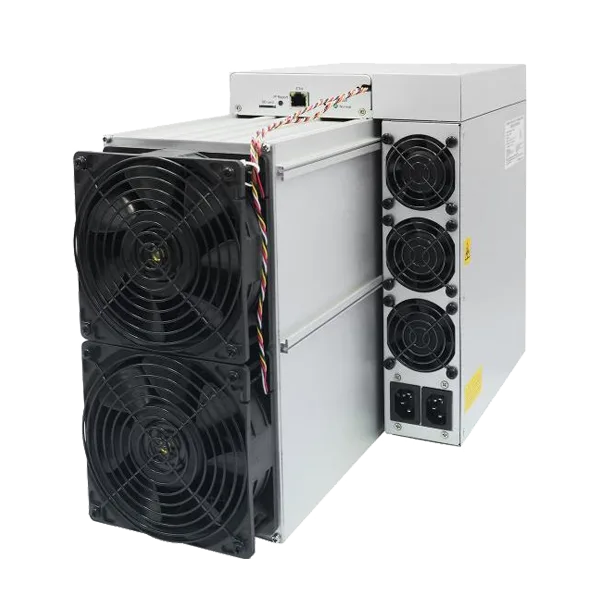
Antminer E9 Pro
EtHash ASIC miner primarily for Ethereum Classic mining post-ETH merge
Réponse rapide
The Antminer E9 Pro is a EtHash miner rated about 3680 MH/s at roughly 2,200 W, built on the BM1360 ASIC. An industrial-class unit — loud and power-hungry, best suited to a dedicated mining space, not living areas.
Professional-Grade Miner
This miner draws 2,200W and produces 75 dB of noise — it is designed for dedicated mining environments, not living spaces. Professional-grade miners deliver the highest hashrate and revenue per unit but require proper infrastructure: a 240V circuit, adequate ventilation or exhaust ducting, and a space where noise is not a concern (garage, basement, warehouse, or outdoor enclosure).
For home miners looking for a quieter alternative, consider our Bitcoin Space Heater builds or explore open-source miners like the Bitaxe that are purpose-built for residential environments.
Heater-Class Miner
At 2,200W, this miner outputs approximately 7506.4 BTU/hr of heat — equivalent to a standard electric space heater. Every watt consumed by an ASIC miner is converted to heat with 100% efficiency, making it a space heater that also mines Bitcoin.
During heating season, miner heat can offset part of the heat a room would otherwise need from another electric heater. The economics depend on your electricity rate, room heat demand, BTC price, network difficulty, and noise constraints.
Calculateur de rentabilité
| Period | Revenue | Electricity Cost | Profit |
|---|---|---|---|
| Daily | $0.00 | $3.70 | $-3.70 |
| Weekly | $0.00 | $25.87 | $-25.87 |
| Monthly | $0.00 | $110.88 | $-110.88 |
| Yearly | $0.04 | $1,349.04 | $-1,349.00 |
Heating offset estimates the value of heat replacing an electric space heater during heating season (~6 months/year in Canada). Actual savings depend on your heating setup and climate.
Where to Buy the Antminer E9 Pro
D-Central Technologies is a Bitcoin-only company. For this miner, check out our trusted partner retailers below.
ASIC Miner Market
United StatesWide selection of new and used ASIC miners. US-based shipping.
MagasinerMinersDeals
United StatesCompetitive prices on new ASIC miners with coupon codes.
MagasinerPartner links may earn D-Central a commission at no extra cost to you. Have you considered Bitcoin mining instead? Explore Bitcoin miners →
Full Specifications
| Model | Antminer E9 Pro |
|---|---|
| Model Number | E9 Pro |
| Manufacturer | Bitmain |
| Algorithme | EtHash |
| Coins Mined | Ethereum Classic (ETC) |
| Taux de hachage | 3680 MH/s |
| Consommation électrique | 2,200 W |
| Efficiency | 0.6 J/MH |
| Niveau de bruit | 75 dB |
| Chip Model | BM1360 |
| Cooling | Air |
| Voltage Range | 200-240V AC |
| Operating Temperature | 5-40°C |
| Dimensions | 400x195x290 |
| Weight | 14.2 |
| Interface | Ethernet |
| BTU Output | 7506.4 BTU/hr |
| Equivalent Heater | Equal to a 2,200W space heater |
| Daily Power Cost | $3.70/day |
| Monthly Power Cost | $110.88/mo |
| Circuit Requirement | 240V circuit required |
| Release Date | 2023-01-01 |
| MSRP | $3,000.00 |
| État | Active |
Home Mining Assessment
EtHash ASIC miner primarily for Ethereum Classic mining post-ETH merge
The Antminer E9 Pro is Bitmain’s flagship EtHash ASIC: roughly 3.68 GH/s for about 2,200 W at the wall, or about 0.60 J/MH. It was built for Ethereum mining before the 2022 Merge ended that market; today it earns on Ethereum Classic and other EtHash coins. It is a memory-hard machine housed in the familiar air-cooled Antminer chassis.
A different kind of ASIC: memory-hard, not hash-dense
Almost everything D-Central works on day to day is a SHA-256 Bitcoin miner, where the win comes from cramming as many tiny hashing cores as possible onto a die. The E9 Pro is the opposite animal. It mines EtHash (also written Ethash), the algorithm Ethereum used while it was proof-of-work, and EtHash was deliberately designed to be memory-hard. Mining it means repeatedly reading random slices of a large dataset called the DAG (a directed acyclic graph that grows over time) out of fast memory. The bottleneck is memory bandwidth, not raw compute.
That single fact shapes the whole machine. Where a Bitcoin ASIC board is a dense string of hashing chips, an EtHash board is fundamentally a bank of fast memory plus the controllers that feed it. The board must carry enough on-board memory to hold the entire current DAG; if it cannot, it simply stops being able to mine that coin. This is also why EtHash resisted ASICs for years longer than SHA-256 — you cannot out-shrink a memory-bandwidth problem the way you can out-shrink a compute problem, so the efficiency gap between an EtHash ASIC and a GPU is real but far narrower than the chasm between a Bitcoin ASIC and a CPU.
A note on the chip designation
Our database records the on-board ASIC as a BM1360-class part. We want to be straight about the limits of that label: Bitmain never published silicon documentation for its EtHash line the way it did for its SHA-256 chips, and in our own chip research a « BM1360 » string also turns up in unrelated, Bitcoin-side firmware as an unconfirmed home-class part. So we treat the exact die identity and its internal layout — core counts, memory-controller topology, voltage-domain map — as recorded but not independently confirmed, and we will not invent numbers we cannot stand behind. What is certain is the behaviour: this is a memory-bound EtHash pipeline, and that is what determines how it performs, fails, and gets repaired.
Real-world power and efficiency
The E9 Pro is rated at 3.68 GH/s for about 2,200 W. That nameplate is a wall figure — it already includes power-supply conversion loss — so size your circuit around the full ~2.2 kW draw, not a silicon-only number. It is a 200–240 V AC machine and is not designed to run on standard North American 120 V.
On efficiency, one honest correction is worth making. A spec sheet that reports this miner at « 597,826 J/TH » is simply expressing a megahash-scale machine in terahash units — arithmetically true, practically meaningless. For a memory-hard miner the meaningful unit is joules per megahash, and here that works out to about 0.60 J/MH (roughly 598 J/GH). Quote it that way and it is easy to compare against the alternative: a well-tuned high-end GPU lands somewhere around 2–3 J/MH on EtHash, so the E9 Pro is on the order of three to four times more efficient than GPUs while delivering the hashrate of dozens of cards in a single box. That density and efficiency, not novelty, is the entire reason an EtHash ASIC exists.
| EtHash mining approach | Typical hashrate | Efficiency (approx.) | Practical reality |
|---|---|---|---|
| High-end GPU (tuned) | ~90–100 MH/s | ~2–3 J/MH | Flexible, mines many algorithms |
| 8-card GPU rig | ~0.8 GH/s | ~2–3 J/MH | Heat and complexity of eight cards |
| Antminer E9 Pro | ~3.68 GH/s | ~0.60 J/MH | Far denser; fixed to EtHash only |
Unlike a modern Bitcoin ASIC, the E9 Pro has very little practical tuning headroom: there is no mature third-party autotuning firmware for EtHash hardware (more on that below), so in the real world you run it close to its stock operating point. Where you can still optimise is on the economic side — pool choice, electricity rate, and heat reuse. We catalogue documented wattage and efficiency points for hardware we work on in our ASIC power profiles database, which is the right place to sanity-check any tuning plan before you commit a circuit to it.
At 2,200 W the E9 Pro also throws off roughly 7,500 BTU/h of heat. We are in Laval, Quebec, so we mean this literally: that waste heat is a resource, not a nuisance. Duct the exhaust into a workshop, garage, or basement and the machine doubles as a space heater that happens to earn coin — which, given EtHash economics today, is often the most honest way to justify running one.
What it actually mines now: life after the Merge
This machine cannot be understood without the event that reshaped its world. On 15 September 2022, Ethereum’s Merge switched the network from proof-of-work to proof-of-stake and ended ASIC and GPU mining of ETH overnight. The E9 Pro arrived into that aftermath, and its remaining job is to mine the EtHash-family coins that stayed on proof-of-work — chiefly Ethereum Classic (ETC), alongside smaller chains such as EthereumPoW.
Ethereum Classic uses Etchash, a variant of EtHash. Crucially for owners of fixed-memory hardware, ETC deliberately slowed its DAG growth years ago (the ECIP-1099 change roughly doubled the epoch length) specifically so that devices with a bounded amount of memory stay able to mine it for far longer. That is good news for the longevity of a machine like this — but it does not change the basic economics: post-Merge, an EtHash ASIC is a single-ecosystem tool chasing a much smaller reward pool than ETH once offered. Buy and run one with clear eyes about that.
Firmware and software reality
The E9 Pro runs Bitmain’s stock firmware, and for this machine that is essentially the whole story. The rich third-party tuning ecosystem that exists for Bitmain’s SHA-256 line — the autotuning, custom-power-profile firmwares that owners of an S19 or S21 take for granted — does not meaningfully exist for EtHash hardware. The market simply collapsed after the Merge before that software matured, so we will not pretend you can flash your way to dramatically better numbers here.
Two related points, stated plainly so there is no confusion. First, D-Central’s own DCENT_OS firmware program targets Bitcoin SHA-256 ASICs, not EtHash hardware — it is not a path for this machine, and we would rather tell you that than imply otherwise. Second, pool-protocol developments you may have read about on the Bitcoin side, such as Stratum V2, belong to SHA-256 mining; EtHash pools use their own stratum dialect, so those Bitcoin-world features are simply not part of this miner’s world. Configuration here is conventional: point it at an ETC (or other EtHash) pool over its Ethernet interface and let the stock firmware run.
Common faults and troubleshooting
Because the E9 Pro is a memory-bound machine, its failure signatures skew toward memory and power rather than the chip-string faults typical of a Bitcoin ASIC. The patterns we see most often:
- A hashboard reads as missing or shows zero hashrate. A failed memory device, a bad solder joint, or a dead power stage can take an entire board offline, and the controller reports the whole board rather than a partial count.
- DAG load or memory errors. Symptoms like a board that initialises but never settles into a stable hashrate, or that drops out shortly after the DAG epoch advances, frequently point to marginal memory rather than the compute side.
- Fan errors. Like every Antminer-chassis machine, it will refuse to mine or throttle hard if a fan fails or drops below its minimum RPM.
- Temperature and sensor faults. A flaky sensor can trip the firmware’s safety logic and present as a thermal shutdown even when the hardware is actually fine.
- Low or unstable hashrate. Usually degraded thermal interface material, a marginal power supply, or weak memory being de-rated.
Our ASIC fault finder walks these symptoms — dead boards, fan and sensor faults, power errors — down to a probable root cause before you ever open the case.
Repair and longevity
D-Central has repaired Bitmain hardware in-house since 2016, and the E9 Pro is in scope. The work is genuinely component-level: diagnosing and reflowing or replacing failed memory devices, rebuilding on-board power stages, and servicing the control board, fans, and cooling — not swapping whole units. Because so much of an EtHash board’s cost lives in its memory and power circuitry, finding and fixing the one failed component is almost always far cheaper than writing the machine off.
A well-kept E9 Pro — clean filters, fresh thermal paste, a stable power feed, sensible operating temperatures — is a multi-year machine, and the ECIP-1099 memory-friendly DAG schedule means it should stay capable of mining ETC well into the future. When something does fail, send the board in rather than bin the unit. Our ASIC repair service covers exactly this kind of diagnosis and turnaround.
Who it is for, and buying
Let us be honest about fit, because this is a specialist tool, not a general-purpose miner. The E9 Pro makes sense for someone with a specific commitment to Ethereum Classic or another EtHash coin, for an operator who wants to diversify a fleet away from pure Bitcoin exposure, or for anyone who values the heat as much as the coin and wants a quiet-by-data-center-standards 2.2 kW heater that pays for part of itself. At 75 dB it is not a living-room device; it wants a dedicated 240 V circuit and a space where noise and a steady stream of warm exhaust are welcome.
If your real goal is durable, sovereign mining rather than chasing one shrinking ecosystem, it is fair to say that SHA-256 Bitcoin hardware is the more future-proof path — the coin base is not going anywhere, and the repair, firmware, and resale ecosystems around it are deep. A learner or hobbyist is usually better served by an open-source single-chip Bitcoin board such as a Bitaxe than by a retired-market EtHash ASIC. You can see our current ASIC lineup, and talk to people who actually fix these machines, through the D-Central shop; we build and bench-test to order rather than drop-ship from a warehouse.
Generational context
Credit where it is due: Bitmain’s E-series was a genuine engineering feat. Making EtHash — an algorithm explicitly designed to resist ASICs — economical in dedicated silicon at all is hard, and the E9 Pro refined the original E9 into a meaningfully more efficient package. The tragedy of its timing is not Bitmain’s doing: the entire EtHash ASIC category, from this machine to its Innosilicon, iPollo, and Jasminer rivals, was built for a market that proof-of-stake removed. What is left is a focused ETC-and-friends niche, and within that niche the E9 Pro remains one of the more capable air-cooled options you can put on a bench.
| Antminer E9 Pro — at a glance | Specification |
|---|---|
| Algorithm | EtHash / Etchash |
| Primary coin today | Ethereum Classic (ETC) |
| Hashrate | ~3.68 GH/s (3,680 MH/s) |
| Power (wall) | ~2,200 W |
| Efficiency | ~0.60 J/MH (~598 J/GH) |
| Input voltage | 200–240 V AC |
| Cooling / noise | Air · ~75 dB |
| Heat output | ~7,500 BTU/h |
| Dimensions / weight | 400 × 195 × 290 mm · 14.2 kg |
| Interface | Ethernet |
| Released | 2023 |
For full specifications, live profitability, and side-by-side comparisons, view the Antminer E9 Pro in our ASIC miner database, and cross-reference our power-profile data before you finalise a circuit and tuning plan.
Broken miner? Get a real quote.
Tell us the symptom and get an instant repair-tier estimate ($95 / $145 / $195 CAD). Mail-in from across Canada, bench in Laval, Quebec.
Send it to D-Central — start a repair →Related Miners
Jasminer X16-Q
iPollo V1 Mini Wifi 330
iPollo V2H
Jasminer X16-Q
Comparer le Antminer E9 Pro
Foire aux questions
What are the current mining economics for the Antminer E9 Pro?
At $0.07/kWh, the Antminer E9 Pro currently shows an estimated daily net cost of $3.70 before pool fees and hardware cost. Lower electricity rates, network changes, BTC price changes, or useful heat recovery can change the result.
Can I mine Bitcoin at home with the Antminer E9 Pro?
The Antminer E9 Pro has a home mining score of 11/100. With 75 dB noise and 2,200W power draw, it may require a dedicated space like a garage, basement, or outdoor enclosure. Consider noise insulation and proper ventilation.
Can the Antminer E9 Pro heat my home?
The Antminer E9 Pro outputs approximately 7506.4 BTU/hr of heat. For reference, a typical space heater produces 5,000-5,500 BTU/hr. All electrical energy consumed by the miner is converted to heat, making it 100% efficient as a heater. D-Central offers Bitcoin Space Heater builds designed specifically for home heating integration.
Does D-Central repair the Antminer E9 Pro?
Yes, D-Central provides professional repair services for the Antminer E9 Pro. Services include hashboard repair, control board diagnostics, fan replacement, and full refurbishment. Ship your miner to our Laval, Quebec facility for diagnosis and repair.
What power supply does the Antminer E9 Pro need?
The Antminer E9 Pro draws 2,200W of power. You need a power supply rated for at least 2,420W with appropriate voltage (200-240V AC). D-Central stocks compatible power supplies in our shop. Always use a quality PSU from a reputable manufacturer to protect the miner and wiring.