
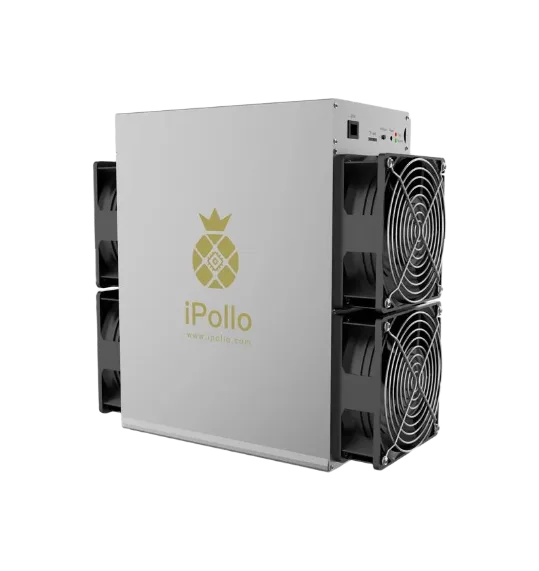
iPollo V2
Réponse rapide
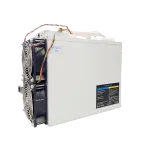
The iPollo V2 is a EtHash miner rated about 10 GH/s at roughly 1,500 W. An industrial-class unit — loud and power-hungry, best suited to a dedicated mining space, not living areas.
Professional-Grade Miner
This miner draws 1,500W and produces 75 dB of noise — it is designed for dedicated mining environments, not living spaces. Professional-grade miners deliver the highest hashrate and revenue per unit but require proper infrastructure: a 240V circuit, adequate ventilation or exhaust ducting, and a space where noise is not a concern (garage, basement, warehouse, or outdoor enclosure).
For home miners looking for a quieter alternative, consider our Bitcoin Space Heater builds or explore open-source miners like the Bitaxe that are purpose-built for residential environments.
Heater-Class Miner
At 1,500W, this miner outputs approximately 5118 BTU/hr of heat — equivalent to a standard electric space heater. Every watt consumed by an ASIC miner is converted to heat with 100% efficiency, making it a space heater that also mines Bitcoin.
During heating season, miner heat can offset part of the heat a room would otherwise need from another electric heater. The economics depend on your electricity rate, room heat demand, BTC price, network difficulty, and noise constraints.
Calculateur de rentabilité
| Period | Revenue | Electricity Cost | Profit |
|---|---|---|---|
| Daily | $0.00 | $2.52 | $-2.52 |
| Weekly | $0.00 | $17.64 | $-17.64 |
| Monthly | $0.01 | $75.60 | $-75.59 |
| Yearly | $0.11 | $919.80 | $-919.69 |
Heating offset estimates the value of heat replacing an electric space heater during heating season (~6 months/year in Canada). Actual savings depend on your heating setup and climate.
Where to Buy the iPollo V2
D-Central Technologies is a Bitcoin-only company. For this miner, check out our trusted partner retailers below.
Partner links may earn D-Central a commission at no extra cost to you. Have you considered Bitcoin mining instead? Explore Bitcoin miners →
Full Specifications
| Model | iPollo V2 |
|---|---|
| Model Number | V2 |
| Manufacturer | iPollo |
| Algorithme | EtHash |
| Coins Mined | Ethereum Classic (ETC) |
| Taux de hachage | 10 GH/s |
| Consommation électrique | 1,500 W |
| Efficiency | 150 J/GH |
| Niveau de bruit | 75 dB |
| Dimensions | 430 x 195 x 290mm |
| Weight | 16.5 |
| BTU Output | 5118 BTU/hr |
| Equivalent Heater | Equal to a 1,500W space heater |
| Daily Power Cost | $2.52/day |
| Monthly Power Cost | $75.60/mo |
| Circuit Requirement | Standard 120V 15A |
| Release Date | 2024-11-01 |
| MSRP | $5,140.00 |
| État | Active |
Home Mining Assessment
The iPollo V2 is an EtHash (Etchash) ASIC built to mine Ethereum Classic (ETC). It is rated at roughly 10 GH/s for about 1,500 W — close to 0.15 J/MH. Released in November 2024, it is a single-purpose, memory-bound machine whose real working life is set by the ETC DAG, not by Bitcoin’s economics.
What the iPollo V2 actually is
Most pages that mention the iPollo V2 quietly treat it like a Bitcoin miner, then quote an efficiency number in joules-per-terahash. That framing is misleading. The V2 does not run SHA-256, it runs EtHash — specifically the Etchash variant used by Ethereum Classic. Hashes on EtHash are computationally nothing like the double-SHA-256 hashes a Bitcoin ASIC performs, so a « J/TH » figure for this machine is a cross-algorithm normalization and is not directly comparable to an Antminer or Whatsminer. The honest, native way to express its efficiency is in joules per megahash: roughly 0.15 J/MH, or about 150 W for every GH/s of EtHash throughput.
We say this up front because it matters for buyers. The iPollo V2 cannot and will never mine Bitcoin. It is a tool for one job — turning electricity into Ethereum Classic shares — and everything about its design, lifespan, and resale value follows from that single fact.
Architecture: a memory-bound ASIC, not a pure-compute one
This is the most important architectural point about any EtHash machine, and it is where the iPollo V2 differs fundamentally from a Bitcoin SHA-256 miner. A Bitcoin ASIC is almost pure combinational logic: thousands of tiny hashing cores and very little memory. EtHash, by contrast, was deliberately designed to be memory-hard. To validate work, the chip must repeatedly read pseudo-random slices of a large dataset called the DAG (Directed Acyclic Graph). That dataset has to live in fast on-board memory next to the hashing engine.
So the V2 is best understood as a comparatively modest hashing ASIC bolted to a bank of high-speed memory sized to hold the entire ETC DAG. The memory subsystem — its capacity and bandwidth — is the limiting resource, not raw logic gate count. We describe the V2’s silicon functionally here rather than quote a chip SKU or per-board chip count, because iPollo does not publish a verified teardown and we will not invent numbers we cannot stand behind. What we can state with confidence is the behaviour: like all EtHash hardware, the V2’s performance and longevity are governed by how much DAG it can hold and how fast it can stream it.
Real-world power, heat and noise
At its rated 1,500 W draw, the iPollo V2 behaves like a 1.5 kW resistive load with a fan attached. Expect wall draw to sit at or slightly above the nameplate once PSU losses are counted — published ASIC power figures are typically measured at the board, not the outlet. Plan for a dedicated branch circuit; this is not a unit you share with household loads.
| Attribute | iPollo V2 (as configured) | Notes |
|---|---|---|
| Algorithm | EtHash / Etchash | Ethereum Classic (ETC) only |
| Rated hashrate | ~10 GH/s | EtHash throughput, not SHA-256 |
| Power draw | ~1,500 W | Measure at the wall under load |
| Native efficiency | ~0.15 J/MH (150 W per GH/s) | EtHash-native; J/TH figure is a cross-algo conversion |
| Heat output | ~5,118 BTU/h | 1,500 W × 3.412 — nearly all input becomes heat |
| Noise | ~75 dB | Server-room class; not living-space friendly |
| Weight / size | 16.5 kg / 430 × 195 × 290 mm | Standard shoebox ASIC form factor |
| Released | November 2024 | Single-coin EtHash machine |
Thermodynamically, a miner is a heater that happens to compute: very close to all of those 1,500 W leave the chassis as heat, here about 5,118 BTU/h. That waste heat is genuinely useful — ducted into a workshop, garage or grow space it offsets resistive heating you would have paid for anyway. The trade-off is the ~75 dB of fan noise, which is loud enough that the V2 belongs in a garage, shed or sound-dampened enclosure rather than an occupied room.
On tuning headroom: EtHash ASICs do not have the deep, published power-profile catalogs that the big Bitcoin models do. There is no autotuner ecosystem here calculating dozens of voltage/frequency points at runtime. You can usually trim or push the operating point modestly within stock limits, but treat the rated figures as the realistic envelope. If you are cross-shopping the broader fleet and want to see how disciplined power tuning works on machines that do support it, our ASIC power profiles database is the reference — just note those profiles are SHA-256 specific and do not transfer to this unit.
Firmware: stock-only, and an honest word on DCENT_OS
The rich third-party firmware scene that mining hackers love — the custom builds that unlock autotuning, immersion presets and Stratum V2 — is a SHA-256 / Bitcoin phenomenon. It does not exist for EtHash hardware. The iPollo V2 runs iPollo’s closed stock firmware: a web dashboard for pool configuration, monitoring and updates, and that is the supported reality. There is no mature aftermarket OS for it.
We build firmware ourselves, so we will be blunt about scope: DCENT_OS is a Bitcoin/SHA-256 project and does not run on EtHash machines like the V2. Anyone telling you to « flash custom firmware » on this miner for a big efficiency win is selling you something that does not apply to this algorithm. Keep the stock firmware current, point it at a reputable ETC pool, and judge the V2 on its stock numbers — not on imagined gains from software that was never written for it.
Common faults and troubleshooting
Most of what fails on the V2 is what fails on any modern ASIC, plus one category unique to EtHash:
- Power supply faults — the hardest-worked component in any 1.5 kW miner. Symptoms: no power, random restarts under load, or the unit refusing to ramp.
- Fan failures — a stalled or noisy fan triggers thermal protection and drops hashrate. Often the cheapest, highest-impact fix.
- Under-performing hash engine — accepted hashrate well below the rated 10 GH/s, or rising rejected shares, usually points to a thermal, power-delivery or memory-channel problem rather than the whole board being dead.
- DAG / memory errors (EtHash-specific) — bursts of invalid shares, « DAG generation failed » states, or a clean start that degrades as the epoch advances are classic signs of either a memory fault or the DAG approaching the on-board memory ceiling (see longevity, below).
- Network and pool config — the most common « it stopped mining » cause is a stale pool URL, wrong worker credentials, or a dropped connection, not a hardware fault.
Work the symptom methodically before condemning a board. Our ASIC fault finder walks the same fault tree D-Central’s bench technicians use — isolate power, then cooling, then the hashing/memory subsystem, then the network — and it applies to EtHash units just as it does to SHA-256 machines.
Repair and longevity
D-Central has repaired ASICs in-house since 2016, and the failure modes that kill a miner — blown PSUs, dead fans, swollen capacitors, cracked connectors, controller faults — are universal across algorithms. Those are serviceable on the V2 the same way they are on an Antminer; our ASIC repair service is the place to start if yours has stopped earning. We will always tell you honestly whether a unit is worth fixing rather than upselling a repair that does not pay for itself.
The catch with any EtHash miner is the one repair nobody can perform: the DAG memory wall. The ETC DAG grows as the chain advances, epoch by epoch. When it eventually exceeds the V2’s on-board memory, the machine simply can no longer mine ETC — no board swap fixes that, because the hardware was never sized for it. Ethereum Classic anticipated this: the ECIP-1099 « Thanos » upgrade doubled the epoch length and halved the DAG growth rate specifically to extend the usable life of memory-limited hardware. That bought EtHash ASICs and older GPUs years of additional runway, but it does not remove the ceiling — it raises it. The practical takeaway: with this class of miner, the retirement clock is set by memory capacity versus DAG growth, not by chip wear. Plan your payback window accordingly.
Who it is for — and who should look elsewhere
The iPollo V2 makes sense for a specific operator: someone who wants exposure to Ethereum Classic mining, who already has cheap or surplus power and a tolerance for noise, and who values the waste heat. It is a reasonable diversification play for a miner who wants a foot in a non-Bitcoin proof-of-work coin, and a decent heat source for a workshop or outbuilding.
It is the wrong machine if your goal is Bitcoin. EtHash and SHA-256 are different worlds; the V2 cannot mine BTC, and its resale and longevity ride entirely on ETC’s price and DAG curve — a concentration risk a Bitcoin ASIC does not carry. If Bitcoin is what you actually want, browse the SHA-256 fleet in our ASIC miner database instead, where efficiency is measured in real J/TH and the firmware and resale ecosystems are far deeper.
Generational context
To put the V2 in its lineage: after Ethereum’s September 2022 move to proof-of-stake (The Merge), the entire EtHash mining base — GPUs and ASICs alike — had nowhere to go but the remaining EtHash/Etchash chains, chiefly Ethereum Classic. That migration is what kept a market for machines like this alive. iPollo earned its place in that niche with the well-regarded V1 family (the V1, V1 Mini and V1 Classic), and it competes against Bitmain’s E-series EtHash miners. We credit those predecessors plainly — the V2 stands on the shoulders of a generation of EtHash hardware that proved the category.
Read the iPollo V2 for what it is: a focused, memory-bound EtHash ASIC for Ethereum Classic, honest at roughly 0.15 J/MH, with a lifespan governed by the DAG and a heat output that is a feature, not a flaw — provided you go in with clear eyes about the single coin it serves and the memory ceiling that will one day retire it.
Broken miner? Get a real quote.
Tell us the symptom and get an instant repair-tier estimate ($95 / $145 / $195 CAD). Mail-in from across Canada, bench in Laval, Quebec.
Send it to D-Central — start a repair →Related Miners
Jasminer X16-Q pro
Bitmain Antminer E11 (9Gh)
Innosilicon A10 Pro+ ETH (750Mh)
Innosilicon A10 Pro ETH (500Mh)
Foire aux questions
What are the current mining economics for the iPollo V2?
At $0.07/kWh, the iPollo V2 currently shows an estimated daily net cost of $2.52 before pool fees and hardware cost. Lower electricity rates, network changes, BTC price changes, or useful heat recovery can change the result.
Can I mine Bitcoin at home with the iPollo V2?
The iPollo V2 has a home mining score of 11/100. With 75 dB noise and 1,500W power draw, it may require a dedicated space like a garage, basement, or outdoor enclosure. Consider noise insulation and proper ventilation.
Can the iPollo V2 heat my home?
The iPollo V2 outputs approximately 5118 BTU/hr of heat. For reference, a typical space heater produces 5,000-5,500 BTU/hr. All electrical energy consumed by the miner is converted to heat, making it 100% efficient as a heater. D-Central offers Bitcoin Space Heater builds designed specifically for home heating integration.
What power supply does the iPollo V2 need?
The iPollo V2 draws 1,500W of power. You need a power supply rated for at least 1,650W with appropriate voltage (200-240V AC). D-Central stocks compatible power supplies in our shop. Always use a quality PSU from a reputable manufacturer to protect the miner and wiring.