
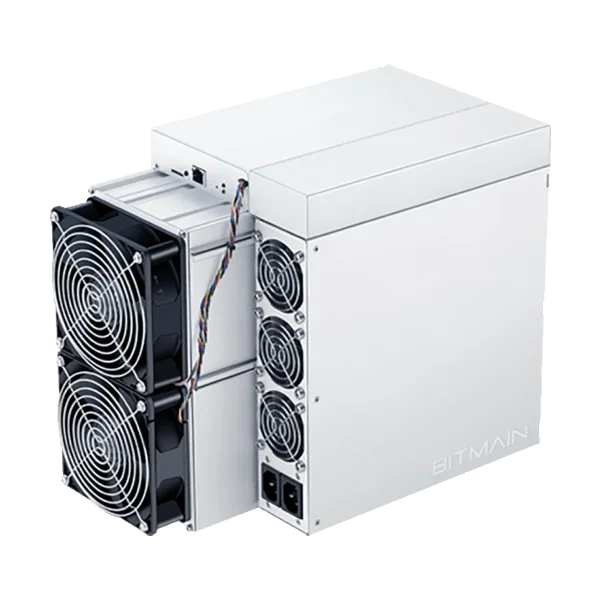
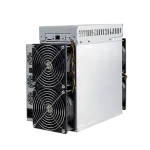
Bitmain Antminer K7 (63.5Th)
Réponse rapide
The Bitmain Antminer K7 (63.5Th) is a Eaglesong miner rated about 63.5 TH/s at roughly 3,080 W. An industrial-class unit — loud and power-hungry, best suited to a dedicated mining space, not living areas.
Professional-Grade Miner
This miner draws 3,080W and produces 75+ dB of noise — it is designed for dedicated mining environments, not living spaces. Professional-grade miners deliver the highest hashrate and revenue per unit but require proper infrastructure: a 240V circuit, adequate ventilation or exhaust ducting, and a space where noise is not a concern (garage, basement, warehouse, or outdoor enclosure).
For home miners looking for a quieter alternative, consider our Bitcoin Space Heater builds or explore open-source miners like the Bitaxe that are purpose-built for residential environments.
Heater-Class Miner
At 3,080W, this miner outputs approximately 10509 BTU/hr of heat — equivalent to a standard electric space heater. Every watt consumed by an ASIC miner is converted to heat with 100% efficiency, making it a space heater that also mines Bitcoin.
During heating season, miner heat can offset part of the heat a room would otherwise need from another electric heater. The economics depend on your electricity rate, room heat demand, BTC price, network difficulty, and noise constraints.
Calculateur de rentabilité
| Period | Revenue | Electricity Cost | Profit |
|---|---|---|---|
| Daily | $1.96 | $5.17 | $-3.21 |
| Weekly | $13.74 | $36.22 | $-22.48 |
| Monthly | $58.88 | $155.23 | $-96.35 |
| Yearly | $716.36 | $1,888.66 | $-1,172.30 |
Heating offset estimates the value of heat replacing an electric space heater during heating season (~6 months/year in Canada). Actual savings depend on your heating setup and climate.
Where to Buy the Bitmain Antminer K7 (63.5Th)
D-Central Technologies is a Bitcoin-only company. For this miner, check out our trusted partner retailers below.
ASIC Miner Market
United StatesWide selection of new and used ASIC miners. US-based shipping.
MagasinerMinersDeals
United StatesCompetitive prices on new ASIC miners with coupon codes.
MagasinerPartner links may earn D-Central a commission at no extra cost to you. Have you considered Bitcoin mining instead? Explore Bitcoin miners →
Full Specifications
| Model | Bitmain Antminer K7 (63.5Th) |
|---|---|
| Model Number | Antminer K7 (63.5Th) |
| Manufacturer | Bitmain |
| Algorithme | Eaglesong |
| Coins Mined | Nervos (CKB) |
| Taux de hachage | 63.5 TH/s |
| Consommation électrique | 3,080 W |
| Efficiency | 48.5 J/TH |
| Dimensions | 430*195.5*290mm |
| BTU Output | 10509 BTU/hr |
| Equivalent Heater | Equal to a 3,080W space heater |
| Daily Power Cost | $5.17/day |
| Monthly Power Cost | $155.23/mo |
| Circuit Requirement | 240V circuit required |
| Release Date | 2023-01-01 |
| MSRP | $1,860.00 |
| État | Active |
Home Mining Assessment
The Bitmain Antminer K7 (63.5 Th) is a single-algorithm ASIC built to mine Nervos CKB on the Eaglesong proof-of-work. It pairs three hashboards with an APW12-class power supply for a rated 63.5 TH/s at roughly 3,080 W — about 48.5 J/TH on Eaglesong. It is a 240 V altcoin machine, not a Bitcoin miner.
What the Antminer K7 actually is
Bitmain built the K7 for one job: hashing the Eaglesong function that secures the Nervos Common Knowledge Base (CKB) network. Eaglesong is a purpose-designed ARX hash, and the K7’s silicon does nothing else — it cannot mine Bitcoin (SHA-256), Litecoin (Scrypt), or any other coin. That single-purpose design is the most important fact to understand before buying one: its resale value, profitability, and useful life are tied entirely to the health of the Nervos CKB network and its Eaglesong difficulty.
The 63.5 Th unit is the higher-binned member of the K7 family; Bitmain also shipped a slightly lower-clocked 58 Th sibling on the same chassis. Both descend from the earlier Antminer K5, Bitmain’s first-generation Eaglesong machine, and the K7 represents a large generational jump in throughput per box.
Chip and hashboard architecture
The K7 follows the same modular template as every modern air-cooled Antminer: a single Linux control board running a cgminer-derived mining daemon, three hashboard chains (Chain 0/1/2), an APW-series PSU, and a bank of fans, all wired together inside the familiar 430 × 195.5 × 290 mm sheet-metal case. The control board talks to each hashboard over an 18-pin ribbon cable that carries low-voltage power, ground, and the digital signal chain (clock, serial TX/RX, reset, and an I²C temperature-sensor bus).
On each board, Bitmain’s custom Eaglesong ASICs are daisy-chained in series and fed by a boost circuit that steps the PSU rail up into a string of voltage domains. This is a detail many spec sheets get wrong: voltage on an Antminer hashboard is regulated per domain, not per chip. A « domain » is a small group of chips sharing one regulated rail in series, so the firmware can only trim voltage at the domain level — never one chip at a time. Understanding that distinction is the difference between a productive board-level repair and chasing a fault that the hardware was never designed to expose.
D-Central does not publish an invented per-chip count for the K7’s Eaglesong silicon, because the manufacturer never documented the exact die population per board and we will not guess at numbers we cannot verify. What we can say with confidence is structural: it is a three-chain, series-domain Antminer, and it behaves on the bench like its APW12-family stablemates.
Real-world power and efficiency
The published 3,080 W figure is a wall-side rating at room temperature with a roughly ±5% tolerance, so in practice a healthy K7 pulls somewhere in the region of 2,930–3,230 W depending on ambient temperature, PSU conversion loss, and how hard the pool is pushing it. The conversion losses of the power supply are already baked into that wall figure — the PSU itself runs at roughly 93–95% efficiency.
Efficiency works out to about 48.5 J/TH on Eaglesong. That number must be read in context: a joule-per-terahash figure is only comparable within the same algorithm. You cannot line the K7’s 48.5 J/TH up against a modern SHA-256 Bitcoin miner at 15–20 J/TH and conclude it is « inefficient » — Eaglesong and SHA-256 are different functions doing different amounts of work per hash. Judge the K7 only against other CKB miners.
A critical practical point for North American buyers: the K7’s APW12 (1417-series) supply is a 200–240 V unit. It is not a 120 V machine, and it cannot be made into one — a standard household 15 A/120 V circuit will not run it. You need a 240 V drop, the same as you would for an Antminer L7 or S19. Tuning headroom on the K7 is modest compared with the deep undervolting possible on the Bitcoin fleet, but there is room to trade a little hashrate for efficiency or vice-versa. For how that trade-off works in general — and the tooling we use to find a stable operating point — see our ASIC power profiles reference.
| Specification | Antminer K7 (63.5 Th) |
|---|---|
| Manufacturer | Bitmain |
| Algorithm | Eaglesong |
| Coin | Nervos CKB |
| Rated hashrate | 63.5 TH/s |
| Rated wall power | ~3,080 W (±5%) |
| Efficiency | ~48.5 J/TH (on Eaglesong) |
| Power supply | Integrated APW12-class (1417-series), 14–17 V DC, up to 233 A |
| Input voltage | 200–240 V AC (no 120 V support) |
| Architecture | 3 hashboard chains + control board (cgminer-derived firmware) |
| Voltage control | Per voltage domain (not per chip) |
| Dimensions | 430 × 195.5 × 290 mm |
| Cooling | Forced air (fan-cooled) |
| Heat output | ~10,509 BTU/h |
| Launch | Late 2023 |
Firmware compatibility — the honest picture
This is where Eaglesong owners need a reality check that most listings won’t give them. The rich aftermarket-firmware ecosystem you may have read about — the third-party operating systems that add autotuning, finer voltage steps, and advanced pool features — was built almost exclusively for SHA-256 Bitcoin hardware (the S19 and S21 families and their kin). Those projects do not target Eaglesong machines, and there is no mature third-party firmware for the K7. Our own DCENT_OS work is likewise Bitcoin-focused and does not cover this model.
In plain terms: you run the K7 on Bitmain’s stock firmware, and your tuning is whatever the stock interface exposes. That is not a knock on the machine — it is simply the state of the altcoin-ASIC software world, and we would rather tell you up front than have you buy expecting an autotuner that doesn’t exist. Keep the stock firmware patched, change the default credentials, and isolate the miner on its own network segment.
Common faults and troubleshooting
Because the K7 shares the Antminer control architecture, it also shares the same failure vocabulary as the rest of the fleet. The faults we see most often on three-chain machines like this are:
- A chain dropping out — the dashboard shows two boards instead of three, or reports « 0 ASIC » found on a chain. Usually a dead domain, a failed chip breaking the series string, or a damaged signal cable.
- Low chip/ASIC count or reduced hashrate — one or more chips in a chain have failed, so the board reports fewer working ASICs and the box falls short of 63.5 TH/s.
- Temperature-sensor errors — a board reports an implausible or missing temperature, tripping a protective shutdown; often the I²C sensor line rather than an actual overheat.
- Fan errors — a stalled or out-of-range fan, which the firmware treats as a hard fault and refuses to mine through.
- PSU communication / power faults — the APW12 supply is a smart unit that talks to the control board over I²C; a comms fault can look like a « no power » or under-voltage condition.
If your K7 is throwing one of these, our ASIC fault finder walks symptom-to-cause and points to the right next step before you start swapping parts.
Repair and longevity
The K7 is a repairable machine, and D-Central has repaired Antminers in-house in Laval since 2016. It sits firmly within the set of models supported by the hashboard test fixtures and PSU testers we and the wider repair trade use, so chain-level diagnosis, dead-chip identification, and board-level rework are all on the table rather than a forced full-unit write-off. Typical economically-sensible repairs include reflowing or replacing failed Eaglesong chips on a single chain, restoring a dead voltage domain, recovering a board after a cable or connector fault, and servicing the APW12 supply.
Because the PSU is shared with the Antminer L7, KA3, DR7 and HS3, parts knowledge and spares are comparatively easy to source — a meaningful advantage for keeping an aging altcoin rig productive. If your unit is down, our ASIC repair service can assess it and quote a board-level fix.
Who the K7 is for — and buying notes
The K7 is for miners who specifically want exposure to Nervos CKB and have the infrastructure to run a ~3 kW, 240 V, fan-cooled industrial box: a dedicated circuit, real airflow, and tolerance for jet-engine noise. It is not a home-friendly or Bitcoin machine, and Bitcoiners looking to stack sats or learn solo mining are far better served by a SHA-256 unit or a small Bitaxe-class device than by an Eaglesong miner. Treat any CKB profitability estimate as volatile — single-algorithm altcoin ASICs live and die by one network’s price and difficulty.
If the K7 fits your plan, decide between the 63.5 Th unit here and its lower-power 58 Th sibling, and browse the full ASIC miner catalog to compare it against current and used inventory.
Generational context
The K7 sits in Bitmain’s altcoin lineup rather than its Bitcoin line. It directly succeeds the Antminer K5, Bitmain’s first Eaglesong/CKB miner, multiplying throughput per chassis many times over. Alongside it, Bitmain shipped a family of single-algorithm machines that share the same 14–17 V APW12 power platform — the Scrypt L7, the Kadena KA3, the Decred DR7, and the Handshake HS3 — which is why these units feel so similar on the bench despite mining completely different coins. Launched in late 2023, the K7 remains the reference Eaglesong ASIC for anyone committed to securing the Nervos network, and a machine D-Central is equipped to keep running long after its warranty ends.
Broken miner? Get a real quote.
Tell us the symptom and get an instant repair-tier estimate ($95 / $145 / $195 CAD). Mail-in from across Canada, bench in Laval, Quebec.
Send it to D-Central — start a repair →Related Miners
Goldshell CK5
Bitmain CK6-SE
Todek Toddminer C1 PRO
iBeLink BM-N3 Max
Comparer le Bitmain Antminer K7 (63.5Th)
Foire aux questions
What are the current mining economics for the Bitmain Antminer K7 (63.5Th)?
At $0.07/kWh, the Bitmain Antminer K7 (63.5Th) currently shows an estimated daily net cost of $3.21 before pool fees and hardware cost. Lower electricity rates, network changes, BTC price changes, or useful heat recovery can change the result.
Can I mine Bitcoin at home with the Bitmain Antminer K7 (63.5Th)?
The Bitmain Antminer K7 (63.5Th) has a home mining score of 8/100. With 0 dB noise and 3,080W power draw, it may require a dedicated space like a garage, basement, or outdoor enclosure. Consider noise insulation and proper ventilation.
Can the Bitmain Antminer K7 (63.5Th) heat my home?
The Bitmain Antminer K7 (63.5Th) outputs approximately 10509 BTU/hr of heat. For reference, a typical space heater produces 5,000-5,500 BTU/hr. All electrical energy consumed by the miner is converted to heat, making it 100% efficient as a heater. D-Central offers Bitcoin Space Heater builds designed specifically for home heating integration.
What power supply does the Bitmain Antminer K7 (63.5Th) need?
The Bitmain Antminer K7 (63.5Th) draws 3,080W of power. You need a power supply rated for at least 3,388W with appropriate voltage (200-240V AC). D-Central stocks compatible power supplies in our shop. Always use a quality PSU from a reputable manufacturer to protect the miner and wiring.