
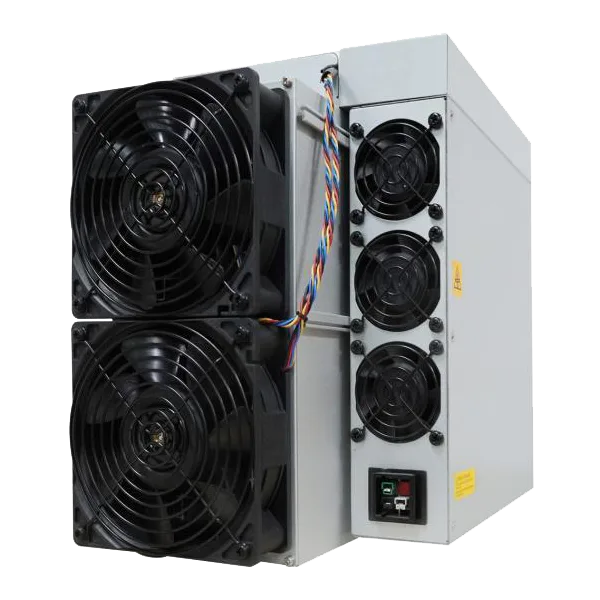
Antminer L9
Next-gen Scrypt miner, nearly double the L7 hashrate with similar power draw
Réponse rapide
The Antminer L9 is a Scrypt miner rated about 16000 MH/s at roughly 3,360 W, built on the BM1900 ASIC. An industrial-class unit — loud and power-hungry, best suited to a dedicated mining space, not living areas.
Professional-Grade Miner
This miner draws 3,360W and produces 75 dB of noise — it is designed for dedicated mining environments, not living spaces. Professional-grade miners deliver the highest hashrate and revenue per unit but require proper infrastructure: a 240V circuit, adequate ventilation or exhaust ducting, and a space where noise is not a concern (garage, basement, warehouse, or outdoor enclosure).
For home miners looking for a quieter alternative, consider our Bitcoin Space Heater builds or explore open-source miners like the Bitaxe that are purpose-built for residential environments.
Heater-Class Miner
At 3,360W, this miner outputs approximately 11464.3 BTU/hr of heat — equivalent to a standard electric space heater. Every watt consumed by an ASIC miner is converted to heat with 100% efficiency, making it a space heater that also mines Bitcoin.
During heating season, miner heat can offset part of the heat a room would otherwise need from another electric heater. The economics depend on your electricity rate, room heat demand, BTC price, network difficulty, and noise constraints.
Calculateur de rentabilité
| Period | Revenue | Electricity Cost | Profit |
|---|---|---|---|
| Daily | $0.00 | $5.64 | $-5.64 |
| Weekly | $0.00 | $39.51 | $-39.51 |
| Monthly | $0.01 | $169.34 | $-169.33 |
| Yearly | $0.18 | $2,060.35 | $-2,060.17 |
Heating offset estimates the value of heat replacing an electric space heater during heating season (~6 months/year in Canada). Actual savings depend on your heating setup and climate.
Where to Buy the Antminer L9
D-Central Technologies is a Bitcoin-only company. For this miner, check out our trusted partner retailers below.
ASIC Miner Market
United StatesWide selection of new and used ASIC miners. US-based shipping.
MagasinerMinersDeals
United StatesCompetitive prices on new ASIC miners with coupon codes.
MagasinerPartner links may earn D-Central a commission at no extra cost to you. Have you considered Bitcoin mining instead? Explore Bitcoin miners →
Full Specifications
| Model | Antminer L9 |
|---|---|
| Model Number | L9 |
| Manufacturer | Bitmain |
| Algorithme | Scrypt |
| Coins Mined | Litecoin (LTC), Dogecoin (DOGE) |
| Taux de hachage | 16000 MH/s |
| Consommation électrique | 3,360 W |
| Efficiency | 0.21 J/MH |
| Niveau de bruit | 75 dB |
| Chip Model | BM1900 |
| Cooling | Air |
| Voltage Range | 200-240V AC |
| Operating Temperature | 5-40°C |
| Dimensions | 400x195x290 |
| Weight | 14.8 |
| Interface | Ethernet |
| BTU Output | 11464.3 BTU/hr |
| Equivalent Heater | Equal to a 3,360W space heater |
| Daily Power Cost | $5.64/day |
| Monthly Power Cost | $169.34/mo |
| Circuit Requirement | 240V circuit required |
| Release Date | 2024-05-01 |
| MSRP | $6,500.00 |
| État | Active |
Home Mining Assessment
Next-gen Scrypt miner, nearly double the L7 hashrate with similar power draw
The Antminer L9 is Bitmain’s current flagship Scrypt miner, built for Litecoin and merge-mined Dogecoin. It delivers roughly 16,000 MH/s (16 GH/s) from a 3,360 W draw on 200–240 V, landing near 0.21 J/MH — about 40% more efficient than the L7 it replaces, and the tightest Scrypt efficiency seen to date.
Chip and hashboard architecture
The L9 is driven by Bitmain’s BM1486 Scrypt ASIC. Firmware images pulled from real L9 units identify the silicon as BM1486 across every platform variant — a detail worth stating clearly, because the L9 is sometimes mislabelled with the L7’s BM1489 or with placeholder part numbers. It is a distinct, newer chip in the same Scrypt lineage that began with the BM1485 (Antminer L3/L3+) and continued through the BM1489 (Antminer L7).
Scrypt ASICs are a very different animal from the SHA-256 chips that mine Bitcoin. Litecoin’s Scrypt parameters (N=1024, r=1, p=1) make the algorithm deliberately memory-hard: each hashing core needs roughly 128 KB of on-die SRAM scratchpad to compute a single nonce. The practical consequence is that a Scrypt die is dominated by SRAM rather than hashing logic, so these chips carry far fewer cores than a comparable Bitcoin ASIC of the same generation. It also changes the work format — unlike a Bitcoin chip, which receives a pre-computed 32-byte midstate, a Scrypt chip is fed the full 80-byte block header and performs the entire computation internally.
On the L9, firmware enumerates the machine (hashboard model code BSL41601) as three hashboards, each populated with roughly 110 BM1486 chips, wired as a long UART command chain per board. The control board is an Amlogic A113D SoC — a generational jump from the L7, which used a Xilinx Zynq, and the original L3+, which used a TI BeagleBone. The Amlogic platform is the same modern control architecture Bitmain adopted across its S21-era machines, which is why the L9 shares much of its firmware tooling, fan-control and PSU-handshake stack with that generation rather than with older Scrypt hardware.
Power on each board is delivered through series-connected voltage domains, with several chips sharing each domain. This is the single most important thing to understand about how these boards behave and fail: regulation is per-domain, not per-chip. The firmware and PIC-mediated voltage controller set a domain voltage, and every chip in that domain rides it. On the earlier Scrypt boards the tolerance between domains was about ±0.05 V, and the same principle holds here — a domain that drifts off its neighbours is the fingerprint of a weak chip or a failing regulator, not a quirk to ignore.
Real-world power and efficiency
The nameplate figure is 16,000 MH/s at 3,360 W, which works out to about 0.21 J/MH (210 J/GH). That is a genuinely large step forward for Scrypt: the L7 sits near 0.36 J/MH and the old L3+ near 1.6 J/MH, so the L9 cuts energy per hash by roughly 40% versus the L7 while nearly doubling its throughput. Like all Bitmain machines, the published wattage is measured at the wall on a 200–240 V circuit; at a roughly 14 A draw on 240 V you should size a dedicated 200–240 V circuit with headroom rather than running it near a breaker’s limit. The L9 is not a 120 V machine — the L-series needs a 220–240 V supply to hit spec.
Where the L9 is most interesting is its tuning headroom. The autotuner profiles baked into aftermarket firmware show an unusually flat efficiency curve — the chip holds near 0.213 J/MH across a wide band, so you can move the operating point substantially without paying the efficiency penalty you would on most miners. Representative profiles from our firmware research:
| Mode | Hashrate | Power | Efficiency |
|---|---|---|---|
| Underclock (quiet/cool) | ~11,900 MH/s | ~2,545 W | 0.214 J/MH |
| Near-stock | ~16,200 MH/s | ~3,450 W | 0.213 J/MH |
| Efficiency ceiling | ~17,300 MH/s | ~3,677 W | 0.213 J/MH |
| Overclock (max push) | ~21,600 MH/s | ~5,453 W | 0.252 J/MH |
The takeaway: you can pull the L9 back to under 2,600 W for cheaper, cooler, quieter operation without losing efficiency, or push past 17 GH/s while staying at the same J/MH — only beyond roughly 17,300 MH/s does efficiency start to climb. These are runtime-calculated autotuner targets, not fixed presets; the firmware binary-searches for the minimum stable voltage per board and trims per-domain frequency to hold the profile. Stock frequency lands around 700 MHz at roughly 825 mV. For the full set of operating points and where the sweet spot sits for your electricity cost, see our ASIC power-profiles database.
Firmware compatibility
The L9 ships with Bitmain’s stock firmware, a cgminer-based stack running on the Amlogic control board, managed through the standard web dashboard. Stock is the right starting point for most operators and is required to keep the manufacturer warranty intact.
Aftermarket firmware does exist for the L9 in both of its control-board variants, and it unlocks finer autotuning, the eco/overclock profiles above, and richer telemetry. Be honest with yourself about the trade-offs before flashing any third-party image, regardless of vendor: most carry a developer fee, many phone home to vendor servers by default, and several gate their advanced controls behind a warranty-cancellation toggle. Read what a firmware actually does before you trust it on a fleet. D-Central’s own firmware effort, DCENT_OS, is being built for exactly this class of modern Amlogic-based machines, with a sovereignty-first, no-phone-home posture; it is in public beta (GPL-3.0, public beta open since 9 July 2026) and we are happy to talk through where it fits.
One point that often confuses new Scrypt operators: Stratum V2 does not apply here. Stratum V2 is a Bitcoin/SHA-256 development — natively supported only by BraiinsOS+ — and Scrypt pools mine over Stratum V1. The L9 connects to Litecoin/Dogecoin pools using standard Stratum V1 work, which is also why its work packets carry the full header rather than a midstate.
Common faults and troubleshooting
Because the L9 puts three independent hashboards in series, the most common failure mode you will see is a missing board: one chain drops out and the dashboard reports roughly two-thirds of nameplate hashrate with an ASIC/chip count below expected. Walking the diagnosis usually means isolating which board lost its chain, then tracing whether the cause is a dead chip, a broken UART link in the daisy chain, or a voltage-domain fault.
- Voltage-domain imbalance — a single weak BM1486 can drag its whole domain off voltage. Measuring domain voltages and looking for the outlier (beyond the ~±0.05 V tolerance) is the fastest way to localise a chip-level fault on a Scrypt board.
- Thermal throttling and shutdown — firmware throttles frequency as chip temperature approaches ~85 °C and triggers an emergency stop near 90 °C (or ~80 °C board temperature). At 16 GH/s the L9 makes a lot of heat, so dusty intakes and warm ambient air are the usual culprits behind temperature-protection events. Keep intake air below 40 °C.
- Fan faults — the L9 runs four fans on tachometer feedback. A stalled fan (tach reading zero) is flagged within seconds and will pull the machine into a protective stop; fans hold full duty during cooldown by design.
- PSU and watchdog issues — the L9 expects a modern APW12-class PSU speaking the newer PMBus protocol, with a watchdog heartbeat roughly every second. A miner that powers up, hashes briefly, then resets can point to PSU calibration or under-delivery rather than the hashboards themselves.
Our ASIC fault finder walks through these symptom-to-cause paths step by step, including how to read low-chip-count, temperature-protect and fan-lost conditions before you start swapping parts.
Repair and longevity
The L9 is repairable, and D-Central has repaired Bitmain hardware in-house since 2016. Scrypt hashboards respond to the same disciplined, component-level work as their SHA-256 siblings: domain-voltage diagnosis, chip-level reball and replacement, regulator and level-shifter repair, connector and PSU work. The honest caveat with a chip this new is that BM1486 replacement stock is still thinner than the well-supplied L3+/L7 channels, so board-level diagnosis and recovery matters even more than on older Scrypt machines.
For longevity, the same fundamentals pay off here that pay off everywhere: keep the intake clean, keep ambient air cool, and consider running one of the flat-efficiency underclock profiles — pulling the L9 back toward ~2,500 W costs you little in efficiency while easing thermal and electrical stress on the boards. When something does go wrong, a board-level repair is almost always cheaper than a replacement machine; see our ASIC repair service.
Who it is for and buying
The L9 is a serious production Scrypt machine, not a quiet home appliance. At roughly 75 dB it belongs in a dedicated mining space or a Hashcenter, it needs a 200–240 V circuit, and it merge-mines Litecoin and Dogecoin together — the combined LTC+DOGE reward is what makes Scrypt economics work. For operators who already run Scrypt, it is the efficiency leader and the natural upgrade path from the L7. Its ~11,460 BTU/h of waste heat can also be ducted to warm a space, turning energy you would otherwise spend on heating into hashrate, though the noise and 240 V requirement keep it out of most living rooms.
If you are weighing the L9 against the rest of the field — or deciding whether to buy new, source a refurbished unit, or repair what you already own — that is exactly the kind of question we are built to answer. Browse the broader Scrypt and SHA-256 lineup in our miner catalog, and reach out if you want a straight read on whether the L9 is the right tool for your power cost and goals.
Generational context
Place the L9 on the Scrypt timeline and the progress is obvious. The BM1485-based L3+ (2017) managed about 504 MH/s at 800 W and 1.6 J/MH. The BM1489-based L7 (2021) lifted that to 9,500 MH/s at 3,425 W and 0.36 J/MH, moving to a Zynq control board. The BM1486-based L9 (2024) again nearly doubles throughput to ~16 GH/s at similar power, cuts efficiency to ~0.21 J/MH, and modernises the platform onto Amlogic silicon.
| Model | ASIC | Hashrate | Power | Efficiency | Control board |
|---|---|---|---|---|---|
| Antminer L3+ | BM1485 (28 nm) | 504 MH/s | 800 W | ~1.6 J/MH | BeagleBone (AM335x) |
| Antminer L7 | BM1489 | 9,500 MH/s | 3,425 W | ~0.36 J/MH | Xilinx Zynq |
| Antminer L9 | BM1486 | 16,000 MH/s | 3,360 W | ~0.21 J/MH | Amlogic A113D |
Credit where it is due: Bitmain’s Scrypt line is the reason a hobbyist or small operator can mine Litecoin and Dogecoin at home-scale efficiency at all, and each generation has narrowed the gap to the physical limits of a memory-hard algorithm. The L9 is the current high-water mark of that work — and the machine we expect to see on Scrypt benches, and on our repair bench, for years to come.
Broken miner? Get a real quote.
Tell us the symptom and get an instant repair-tier estimate ($95 / $145 / $195 CAD). Mail-in from across Canada, bench in Laval, Quebec.
Send it to D-Central — start a repair →Related Miners

Goldshell LT5
Goldshell MINI DOGE III (650Mh)
Bitmain Antminer L3+ (600Mh)
VOLCMINER D1 Mini Pre 2.2Gh
Foire aux questions
What are the current mining economics for the Antminer L9?
At $0.07/kWh, the Antminer L9 currently shows an estimated daily net cost of $5.64 before pool fees and hardware cost. Lower electricity rates, network changes, BTC price changes, or useful heat recovery can change the result.
Can I mine Bitcoin at home with the Antminer L9?
The Antminer L9 has a home mining score of 8/100. With 75 dB noise and 3,360W power draw, it may require a dedicated space like a garage, basement, or outdoor enclosure. Consider noise insulation and proper ventilation.
Can the Antminer L9 heat my home?
The Antminer L9 outputs approximately 11464.3 BTU/hr of heat. For reference, a typical space heater produces 5,000-5,500 BTU/hr. All electrical energy consumed by the miner is converted to heat, making it 100% efficient as a heater. D-Central offers Bitcoin Space Heater builds designed specifically for home heating integration.
Does D-Central repair the Antminer L9?
Yes, D-Central provides professional repair services for the Antminer L9. Services include hashboard repair, control board diagnostics, fan replacement, and full refurbishment. Ship your miner to our Laval, Quebec facility for diagnosis and repair.
What power supply does the Antminer L9 need?
The Antminer L9 draws 3,360W of power. You need a power supply rated for at least 3,696W with appropriate voltage (200-240V AC). D-Central stocks compatible power supplies in our shop. Always use a quality PSU from a reputable manufacturer to protect the miner and wiring.