
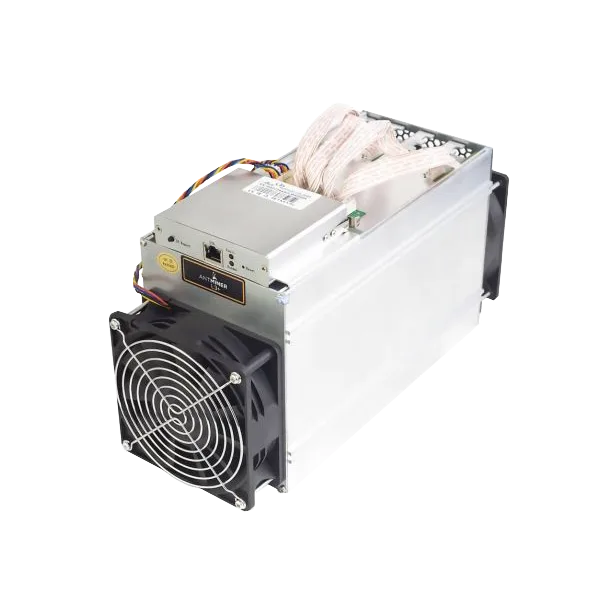
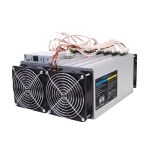
Antminer L3+
Classic Scrypt miner widely used in D-Central space heater builds. Very affordable on secondary market. Mines LTC and DOGE via merge mining.
Réponse rapide
The Antminer L3+ is a Scrypt miner rated about 504 MH/s at roughly 800 W, built on 288× BM1485. An industrial-class unit — loud and power-hungry, best suited to a dedicated mining space, not living areas.
DCENT_OS Compatible
DCENT_OS is custom firmware developed by D-Central Technologies specifically for home miners. It transforms this miner with whisper-quiet fan profiles, 120V North American outlet support, auto-tuning for maximum efficiency, heater mode integration, and a clean web dashboard for monitoring.
Miners running DCENT_OS score higher on our Home Mining Assessment because the firmware is purpose-built to make industrial hardware livable in residential spaces.
Learn More About DCENT_OS →Professional-Grade Miner
This miner draws 800W and produces 75 dB of noise — it is designed for dedicated mining environments, not living spaces. Professional-grade miners deliver the highest hashrate and revenue per unit but require proper infrastructure: a 240V circuit, adequate ventilation or exhaust ducting, and a space where noise is not a concern (garage, basement, warehouse, or outdoor enclosure).
However, this miner is compatible with DCENT_OS — D-Central's custom firmware that adds whisper-quiet fan profiles and 120V North American outlet support. With DCENT_OS installed, this industrial miner can be transformed for home use.
Heater-Class Miner
At 800W, this miner outputs approximately 2729.6 BTU/hr of heat — equivalent to a standard electric space heater. Every watt consumed by an ASIC miner is converted to heat with 100% efficiency, making it a space heater that also mines Bitcoin.
During heating season, miner heat can offset part of the heat a room would otherwise need from another electric heater. The economics depend on your electricity rate, room heat demand, BTC price, network difficulty, and noise constraints.
Calculateur de rentabilité
| Period | Revenue | Electricity Cost | Profit |
|---|---|---|---|
| Daily | $0.00 | $1.34 | $-1.34 |
| Weekly | $0.00 | $9.41 | $-9.41 |
| Monthly | $0.00 | $40.32 | $-40.32 |
| Yearly | $0.01 | $490.56 | $-490.55 |
Heating offset estimates the value of heat replacing an electric space heater during heating season (~6 months/year in Canada). Actual savings depend on your heating setup and climate.
Buy from D-Central
In stock and ready to ship from Laval, Quebec.
Full Specifications
| Model | Antminer L3+ |
|---|---|
| Model Number | L3+ |
| Manufacturer | Bitmain |
| Algorithme | Scrypt |
| Coins Mined | Litecoin (LTC), Dogecoin (DOGE) |
| Taux de hachage | 504 MH/s |
| Consommation électrique | 800 W |
| Efficiency | 1.59 J/MH |
| Niveau de bruit | 75 dB |
| Chip Model | BM1485 |
| Chip Count | 288 |
| Cooling | Air |
| Voltage Range | 100-240V AC |
| Operating Temperature | 0-40°C |
| Dimensions | 352x130x187 |
| Weight | 5.5 |
| Interface | Ethernet |
| BTU Output | 2729.6 BTU/hr |
| Equivalent Heater | Half a standard space heater (2,730 BTU/hr) |
| Daily Power Cost | $1.34/day |
| Monthly Power Cost | $40.32/mo |
| Circuit Requirement | Standard 120V 15A |
| Release Date | 2017-05-01 |
| État | Discontinued |
Custom Power Profiles
With custom firmware like DCENT_OS, this miner can be tuned across a wide range of power levels. Lower wattage improves efficiency and reduces electricity costs; higher wattage increases hashrate at the expense of efficiency.
| Wattage | Taux de hachage | Efficiency |
|---|---|---|
| 450 W | 350 MH/s | 1.29 J/MH |
| 550 W | 420 MH/s | 1.31 J/MH |
| 650 W | 480 MH/s | 1.35 J/MH |
| 800 W | 504 MH/s | 1.59 J/MH |
| 900 W | 560 MH/s | 1.61 J/MH |
| 1,000 W | 620 MH/s | 1.61 J/MH |
Actual performance varies by individual unit silicon quality, ambient temperature, and cooling configuration. These operating points are achievable with custom tuning firmware such as DCENT_OS; values are calculated at runtime by the autotuner, not fixed presets.
Home Mining Assessment
Classic Scrypt miner widely used in D-Central space heater builds. Very affordable on secondary market. Mines LTC and DOGE via merge mining.
The Antminer L3+ is Bitmain’s classic 2017 Scrypt miner, rated at 504 MH/s for roughly 800 W at the wall while mining Litecoin and, through merge-mining, Dogecoin. It packs 288 BM1485 ASICs across four hashboards, runs on air cooling at about 75 dB, and today lives mostly as an affordable hobby rig and space heater.
BM1485 silicon and the four-board Scrypt hashboard
The L3+ is built around Bitmain’s BM1485, a Scrypt-optimized ASIC fabricated on a TSMC 28 nm process. Each chip carries 12 hashing cores and runs at a stock frequency of 384 MHz. This is mature, well-understood silicon: 28 nm was already a generation behind the leading edge when the L3+ shipped in 2017, which is exactly why these machines are so durable and so cheap to keep running today. There is no exotic packaging to fail and no fragile fine-pitch node to coax.
A complete L3+ uses four identical hashboards, each populated with 72 BM1485 chips — 288 ASICs in total. The chips are wired in series strings, and power is regulated per voltage domain, not per chip. Each board organizes its 72 chips into 12 domains of 6 chips, with the per-chip core sitting near 0.80 V and the full series string running around 9.6 V; the stock firmware’s nameplate voltage target is 10.0 V. Understanding the domain layout matters for repair: when a board loses hashrate but does not go fully dark, the fault usually lives in one domain’s regulation, not in a single chip.
A BeagleBone Black brain, not a Zynq board
One detail that surprises people coming from the S9 or S17 era: the L3+ control board is not a Xilinx Zynq SoC. It is a TI BeagleBone Black (AM335x). Because of that, the L3+ does not manage its hashboards through the I²C PIC scheme that the S9 family uses. Instead, the BeagleBone drives the boards directly over GPIO lines — dedicated pins for chain plug-detection, chain reset, and the fan interface. This is a quirk worth knowing, because it shapes both how the machine boots and how it is repaired. The chip-domain voltages and the chain map are characteristic of the platform, so a board swapped in from a different unit must match the same wiring expectations.
Fan control is another platform fingerprint. The L3+ drives its fans with a 10 kHz PWM signal from the BeagleBone’s hardware timer, where most later Antminers settled on 25 kHz. It is a small thing, but it is the kind of hardware-fixed behaviour that defines the L3+ and that any firmware port has to respect to keep the fans behaving.
Real-world power draw, efficiency, and tuning headroom
Bitmain’s nameplate for the L3+ is 504 MH/s at 800 W. Measured at the wall, a healthy unit on stock firmware lands close to that figure, with real draw drifting up or down a little depending on ambient temperature, PSU efficiency, and how tightly the individual chips were binned. That works out to roughly 1.6 joules per megahash (J/MH) — the meaningful efficiency metric for a Scrypt machine.
The specification card on this page normalizes every miner to joules-per-terahash so that wildly different machines can sit in one database, which is why you will see a very large J/TH number for the L3+. Do not read that as a like-for-like comparison against a SHA-256 Bitcoin miner; Scrypt and SHA-256 are different algorithms doing different work. The honest, comparable figure for the L3+ is about 1.6 J/MH at the wall.
The L3+ has a modest amount of tuning headroom in both directions. Under-clocking trades hashrate for a better efficiency curve and a quieter, cooler machine — useful when you are running it primarily for heat. Pushing frequency the other way buys a little more hashrate at the cost of disproportionately higher draw and heat. The table below shows approximate, modeled tuning targets; treat them as a starting map rather than a guarantee, because 28 nm silicon from 2017 varies meaningfully from unit to unit.
| Setting | Frequency (approx.) | Hashrate (approx.) | Wall power (approx.) |
|---|---|---|---|
| Efficiency under-clock | ~320 MHz | ~430 MH/s | ~600 W |
| Stock | 384 MHz | 504 MH/s | 800 W |
| Mild over-clock | ~432 MHz | ~565 MH/s | ~950 W |
For the full picture of frequency, voltage, and power steps across the Scrypt family, see our ASIC power profiles database. The stock-firmware sweet spot for most home operators is a slight under-clock — you give up a little hashrate but gain a meaningfully better efficiency curve and lower fan noise.
Firmware: stock cgminer, custom options, and DCENT_OS
Out of the box the L3+ runs Bitmain’s stock build of cgminer in Scrypt mode at a fixed frequency. It speaks Stratum V1 to Litecoin and Dogecoin pools. It is worth being clear about one thing the L3+ cannot do: there is no firmware that brings Stratum V2 to this Scrypt platform. Native Stratum V2 lives on a different lineage of hardware and firmware entirely, so anyone pointing an L3+ at a pool is using V1, and that is fine — V1 has mined Scrypt reliably for a decade.
Aftermarket custom firmware did appear for the L3+ over the years, generally to unlock manual frequency and voltage control and basic autotuning beyond what the stock build exposes. We deliberately keep that discussion generic: the L3+ is old hardware, and chasing the last few megahashes on a custom build rarely pays for the risk of a bad flash on a control board you cannot easily replace.
The sovereign path we are building is DCENT_OS, D-Central’s GPL-3.0 open-source Antminer firmware. DCENT_OS already carries a BM1485 silicon profile, and the L3+ is a target on the roadmap rather than a shipping driver today — the project is in public beta as of July 2026. We mention it here honestly: if you want a Scrypt machine whose firmware you can read, audit, and own, the L3+ is one of the platforms we are working toward, but it is not finished yet. We would rather tell you that than overstate it.
Common L3+ faults and how to diagnose them
After years in the field, L3+ failures cluster into a handful of predictable patterns. None of them are mysterious, and most are repairable:
- A dead or zero-ASIC chain. One of the four boards reports no chips, or the miner refuses to find the expected chip count. On the L3+ this is frequently a chain not being detected at all — a reseating or plug-detect issue on the BeagleBone’s GPIO lines — before it is ever a dead chip.
- Ribbon-cable and connector faults. The flat cables between the control board and the hashboards age, and a single intermittent connection can knock out a whole chain. Reseating or replacing the ribbon is often the entire fix.
- Voltage-domain regulation failures. A board that hashes low rather than not at all usually has a struggling domain — a failing regulator or a chip dragging its string. Because the L3+ regulates per domain, the damage is contained and the board is a strong repair candidate.
- Temperature-sensor and fan faults. A bad sensor reading or a stalled fan will make the firmware throttle or shut the machine down to protect itself. With the L3+’s 10 kHz fan signal, a mismatched replacement fan can also read wrong.
- Control-board / SD corruption. The BeagleBone’s storage can corrupt, leaving a unit that powers up but never mines. This is a re-flash or control-board service rather than a hashboard problem.
When you are not sure which of these you are looking at, walk the symptoms through our ASIC fault finder. It is built to turn a vague « it stopped hashing » into a specific, testable cause — chain, cable, domain, sensor, or controller — so you replace the right part the first time.
Repair and longevity: keeping a 2017 Scrypt workhorse alive
D-Central has been doing in-house, board-level ASIC repair since 2016, which means the L3+ is hardware we have worked on since it was current. The same things that make the L3+ a good buy on the secondary market — mature 28 nm silicon, a simple BeagleBone controller, contained per-domain power — also make it genuinely repairable rather than disposable. Cold-joint reflows, individual chip replacement, domain-regulator repair, ribbon and connector work, and control-board re-flashing are all routine on this platform.
If you have an L3+ that has gone quiet, it is almost always worth diagnosing before retiring. Our ASIC repair service covers exactly this class of legacy Scrypt hardware. Keeping an old miner in service one more season is the most decentralized, lowest-waste thing you can do with it — every repaired board is one fewer machine in a landfill and one more independent hasher on the network.
Who the Antminer L3+ is for
Let us be straight about it: in 2026 the L3+ is not a profit-first machine. At roughly 1.6 J/MH it cannot compete with current Scrypt hardware on electricity cost, and you should not buy one expecting it to pay for itself on hashrate alone. What it is, is one of the best on-ramps into Scrypt mining there is.
- Hobby and learning. Cheap on the secondary market, well-documented, and forgiving — the L3+ is an ideal first ASIC for understanding how Scrypt mining, pools, and firmware actually work.
- Algorithm diversification. If your stack is all SHA-256, an L3+ puts you on Litecoin and Dogecoin (the two are merge-mined, so a single Scrypt machine pointed at a merge-mining pool earns both at once).
- A heater that happens to mine. The L3+ turns essentially all of its ~800 W into heat — around 2,730 BTU/h. Ducted into a room or a workshop, that is heat you were going to pay for anyway, now doing double duty as hashrate. It is a long-time favourite in D-Central space-heater builds.
If your priority is efficiency and modern hashrate instead, browse the full ASIC miner database for current options, or step up within the same Scrypt family to the Antminer L7.
Where the L3+ sits in the Scrypt generation
The L3+ was the machine that made home Scrypt mining mainstream, and Bitmain iterated on it directly. The short-lived L3++ used higher-binned BM1485 silicon for more hashrate at the same 28 nm node, and the line eventually leapt forward with the L7, which moved to the 7 nm BM1489 and an order-of-magnitude better efficiency. The table below puts that lineage in perspective and credit where it is due — each step was a real engineering advance.
| Model | Chip / node | Chips (per board × boards) | Hashrate | Wall power | Efficiency |
|---|---|---|---|---|---|
| Antminer L3+ | BM1485 / 28 nm | 288 (72 × 4) | 504 MH/s | ~800 W | ~1.6 J/MH |
| Antminer L3++ | BM1485 (higher bin) / 28 nm | 288 (72 × 4) | ~580–600 MH/s | ~950 W | ~1.6 J/MH |
| Antminer L7 | BM1489 / 7 nm | 480 (120 × 4) | ~9,500 MH/s | ~3,425 W | ~0.36 J/MH |
Seen against that lineage, the L3+ is the honest classic of the family: not the fastest, not the most efficient, but rugged, repairable, and cheap enough that it keeps finding new jobs. For a learning rig, a Scrypt toehold, or a heater that quietly earns its keep, it remains one of the easiest machines to recommend — and one we are glad to keep running.
Broken miner? Get a real quote.
Tell us the symptom and get an instant repair-tier estimate ($95 / $145 / $195 CAD). Mail-in from across Canada, bench in Laval, Quebec.
Send it to D-Central — start a repair →Related Miners
Innosilicon A4 Dominator
Goldshell MINI DOGE III (650Mh)
Bitmain Antminer L7 (8.8Gh)
Innosilicon A6 LTCMaster
Codes d'erreur courants du Antminer L3+
Codes d'erreur connus et guides de dépannage pour le Antminer L3+. Cliquez sur une erreur pour des instructions de réparation étape par étape.
Foire aux questions
What are the current mining economics for the Antminer L3+?
At $0.07/kWh, the Antminer L3+ currently shows an estimated daily net cost of $1.34 before pool fees and hardware cost. Lower electricity rates, network changes, BTC price changes, or useful heat recovery can change the result.
Can I mine Bitcoin at home with the Antminer L3+?
The Antminer L3+ has a home mining score of 22/100. With 75 dB noise and 800W power draw, it may require a dedicated space like a garage, basement, or outdoor enclosure. Consider noise insulation and proper ventilation.
Can the Antminer L3+ heat my home?
The Antminer L3+ outputs approximately 2729.6 BTU/hr of heat. For reference, a typical space heater produces 5,000-5,500 BTU/hr. All electrical energy consumed by the miner is converted to heat, making it 100% efficient as a heater. D-Central offers Bitcoin Space Heater builds designed specifically for home heating integration.
Does D-Central repair the Antminer L3+?
Yes, D-Central provides professional repair services for the Antminer L3+. Services include hashboard repair, control board diagnostics, fan replacement, and full refurbishment. Ship your miner to our Laval, Quebec facility for diagnosis and repair.
What power supply does the Antminer L3+ need?
The Antminer L3+ draws 800W of power. You need a power supply rated for at least 880W with appropriate voltage (100-240V AC). D-Central stocks compatible power supplies in our shop. Always use a quality PSU from a reputable manufacturer to protect the miner and wiring.