
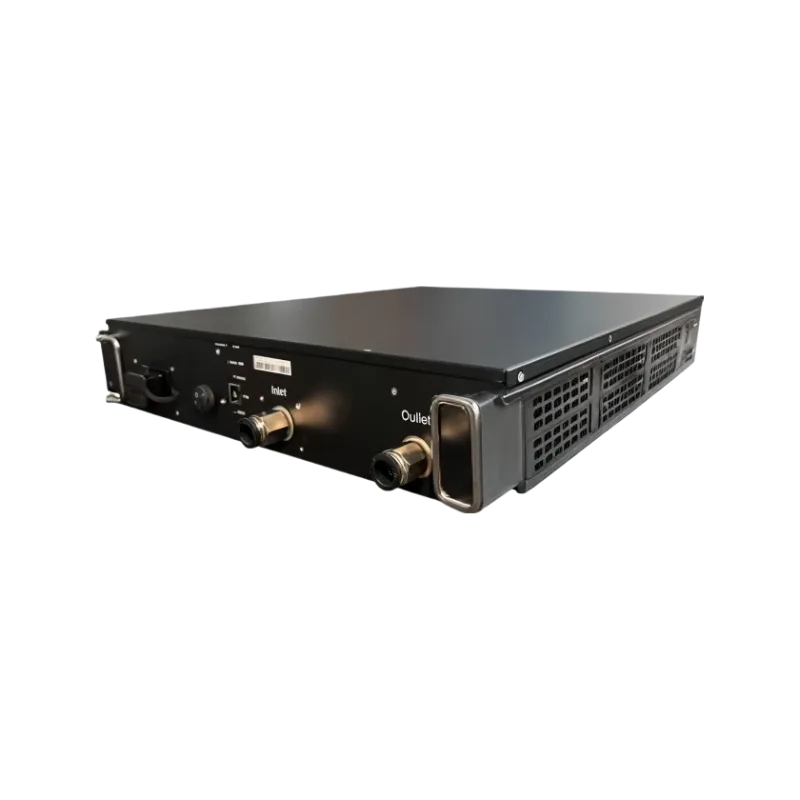
Bitmain Antminer L11 Hyd 2U (35Gh)
Réponse rapide
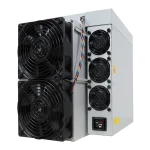
The Bitmain Antminer L11 Hyd 2U (35Gh) is a Scrypt miner rated about 35 GH/s at roughly 5,775 W. An industrial-class unit — loud and power-hungry, best suited to a dedicated mining space, not living areas.
Hydro-Cooled Miner
This miner uses a closed-loop liquid cooling system (hydro cooling) instead of traditional air cooling. Water or coolant circulates through internal channels to absorb heat from the ASIC chips, then transfers it to an external radiator or facility cooling loop.
Hydro-cooled miners run significantly quieter than air-cooled models since they eliminate or minimize fan noise. They also achieve higher hashrates and better efficiency because the chips can be driven harder while staying within safe thermal limits. The trade-off: hydro miners require compatible water infrastructure — inlet/outlet connections, a cooling distribution unit (CDU), and proper plumbing.
Hydro cooling is ideal for professional mining operations and data centers where water infrastructure already exists, or for home miners building a dedicated water-cooled setup to eliminate noise completely.
Professional-Grade Miner
This miner draws 5,775W and produces 50 dB of noise — it is designed for dedicated mining environments, not living spaces. Professional-grade miners deliver the highest hashrate and revenue per unit but require proper infrastructure: a 240V circuit, adequate ventilation or exhaust ducting, and a space where noise is not a concern (garage, basement, warehouse, or outdoor enclosure).
For home miners looking for a quieter alternative, consider our Bitcoin Space Heater builds or explore open-source miners like the Bitaxe that are purpose-built for residential environments.
Calculateur de rentabilité
| Period | Revenue | Electricity Cost | Profit |
|---|---|---|---|
| Daily | $0.00 | $9.70 | $-9.70 |
| Weekly | $0.01 | $67.91 | $-67.91 |
| Monthly | $0.03 | $291.06 | $-291.03 |
| Yearly | $0.39 | $3,541.23 | $-3,540.84 |
Heating offset estimates the value of heat replacing an electric space heater during heating season (~6 months/year in Canada). Actual savings depend on your heating setup and climate.
Where to Buy the Bitmain Antminer L11 Hyd 2U (35Gh)
D-Central Technologies is a Bitcoin-only company. For this miner, check out our trusted partner retailers below.
ASIC Miner Market
United StatesWide selection of new and used ASIC miners. US-based shipping.
MagasinerMinersDeals
United StatesCompetitive prices on new ASIC miners with coupon codes.
MagasinerPartner links may earn D-Central a commission at no extra cost to you. Have you considered Bitcoin mining instead? Explore Bitcoin miners →
Full Specifications
| Model | Bitmain Antminer L11 Hyd 2U (35Gh) |
|---|---|
| Model Number | Antminer L11 Hyd 2U (35Gh) |
| Manufacturer | Bitmain |
| Algorithme | Scrypt |
| Coins Mined | Litecoin (LTC), Dogecoin (DOGE) |
| Taux de hachage | 35 GH/s |
| Consommation électrique | 5,775 W |
| Efficiency | 165 J/GH |
| Niveau de bruit | 50 dB |
| Cooling | Hydro |
| Dimensions | 445 x 88 x 670mm |
| Weight | 23.2 |
| BTU Output | 19704 BTU/hr |
| Equivalent Heater | Equal to a 5,775W space heater |
| Daily Power Cost | $9.70/day |
| Monthly Power Cost | $291.06/mo |
| Circuit Requirement | 240V circuit required |
| Release Date | 2025-12-01 |
| MSRP | $15,998.00 |
| État | Active |
Home Mining Assessment
The Bitmain Antminer L11 Hyd 2U is a water-cooled Scrypt miner: a 35 GH/s, 5,775 W rack unit that merge-mines Litecoin and Dogecoin at roughly 0.165 J/MH — the most efficient Scrypt machine Bitmain has shipped. Released December 2025, it is a Hashcenter-class workhorse, not a plug-and-play home heater.
Chip and hashboard architecture
The L11 is the latest entry in Bitmain’s Scrypt lineage, which runs on a completely different ASIC family from the SHA-256 S- and T-series. That line began with the BM1485 (TSMC 28 nm) inside the Antminer L3+, matured with the BM1489 (TSMC 7 nm DUV) in the L7, and continued through the BM148x-series Scrypt silicon used in the L9. Each chip packs a handful of dedicated Scrypt cores rather than the SHA-256 hashing engines you find in an S21 — the two algorithms share almost no silicon.
Mechanically, every modern Antminer hashboard works the same way: the ASICs are daisy-chained in series across the board, and they are grouped into voltage domains — clusters of chips that share one regulated power rail fed by a local LDO or buck converter. Voltage is controlled per domain, not per chip. A boost circuit lifts the PSU rail (typically into the 14–25 V range depending on model), then each domain’s regulators step that down to the sub-volt core voltage the Scrypt cores need. This series-string design is why a single failed chip can pull an entire domain — and sometimes a whole board — offline.
For the brain of the machine, the recent Scrypt units moved to Bitmain’s Amlogic A113D control board (a quad-core ARM Cortex-A53 SoC originally designed for audio). It drives the hashboards over software-bit-banged UART with no FPGA in the path, boots from internal NAND, and recovers only through a micro-USB OTG port. The earlier L7 used a Xilinx Zynq board instead. D-Central has fully torn down and reverse-engineered the L7 and L9 firmware and control-board stacks in-house. The L11 is recent enough that we have not yet completed a full silicon teardown, so we describe its exact chip SKU, chip count and domain map as consistent with the Scrypt family rather than publishing numbers we have not personally verified — that honesty is the whole point of this reference.
Real-world power and efficiency
The L11 Hyd’s 5,775 W nameplate is the figure to plan around, but a few nuances matter. First, that number is the miner’s own draw at its rated profile; real wall draw sits within a few percent of it, and on top of that a hydro deployment adds facility overhead the spec sheet does not count — the coolant pump and dry cooler (or cooling tower) that reject the heat. Budget for that when you size a circuit and a power bill. At 240 V the unit alone pulls roughly 24 A, so it wants a dedicated high-amperage feed; in production most operators run these on three-phase PDUs.
On efficiency, ignore the « 165,000 J/TH » you may see auto-generated in spec tables. Scrypt efficiency is conventionally expressed in joules per megahash (J/MH), and the L11 Hyd lands at about 0.165 J/MH (5,775 W ÷ 35,000 MH/s). That J/TH figure is the same number wearing SHA-256 clothing, and comparing it to an S21’s J/TH is meaningless — different algorithm, different hardware. Measured against its own family, 0.165 J/MH is a genuine step forward: D-Central’s firmware analysis shows the L7 holds roughly 0.36 J/MH at its 9.5 GH/s stock point, and the L9 profile set is remarkably flat at about 0.213 J/MH up to ~17 GH/s. The L11 hydro pushes that frontier lower again.
There is real tuning headroom here. The Scrypt firmware ships a runtime autotuner — the power profiles are calculated on the fly for the silicon in front of it, not pulled from a fixed preset table. For reference, the L7 firmware exposes 16 profiles spanning roughly 4,800 MH/s @ 1,855 W up to 12,000 MH/s @ 6,000 W, while the L9 set runs 19 profiles. Expect the L11 to behave the same way: undervolt for efficiency, or push frequency for raw hashrate, trading J/MH against output. Our ASIC power profiles database documents these curves across the Scrypt line so you can dial in a target before you buy.
| Spec | Antminer L11 Hyd 2U |
|---|---|
| Algorithm | Scrypt (Litecoin + Dogecoin, merge-mined) |
| Hashrate (stock) | 35 GH/s (35,000 MH/s) |
| Power draw (nameplate) | 5,775 W |
| Efficiency | ~0.165 J/MH |
| Cooling | Hydro (water loop, 2U rack) |
| Noise | ~50 dB |
| Dimensions | 445 × 88 × 670 mm (19″ rack, 2U) |
| Weight | 23.2 kg |
| Heat output | ~19,704 BTU/h (into the coolant loop) |
| Released | December 2025 |
| MSRP | ~US$15,998 |
Firmware compatibility
Out of the box the L11 runs Bitmain’s stock Scrypt firmware (a cgminer-scrypt stack on the Amlogic platform). One practical reality: Bitmain locks the firmware on control boards shipped since early 2024, so reflashing or running third-party builds requires an unlock step on modern units — plan for that rather than assuming an open device.
Third-party firmware support for Scrypt machines is real but far thinner than for SHA-256 Antminers, and it is honest to say so. Community cgminer-scrypt builds cover the L7 and L9; for a December-2025 release like the L11, expect a lag before stable, well-tested third-party images appear. Do not assume day-one support. It is also worth being precise about Stratum: only BraiinsOS+ natively speaks Stratum V2, and BraiinsOS+ is a SHA-256-only firmware — there is no Braiins build for Scrypt. L11 mining is Stratum V1, full stop. D-Central’s own firmware work (DCENT_OS, a GPL-3.0 project in public beta since July 2026) is currently focused on SHA-256 Antminers; Scrypt is not yet a target, and we would rather tell you that than over-promise.
Common faults and troubleshooting
A hydro unit adds a whole failure category on top of the usual ASIC issues — the cooling loop. Watch for falling flow or pressure, fouled or undersized dry coolers, air pockets after a refill, and seepage at the quick-disconnect fittings. The firmware’s thermal guardrails are aggressive: chips throttle frequency around 85 °C and trigger an emergency shutdown near 90 °C, with the board-temperature danger threshold around 80 °C. If a temperature sensor returns an error, the controller fails safe — flow and any fans go to maximum and mining stops — so a « miner keeps stopping » complaint is often a sensor or coolant-flow problem, not the chips.
On the electrical side the classic Scrypt faults mirror the SHA-256 world: a dead hashboard or chain (one of the boards dropping out of the reported total), a failed voltage domain showing up as a reduced chip count on one board, PSU faults, and loose or oxidized board-to-control-board cabling. Because the chips sit in a series string, a single bad ASIC or a cracked domain regulator can take down far more than itself. Our ASIC fault finder walks you from the symptom (zero hashrate, missing chips, temperature or fan/flow errors, won’t-boot) to the likely root cause and the board-level fix.
Repair and longevity
D-Central has run an in-house ASIC repair bench in Laval, Quebec since 2016, and Scrypt boards are squarely in scope. That means component-level diagnosis and rework rather than parts-swapping: reflowing or replacing individual Scrypt ASICs, rebuilding failed voltage domains and regulators, reseating hydro cold plates, repairing or replacing PSUs, and recovering bricked control boards. A hydro L11 is a five-figure asset; with disciplined coolant maintenance and board-level repair it can run productively for years past the point where most operators would write it off. If you have an L11, an L9 or an L7 down, send it to our ASIC repair service for an assessment.
Who it is for, and buying
Be realistic about deployment: the L11 Hyd is a Hashcenter and facility machine, not a basement heater. It is a 2U rack unit that needs a plumbed water loop (CDU or dry cooler), a high-amperage 240 V or three-phase feed, and somewhere to send roughly 19,704 BTU/h of heat. Where it shines is heat reuse: because the waste energy leaves as hot water rather than blasting air, it integrates cleanly into hydronic heating — space heating, process heat, greenhouse or pool loops — turning a heating bill into Scrypt hashrate. That is a far better fit than trying to duct a 5,775 W rack unit into a living room. If you are evaluating Scrypt hardware, want help spec’ing a deployment, or are weighing the L11 against a fleet of air-cooled L9s, D-Central builds and supports to order — talk to us before you commit a five-figure budget.
Generational context
Scrypt mining is a parallel universe to Bitcoin’s SHA-256: it secures Litecoin, and because Dogecoin merge-mines on Litecoin’s chain via AuxPoW, one Scrypt machine earns both coins from the same work at no extra power. Bitmain has carried this niche forward across four hardware generations — from the 28 nm L3+, to the 7 nm L7, to the L9, and now the hydro L11 — each roughly cutting J/MH against the last. Credit where it is due: Bitmain has done the hard silicon and thermal engineering to keep Scrypt competitive long after most vendors abandoned the algorithm. The L11 Hyd is the current high-water mark of that work — the fastest, most efficient, and most facility-oriented Scrypt miner you can buy, and a machine D-Central is equipped to tune, repair and keep hashing for the long haul.
Broken miner? Get a real quote.
Tell us the symptom and get an instant repair-tier estimate ($95 / $145 / $195 CAD). Mail-in from across Canada, bench in Laval, Quebec.
Send it to D-Central — start a repair →Related Miners
FluMiner L3
Goldshell Mini-DOGE III
Bitmain Antminer L3++ (596Mh)
Antminer L9
Comparer le Bitmain Antminer L11 Hyd 2U (35Gh)
Foire aux questions
What are the current mining economics for the Bitmain Antminer L11 Hyd 2U (35Gh)?
At $0.07/kWh, the Bitmain Antminer L11 Hyd 2U (35Gh) currently shows an estimated daily net cost of $9.70 before pool fees and hardware cost. Lower electricity rates, network changes, BTC price changes, or useful heat recovery can change the result.
Can I mine Bitcoin at home with the Bitmain Antminer L11 Hyd 2U (35Gh)?
The Bitmain Antminer L11 Hyd 2U (35Gh) has a home mining score of 32/100. With 50 dB noise and 5,775W power draw, it may require a dedicated space like a garage, basement, or outdoor enclosure. Consider noise insulation and proper ventilation.
Can the Bitmain Antminer L11 Hyd 2U (35Gh) heat my home?
The Bitmain Antminer L11 Hyd 2U (35Gh) outputs approximately 19704 BTU/hr of heat. For reference, a typical space heater produces 5,000-5,500 BTU/hr. All electrical energy consumed by the miner is converted to heat, making it 100% efficient as a heater. D-Central offers Bitcoin Space Heater builds designed specifically for home heating integration.
What power supply does the Bitmain Antminer L11 Hyd 2U (35Gh) need?
The Bitmain Antminer L11 Hyd 2U (35Gh) draws 5,775W of power. You need a power supply rated for at least 6,353W with appropriate voltage (200-240V AC). D-Central stocks compatible power supplies in our shop. Always use a quality PSU from a reputable manufacturer to protect the miner and wiring.