
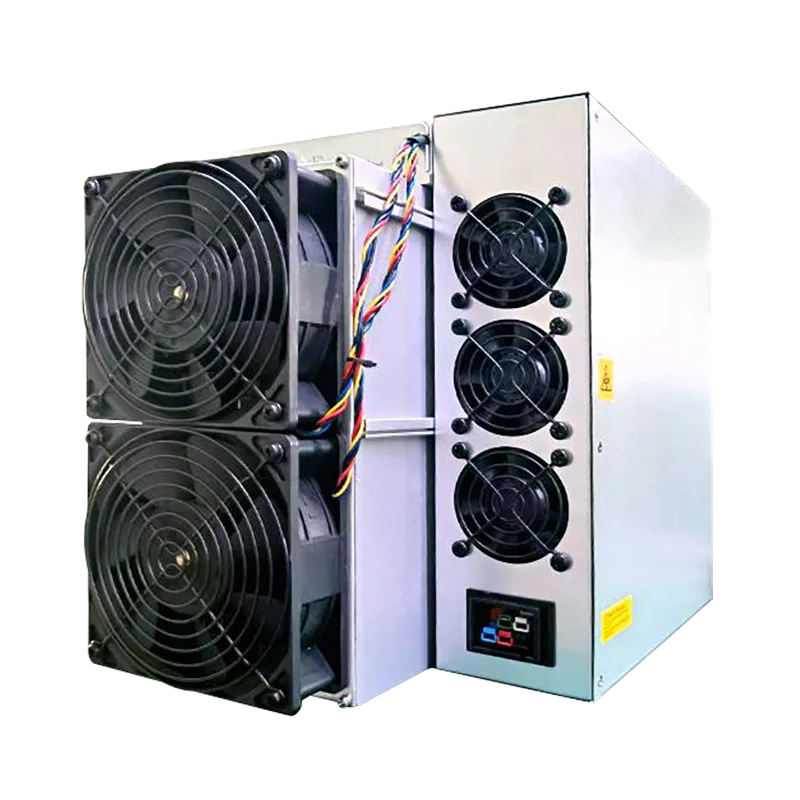
Antminer S21 Pro
Industrial-grade miner, requires dedicated space and 240V circuit
Réponse rapide
The Antminer S21 Pro is a Bitcoin miner rated about 234 TH/s at roughly 3,510 W (about 15 J/TH), built on 91× BM1370. An industrial-class unit — loud and power-hungry, best suited to a dedicated mining space, not living areas.
Professional-Grade Miner
This miner draws 3,510W and produces 75 dB of noise — it is designed for dedicated mining environments, not living spaces. Professional-grade miners deliver the highest hashrate and revenue per unit but require proper infrastructure: a 240V circuit, adequate ventilation or exhaust ducting, and a space where noise is not a concern (garage, basement, warehouse, or outdoor enclosure).
For home miners looking for a quieter alternative, consider our Bitcoin Space Heater builds or explore open-source miners like the Bitaxe that are purpose-built for residential environments.
Calculateur de rentabilité
| Period | Revenue | Electricity Cost | Profit |
|---|---|---|---|
| Daily | $7.23 | $5.90 | $1.34 |
| Weekly | $50.63 | $41.28 | $9.35 |
| Monthly | $216.97 | $176.90 | $40.07 |
| Yearly | $2,639.81 | $2,152.33 | $487.48 |
Heating offset estimates the value of heat replacing an electric space heater during heating season (~6 months/year in Canada). Actual savings depend on your heating setup and climate.
Buy from D-Central
In stock and ready to ship from Laval, Quebec.
Where to Buy the Antminer S21 Pro
D-Central Technologies
CanadaBitcoin Mining Hackers since 2016. Ships from Laval, Quebec.
Full Specifications
| Model | Antminer S21 Pro |
|---|---|
| Model Number | S21 Pro |
| Manufacturer | Bitmain |
| Algorithme | SHA-256 |
| Coins Mined | Bitcoin (BTC) |
| Taux de hachage | 234 TH/s |
| Consommation électrique | 3,510 W |
| Efficiency | 15 J/TH |
| Niveau de bruit | 75 dB |
| Chip Model | BM1370 |
| Chip Count | 91 |
| Cooling | Air |
| Voltage Range | 200-240V AC |
| Operating Temperature | 5-40°C |
| Dimensions | 400x195x290 |
| Weight | 15 |
| Interface | Ethernet |
| BTU Output | 11976.1 BTU/hr |
| Equivalent Heater | Equal to a 3,510W space heater |
| Daily Power Cost | $5.90/day |
| Monthly Power Cost | $176.90/mo |
| Circuit Requirement | 240V circuit required |
| Release Date | 2024-04-01 |
| MSRP | $6,800.00 |
| État | Active |
Home Mining Assessment
Industrial-grade miner, requires dedicated space and 240V circuit
The Antminer S21 Pro is Bitmain’s air-cooled, efficiency-refined SHA-256 miner: 234 TH/s for about 3,510 W at the wall, roughly 15 J/TH. Built on the 5nm BM1370 ASIC across three hashboards, it slots between the original S21 and the S21 XP flagship as the practical workhorse of the S21 family.
Chip and hashboard architecture
The S21 Pro is powered by Bitmain’s BM1370, a SHA-256 ASIC fabricated on TSMC’s 5nm process (the same node family as the BM1368 in the original S21, not a 3nm part as some spec sheets claim). The BM1370 is the refined, higher-output sibling of the S21’s silicon, and it is what lets the Pro reach 234 TH/s in roughly the same power envelope and physical footprint as a standard S21.
Inside the chassis are three hashboards, each carrying 91 BM1370 chips — 273 ASICs in total. The chips on each board are wired as a series string fed from the PSU’s high-voltage rail, then stepped down on-board. This is the single most important thing to understand about repairing or tuning the machine: voltage is regulated per voltage domain, not per individual chip. Each board is divided into a handful of domains (the Pro exposes four temperature sensors per board, read over an I2C bus switch), and the autotuner trims the rail for a whole domain at a time. Because the chips sit in series, one dead chip pulls the entire string down and the controller reports the whole hashboard as missing — there is no « limp on two-thirds of a board » mode.
The control board is an Amlogic A113D (AXG) SoC running four Cortex-A53 cores — no FPGA and no PIC microcontroller. This is the « no-PIC » generation: where the older S19 line used PIC controllers to manage hashboard power and temperature, the S21/S21 Pro set voltage directly through I2C DACs (TAS5782M-class parts repurposed as voltage controllers). All three chains are driven over a single UART, with GPIO reset lines selecting which board is being addressed. For context on how far the chip-per-board count has moved across generations: an S19 packs 76 chips per board, an S19 Pro 114, the S21 108, and the S21 Pro consolidates to 91 far more capable BM1370 dies per board.
| Board-level detail | Antminer S19 (BM1398) | Antminer S21 (BM1368) | Antminer S21 Pro (BM1370) |
|---|---|---|---|
| Process node | TSMC 7nm | TSMC 5nm | TSMC 5nm |
| Chips per board | 76 | 108 | 91 |
| Control board | Zynq FPGA + PIC | Amlogic A113D (no-PIC) | Amlogic A113D (no-PIC) |
| Voltage control | Per-domain (PIC) | Per-domain (~1.2 V) | Per-domain (I2C DAC) |
Real-world power and efficiency
Bitmain rates the S21 Pro at 234 TH/s and 3,510 W, which works out to 15 J/TH at the wall — the figure the spec card reports. That nameplate already includes PSU conversion loss, so plan your circuit around the full ~3.5 kW draw rather than the silicon-only number; on a 240 V single-phase circuit that is roughly 15 A of continuous load, and you want real headroom on the breaker. The S21 Pro is a 200–240 V AC machine and is not designed to run on standard North American 120 V.
Power is delivered by an integrated APW12-class supply (the PW380X1215GA-c on AML units), which calibrates itself against data stored in its own EEPROM at boot. The stock firmware does not run a single fixed clock — its autotuner is calculated at runtime, binary-searching for the minimum stable voltage per domain and ramping the PLL up in steps with settle time between each. That means the 15 J/TH headline is a starting point, not a ceiling: efficiency-focused operators can trade hashrate for a lower J/TH, and the chip will hold a flatter efficiency curve than the older 7nm hardware. We catalogue the documented wattage/hashrate/efficiency points for this class of miner in our ASIC power profiles database so you can see exactly where the knee in the curve sits before you commit a tuning plan.
At 234 TH/s the S21 Pro also throws off roughly 11,976 BTU/h of heat. In a cold climate — and we are in Laval, Quebec, so we mean it — that waste heat is not a problem to dump but a resource to duct. Run the exhaust into a workshop or basement and the machine doubles as a space heater that happens to earn sats.
Firmware compatibility
Out of the box the S21 Pro runs Bitmain’s stock firmware, which is solid and safe but deliberately conservative: its tuning presets are locked, and there is no native support for newer pool protocols. The BM1370 is a supported target for the third-party autotuning firmwares that the wider community maintains for the S21 generation; these unlock custom power profiles, finer per-domain control, and undervolting beyond what the stock presets allow. We deal with those images every day in the shop, and the honest reality is that they buy you flexibility at the cost of vendor warranty and a steeper learning curve — worth it for a serious operator, overkill for a single home unit.
If Stratum V2 is on your roadmap, note that native support for it lives in only one firmware lineage today; most stock and third-party images still speak Stratum V1. And for miners who care about running open, auditable software on their own hardware, D-Central’s own DCENT_OS firmware program is extending its driver coverage across the Antminer line as part of a longer push toward operator sovereignty — we will say plainly that BM1370 support there is still maturing rather than oversell it.
Common faults and troubleshooting
Most S21 Pro field failures fall into a few buckets, and the symptoms map cleanly onto the architecture above:
- A hashboard reads as missing or « 0 ASIC. » Because each board is one 91-chip series string, a single failed chip, a broken trace, or a dead domain takes the whole board offline. The controller cannot see « most » of the board — it sees nothing.
- Temperature-sensor errors. The Pro reads its sensors over an I2C bus switch; a flaky switch or sensor will trip the firmware’s safety logic. Stock thermal limits shut the miner down at a 90 °C chip junction or an 80 °C board temperature, and begin throttling around 85 °C, so a misreporting sensor often looks like a thermal fault when the silicon is fine.
- Fan errors. The S21 Pro is a four-fan machine and will refuse to mine, or down-clock hard, if it loses a fan or one drops below its minimum RPM.
- Low or unstable hashrate. Usually weak chips being throttled by the autotuner, marginal PSU output, or thermal paste/heatsink contact that has degraded.
Our ASIC fault finder walks these symptoms — dead chains, sensor faults, fan and PSU errors, and the matching Antminer error codes — down to a probable root cause before you open the case.
Repair and longevity
D-Central has been repairing Bitmain hardware in-house since 2016, and the S21 Pro is squarely in scope. The no-PIC design changes where faults live versus the S19 era: instead of a misbehaving PIC, problems concentrate in the I2C voltage DACs, the on-board buck and LDO stages that feed each domain, and the BM1370 dies themselves. Because the chips are in series, board-level repair is genuinely worthwhile — finding and replacing the one bad chip in a 91-chip string restores a board that would otherwise be scrap. That is component-level work: chip-level diagnosis, domain voltage measurement, and BGA rework, not board-swapping.
A well-maintained S21 Pro — clean filters, fresh thermal interface, a clean power feed, and sane tuning — is a multi-year machine. When something does fail, sending the board for repair is almost always cheaper than replacing the unit. See our ASIC repair service for what we diagnose and turn around on the S21 family.
Who it is for, and buying
The S21 Pro is built for operators who want current-generation efficiency without paying the premium — or the plumbing — of a hydro or immersion flagship. At 75 dB and ~3.5 kW it is not a living-room device; it wants a dedicated 240 V circuit and a space where noise and a constant stream of warm exhaust are acceptable, whether that is a garage, a workshop, a heated outbuilding, or a small hosted deployment. If you can capture and reuse the heat, the effective cost of running it drops meaningfully.
If you are mining at home purely to learn or to stack on a hobby budget, an industrial machine like this is the wrong tool — an open-source single-chip board such as a Bitaxe is a saner, quieter, cheaper entry point. But if your goal is real, efficient hashrate on a serious circuit, the S21 Pro is one of the best-balanced air-cooled choices in its class. You can source it, along with the rest of our current ASIC lineup, through the D-Central shop, and because we build and test to order rather than drop-ship from a warehouse, every unit is bench-checked before it leaves us.
Generational context
The S21 Pro is a 2024 member of Bitmain’s S21 family, and credit where it is due: the leap from the 7nm S19 era to the 5nm S21 silicon is one of the larger efficiency jumps the industry has seen, and the BM1370 is a clean refinement of that work. Within the family, the original S21 (BM1368) lands around 17.5 J/TH, the S21 Pro pulls that down to 15 J/TH on the same air-cooled platform, and the liquid-cooled S21 XP variants (also BM1370) push efficiency toward 12–13.5 J/TH at the cost of a cooling loop. The Pro is the sweet spot for anyone who wants modern efficiency in a self-contained, air-cooled box.
| Model | ASIC | Process | Hashrate | Power | Efficiency |
|---|---|---|---|---|---|
| Antminer S21 | BM1368 | TSMC 5nm | ~200 TH/s | ~3,500 W | ~17.5 J/TH |
| Antminer S21 Pro | BM1370 | TSMC 5nm | 234 TH/s | 3,510 W | 15 J/TH |
| Antminer S21 XP (air) | BM1370 | TSMC 5nm | ~270 TH/s class | ~3,645 W+ | ~12–13.5 J/TH |
For full specifications, live profitability, and side-by-side comparisons, view the Antminer S21 Pro in our ASIC miner database, and pair it with our power-profile data before you finalize a tuning and circuit plan.
Broken miner? Get a real quote.
Tell us the symptom and get an instant repair-tier estimate ($95 / $145 / $195 CAD). Mail-in from across Canada, bench in Laval, Quebec.
Send it to D-Central — start a repair →Related Miners
Bitmain Antminer S19 XP+ Hyd (293Th)
Antminer S19 Pro+ Hyd
Auradine Teraflux AT2880
Bitmain Antminer S21+ Hyd
Codes d'erreur courants du Antminer S21 Pro
Codes d'erreur connus et guides de dépannage pour le Antminer S21 Pro. Cliquez sur une erreur pour des instructions de réparation étape par étape.
Foire aux questions
What are the current mining economics for the Antminer S21 Pro?
At $0.07/kWh electricity, the Antminer S21 Pro currently shows an estimated $1.34 daily net result before pool fees and hardware cost. Results depend on your electricity rate and Bitcoin network conditions. Use the calculator above with your actual electricity rate.
Can I mine Bitcoin at home with the Antminer S21 Pro?
The Antminer S21 Pro has a home mining score of 8/100. With 75 dB noise and 3,510W power draw, it may require a dedicated space like a garage, basement, or outdoor enclosure. Consider noise insulation and proper ventilation.
Can the Antminer S21 Pro heat my home?
The Antminer S21 Pro outputs approximately 11976.1 BTU/hr of heat. For reference, a typical space heater produces 5,000-5,500 BTU/hr. All electrical energy consumed by the miner is converted to heat, making it 100% efficient as a heater. D-Central offers Bitcoin Space Heater builds designed specifically for home heating integration.
Does D-Central repair the Antminer S21 Pro?
Yes, D-Central provides professional repair services for the Antminer S21 Pro. Services include hashboard repair, control board diagnostics, fan replacement, and full refurbishment. Ship your miner to our Laval, Quebec facility for diagnosis and repair.
What power supply does the Antminer S21 Pro need?
The Antminer S21 Pro draws 3,510W of power. You need a power supply rated for at least 3,861W with appropriate voltage (200-240V AC). D-Central stocks compatible power supplies in our shop. Always use a quality PSU from a reputable manufacturer to protect the miner and wiring.