
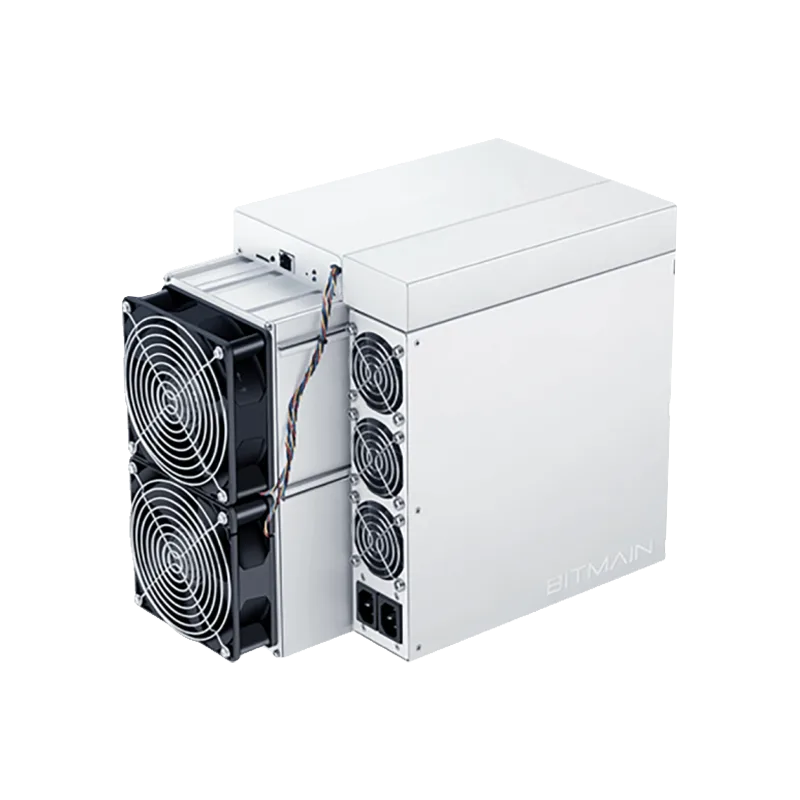
Antminer T21
Budget alternative to S21 with slightly lower efficiency
Réponse rapide
The Antminer T21 is a Bitcoin miner rated about 190 TH/s at roughly 3,610 W (about 19 J/TH), built on 324× BM1368. An industrial-class unit — loud and power-hungry, best suited to a dedicated mining space, not living areas.
Professional-Grade Miner
This miner draws 3,610W and produces 75 dB of noise — it is designed for dedicated mining environments, not living spaces. Professional-grade miners deliver the highest hashrate and revenue per unit but require proper infrastructure: a 240V circuit, adequate ventilation or exhaust ducting, and a space where noise is not a concern (garage, basement, warehouse, or outdoor enclosure).
For home miners looking for a quieter alternative, consider our Bitcoin Space Heater builds or explore open-source miners like the Bitaxe that are purpose-built for residential environments.
Calculateur de rentabilité
| Period | Revenue | Electricity Cost | Profit |
|---|---|---|---|
| Daily | $5.88 | $6.06 | $-0.19 |
| Weekly | $41.15 | $42.45 | $-1.30 |
| Monthly | $176.36 | $181.94 | $-5.58 |
| Yearly | $2,145.77 | $2,213.65 | $-67.88 |
Heating offset estimates the value of heat replacing an electric space heater during heating season (~6 months/year in Canada). Actual savings depend on your heating setup and climate.
Where to Buy the Antminer T21
D-Central Technologies
CanadaBitcoin Mining Hackers since 2016. Ships from Laval, Quebec.
magasiner le materiel de minage BitcoinASIC Miner Market
United StatesWide selection of new and used ASIC miners. US-based shipping.
MagasinerMinersDeals
United StatesCompetitive prices on new ASIC miners with coupon codes.
MagasinerFull Specifications
| Model | Antminer T21 |
|---|---|
| Model Number | T21 |
| Manufacturer | Bitmain |
| Algorithme | SHA-256 |
| Coins Mined | Bitcoin (BTC) |
| Taux de hachage | 190 TH/s |
| Consommation électrique | 3,610 W |
| Efficiency | 19 J/TH |
| Niveau de bruit | 75 dB |
| Chip Model | BM1368 |
| Chip Count | 324 |
| Cooling | Air |
| Voltage Range | 200-240V AC |
| Operating Temperature | 5-40°C |
| Dimensions | 400x195x290 |
| Weight | 14.6 |
| Interface | Ethernet |
| BTU Output | 12317.3 BTU/hr |
| Equivalent Heater | Equal to a 3,610W space heater |
| Daily Power Cost | $6.06/day |
| Monthly Power Cost | $181.94/mo |
| Circuit Requirement | 240V circuit required |
| Release Date | 2023-11-01 |
| MSRP | $4,200.00 |
| État | Active |
Home Mining Assessment
Budget alternative to S21 with slightly lower efficiency
The Antminer T21 is Bitmain’s air-cooled, value-tier member of the S21 generation: a SHA-256 Bitcoin miner rated at 190 TH/s drawing roughly 3,610 W, for about 19 J/TH. It runs the same TSMC 5nm BM1368 ASIC as the flagship S21, trading a little efficiency for a lower entry price.
Chip and hashboard architecture
At the heart of the T21 is Bitmain’s BM1368, a fifth-generation SHA-256 ASIC fabricated on TSMC’s 5nm process and introduced in 2023 (chip ID 0x1368). This is the identical silicon Bitmain ships in the base Antminer S21 — the two models share the BM1368 envelope and differ in product packaging and binning rather than in their die. Each BM1368 carries 1,280 hashing cores (organized as 80 large cores subdivided into 16 small cores apiece), and the T21 simply runs that proven silicon in an air-cooled, three-hashboard chassis.
The T21’s three hashboards belong to the BHB68701 / BHB68703 board family, with each board carrying a long series string of BM1368 dies fed from the unit’s integrated power supply. Two important architectural points are routinely garbled by spec aggregators, so it is worth stating them precisely:
- Voltage is regulated per domain, not per chip. The chips on each board are grouped into voltage domains, and the firmware sets voltage at the domain level along the string. There is no individual per-chip voltage rail — a distinction that matters the moment you start tuning.
- The mainstream T21 control board is a « no-PIC » design. Like the rest of the S21 generation, the BM1368-based T21 moves away from the separate per-board PIC microcontroller that S19-era boards leaned on. The common build uses an Amlogic AXG (A113D) control board with a TAS5782M digital DAC handling voltage, while temperature telemetry is read directly over I2C; some later units use a CVITEK CV1835 control-board variant. The silicon itself is the no-PIC S21-class die.
Each board reports through two on-board temperature sensors. That lean sensor layout is normal for this generation and is one reason firmware behaviour around thermal faults (below) is worth understanding before you deploy.
Real-world power and efficiency
The 3,610 W nameplate is the board-and-chip figure. At the wall you should budget a little more, because the integrated APW12-class supply (Bitmain’s APW171215a / APW380 family) is not 100% efficient — plan for roughly 3,700–3,800 W of real draw under sustained load. Like every S21-generation Antminer, the T21 expects 200–240 V AC; on a 120 V circuit it will not reach rated hashrate, so a dedicated 240 V circuit (call it ~16 A) is part of the install, not an optional upgrade.
At 19 J/TH the T21 sits squarely in the current-generation efficiency tier — a massive leap over the 7nm S19 era it descends from, though a step behind the base S21’s ~17.5 J/TH and the S21 Pro’s mid-15s. The underlying BM1368 silicon is capable of roughly 15–17 J/TH when tuned toward efficiency, which is where power profiles come in:
- Underclocking (lower frequency and domain voltage) pulls J/TH down, cuts heat, and quiets the fans — the right move for home or heat-reuse setups.
- Overclocking buys more terahash but worsens J/TH, raises junction temperatures, and stresses the boards and PSU harder.
It is worth being clear about how that tuning actually works: the autotuner is calculated at runtime, not a fixed table of presets. The firmware performs a live binary search for the minimum stable voltage at each frequency, then locks in a per-board result. Explore the realistic frequency/voltage envelope for this class of hardware in our ASIC power profiles database before committing a profile to a production unit.
One genuinely useful side effect of all that power: the T21 dumps roughly 12,300 BTU/h of waste heat. Ducted into a shop, garage, or basement, that turns electricity you would have spent on heating into hashrate — provided you can live with the noise.
Firmware compatibility
Out of the box the T21 runs Bitmain’s signed stock firmware on its no-PIC control board. That firmware is competent and safe, but it is locked down: limited SSH access, conservative tuning, and no Stratum V2.
The S21 generation does have an aftermarket firmware ecosystem, and builds targeting the BM1368 platform exist. Two honest caveats apply. First, flashing third-party firmware generally voids the manufacturer warranty, and you should always confirm explicit T21 support for the exact build before writing it — firmware support for newer 5nm Bitmain hardware varies by release. Second, if Stratum V2 matters to you, note that only BraiinsOS+ speaks Stratum V2 natively; most aftermarket firmware still mines over Stratum V1.
D-Central’s own DCENT_OS already recognizes the BM1368 family the T21 is built on — the same silicon path we drive on our bench S21. DCENT_OS is in public beta today (GPL-3.0, public beta open since 9 July 2026) and is built squarely on the shoulders of the open-source mining-firmware community that made any of this possible; it is one more layer of the stack put back in the operator’s hands, not a claim to have outdone anyone.
Common faults and troubleshooting
The T21 inherits the failure modes of the wider S21 generation. The ones we see most on the repair bench:
- A hashboard dropping out — one of the three chains reads a low or zero ASIC count, taking a third of the hashrate with it. This is usually a board-level fault (a bad chip in the series string, a power-domain issue, or a UART/communication break), and it is repairable rather than terminal.
- Temperature-sensor errors. With only two sensors per board, a failed or noisy sensor matters. When the firmware reads a sensor as
error, it falls back to the chip’s internal die temperature and, failing that, forces fans to 100% and stops mining to stay safe. - Thermal throttle and shutdown. Chips throttle frequency around 85 °C junction, and the unit emergency-stops at roughly 90 °C chip or 80 °C board temperature — with fans pinned to full for cool-down. Persistent throttling almost always points to airflow, ambient heat, dust, or paste/heatsink problems.
- Fan failure. A tachometer reading zero for a few seconds flags the fan as lost; lose enough fans and the miner stops outright.
- PSU faults. The APW12-class supply communicates over PMBus with a watchdog that expects a heartbeat roughly every 30 seconds. PSU faults can masquerade as board faults, so the supply is always part of the diagnosis.
Working through an unfamiliar symptom is exactly what our ASIC fault finder is built for — it walks you from the symptom to the likely subsystem and the relevant error codes.
Repair and longevity
D-Central has run an in-house ASIC repair bench in Laval, Quebec since 2016, and we service the T21 directly. Because the failure modes above are overwhelmingly board-level, most « dead » T21s are recoverable: chip-level work on the BM1368 string (diagnosis, reflow, reball, and replacement), power-domain and PSU repair, control-board and fan/sensor service, and full retest under load. A 5nm miner that still does ~19 J/TH is worth fixing rather than scrapping — see our ASIC repair service for what we handle.
Longevity on the T21 is mostly about discipline: keep ambient temperatures down and intake filters clean, give it the 240 V circuit it actually wants, avoid sustained aggressive overclocks, and keep firmware current. Treated that way, the BM1368’s efficiency keeps the T21 economically relevant well past older 7nm gear, and its boards stay serviceable when something eventually does fail.
Who the T21 is for
The T21 is the pragmatic current-generation choice: you get genuine 5nm BM1368 efficiency at a lower upfront cost than the S21 or S21 Pro, in exchange for slightly higher J/TH. It is a strong fit for operators scaling up who care about dollars-per-terahash on acquisition, and for heat-reuse builds where ~12,300 BTU/h of usable warmth is a feature. It is not a quiet-room machine — at 75 dB it belongs in a shed, garage, dedicated mining space, or a ducted setup, not a living room.
If you are early in the journey and want something you can learn on, tune, and run on a normal outlet, an open-source single-board miner such as a Bitaxe is a far better classroom than a 3.6 kW industrial unit; browse the full lineup in our ASIC miner catalog. Our T21 builds are assembled and bench-tested to order, so quoted lead times reflect hand preparation rather than a warehouse pull.
Where the T21 sits in the generations
Bitmain’s SHA-256 line runs from the 16nm BM1387 (S9), through 7nm BM1397/BM1398 (S17 and S19), into the 5nm era: BM1362 and BM1366 (S19j Pro, S19 XP), then the fifth-generation BM1368 that powers the S21 and this T21. The T21 is the spiritual successor to the air-cooled 7nm T19 — and the generational jump is dramatic, roughly halving the energy spent per terahash. Within its own generation, the T21 is the value tier; the S21 is the efficiency baseline, and the BM1370-based S21 Pro and S21 XP push efficiency further still.
| Model | ASIC (node) | Hashrate | Power | Efficiency | Cooling |
|---|---|---|---|---|---|
| Antminer T21 | BM1368 (5nm) | 190 TH/s | ~3,610 W | ~19 J/TH | Air |
| Antminer S21 | BM1368 (5nm) | 200 TH/s | ~3,500 W | ~17.5 J/TH | Air |
| Antminer S21 Pro | BM1370 (5nm) | 234 TH/s | ~3,510 W | ~15 J/TH | Air |
D-Central’s technicians repair, tune, and supply the Antminer T21. For live profitability math, full specifications, and head-to-head comparisons, see the detailed entry for the T21 in our ASIC miner database, and reach out if you have a unit that needs a bench.
Broken miner? Get a real quote.
Tell us the symptom and get an instant repair-tier estimate ($95 / $145 / $195 CAD). Mail-in from across Canada, bench in Laval, Quebec.
Send it to D-Central — start a repair →Related Miners
Canaan Avalon A15Pro-218T
Canaan Avalon Nano 3
Whatsminer M56S+
Whatsminer M50S+
Codes d'erreur courants du Antminer T21
Codes d'erreur connus et guides de dépannage pour le Antminer T21. Cliquez sur une erreur pour des instructions de réparation étape par étape.
Antminer T21 – Fan Speed Error
Antminer T21 (190 TH/s, air-cooled chassis)
Antminer T21 – Hashboard Not Detected
Antminer T21
Antminer T21 – Low Hashrate
Antminer T21
Antminer T21 – Temperature Too High
Antminer T21
Foire aux questions
What are the current mining economics for the Antminer T21?
At $0.07/kWh, the Antminer T21 currently shows an estimated daily net cost of $0.19 before pool fees and hardware cost. Lower electricity rates, network changes, BTC price changes, or useful heat recovery can change the result.
Can I mine Bitcoin at home with the Antminer T21?
The Antminer T21 has a home mining score of 8/100. With 75 dB noise and 3,610W power draw, it may require a dedicated space like a garage, basement, or outdoor enclosure. Consider noise insulation and proper ventilation.
Can the Antminer T21 heat my home?
The Antminer T21 outputs approximately 12317.3 BTU/hr of heat. For reference, a typical space heater produces 5,000-5,500 BTU/hr. All electrical energy consumed by the miner is converted to heat, making it 100% efficient as a heater. D-Central offers Bitcoin Space Heater builds designed specifically for home heating integration.
Does D-Central repair the Antminer T21?
Yes, D-Central provides professional repair services for the Antminer T21. Services include hashboard repair, control board diagnostics, fan replacement, and full refurbishment. Ship your miner to our Laval, Quebec facility for diagnosis and repair.
What power supply does the Antminer T21 need?
The Antminer T21 draws 3,610W of power. You need a power supply rated for at least 3,971W with appropriate voltage (200-240V AC). D-Central stocks compatible power supplies in our shop. Always use a quality PSU from a reputable manufacturer to protect the miner and wiring.