
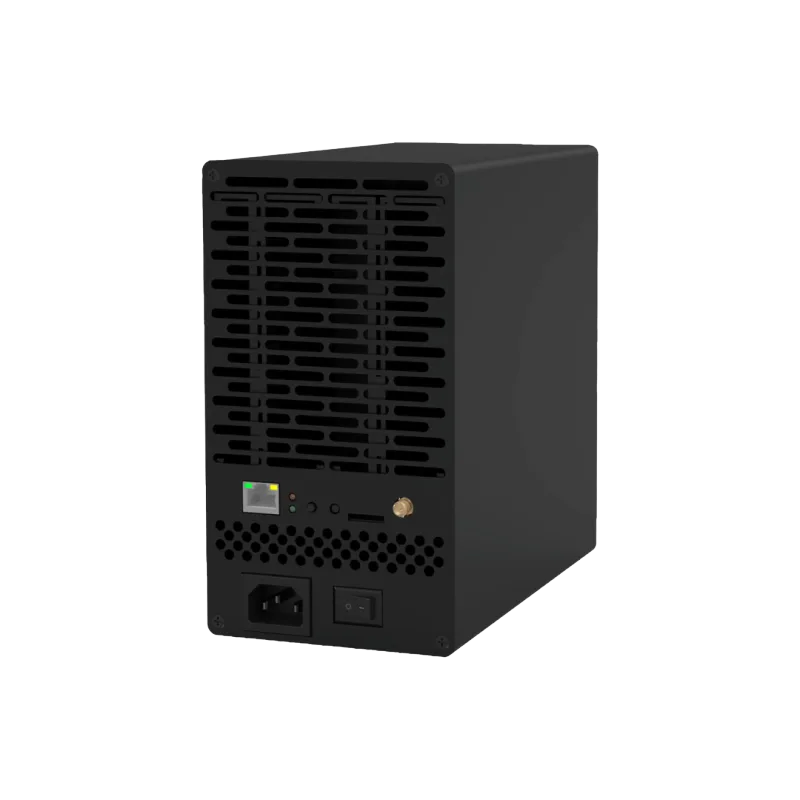
Iceriver KAS KS0 Ultra
Réponse rapide
The Iceriver KAS KS0 Ultra is a KHeavyHash miner rated about 400 GH/s at roughly 100 W. Quiet and efficient enough for home or desktop solo mining.
Calculateur de rentabilité
| Period | Revenue | Electricity Cost | Profit |
|---|---|---|---|
| Daily | $0.01 | $0.17 | $-0.16 |
| Weekly | $0.09 | $1.18 | $-1.09 |
| Monthly | $0.37 | $5.04 | $-4.67 |
| Yearly | $4.51 | $61.32 | $-56.81 |
Heating offset estimates the value of heat replacing an electric space heater during heating season (~6 months/year in Canada). Actual savings depend on your heating setup and climate.
Where to Buy the Iceriver KAS KS0 Ultra
D-Central Technologies is a Bitcoin-only company. For this miner, check out our trusted partner retailers below.
ASIC Miner Market
United StatesWide selection of new and used ASIC miners. US-based shipping.
MagasinerMinersDeals
United StatesCompetitive prices on new ASIC miners with coupon codes.
MagasinerPartner links may earn D-Central a commission at no extra cost to you. Have you considered Bitcoin mining instead? Explore Bitcoin miners →
Full Specifications
| Model | Iceriver KAS KS0 Ultra |
|---|---|
| Model Number | KAS KS0 Ultra |
| Manufacturer | IceRiver |
| Algorithme | KHeavyHash |
| Coins Mined | Kaspa (KAS) |
| Taux de hachage | 400 GH/s |
| Consommation électrique | 100 W |
| Efficiency | 0.25 J/GH |
| Niveau de bruit | 35 dB |
| Dimensions | 200*194*74mm |
| Weight | 2.5 |
| BTU Output | 341 BTU/hr |
| Equivalent Heater | Small personal heater (341 BTU/hr) |
| Daily Power Cost | $0.17/day |
| Monthly Power Cost | $5.04/mo |
| Circuit Requirement | Standard 120V 15A |
| Release Date | 2024-06-01 |
| MSRP | $77.00 |
| État | Active |
Home Mining Assessment
The IceRiver KAS KS0 Ultra is an entry-level Kaspa (kHeavyHash) ASIC that delivers roughly 400 GH/s for about 100 watts at the wall — near 0.25 joules per gigahash. Its draw is its appeal: a quiet, self-contained box you can plug into any household outlet to learn Kaspa mining at home, rather than chase industrial-scale profit.
What the KS0 Ultra is, in one table
Every number below is the verified specification we carry in the D-Central miner database for this exact model. Treat the spec card on this page as the live source; the table is a scannable summary for quick reference.
| Specification | IceRiver KAS KS0 Ultra |
|---|---|
| Algorithm / coin | kHeavyHash (Kaspa, KAS) |
| Hashrate | 400 GH/s |
| Power draw (nameplate) | 100 W |
| Efficiency | ~0.25 J/GH (0.25 W per GH/s) |
| Noise | 35 dB |
| Weight | 2.5 kg |
| Dimensions | 200 × 194 × 74 mm |
| Heat output | ~341 BTU/h |
| Form factor | Self-contained desktop unit (PSU, controller and fan built in) |
| Released | June 2024 |
Chip and hashboard architecture
The KS0 Ultra mines kHeavyHash, the proof-of-work used by Kaspa. kHeavyHash is built around Keccak hashing with a matrix-multiply step in the middle, and — unlike the memory-hard Scrypt algorithm behind Litecoin ASICs — it is light on on-chip memory. That matters for silicon design: a kHeavyHash core spends its die area on hashing and matrix logic rather than on large SRAM scratchpads, which is part of why a compact, low-wattage device like this one can still post a respectable gigahash figure.
IceRiver builds its own purpose-made kHeavyHash ASIC for this hardware. We want to be straight with you about what is and isn’t publicly known: IceRiver does not publish the chip SKU, process node, die photos, or board schematics for the KS0 family. Where our teardown work on Bitmain and MicroBT SHA-256 hardware lets us speak to the exact chip count per board, control-board silicon and voltage map, no equivalent public documentation exists for this Kaspa unit. Anyone quoting a specific node or chip part number for the KS0 Ultra is guessing, and we won’t.
What we can describe with confidence are the electrical principles every modern mining ASIC board shares. Hashing chips are daisy-chained in a serial string and grouped into voltage domains — clusters of chips that share one regulated power rail fed by a buck converter or LDO. Voltage is regulated per domain, not per individual chip; a single bad chip or a failed domain regulator can pull an entire string offline. The KS0 Ultra differs from a split-architecture Antminer in packaging: instead of separate control board, hashboards and external PSU, it integrates the controller, power supply and cooling into one small chassis. That makes it tidy and quiet, but it also means the board is far less modular than a rack ASIC when something fails.
Real-world power and efficiency
The 100 W nameplate is the figure to plan around, but the number you pay for is the draw at the wall. With the PSU and fan included in the same box, expect measured consumption to sit a little above the rating once conversion losses are counted — a small delta on a 100 W device, but worth knowing if you are sizing a circuit or stacking several units.
Efficiency works out to about 0.25 J/GH. One honest clarification on units: Kaspa hardware is compared in joules per gigahash, not the joules-per-terahash tiers used to rank Bitcoin SHA-256 miners. The « 250 J/TH » figure you may see elsewhere is simply 0.25 J/GH rewritten per terahash, and it should not be read against Bitcoin’s efficiency ladder — the algorithms, hash units and economics are completely different. Judged on its own terms, the KS0 Ultra is a low-power desktop-class Kaspa miner, not a flagship; the newer industrial KS-series machines push more gigahash per watt, but they do it at multi-kilowatt draws that defeat the whole point of this unit.
On tuning: IceRiver ships a closed stock firmware with no published undervolt or autotune toolchain, so there is little practical headroom to chase here. Our ASIC power-profiles database is the right place to understand how profile tuning works in general — runtime-calculated voltage and frequency curves rather than fixed presets — but be aware that catalog is centred on SHA-256 Antminer-class hardware. There is no comparable open profile library for IceRiver Kaspa units, and we would rather tell you that than imply tuning gains the hardware can’t deliver.
One more expectation to set honestly: at 100 W, this miner emits roughly 341 BTU/h of heat. That is genuine warmth in a small room, but it is a fraction of a real space heater — a typical 1,500 W electric heater puts out around fifteen times as much. Run the KS0 Ultra for its low draw and quiet operation, not as a heating appliance.
Firmware compatibility
Stock firmware is IceRiver’s own: a web dashboard for pool and wallet configuration, monitoring and updates. It is closed-source and the only officially supported option for the device.
The aftermarket-firmware reality is the part owners most often get wrong, so here it is plainly. The open-source and third-party firmware ecosystem people associate with ASIC tuning — BraiinsOS+, VNish, LuxOS — targets Bitmain and MicroBT SHA-256 hardware only. None of them run on IceRiver Kaspa machines. Stratum V2, which only BraiinsOS+ supports natively, is likewise a Bitcoin-mining feature and does not apply here. In short, there is no alternative firmware for the KS0 Ultra; you run IceRiver’s image or you don’t run it at all.
For the same reason, our own DCENT_OS firmware work is not a fit for this miner. DCENT_OS is built for SHA-256 Antminer-class hardware and does not run on IceRiver Kaspa units — we mention it only to close the loop, not to suggest a path that doesn’t exist.
Common faults and troubleshooting
Small all-in-one ASICs like this fail in predictable, mostly mundane ways. The usual suspects, in rough order of frequency:
- Network and pool configuration — a miner that shows power but no accepted shares is far more often a wrong pool URL, dead wallet field or DHCP/IP issue than a hardware fault. Check this first, every time.
- Fan and thermal — a single built-in fan does all the cooling work. A clogged fan or dust-blanketed board drives temperatures up, and the firmware will throttle or halt to protect the silicon. Periodic dust-out is the cheapest maintenance you can do.
- Power delivery — with the PSU integrated, brown-outs, a weak outlet or a failing internal supply show up as random reboots or a unit that won’t post.
- Hashboard degradation — over time, a weak voltage domain or a degraded chip in the chain can drop your effective hashrate below the 400 GH/s rating.
Our ASIC fault finder walks you through symptom-based triage. A fair caveat: D-Central’s error-code library and fault trees are deepest for Antminer-class hardware, where we have the most teardown and repair history. The general electrical and thermal logic still applies to a Kaspa box, but don’t expect IceRiver-specific error tables — those simply aren’t published.
Repair and longevity
D-Central has been doing in-house ASIC repair in Laval since 2016, and the failure modes on a small Kaspa unit are board-level work we know well: PSU and fan replacement, connector and solder-joint repair, and diagnosis of weak chips or domains on the hashing string. If your KS0 Ultra has stopped hashing or dropped well below rate, our ASIC repair service is the honest first call before you write the unit off.
Two longevity realities specific to altcoin ASICs are worth saying out loud. First, replacement parts for IceRiver hardware are harder to source than for mainstream Antminers, so some repairs depend on donor units. Second, the sealed single-board design that makes the KS0 Ultra so tidy also limits modular swaps — you can’t simply hot-swap a hashboard the way you can on a rack miner. Kept clean, fed clean power and run within its thermal envelope, a unit like this can mine for years; abused on a dusty shelf in a hot room, it won’t.
Who it’s for, and buying
The KS0 Ultra is a sensible first ASIC and a genuinely good teaching tool. If you want to learn how pools, wallets, share submission and miner monitoring actually work — on real hardware, quietly, in a home or office, without rewiring your panel or annoying the household at 35 dB — this is a reasonable, low-stakes way in. It is also a fit for hobby Kaspa mining where the goal is participation and learning rather than return.
It is not the right tool if your aim is profit at scale. Kaspa’s network hashrate has climbed steeply as larger industrial KS-series machines have flooded in, so a 400 GH/s unit’s share of block rewards is small, and electricity plus difficulty will dominate the math. Be clear-eyed about that going in. If you later outgrow it, browse the full ASIC miner database to compare where the KS0 Ultra sits against higher-tier Kaspa and Bitcoin hardware.
Generational context
Within IceRiver’s line-up, the KS0 family sits at the entry tier and the Ultra is its top variant — the most gigahash you can get in that small, ~100 W, plug-into-the-wall form factor. Above it, the KS1 and KS2 occupy the mid range, while the KS3, KS3M, KS5L and KS5M are industrial machines drawing multiple kilowatts and intended for hosted or warehouse deployment, not a living room.
Credit where it’s due: IceRiver was among the manufacturers that made Kaspa ASIC mining accessible to ordinary people, and the KS0 Ultra is a clean execution of that idea — quiet, compact and cheap to run. Read it for what it is: an entry-level, low-power Kaspa miner that earns its place as a learning rig and a quiet hobby unit, with no pretensions to the efficiency or output of the big iron higher up the stack. That is exactly the honest frame we’d want set before you buy or before you bring one to us for repair.
Broken miner? Get a real quote.
Tell us the symptom and get an instant repair-tier estimate ($95 / $145 / $195 CAD). Mail-in from across Canada, bench in Laval, Quebec.
Send it to D-Central — start a repair →Related Miners
Iceriver KS0
IceRiver KS0
Iceriver KAS KS0 Pro
Iceriver KS5L
Comparer le Iceriver KAS KS0 Ultra
Foire aux questions
What are the current mining economics for the Iceriver KAS KS0 Ultra?
At $0.07/kWh, the Iceriver KAS KS0 Ultra currently shows an estimated daily net cost of $0.16 before pool fees and hardware cost. Lower electricity rates, network changes, BTC price changes, or useful heat recovery can change the result.
Can I mine Bitcoin at home with the Iceriver KAS KS0 Ultra?
Yes, the Iceriver KAS KS0 Ultra scores 100/100 for home mining viability. It produces 35 dB of noise and draws 100W. It is suitable for home environments with appropriate placement considerations.
Can the Iceriver KAS KS0 Ultra heat my home?
The Iceriver KAS KS0 Ultra outputs approximately 341 BTU/hr of heat. For reference, a typical space heater produces 5,000-5,500 BTU/hr. All electrical energy consumed by the miner is converted to heat, making it 100% efficient as a heater. D-Central offers Bitcoin Space Heater builds designed specifically for home heating integration.
What power supply does the Iceriver KAS KS0 Ultra need?
The Iceriver KAS KS0 Ultra draws 100W of power. You need a power supply rated for at least 110W with appropriate voltage (200-240V AC). D-Central stocks compatible power supplies in our shop. Always use a quality PSU from a reputable manufacturer to protect the miner and wiring.