Here’s a thing nobody tells new home miners: square footage is almost never your real constraint. People agonize over where to put a miner, stack shelving units, plan vertical racks — and then get blindsided by the heat, the noise, and the breaker that won’t carry the load. “Space efficiency” in home mining isn’t about cramming hardware into a closet. It’s about fitting a mining operation into your home — your power, your air, your acoustic environment, your living space — without it taking over.
This is the practical guide to doing exactly that: how to think about the four kinds of “space” a miner actually consumes, and how to pick hardware that fits all four.
The four dimensions of space a miner really takes up
A miner occupies four kinds of room in your home. Get all four right and the setup disappears into your life. Get one wrong and the whole thing becomes a problem.
- Physical space — the actual footprint on a shelf or floor. The one everyone thinks about, and the easiest to solve.
- Thermal space — the volume of air the miner needs to breathe, and where its heat goes. A miner with no thermal room overheats and throttles, no matter how neatly it’s tucked away.
- Acoustic space — how far the noise travels. A miner in a small apartment “fills” far more space acoustically than physically.
- Electrical space — the headroom on your circuit. The most invisible constraint and the one that ends the most home mining plans.
Notice the trap: optimizing only for physical space — packing miners tight on a rack — actively makes thermal and acoustic space worse. The right approach treats all four together.
Start with the hardware decision, because it sets everything else
Your space problem is mostly defined the moment you choose a miner. Two genuinely different scales:
The genuinely compact path: open-source miners
A Bitaxe is the most space-efficient miner there is — across all four dimensions at once. Physically it’s a single board that lives on a desk. Thermally it sheds roughly 15 W, no more than a phone charger, so it needs almost no thermal room. Acoustically it’s near-silent. Electrically it sips from any normal outlet. There is no “where do I put this” problem with a Bitaxe — it fits anywhere a paperback fits.
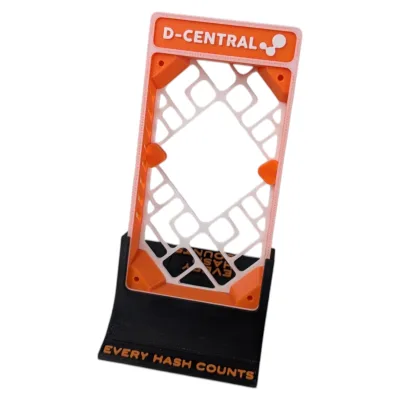
The Bitaxe board generations run Max, Ultra, Supra, and Gamma, and D-Central is a Bitaxe pioneer — we built the original Mesh Stand and developed the heatsinks the ecosystem now relies on. For genuinely space-constrained miners, the open-source family — Bitaxe, plus NerdAxe, NerdQAxe, and Nerdminer — is the honest answer. You won’t get full-size hashrate, but you get a real solo block lottery ticket, the best hands-on education in mining, and a setup that never fights your home. Start with the complete Bitaxe guide and the Bitaxe accessories guide, then browse the Bitaxe lineup.
The “compact for what it is” path: full-size ASICs
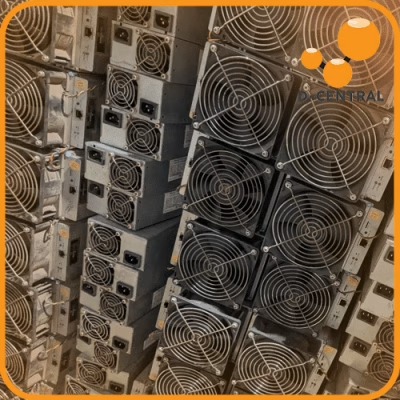
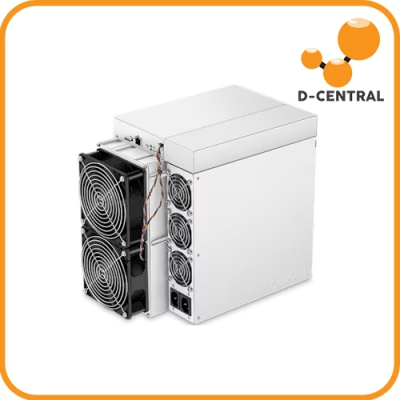
If you want serious hashrate, you need a full-size ASIC — and “space efficient” then means choosing a build designed to coexist with a home rather than a data centre. D-Central’s Antminer Slim Edition exists for this: a custom build of popular Antminer models, repackaged and tuned to run quieter and fit a residential setup. It’s not pocket-sized — a full-size ASIC never is — but it’s engineered to take up less thermal and acoustic space than a stock unit, which is the part that actually matters at home.
The smartest full-size space strategy in a cold climate: don’t think of the miner as something to hide, think of it as a heater that belongs in your living space. D-Central’s Antminer S9 Space Heater Edition and the Space Heater lineup are built so the miner earns its footprint by replacing your space heater — at which point it isn’t taking up space, it’s doing a job you needed done anyway.
Physical space: the easy dimension
Solve this one fast and move on to the dimensions that actually bite.
- Go vertical — but leave air gaps. Wall-mounted shelving and racks reclaim floor space. The catch: never stack miners so tightly that one unit’s hot exhaust becomes the next unit’s intake. Vertical stacking is fine; vertical suffocation is not.
- Use dead space. A Bitaxe lives on a bookshelf. A full-size unit fits under a workbench or in a closet — as long as that closet can handle the heat and air (more on that next).
- Manage cables. Tidy cable routing isn’t just aesthetics — loose cable nests block airflow and turn a clean install into a dust trap.
Thermal space: where tight setups go wrong
This is the dimension that punishes over-aggressive “space saving.” Every watt a miner draws comes out as heat — a full-size ASIC dumps 1–3 kW of it. That heat needs somewhere to go, and a miner sealed in a tight space with no airflow will throttle its hashrate to protect itself or fail outright.
- Separate intake from exhaust. The single most important rule. Cool air in one side, hot air out the other, and never let the two mix. This is what a shroud is for — it channels exhaust cleanly away instead of letting it recirculate.
- Duct the heat where you want it. Shrouds and duct adapters let you send exhaust into a room you want warm, up a stairwell, or out a window in summer. Ducting is what makes a closet install viable — it gives the heat an exit.
- In a cold climate, the heat is the feature. If the miner is heating your home, its thermal “footprint” isn’t a cost — it’s the product. The 5-year heater cost comparison shows why that reframes the whole question.
For Bitaxe-class miners, thermal space is a non-issue — a small heatsink and a bit of open air is all they need, covered in our Bitaxe cooling guide.
Acoustic space: the dimension that gets you reported
A stock full-size ASIC is as loud as a vacuum cleaner running 24/7. In a home — especially an apartment — that noise “occupies” far more space than the box does. Acoustic space management:
- Pick quiet hardware first. A Bitaxe is silent. A quiet-tuned Slim Edition build is the next best thing. You cannot soundproof your way out of the wrong unit.
- Contain it. A sound-dampening enclosure with proper managed airflow can dramatically cut a full-size miner’s noise — the airflow management is non-negotiable, or you trade noise for heat death.
- Place it smart. Against an exterior wall, away from bedrooms and shared walls, behind a closed door.
Full detail in our complete guide to quiet home mining.
Electrical space: the invisible ceiling
This is the constraint that quietly ends more home mining plans than any other, because you can’t see it until you trip a breaker. A full-size ASIC is a continuous high-draw load. Stack two or three on one circuit and you’re past what that wiring can safely carry around the clock — that’s a fire risk, not a clever space-saving hack.
- Know your circuit’s rating before you add hardware, and know that continuous loads should sit well under a breaker’s rated maximum.
- A full-size miner usually wants its own dedicated circuit — often a 240V drop. Our space heater electrical guide covers exactly what an electrician needs to know.
- Never daisy-chain power strips to “fit” more miners on one outlet. The wiring doesn’t care how neat your shelf looks.
- Bitaxe-class miners sidestep this entirely — at ~15 W, you could run a dozen on a single normal outlet. Another reason the open-source path is the genuinely space-efficient one for tight situations.
Run the numbers before you build the rack
Before you commit to a layout, commit to the math. Drop your real electricity rate and a specific miner’s wall-power spec into our mining profitability calculator, and use the power cost calculator to see your running cost. A space-efficient setup that loses money isn’t efficient — it’s just tidy. The honest move for most space-constrained homes is to start with one Bitaxe, learn how it fits all four dimensions of your space, and scale deliberately.
The bottom line
“Maximizing space efficiency” in home mining isn’t a shelving problem. It’s a fit problem — physical, thermal, acoustic, and electrical, all at once. The single biggest lever is the hardware you choose. A Bitaxe wins every dimension by default, which is why it’s the right call for genuinely tight spaces. A full-size ASIC takes real room, but a quiet-tuned build run as a winter heater earns its footprint instead of just consuming it.
D-Central has been hacking institutional mining hardware into home-friendly gear since 2016 — and a lot of that work, from the original Bitaxe Mesh Stand to the Slim Edition to the shroud and ducting accessories, exists specifically to make miners fit into real homes. Browse the Bitaxe and open-source lineup for the genuinely compact path, or the quiet-tuned Antminer builds if you’ve got the room and the wiring for serious hashrate.