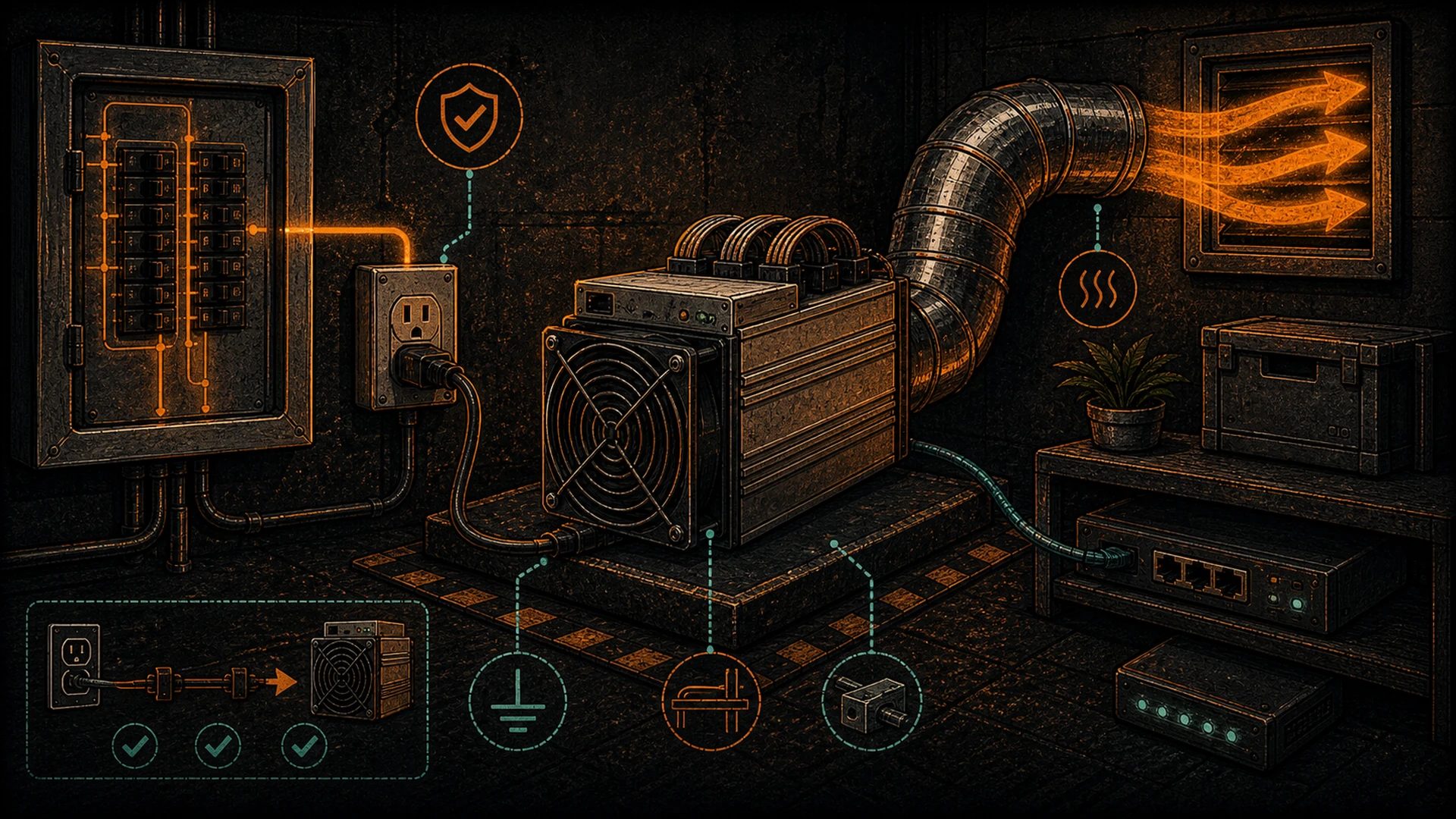
A Bitcoin mining heater is a continuous electrical load whose safe installation depends on the exact equipment, premises wiring, adopted code edition, manufacturer instructions, and the authority having jurisdiction (AHJ). This guide is educational: it does not approve a site, replace a load calculation, or authorize electrical work.
Equipment, power supplies, cords, connectors, firmware settings, cooling, enclosures, maintenance, and premises wiring can all fail. De-energize equipment showing heat damage, arcing, odor, repeated protective-device operation, loose connections, or abnormal behavior, and obtain qualified help.
Why Electrical Planning Matters
Continuous operation exposes weak connections and incorrectly selected components for long periods. Safe planning begins before energization with exact documentation, a site-specific load calculation, permits and inspection where required, and equipment that is listed and rated for its use.
Power Requirements by Exact Model
Model-family names are not electrical specifications. Record the exact miner, PSU, hardware revision, firmware, operating mode, input-voltage range, maximum nameplate current or power, connector, cord, and environmental limits.
Equipment Documentation Reference
Use a dated manufacturer manual and the physical nameplate for the exact assembly. Measured wall power can verify operation but does not expand an input rating or certify an installation. The heater selection guide is not a substitute for those documents.
Supply Voltage — A Site and Equipment Decision
Voltage choice follows the exact PSU input rating, configured maximum load, branch circuit, connectors, and local supply. Do not infer compatibility from a miner family or adapter shape.
When a 120 V Configuration May Be Documented
Use 120 V only when every component is explicitly rated for it and the AHJ-approved circuit design supports the continuous load. A firmware power limit does not change PSU input rating, conductor protection, connector rating, or product listing.
When Equipment Requires Another Supply
If the exact nameplate excludes 120 V, do not energize it at 120 V. A different PSU or bypass is a different system requiring documented compatibility and a fresh safety assessment. See the PSU service reference for repair context, not installation approval.
Planning a New Circuit
Cost and scope depend on jurisdiction, permits, service capacity, panel, route, conductor system, protective devices, inspection, and restoration work. Obtain itemized local quotes after a load calculation.
Circuit Quote Inputs
Provide the electrician with equipment nameplates, maximum configured load, duty cycle, desired location, cord and receptacle documentation, panel information, and future-load plans. Do not select capacity from a generic price table.
Circuit Requirements
The locally adopted code, AHJ, equipment instructions, and site conditions control design. Relevant variables include conductor material and insulation, temperature ratings, terminations, ambient and bundling derating, voltage drop, grounding and bonding, fault protection, and other loads.
Dedicated Circuits
A dedicated circuit may be required by equipment instructions, calculated load, or local code and often simplifies coordination. Shared-circuit feasibility cannot be established from miner watts alone.
Continuous-Load Sizing
Continuous-load treatment varies with the adopted code, equipment, and ratings. A common 125%-of-continuous-load sizing relationship is sometimes described inversely as an 80% limit, but exceptions and 100%-rated assemblies exist. Apply the actual rule in context.
Continuous-Load Decision Inputs
Calculate from the exact maximum load and include other continuous and noncontinuous loads as the governing code requires. Arithmetic alone does not prove a circuit safe.
Conductor Selection
American wire gauge alone is insufficient. Material, ampacity table, insulation and terminal temperature ratings, ambient, bundling, installation method, length, voltage drop, overcurrent protection, and local amendments all matter.
Conductor Design Record
Document the professional design basis rather than copying a generic gauge table. Never increase a breaker rating without verifying the entire conductor, termination, receptacle, equipment, and load system.
Overcurrent and Fault Protection
Protective-device selection must coordinate with conductors, equipment, available fault current, and local requirements. A breaker trip can indicate overload, short circuit, ground or arc fault, heat, equipment failure, or a connection problem; its response is not proof that every hazard was prevented.
Receptacles, Plugs, and Connections
Use mating, listed and rated components for the voltage, current, duty, conductor, and environment. Do not modify blades, improvise adapters, or assume an existing dryer or tool receptacle is suitable.
Connection Documentation
Record receptacle and plug configuration, listing, conductor and terminal ratings, torque procedure, enclosure/environment, grounding, and inspection. Physical fit alone is not compatibility.
Power Supply Unit Requirements
The exact PSU nameplate and manual control input voltage, frequency, current, output, connector, cooling, and environmental limits. Miner and PSU model families can contain materially different revisions.
PSU Verification Record
Record model and serial/revision, input range, maximum input, output rating, cord/connector, firmware compatibility, condition, and dated documentation. A product installation guide applies only to the configuration it identifies.
Power Limits and Input Ratings
Underclocking may reduce measured load, but a software setting is not a substitute for PSU input compatibility or circuit design. Configuration changes must remain inside every documented component limit.
Efficiency at Different Inputs
Efficiency varies across PSU model, revision, input, output load, temperature, power quality, and test method. Use a dated efficiency curve or appropriately measured wall data; voltage alone does not guarantee a fixed percentage saving.
Installation Safety Checklist
Before energization, verify exact documentation, load calculation, permits/inspection, component listings and ratings, conductor and protection design, grounding/bonding, clearances, ventilation, strain relief, torque, environment, and emergency isolation. Links to grounding, surge planning, and heat control are educational checkpoints.
Surge Protection
Surge protection is not automatically satisfied by a plug strip. Need, type, rating, location, coordination, grounding/bonding, and installation depend on the service, equipment instructions, adopted code, and AHJ.
Coordinated Surge Protection
Service, distribution, and point-of-use devices serve different roles. Any point-of-use device must be listed and rated for the voltage, connection, continuous load, and environment. Review the complete path with qualified guidance.
Lightning and Utility Events
No surge device guarantees protection from every event. Building grounding/bonding, service design, exposure, device ratings, and replacement indicators matter.
Grounding and Ground-Fault Protection
Grounding, bonding, GFCI, and AFCI requirements vary by location, occupancy, circuit, equipment, and adopted code. Never create a neutral-to-ground jumper at a receptacle.
Verifying an Outlet
A three-light outlet tester detects only limited wiring patterns. It does not verify grounding impedance, conductor condition, load capacity, torque, protective-device operation, or code compliance. See verification limitations before relying on an indicator.
GFCI and AFCI
The AHJ determines required protection and any equipment compatibility investigation. Nuisance operation should be diagnosed, not bypassed.
Heat Output and Ventilation
Nearly all wall input ultimately becomes heat within a defined system boundary, but component location, exhaust routing, losses, and measurement conditions matter. Heat is also a safety load that requires clearance and airflow.
Heat Calculation Method
For an illustrative steady measured input, BTU/hr is watts multiplied by approximately 3.412. This is a conversion, not a model guarantee; use measured wall power and state the defined system boundary.
When Heat Is Useful
Useful heat depends on seasonal demand, placement, controls, distribution, noise, maintenance, and the displaced system. A heat pump may deliver more useful heat per unit of electricity.
When Heat Must Be Removed
If heat is unwanted, exhaust and cooling consume resources and affect economics. Do not route exhaust where moisture, contaminants, recirculation, pressure, weather, or code requirements create hazards.
Ventilation Design
Use equipment airflow and temperature limits plus site heat calculations. Maintain clearances, prevent recirculation, and account for filters, ducts, fan curves, makeup air, and failure modes. See the selection guide and heat-reuse overview as context only.
Canadian Electrical Code Context
The official CSA C22.1 source is a model code; provinces and territories adopt editions with amendments and enforcement processes. Confirm the currently adopted edition and local rules.
CEC and NEC Are Not Interchangeable
The US NFPA 70 process and Canadian code system have distinct text, adoption, amendments, and authorities. Do not combine them into one generic North American rule.
Jurisdiction Comparison Record
Record location, adopted code edition, amendments, AHJ, utility rules, permit and inspection requirements, equipment listing basis, and responsible qualified person.
Permits and Inspection
Permit scope and who may perform work vary. Confirm with the provincial/territorial and municipal authority before work begins.
Selecting Qualified Electrical Help
Verify licensing where applicable, insurance, permit responsibility, inspection scope, quoted design assumptions, and documentation. For training context, see mining training; it does not replace electrical qualification.
Common Electrical Mistakes
The following are hazard prompts, not a diagnostic procedure. When unsafe conditions are suspected, de-energize and obtain qualified help.
1. Assuming Capacity From Breaker Size
Service and branch capacity require load calculations and component review. Panel amperage multiplied by nominal voltage is not automatically available continuous capacity.
2. Extension Cords and Power Strips
Do not prescribe flexible cords by gauge alone. The CPSC extension-cord guidance identifies shock and fire hazards; equipment instructions, listings, local rules, load, environment, length, connections, and duty control suitability.
3. Selecting Conductors From a Shortcut Table
Gauge without material, temperatures, derating, terminals, installation method, protection, and length is incomplete.
4. Ignoring Protective-Device Operation
Repeated trips require de-energization and investigation. Do not reset repeatedly or install a larger device as a shortcut.
5. Daisy-Chaining Devices
Series-connected power strips and improvised taps add connections and may exceed listings or ratings. Follow exact equipment and distribution documentation.
6. Routing Cords Through Openings
Doors, windows, carpets, sharp edges, heat, moisture, traffic, and UV can damage flexible cord. Do not use routing as a substitute for a properly located approved outlet.
7. Treating Surge Protection as Universal
Select a coordinated design for the site; neither its absence nor a generic plug strip alone proves compliance or safety.
8. Improvised Grounding
Never jumper neutral to ground at a receptacle or defeat a grounding contact. De-energize and have the wiring corrected.
When to Hire an Electrician
Use qualified local help for load calculations, new or modified circuits, panels, unfamiliar supply systems, damaged equipment, repeated trips, heat/arcing evidence, grounding questions, permits, or any task outside your authorization and competence. Contact support for product documentation, not site approval.
Measuring and Monitoring
Measurement supplements—not replaces—design, inspection, and ratings. Establish normal values, alarm thresholds, shutdown response, and periodic connection/airflow maintenance.
Consumer Plug-In Power Meters
A consumer plug-in meter may be unsuitable for a continuous miner load. Verify listing, voltage, current, connector, duty, accuracy, environment, and equipment instructions before use; never use measurement as permission to energize an unverified circuit.
Clamp Ammeters
Clamping a single accessible insulated conductor differs from opening a panel. Panel and exposed-conductor measurements require a qualified person, correctly rated instrument, leads, procedures, and protective equipment.
Outlet Testers
These offer limited screening only. Unexpected results require de-energization and qualified evaluation; a favorable indication does not prove capacity or safety.
Temperature Monitoring
Infrared readings depend on emissivity, target access, distance, airflow, and load. They may miss internal loose connections and never validate an otherwise noncompliant setup.
Frequently Asked Questions
Can I run a mining heater on a standard household outlet?
Only if the exact miner, PSU, cord and connector are rated for that supply and a site-specific load calculation under the locally adopted code confirms the circuit. Model-family wattage or a plug shape does not approve the installation.
Can a high-power mining heater run on 120 V?
Follow the exact PSU nameplate and manufacturer documentation. A firmware limit or third-party PSU does not change the original input rating and creates a new configuration requiring documented compatibility, correctly rated components, and qualified review.
What should I do when a breaker or protective device trips?
De-energize and investigate. Causes can include overload, short circuit, ground or arc fault, heat, equipment failure, or a bad connection. Do not repeatedly reset or upsize protection without a complete qualified review.
Can I use an extension cord?
Do not assume a cord is suitable from gauge or advertised amperage. Equipment instructions, listing, continuous-duty rating, voltage, connectors, length, environment and local rules control. A properly located approved outlet is preferable; do not route cords under carpets or through doors or windows.
How much does a new circuit cost?
There is no durable generic price. Cost depends on permits, service and panel capacity, route, conductors, protection, outlet, inspection, location and restoration. Obtain current itemized local quotes after the load calculation.
Do I need surge protection?
Need and design depend on the service, equipment instructions, adopted code, grounding and bonding, exposure and AHJ. A plug strip is not automatically suitable for a continuous miner load.
How do I verify grounding?
A simple receptacle tester detects only limited wiring patterns and does not verify grounding impedance, conductor condition, capacity, torque or protective-device operation. Use qualified testing appropriate to the site.
Can multiple miners share a circuit?
Only a site-specific calculation and design can answer. Include exact maximum loads, duty, other loads, conductors, terminations, connectors, overcurrent and fault protection, derating and equipment instructions.
Is one supply voltage always more efficient?
No fixed gain applies across PSUs. Compare the exact PSU’s dated efficiency data or suitable wall measurements at the same output, configuration and conditions, while remaining inside all ratings.
What if a circuit trips even below my estimated load?
De-energize and seek qualified diagnosis. Estimates may omit other loads or derating, and trips can indicate wiring, connection, protective-device or equipment faults. Never treat a larger breaker as the fix.
Product and Service Resources
Product resources include mining heaters, the assembly and maintenance guide, electricity-cost methodology, and repair intake. Firmware references—setup guide one, setup guide two, and setup guide three—do not override hardware ratings.
Additional resources cover ASIC miners, chips, tools, an exact product page, heat reuse, and repair.
Bitcoin Space Heaters — Full Lineup
D-Central ASIC Repair Service
Space Heater Assembly & Maintenance Guide
These resources, including the heater hub, do not constitute site-specific electrical approval.