
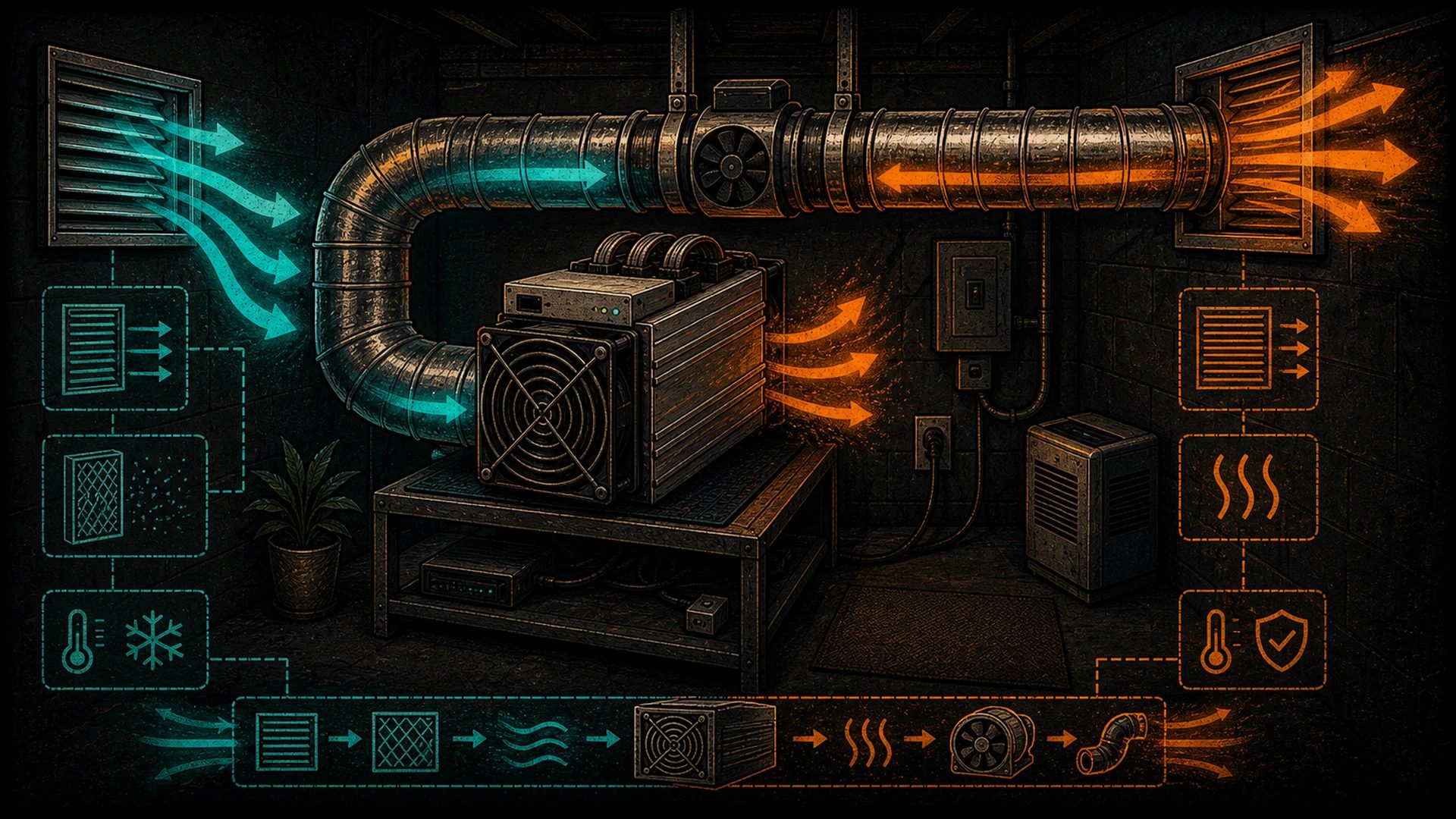
Safety, scope, and commercial-interest disclosure: D-Central sells and services Bitcoin mining equipment and may supply equipment used in airflow projects. That is a financial interest. This page is an educational acceptance framework, not an HVAC, building, electrical, fire-code, occupational-health, or equipment-specific design. It does not select a fan, duct, opening, control, or contractor and does not promise performance or savings. Use the exact equipment documentation and qualified local reviewers.
There is no universal duct diameter, fan rating, room-temperature target, or seasonal configuration for an ASIC installation. The defensible sequence is: identify the equipment envelope, document the building constraints, commission the complete airflow path, measure the operating result, and retain an acceptance record.
1. Set the decision boundary
An ASIC, its onboard fans, the room, intake, exhaust, filters, add-on fans, ducts, terminations, controls, weather, and makeup-air route form one system. A component rating describes a test condition; it is not evidence that the installed system will keep the device within its documented limits.
Operator-owned evidence
- Exact device identity, configuration, firmware, and current manufacturer documentation.
- Rated input and the measured operating state used during commissioning.
- Telemetry, event logs, alarm history, maintenance condition, and sensor map.
- Timestamped measurements at repeatable reference points.
Qualified-review scope
- Building openings, structure, weather protection, moisture, fire and smoke boundaries.
- HVAC pressure relationships, makeup air, combustion appliances, occupied-space exposure, and exhaust destination.
- Electrical supply, controls, interlocks, emergency isolation, and any required permit or inspection.
- Final selection of fans, ducts, materials, dampers, filters, and control sequences.
A home or small-site operator can assemble records and observe closed equipment. Design changes that alter the building or safety systems belong with competent local professionals. In Ontario, for example, the Electrical Safety Authority describes owner obligations and Licensed Electrical Contractor requirements for electrical work; other jurisdictions have their own authorities and rules.
2. Build an evidence register before buying or cutting
| Evidence | Record | Acceptance question | Owner |
|---|---|---|---|
| Equipment envelope | Exact model, hardware revision, configuration, manual revision, inlet/environment limits, required clearances, alarm and shutdown behaviour. | Can every proposed operating mode remain inside the documented envelope? | Equipment owner or service lead |
| Thermal load basis | Nameplate information plus measured wall input and operating state from a safely installed instrument or qualified measurement. | Is the design basis traceable to the actual unit and mode rather than a generic model table? | Commissioning lead |
| Air path | Annotated plan showing intake source, miner orientation, exhaust destination, restrictions, leakage paths, and maintenance access. | Is exhaust prevented from short-circuiting back to the inlet under expected conditions? | HVAC or building reviewer |
| Pressure and makeup air | Commissioned pressure/flow evidence and review of doors, other exhaust equipment, combustion appliances, and occupied spaces. | Can the building supply replacement air without creating another hazard? | Qualified building/HVAC reviewer |
| Weather and moisture | Seasonal extremes, precipitation entry, humidity/condensation assessment, drainage, freeze conditions, and control response. | Are all seasonal modes reviewed, including transitions and shutdown? | Building reviewer |
| Protection and response | Alarm routing, shutdown authority, isolation procedure, sensor-failure response, inspection interval, and responsible names. | Will a fault become a controlled stop instead of prolonged operation? | Site owner |
3. Use a repeatable measurement plan
ASHRAE’s facility guidance treats thermal performance as an equipment-and-facility interface. For an ASIC installation, use the manufacturer-defined inlet location and limits, then add repeatable reference points that reveal room conditions and recirculation. Record the sensor, location, time, weather, equipment state, firmware, fan state, doors or panels, filter condition, and any concurrent exhaust equipment.
- Baseline while off: document the intended path, obstructions, cleanliness, sensor placement, weather, and building state. Do not energize damaged, wet, incomplete, or unreviewed equipment.
- Controlled commissioning: the responsible person defines the permitted operating state and abort criteria. Use installed or non-invasive instruments with all guards and covers in their normal position. Live electrical measurements or work inside equipment are outside this guide.
- Stabilized record: capture inlet and exhaust reference temperatures, ambient/reference temperatures, device telemetry and logs, observed airflow direction, alarm state, and commissioned system measurements at the agreed interval.
- Challenge expected modes: review—not improvise—the credible high-ambient, cold, wind, filter-loading, door-position, other-exhaust, restart, and sensor-failure cases. Some cases require analysis or professional testing rather than intentionally creating a hazardous condition.
- Trend: retain the original acceptance record and compare like-for-like measurements after maintenance, configuration changes, seasonal change, or symptoms.
Temperature alone is not proof of adequate airflow. A device can report acceptable internal telemetry while hot exhaust recirculates locally, a filter loads, makeup air affects another appliance, or an occupied area accumulates heat. Conversely, an advertised fan airflow number does not prove the operating point of the installed path.
4. Treat airflow as a complete system
Filters, screens, guards, transitions, bends, long routes, terminations, backdraft devices, and leakage change resistance. Fans interact with that resistance and with one another. The relevant operating point comes from the complete system, not a free-air catalogue value. An add-on fan can also disturb the miner’s own control logic or create an unexpected failure mode. Selection and control require the applicable performance data and qualified review.
| System question | Evidence to seek | Do not substitute |
|---|---|---|
| Is supply air reaching the device inlet? | Repeatable inlet/reference measurements and direction/pressure evidence under the commissioned building state. | An open door, a room average, or a fan label. |
| Is exhaust leaving without recirculation? | Mapped inlet-to-exhaust separation and measurements at likely short-circuit paths across expected modes. | “Hot air rises” or visual distance alone. |
| Can the building replace exhausted air? | Makeup-air and pressure review including other exhausts, doors, occupied rooms, and combustion equipment. | A passive opening chosen only from duct diameter. |
| Will performance persist? | Filter/loading allowance, inspection access, alarm response, trend limits, and a re-test trigger. | A one-time startup temperature. |
Keep electrical readiness and thermal commissioning as separate acceptance gates. The ASIC commissioning blueprint provides the broader commissioning sequence, while the preventive maintenance framework helps turn the accepted baseline into inspections and trend checks.
5. Review seasons, moisture, people, and heat reuse
Outdoor intake and heat reuse are operating modes, not permanent assumptions. Review hot and cold extremes, humidity, condensation risk, precipitation, smoke or contaminants, wind pressure, freeze conditions, control transitions, outage/restart behaviour, and what happens when the receiving space no longer needs heat. Air below the device’s documented range is not automatically safe.
NIOSH recommends engineering and administrative controls for worker heat exposure. If people enter or work near the installation, include their exposure, access time, hydration/rest arrangements, alarm communication, and emergency response in the site review. This article does not establish an occupational exposure limit.
A heat-reuse path needs a safe alternate rejection mode and a measured receiving load. It must not defeat fire/smoke boundaries, introduce moisture or contaminants, or depend on doors being left in an uncontrolled position. Use the ASIC heat-reuse assessment workbook to document assumptions and measured evidence; it is not a promise of useful capacity, savings, or payback.
6. Sign an acceptance record
Acceptance is a traceable decision, not “the miner stayed on.” Record each approved operating mode separately. A useful record identifies the site, equipment and firmware, drawings and document revisions, reviewer scopes, sensor IDs and positions, weather/building state, measured results, alarms and shutdown tests, unresolved limitations, maintenance interval, seasonal re-test triggers, and the person authorized to stop operation.
| Gate | Pass evidence | If absent or failed |
|---|---|---|
| Documentation | Exact current device envelope and reviewed site constraints are attached. | Do not commission. |
| Physical condition | No damage, obstruction, moisture, incompatible material, or unsafe access condition is recorded. | Keep affected equipment isolated and investigate. |
| Normal operating mode | Commissioned measurements and logs remain within the documented envelope with no unexplained alarm. | Stop; do not “tune around” the alarm. |
| Recirculation and pressure | Evidence covers likely short-circuit paths and the approved building/door/exhaust state. | Escalate system review. |
| Fault response | Alarm ownership, isolation authority, sensor-failure response, and safe rejection path are documented. | Do not leave unattended operation enabled. |
| Change control | Triggers require review after equipment, firmware, duct, filter, fan, control, building, or seasonal changes. | Treat the prior acceptance as no longer sufficient. |
7. Stop and escalation matrix
| Signal | Immediate boundary | Required next evidence |
|---|---|---|
| Smoke, scorching, melted connector or surface, abnormal odour, arcing sound | Use the approved emergency isolation response; do not approach or re-energize to reproduce it. | Qualified electrical/fire and equipment assessment. |
| Water, condensation, snow or rain entry | Keep affected equipment de-energized and do not use heat alone as proof it is dry. | Moisture source correction and qualified inspection before return. |
| Repeated thermal alarm, shutdown, fan fault, or telemetry disagreement | Do not bypass, raise limits, or force operation. | Logs, sensor verification, equipment condition, and system measurements. |
| Inlet/reference trend worsens after a change | Return to the last approved state only if the responsible person’s documented procedure permits it; otherwise remain stopped. | Change record and repeat commissioning. |
| Doors difficult to operate, unexpected drafts, odours from combustion equipment, occupied-space heat | Stop the affected operating mode and ventilate/evacuate as the site emergency plan requires. | Building pressure, combustion-safety, and occupational-health review. |
| Required evidence or accountable reviewer is missing | Do not infer acceptance from prior uptime. | Complete the evidence register and approval. |
For workplace servicing, OSHA’s energy-control standard addresses unexpected energization and stored energy; electrical hazards have additional requirements. Apply the rules governing the actual site. This page does not turn lockout/tagout into a home checklist or authorize work on energized equipment.
Primary sources and review date
- ASHRAE Handbook, Chapter 20: Data Centers and Telecommunication Facilities — equipment/facility interfaces, environmental conditions, airflow, power, and measurement context.
- U.S. Department of Energy, Best Practice Guide for Data Center Design — airflow paths, separation, controls, and whole-facility efficiency context.
- NIOSH heat-stress recommendations — engineering, administrative, training, and emergency controls for worker exposure.
- OSHA 29 CFR 1910.147 — workplace energy-control scope during servicing and maintenance.
- Electrical Safety Authority: property-owner obligations — Ontario-specific electrical-work and notification context.
Sources reviewed 2026-08-29. Standards, manufacturer documents, regulations, site conditions, and URLs can change. Confirm the current revision and the authority governing the installation before relying on any requirement.
Frequently asked questions
Can I select an exhaust fan from its advertised free-air CFM alone?
No. Installed airflow depends on the complete system, including the miner, guards, filters, transitions, ducts, fittings, terminations, makeup-air path, controls, and operating point. Record commissioned measurements instead of treating a catalogue free-air rating as delivered airflow.
Is there one safe duct diameter for every ASIC miner?
No. The device documentation, required operating envelope, route, materials, pressure losses, building conditions, and applicable rules all matter. This guide intentionally does not prescribe a diameter or penetration detail.
Where should inlet temperature be measured?
Use the location and limits defined by the exact device documentation. Document sensor identity and position, then keep the same reference points for trend comparisons. Use installed or non-invasive sensors with guards closed; do not reach into energized equipment.
Is colder outdoor air always better for an ASIC?
No. Air outside the documented operating envelope, moisture, condensation, snow, rain, and abrupt seasonal changes can damage equipment or the building. Cold-weather operation needs a reviewed moisture and control strategy.
Can miner exhaust be sent into an attic or wall cavity?
Do not assume so. A qualified person must evaluate the destination, moisture, fire and smoke boundaries, materials, pressure effects, maintenance access, and local requirements before any building penetration or concealed discharge path is used.
Does captured ASIC heat guarantee useful space heating?
No. Recoverable heat and the receiving load vary with operation, weather, controls, distribution losses, and occupancy needs. Treat reuse as a measured seasonal operating mode with a safe rejection path, not as guaranteed capacity or savings.
What conditions require an immediate stop?
Stop for smoke, scorching, melted parts, unusual odour, water or condensation, repeated thermal alarms, failed fans or controls, blocked paths, operation outside documented limits, or any condition the responsible person cannot explain from evidence.
Who should approve the final airflow system?
The owner should assign accountable reviewers appropriate to the site: the equipment documentation owner, a qualified HVAC or building professional, electrical and fire-safety professionals where their scopes are affected, and the local authority where approval is required.
