
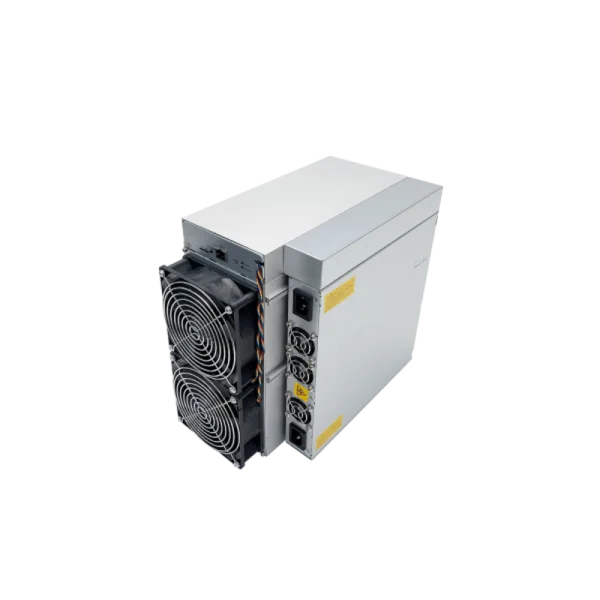
Bitmain Antminer L7 (9.16Gh)
Réponse rapide
The Bitmain Antminer L7 (9.16Gh) is a Scrypt miner rated about 9.16 GH/s at roughly 3,425 W. An industrial-class unit — loud and power-hungry, best suited to a dedicated mining space, not living areas.
Professional-Grade Miner
This miner draws 3,425W and produces 75+ dB of noise — it is designed for dedicated mining environments, not living spaces. Professional-grade miners deliver the highest hashrate and revenue per unit but require proper infrastructure: a 240V circuit, adequate ventilation or exhaust ducting, and a space where noise is not a concern (garage, basement, warehouse, or outdoor enclosure).
For home miners looking for a quieter alternative, consider our Bitcoin Space Heater builds or explore open-source miners like the Bitaxe that are purpose-built for residential environments.
Heater-Class Miner
At 3,425W, this miner outputs approximately 11686 BTU/hr of heat — equivalent to a standard electric space heater. Every watt consumed by an ASIC miner is converted to heat with 100% efficiency, making it a space heater that also mines Bitcoin.
During heating season, miner heat can offset part of the heat a room would otherwise need from another electric heater. The economics depend on your electricity rate, room heat demand, BTC price, network difficulty, and noise constraints.
Calculateur de rentabilité
| Period | Revenue | Electricity Cost | Profit |
|---|---|---|---|
| Daily | $0.00 | $5.75 | $-5.75 |
| Weekly | $0.00 | $40.28 | $-40.28 |
| Monthly | $0.01 | $172.62 | $-172.61 |
| Yearly | $0.10 | $2,100.21 | $-2,100.11 |
Heating offset estimates the value of heat replacing an electric space heater during heating season (~6 months/year in Canada). Actual savings depend on your heating setup and climate.
Buy from D-Central
In stock and ready to ship from Laval, Quebec.
Full Specifications
| Model | Bitmain Antminer L7 (9.16Gh) |
|---|---|
| Model Number | Antminer L7 (9.16Gh) |
| Manufacturer | Bitmain |
| Algorithme | Scrypt |
| Coins Mined | Litecoin (LTC), Dogecoin (DOGE) |
| Taux de hachage | 9.16 GH/s |
| Consommation électrique | 3,425 W |
| Efficiency | 373.91 J/GH |
| Dimensions | 195 x 290 x 370mm |
| Weight | 15 |
| BTU Output | 11686 BTU/hr |
| Equivalent Heater | Equal to a 3,425W space heater |
| Daily Power Cost | $5.75/day |
| Monthly Power Cost | $172.62/mo |
| Circuit Requirement | 240V circuit required |
| Release Date | 2021-11-01 |
| MSRP | $1,599.00 |
| État | Active |
Custom Power Profiles
With custom firmware like DCENT_OS, this miner can be tuned across a wide range of power levels. Lower wattage improves efficiency and reduces electricity costs; higher wattage increases hashrate at the expense of efficiency.
| Wattage | Taux de hachage | Efficiency |
|---|---|---|
| 1,855 W | 4800 MH/s | 0.387 J/MH |
| 2,180 W | 5850 MH/s | 0.373 J/MH |
| 2,550 W | 6900 MH/s | 0.37 J/MH |
| 2,900 W | 7980 MH/s | 0.363 J/MH |
| 3,050 W | 8500 MH/s | 0.359 J/MH |
| 3,255 W | 9020 MH/s | 0.361 J/MH |
| 3,440 W | 9500 MH/s | 0.362 J/MH |
| 3,930 W | 10000 MH/s | 0.393 J/MH |
| 4,350 W | 10500 MH/s | 0.414 J/MH |
| 4,900 W | 11000 MH/s | 0.445 J/MH |
| 5,500 W | 11500 MH/s | 0.478 J/MH |
| 6,000 W | 12000 MH/s | 0.5 J/MH |
Actual performance varies by individual unit silicon quality, ambient temperature, and cooling configuration. These operating points are achievable with custom tuning firmware such as DCENT_OS; values are calculated at runtime by the autotuner, not fixed presets.
Home Mining Assessment
The Antminer L7 (9.16 GH/s) is Bitmain’s flagship-class Scrypt ASIC, built for merged mining of Litecoin (LTC) and Dogecoin (DOGE). It pairs 360 BM1489 7 nm chips across three hashboards to deliver 9.16 GH/s while drawing roughly 3,425 W at the wall — about 0.374 J/MH, and still one of the most capable Scrypt machines ever shipped.
Chip and hashboard architecture
The L7 is powered by Bitmain’s BM1489, a Scrypt-specific ASIC fabricated on a TSMC 7 nm DUV process. That node is the single biggest reason the L7 exists: it let Bitmain pack far more Scrypt cores per watt than the 28 nm BM1485 that powered the earlier L3 family, dragging Scrypt efficiency down from the multi-J/MH era into the sub-0.4 J/MH range.
Internally, the 9.16 GH/s unit is organised as three hashboards, each carrying 120 BM1489 chips — 360 chips in total (Bitmain board code BSL39601). The chips on each board are daisy-chained over a shared UART bus: commands flow forward from chip to chip, and hash results return down a reverse line, which is why a single failed chip can make every chip behind it disappear from the controller.
One detail sets the L7 apart from Bitmain’s SHA-256 boards: each hashboard uses two clock crystals, not one. A first oscillator (Y1) clocks chips 1–60 and a second (Y2) clocks chips 61–120. That split-clock layout means a clock-distribution fault can knock out a clean 60-chip half of a board rather than the whole chain — a useful fingerprint when a board reports almost exactly half its expected chips.
Power is delivered the way every modern Antminer handles it: chips are wired in series into voltage domains, and the regulator controls the voltage of each domain — not each individual chip. There is no per-chip voltage knob on the L7; tuning happens at the domain and board level. Board temperature is read through an on-board PIC microcontroller that relays the I²C sensors back to the controller (the so-called « via-PIC » path), so the L7 — unlike the later no-PIC S21/T21 — still depends on a healthy PIC for thermal telemetry.
Orchestrating all of it is a Xilinx Zynq-7010 (XC7Z010) control board: a dual-core ARM Cortex-A9 running at 667 MHz alongside an Artix-7 FPGA fabric that handles the high-rate UART traffic to the hashboards. It is the same Zynq control-board lineage Bitmain used across its first-generation S9/S17/S19 machines, which is part of why the L7 is so serviceable years after launch.
Real-world power and efficiency
Bitmain’s nameplate for this bin is 9.16 GH/s at roughly 3,425 W. At the wall — including PSU losses and the four cooling fans — that works out to about 0.374 J/MH (≈374 J/GH). The top-binned L7 reaches 9.5 GH/s at the same power envelope, so this 9.16 GH/s unit sits one binning step down: same draw, slightly fewer hashes, a hair less efficient. Both are excellent Scrypt numbers.
A quick note on units, because the spec card can mislead: Scrypt efficiency is conventionally expressed in joules per megahash (J/MH), not the joules-per-terahash figure used for SHA-256 Bitcoin miners. A six-figure « J/TH » reading is just the J/MH value scaled up by a million — it does not mean the L7 is inefficient. Against other Scrypt hardware, ~0.374 J/MH is firmly competitive.
Tuning headroom on Scrypt machines is narrower than on SHA-256 ASICs. The BM1489 has a usable frequency and voltage band you can trade for either lower power or marginally more hash, but the gains are modest compared with an S19 or S21, and aggressive overclocking on a 7 nm Scrypt chip pushes heat fast. If you want to see where a given wattage lands on the curve before committing, work through our ASIC power profiles reference rather than guessing at firmware settings.
Firmware compatibility
The L7 ships on Bitmain’s stock Antminer firmware, a cgminer-based stack with the standard web UI for pools, frequency presets and fan modes. For most operators that is all the L7 needs.
Third-party firmware support for Scrypt hardware is real but thinner than for SHA-256 miners. A small number of aftermarket builds do target the L7’s Zynq platform and add finer autotuning and monitoring — but be clear-eyed about the trade-offs: closed third-party firmware means trusting someone else’s binaries on hardware that controls a multi-kilowatt PSU, and autotuner values are calculated at runtime, not loaded from a fixed preset, so behaviour shifts with chip health and ambient temperature.
One honest limitation worth stating: the only firmware that natively speaks Stratum V2 is BraiinsOS+, and that project is SHA-256-only. There is no native Stratum V2 path for the L7 — Scrypt LTC/DOGE pools are mined over Stratum V1. Our own sovereignty-focused firmware work (DCENT_OS) is centred on SHA-256 hardware today and is in public beta; we would rather tell you that plainly than imply L7 support that does not yet exist.
Common faults and troubleshooting
Most L7 failures fall into a handful of repeatable patterns:
- Partial chip count / dead chain. A hashboard reporting fewer than its 120 chips has a break point: the last detected chip sits just before the fault. Because the L7 is dual-clocked, a count that stops near 60 often points at the second clock half (Y2) or its coupling, while a fully dead chain usually means a shorted chip pulling the bus down.
- Thermal trips. The firmware throttles when chip temperature reaches ~85 °C and triggers an emergency stop at ~90 °C (or ~80 °C board temp). Repeated trips usually mean dried thermal paste, clogged heatsinks or failing fans long before they mean a bad chip.
- Fan and PIC faults. The L7 expects four healthy fans; lose enough of them and the controller halts mining as a safety measure. Because thermal data is relayed through the on-board PIC, a PIC or sensor-bus fault can present as phantom temperature errors even when the board is cool.
- PSU and power errors. A 3,425 W draw is hard on power supplies and on the wall circuit. Under-voltage, brown-outs and PSU protection trips show up as random restarts before they show up as hashboard damage.
Work symptoms back to root cause with our ASIC fault finder, and cross-reference the exact string your miner logs against our Antminer error-code library before you swap any parts — many « dead board » reports are a single chip, a fan, or a loose data ribbon.
Repair and longevity
The L7 is a repairable machine, and that matters: at 7 nm with 360 chips per unit, a board with one or two failed domains is worth fixing, not scrapping. D-Central has run an in-house ASIC repair bench since 2016, and Scrypt boards like the L7’s are diagnosed the same disciplined way as any Antminer hashboard — chain-walking the UART to find the break, checking domain voltages, verifying both clock crystals, and reflowing or replacing individual BM1489 chips rather than condemning the whole board.
Because the L7 rides on the well-understood Zynq control-board platform, controller-side faults (bad flash, corrupt firmware, network bricks) are recoverable too. If your L7 is throwing chip-count errors, running hot, or dropping boards, our ASIC repair service can assess it at the component level — usually for a fraction of replacement cost.
Who the L7 is for
The L7 has a clear job: merged Litecoin + Dogecoin mining at serious scale. Because LTC and DOGE share the Scrypt algorithm, a single L7 earns both coins simultaneously through merged mining, which is the main reason it has stayed in demand long after release. If your goal is Scrypt hashrate per dollar and per watt, it remains the reference machine.
It is decidedly not a quiet home miner — at 3,425 W and full-bore fans it is loud and hot, and it belongs in a garage, shop or dedicated mining space rather than a living room. There is no low-power « tinkerer » equivalent in the Scrypt world the way the Bitaxe exists for SHA-256, so the L7 is the realistic entry point for anyone serious about LTC/DOGE.
That heat is not entirely waste. The unit dumps roughly 11,686 BTU/h, enough to genuinely warm a workshop or be ducted into a space during cold months — turning money you would otherwise spend on heating into Scrypt hashrate. Browse current Scrypt and SHA-256 inventory in our ASIC miner catalog, or talk to us about a refurbished, bench-tested L7.
| Specification | Antminer L7 (9.16 GH/s) |
|---|---|
| Algorithm | Scrypt (LTC + DOGE merged mining) |
| Hashrate | 9.16 GH/s |
| Wall power | ~3,425 W |
| Efficiency | ~0.374 J/MH (≈374 J/GH) |
| ASIC chip | Bitmain BM1489, TSMC 7 nm DUV |
| Layout | 3 hashboards × 120 chips (360 chips); dual-clock (Y1/Y2) |
| Control board | Xilinx Zynq-7010, ARM Cortex-A9 @ 667 MHz |
| Cooling | 4 fans; throttle ~85 °C, shutdown ~90 °C |
| Heat output | ~11,686 BTU/h |
| Dimensions | 195 × 290 × 370 mm |
| Weight | ~15 kg |
| Released | November 2021 |
Generational context
The L7 is the machine that modernised Scrypt mining. Its predecessor, the L3++, ran the 28 nm BM1485 at roughly 0.58 GH/s for about 0.94 kW — efficient for 2017, but an order of magnitude behind on every axis. Moving to the 7 nm BM1489 let the L7 deliver more than fifteen times the hashrate while cutting energy per hash by roughly four-fold. Credit where it is due: Bitmain’s jump from the L3 line to the L7 is one of the cleaner generational leaps in Scrypt hardware, and it defined the category for years.
Bitmain’s own successor, the L9, pushes Scrypt further still — into the mid-teens of GH/s at meaningfully better efficiency — but the L7 remains the workhorse of the LTC/DOGE network and the most widely supported, most repairable Scrypt ASIC in the field. For anyone building or maintaining a Scrypt operation in 2026, it is still the safe, well-understood choice.
| Model | Chip / node | Scrypt hashrate | Wall power | Efficiency |
|---|---|---|---|---|
| L3++ (2017) | BM1485 / 28 nm | ~0.58 GH/s | ~0.94 kW | ~1.6 J/MH |
| L7 9.16 (this unit) | BM1489 / 7 nm | 9.16 GH/s | ~3,425 W | ~0.374 J/MH |
| L7 9.5 (top bin) | BM1489 / 7 nm | 9.5 GH/s | ~3,425 W | ~0.36 J/MH |
| L9 (successor) | next-gen Scrypt | ~16 GH/s (approx.) | ~3.4 kW | ~0.21 J/MH (approx.) |
Broken miner? Get a real quote.
Tell us the symptom and get an instant repair-tier estimate ($95 / $145 / $195 CAD). Mail-in from across Canada, bench in Laval, Quebec.
Send it to D-Central — start a repair →Related Miners
Goldshell X6S
Goldshell Mini-DOGE Pro
Bitmain Antminer U2L9H
FluMiner L3
Comparer le Bitmain Antminer L7 (9.16Gh)
Foire aux questions
What are the current mining economics for the Bitmain Antminer L7 (9.16Gh)?
At $0.07/kWh, the Bitmain Antminer L7 (9.16Gh) currently shows an estimated daily net cost of $5.75 before pool fees and hardware cost. Lower electricity rates, network changes, BTC price changes, or useful heat recovery can change the result.
Can I mine Bitcoin at home with the Bitmain Antminer L7 (9.16Gh)?
The Bitmain Antminer L7 (9.16Gh) has a home mining score of 8/100. With 0 dB noise and 3,425W power draw, it may require a dedicated space like a garage, basement, or outdoor enclosure. Consider noise insulation and proper ventilation.
Can the Bitmain Antminer L7 (9.16Gh) heat my home?
The Bitmain Antminer L7 (9.16Gh) outputs approximately 11686 BTU/hr of heat. For reference, a typical space heater produces 5,000-5,500 BTU/hr. All electrical energy consumed by the miner is converted to heat, making it 100% efficient as a heater. D-Central offers Bitcoin Space Heater builds designed specifically for home heating integration.
What power supply does the Bitmain Antminer L7 (9.16Gh) need?
The Bitmain Antminer L7 (9.16Gh) draws 3,425W of power. You need a power supply rated for at least 3,768W with appropriate voltage (200-240V AC). D-Central stocks compatible power supplies in our shop. Always use a quality PSU from a reputable manufacturer to protect the miner and wiring.