
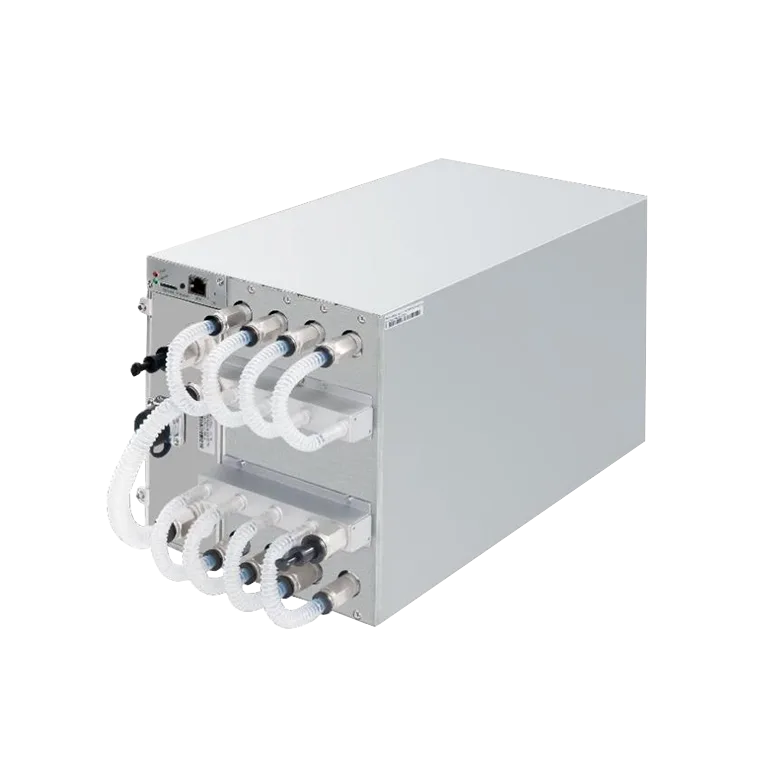
Bitmain Antminer S19e XP Hydro 251T
Réponse rapide
The Bitmain Antminer S19e XP Hydro 251T is a Bitcoin miner rated about 251 TH/s at roughly 5,522 W (about 22 J/TH). An industrial-class unit — loud and power-hungry, best suited to a dedicated mining space, not living areas.
Hydro-Cooled Miner
This miner uses a closed-loop liquid cooling system (hydro cooling) instead of traditional air cooling. Water or coolant circulates through internal channels to absorb heat from the ASIC chips, then transfers it to an external radiator or facility cooling loop.
Hydro-cooled miners run significantly quieter than air-cooled models since they eliminate or minimize fan noise. They also achieve higher hashrates and better efficiency because the chips can be driven harder while staying within safe thermal limits. The trade-off: hydro miners require compatible water infrastructure — inlet/outlet connections, a cooling distribution unit (CDU), and proper plumbing.
Hydro cooling is ideal for professional mining operations and data centers where water infrastructure already exists, or for home miners building a dedicated water-cooled setup to eliminate noise completely.
Professional-Grade Miner
This miner draws 5,522W and produces 50 dB of noise — it is designed for dedicated mining environments, not living spaces. Professional-grade miners deliver the highest hashrate and revenue per unit but require proper infrastructure: a 240V circuit, adequate ventilation or exhaust ducting, and a space where noise is not a concern (garage, basement, warehouse, or outdoor enclosure).
For home miners looking for a quieter alternative, consider our Bitcoin Space Heater builds or explore open-source miners like the Bitaxe that are purpose-built for residential environments.
Calculateur de rentabilité
| Period | Revenue | Electricity Cost | Profit |
|---|---|---|---|
| Daily | $7.97 | $9.28 | $-1.31 |
| Weekly | $55.80 | $64.94 | $-9.14 |
| Monthly | $239.15 | $278.31 | $-39.15 |
| Yearly | $2,909.72 | $3,386.09 | $-476.38 |
Heating offset estimates the value of heat replacing an electric space heater during heating season (~6 months/year in Canada). Actual savings depend on your heating setup and climate.
Where to Buy the Bitmain Antminer S19e XP Hydro 251T
D-Central Technologies
CanadaBitcoin Mining Hackers since 2016. Ships from Laval, Quebec.
magasiner le materiel de minage BitcoinASIC Miner Market
United StatesWide selection of new and used ASIC miners. US-based shipping.
MagasinerMinersDeals
United StatesCompetitive prices on new ASIC miners with coupon codes.
MagasinerFull Specifications
| Model | Bitmain Antminer S19e XP Hydro 251T |
|---|---|
| Model Number | Antminer S19e XP Hydro 251T |
| Manufacturer | Bitmain |
| Algorithme | SHA-256 |
| Coins Mined | Bitcoin (BTC) |
| Taux de hachage | 251 TH/s |
| Consommation électrique | 5,522 W |
| Efficiency | 22 J/TH |
| Niveau de bruit | 50 dB |
| Cooling | Hydro |
| Dimensions | 410*170*209mm |
| Weight | 12.8 |
| BTU Output | 18841 BTU/hr |
| Equivalent Heater | Equal to a 5,522W space heater |
| Daily Power Cost | $9.28/day |
| Monthly Power Cost | $278.31/mo |
| Circuit Requirement | 240V circuit required |
| Release Date | 2025-01-01 |
| MSRP | $816.00 |
| État | Active |
Home Mining Assessment
The Bitmain Antminer S19e XP Hydro 251T is a liquid-cooled SHA-256 Bitcoin miner rated at 251 TH/s for about 5,522 W at the wall — roughly 22 J/TH. It runs Bitmain’s 5 nm BM1366 ASIC across three water-cooled hashboards, making it one of the last and densest hydro members of the S19 generation.
Chip and hashboard architecture
The S19e XP Hydro 251T is built on Bitmain’s BM1366 ASIC — the same TSMC 5 nm silicon that powers the air-cooled S19 XP and the S19k Pro. It is a SHA-256 part (the later S21 XP / BM1370P generation stays on TSMC 5 nm as well), and Bitmain deserves credit here: BM1366 was the chip that pushed the S19 family from the ~29 J/TH BM1398 era down into the low-20s J/TH range and kept the platform competitive for years.
A complete unit follows the standard Antminer layout: one Linux control board plus three hashboards (Chain0, Chain1, Chain2), fed by a single high-current PSU. Where this hydro SKU diverges from the air-cooled S19 XP is hashboard density. An air S19 XP board carries 110 BM1366 dies in 11 voltage domains (10 chips per domain); the hydro board steps up to 17 voltage domains of 12 dies each — 204 BM1366 per board, or roughly 612 dies across the full three-board stack. Liquid cooling is what makes that density and those clocks thermally survivable.
An important accuracy point that gets mangled on most spec sites: voltage on these boards is regulated per voltage domain, not per individual chip. Each domain is a series-wired group of dies fed by its own DC-DC conversion stage; the firmware trims the domain rail, and every chip in that domain shares it. On stock S19 XP-family boards a small microcontroller historically acted as the I2C voltage-domain manager, though later BHB56-series board revisions are « NoPic » and fold that role into the regulator stage. The signal side is a classic daisy chain — command-in to command-out, a shared clock, and a reset line threaded through all 204 chips — which is exactly why a single open die or one cold solder joint on a domain-boundary resistor can take a whole board offline.
The control board is a Xilinx Zynq-7000 SoC with a dual-core ARM Cortex-A9 running at 667 MHz, talking to each hashboard over an 18-pin ribbon that carries 3.3 V logic power, the UART chain, clock, reset, and the I2C temperature/EEPROM lines. The Zynq’s FPGA fabric handles the timing-critical job dispatch and nonce return; the Cortex-A9 cores run cgminer/bmminer and the network stack.
Specifications at a glance
| Specification | Detail |
|---|---|
| Algorithm | SHA-256 (Bitcoin) |
| Rated hashrate | 251 TH/s |
| Wall power (nameplate) | 5,522 W |
| Efficiency | 22 J/TH nameplate (≈20.8 J/TH at the tuner’s efficiency-optimal point) |
| ASIC | Bitmain BM1366 (TSMC 5 nm) |
| Hashboards | 3 × liquid cold-plate boards |
| Per-board layout | 17 voltage domains × 12 dies = 204 BM1366 per board (~612 total) |
| Control board | Xilinx Zynq-7000 SoC, dual Cortex-A9 @ 667 MHz |
| Cooling | Hydro — water/glycol coolant loop (external dry cooler / CDU required) |
| Noise | ~50 dB (from the external loop; no onboard high-RPM fans) |
| Heat output | ~18,841 BTU/h, exported into the coolant loop |
| Weight | 12.8 kg |
| Dimensions | 410 × 170 × 209 mm |
| Release | Early 2025 (late S19-generation hydro) |
Real-world power and efficiency
The 251 TH/s / 5,522 W nameplate is a single point on a wide tuning curve, not a fixed ceiling. Because the coolant loop pulls heat off the dies far more aggressively than air, the BM1366 boards can be clocked across a much larger envelope than the air-cooled S19 XP. In our ASIC power-profiles database, the S19e XP Hydro’s high-performance profile set brackets the rated point neatly: about 5,200 W for 249 TH/s (20.9 J/TH) and 5,345 W for 257 TH/s (20.8 J/TH). In other words, at its efficiency-optimal trim the unit actually lands near 20.8 J/TH — the published 22 J/TH nameplate is the conservative number.
From there the headroom runs both directions. Pulled back toward efficiency, the same boards will sit around 4,200 W for 200 TH/s (21 J/TH), with deeper eco sets reaching into the 2,300–2,900 W band for 74–104 TH/s when you want to throttle for cheap-but-limited power or for heat-led operation. Pushed the other way, the liquid loop supports overclocks up to roughly 7,000 W for ~302 TH/s (23.2 J/TH) before efficiency falls off. Those operating points are calculated at runtime by the firmware’s autotuner against each board’s measured chip health and temperatures — they are not fixed factory presets, and a tired board will quietly settle at a lower clock to stay stable.
One correction worth stating plainly: this is a hydro unit, so its ~18,841 BTU/h of waste heat is carried out in the coolant, not blown into a room as hot air. You cannot duct it like an air-cooled S19. That is a feature, not a limitation — the captured hot coolant is ideal for hydronic loads such as in-floor heating, radiators, a heat-exchanger to a workshop, or pool/greenhouse pre-heat, which is exactly the kind of dual-purpose deployment where these units earn their keep.
Firmware compatibility
Out of the box the S19e XP Hydro runs Bitmain’s stock firmware — a cgminer/bmminer fork with the familiar web UI and port-4028 API. Stock is stable and well understood, but it deliberately leaves efficiency on the table: it does not expose per-board autotuning or the deep undervolt/overclock range the hardware is capable of.
The BM1366 platform is well covered by third-party autotuning firmware, which is where most operators unlock the power-curve flexibility described above. If Stratum V2 support is a hard requirement, note the honest reality: among current firmwares, BraiinsOS+ is the only one with native Stratum V2 — the others speak Stratum V1. As mining hackers ourselves we have a lot of respect for the teams who reverse-engineered and matured these tools; they did the hard work that made aftermarket tuning mainstream.
D-Central’s own firmware effort, DCENT_OS, includes BM1366 silicon support in its driver set and is being developed in the open under GPL-3.0. It is in public beta today (images for the Antminer S9 and S19j Pro, Zynq/XIL boards), and the goal is decentralization — one more firmware option that isn’t locked to a single vendor — rather than a claim of being better than what came before. Whichever route you take, treat a firmware flash on a five-figure hydro asset as a deliberate operation: keep a stock recovery image, and validate on one board before rolling a fleet.
Common faults and troubleshooting
Because all 204 chips on a board sit in a single daisy chain, the most common stock-firmware complaints are « 0 ASIC found » on a chain, a reduced chip count (the chain breaks at chip N), or a board hashing well below its share. Our ASIC fault finder walks these symptoms to a root cause, but the high-probability culprits on a BM1366 hydro board are:
- Dead or shorted die — chain enumeration stops at the failed chip; a hard short collapses the domain voltage. Causes are ESD, thermal stress, or a power event.
- Voltage-domain / regulator faults — an LDO or DC-DC stage failing open or short leaves a domain dead or sagging, which the controller reads as missing chips.
- Signal-chain breaks — a cold solder joint on a CO/CLK/reset pin or a domain-boundary resistor stops the chain forwarding even though the chip is alive.
- Coolant-loop issues (hydro-specific) — these boards live or die by flow. A blocked or air-locked loop, a failing pump, or a clogged cold plate causes thermal shutdowns and intermittent dropouts that masquerade as chip faults. Worn O-rings or fittings, corrosion/galvanic issues from the wrong coolant, and condensation when coolant runs below the dew point are all real-world hydro failure paths.
The diagnostic order is always the same: confirm flow and inlet/outlet temperatures first, then check domain voltages and chain enumeration in the firmware logs before assuming a dead chip. Many « dead » hydro boards are simply starved of coolant.
Repair and longevity
A hydro S19 is a serviceable, long-lived asset — not a disposable appliance. D-Central has repaired Antminers in-house since 2016, and the BM1366 boards in this unit respond to the same component-level work as the rest of the family: chip-level diagnosis with a thermal camera and chain-probe fixture, reflow or replacement of failed BM1366 dies, regulator and LDO rework, domain-boundary resistor and level-shifter repair, EEPROM recovery, and cold-plate/loop service that air-cooled shops simply aren’t equipped for. Board-swapping a whole hashboard to « fix » a single dead chip is exactly the throwaway behaviour we built our ASIC repair service to avoid.
Practical longevity advice for a hydro unit: run clean, correctly inhibited coolant; keep the loop sealed and the dry cooler clear; watch inlet temperature rather than just hashrate; and don’t chase the top of the overclock curve 24/7 — sustained 7 kW operation ages the silicon faster than the 20.8 J/TH sweet spot. Treated well, these boards keep their efficiency for years.
Who it’s for, and buying
The S19e XP Hydro 251T makes sense for operators who already have — or are willing to build — a liquid-cooling loop: container/hashcenter deployments, heat-recovery setups, and anyone exporting mining heat into a hydronic system. It is decidedly not a plug-and-play home unit; without a coolant loop and dry cooler it will not run at all. For a sovereign Bitcoiner heating a space, a hydro S19 paired with a hydronic system is a genuinely elegant way to turn electricity into both sats and warmth — but it asks for more plumbing than an air-cooled box or a single-board Bitaxe-class heater.
If you want the per-coin profitability math, live efficiency tiers, and current availability, browse D-Central’s ASIC miner shop. We build to order and stand behind what we sell — including the repair backstop most resellers don’t offer.
Generational context
The S19e XP Hydro sits at the top of the BM1366 / S19 XP family and at the tail end of the S19 generation. Against the air-cooled S19 XP (~141 TH/s, ~21.5 J/TH on the same BM1366 chip), the hydro variant roughly doubles throughput per unit by adding dies and liquid headroom, while landing in the same low-20s J/TH efficiency band. Its successor generation — the BM1368-based S21 Hydro and the BM1370-based S21 Pro / S21 XP — pushes efficiency into the ~17.5 J/TH and ~12 J/TH territory respectively, so on a pure J/TH basis the S21 hydro line is more efficient.
That doesn’t make the S19e XP Hydro obsolete. At today’s hardware prices it is one of the most cost-effective ways to deploy serious liquid-cooled hashrate, and where electricity is cheap or where the waste heat is being put to work, the gap to an S21 narrows considerably. Bought right, maintained properly, and repaired rather than discarded when a board fails, it remains a workhorse — which is precisely the kind of long-haul, sovereignty-minded machine we like to keep running.
Broken miner? Get a real quote.
Tell us the symptom and get an instant repair-tier estimate ($95 / $145 / $195 CAD). Mail-in from across Canada, bench in Laval, Quebec.
Send it to D-Central — start a repair →Related Miners
Bitmain Antminer T19 Pro Hyd
NerdQAxe++
GMO miner B3
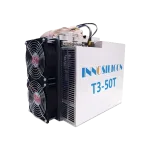
Innosilicon T3 50T
Comparer le Bitmain Antminer S19e XP Hydro 251T
Foire aux questions
What are the current mining economics for the Bitmain Antminer S19e XP Hydro 251T?
At $0.07/kWh, the Bitmain Antminer S19e XP Hydro 251T currently shows an estimated daily net cost of $1.31 before pool fees and hardware cost. Lower electricity rates, network changes, BTC price changes, or useful heat recovery can change the result.
Can I mine Bitcoin at home with the Bitmain Antminer S19e XP Hydro 251T?
The Bitmain Antminer S19e XP Hydro 251T has a home mining score of 32/100. With 50 dB noise and 5,522W power draw, it may require a dedicated space like a garage, basement, or outdoor enclosure. Consider noise insulation and proper ventilation.
Can the Bitmain Antminer S19e XP Hydro 251T heat my home?
The Bitmain Antminer S19e XP Hydro 251T outputs approximately 18841 BTU/hr of heat. For reference, a typical space heater produces 5,000-5,500 BTU/hr. All electrical energy consumed by the miner is converted to heat, making it 100% efficient as a heater. D-Central offers Bitcoin Space Heater builds designed specifically for home heating integration.
What power supply does the Bitmain Antminer S19e XP Hydro 251T need?
The Bitmain Antminer S19e XP Hydro 251T draws 5,522W of power. You need a power supply rated for at least 6,074W with appropriate voltage (200-240V AC). D-Central stocks compatible power supplies in our shop. Always use a quality PSU from a reputable manufacturer to protect the miner and wiring.