
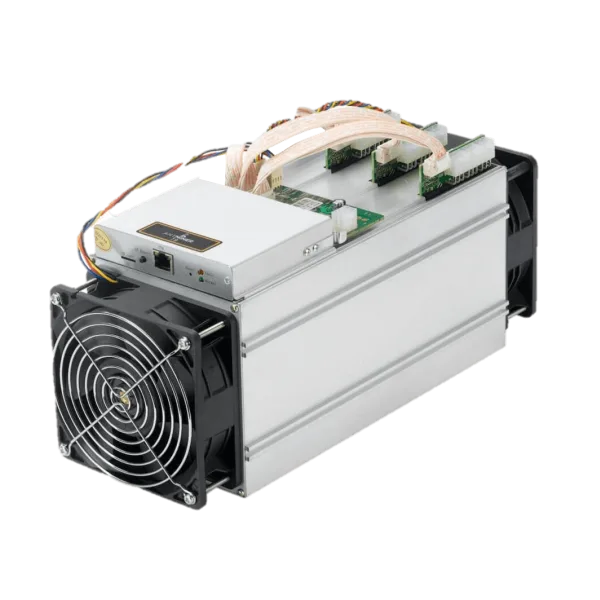
Antminer S9
Legendary miner, still widely used in space heater builds due to availability and low cost
Réponse rapide
The Antminer S9 is a Bitcoin miner rated about 14 TH/s at roughly 1,350 W (about 96.43 J/TH), built on 189× BM1387. An industrial-class unit — loud and power-hungry, best suited to a dedicated mining space, not living areas.
DCENT_OS Compatible
DCENT_OS is custom firmware developed by D-Central Technologies specifically for home miners. It transforms this miner with whisper-quiet fan profiles, 120V North American outlet support, auto-tuning for maximum efficiency, heater mode integration, and a clean web dashboard for monitoring.
Miners running DCENT_OS score higher on our Home Mining Assessment because the firmware is purpose-built to make industrial hardware livable in residential spaces.
Learn More About DCENT_OS →Professional-Grade Miner
This miner draws 1,350W and produces 76 dB of noise — it is designed for dedicated mining environments, not living spaces. Professional-grade miners deliver the highest hashrate and revenue per unit but require proper infrastructure: a 240V circuit, adequate ventilation or exhaust ducting, and a space where noise is not a concern (garage, basement, warehouse, or outdoor enclosure).
However, this miner is compatible with DCENT_OS — D-Central's custom firmware that adds whisper-quiet fan profiles and 120V North American outlet support. With DCENT_OS installed, this industrial miner can be transformed for home use.
Heater-Class Miner
At 1,350W, this miner outputs approximately 4606.2 BTU/hr of heat — equivalent to a standard electric space heater. Every watt consumed by an ASIC miner is converted to heat with 100% efficiency, making it a space heater that also mines Bitcoin.
During heating season, miner heat can offset part of the heat a room would otherwise need from another electric heater. The economics depend on your electricity rate, room heat demand, BTC price, network difficulty, and noise constraints.
Calculateur de rentabilité
| Period | Revenue | Electricity Cost | Profit |
|---|---|---|---|
| Daily | $0.43 | $2.27 | $-1.84 |
| Weekly | $3.03 | $15.88 | $-12.85 |
| Monthly | $12.98 | $68.04 | $-55.06 |
| Yearly | $157.94 | $827.82 | $-669.88 |
Heating offset estimates the value of heat replacing an electric space heater during heating season (~6 months/year in Canada). Actual savings depend on your heating setup and climate.
Buy from D-Central
In stock and ready to ship from Laval, Quebec.
Where to Buy the Antminer S9
D-Central Technologies
CanadaBitcoin Mining Hackers since 2016. Ships from Laval, Quebec.
Full Specifications
| Model | Antminer S9 |
|---|---|
| Model Number | S9 |
| Manufacturer | Bitmain |
| Algorithme | SHA-256 |
| Coins Mined | Bitcoin (BTC) |
| Taux de hachage | 14 TH/s |
| Consommation électrique | 1,350 W |
| Efficiency | 96.4 J/TH |
| Niveau de bruit | 76 dB |
| Chip Model | BM1387 |
| Chip Count | 189 |
| Cooling | Air |
| Voltage Range | 100-240V AC |
| Operating Temperature | 0-40°C |
| Dimensions | 350x135x158 |
| Weight | 4.2 |
| Interface | Ethernet |
| BTU Output | 4606.2 BTU/hr |
| Equivalent Heater | Half a standard space heater (4,606 BTU/hr) |
| Daily Power Cost | $2.27/day |
| Monthly Power Cost | $68.04/mo |
| Circuit Requirement | Standard 120V 15A |
| Release Date | 2016-06-01 |
| État | Discontinued |
Custom Power Profiles
With custom firmware like DCENT_OS, this miner can be tuned across a wide range of power levels. Lower wattage improves efficiency and reduces electricity costs; higher wattage increases hashrate at the expense of efficiency.
| Wattage | Taux de hachage | Efficiency |
|---|---|---|
| 850 W | 10 TH/s | 85 J/TH |
| 1,000 W | 11.5 TH/s | 87 J/TH |
| 1,150 W | 13 TH/s | 88.5 J/TH |
| 1,320 W | 14 TH/s | 94.3 J/TH |
| 1,500 W | 15.5 TH/s | 96.8 J/TH |
| 1,650 W | 16.5 TH/s | 100 J/TH |
Actual performance varies by individual unit silicon quality, ambient temperature, and cooling configuration. These operating points are achievable with custom tuning firmware such as DCENT_OS; values are calculated at runtime by the autotuner, not fixed presets.
Home Mining Assessment
Legendary miner, still widely used in space heater builds due to availability and low cost
The Antminer S9 is Bitmain’s 2016 air-cooled SHA-256 workhorse: roughly 14 TH/s at about 1,350 W from the wall, or close to 96 J/TH. It runs 189 BM1387 16 nm chips across three hashboards. Long discontinued, it survives today as a cheap heater, learning rig, and solo-lottery machine.
Chip and hashboard architecture
The S9 is built around the BM1387, Bitmain’s first-generation TSMC 16 nm SHA-256 ASIC. Each chip carries 114 hashing cores and runs a hardware difficulty of 256, producing roughly 75 GH/s on its own. The machine ships with three identical hashboards, and each board hosts 63 BM1387 chips — 189 chips in total, which is where the ~14 TH/s aggregate figure comes from.
Per hashboard, those 63 chips are organized into 21 voltage domains of 3 chips each. The domains are wired in series to form a single regulated string of roughly 8.4 V, with each domain sitting near 0.40 V. This is the detail most spec sheets get wrong: voltage on the S9 is managed per domain and per board, never per individual chip. A single PIC16F1704 microcontroller per board sets that string voltage through an 8-bit DAC over the FPGA’s I2C bus, addressed at 0x55, 0x56 and 0x57 for the three boards. Its usable window is about 7.94–9.44 V, with the stock firmware defaulting near 8.6 V. The PIC also runs a watchdog (about one minute on stock firmware, tightened to roughly ten seconds under open-source firmware) that cuts power if the control board stops feeding heartbeats.
The brain of the machine is a Xilinx Zynq 7010 (XC7Z010) control board — dual ARM Cortex-A9 cores at 667 MHz alongside a 28K-logic Artix-7 FPGA fabric running the s9io core. The FPGA handles the UART work-distribution FIFOs to the chips and the single I2C bus that reaches the PICs and the TMP75 board-temperature sensors. Those temperature sensors only appear on the bus once the PIC has enabled domain voltage, a quirk worth knowing during diagnostics. Firmware and configuration live on a 256 MB Micron SLC NAND, booted through the Zynq’s first-stage loader and BOOT.bin.
| Component | Specification |
|---|---|
| ASIC chip | BM1387 (TSMC 16 nm, 114 cores, ~75 GH/s each) |
| Chips per board / total | 63 per board × 3 boards = 189 |
| Voltage domains | 21 per board (3 chips per domain, ~0.40 V each, in series) |
| Voltage controller | PIC16F1704 ×3 (I2C 0x55/0x56/0x57), 8-bit DAC, ~7.94–9.44 V |
| Control board | Xilinx Zynq 7010, dual Cortex-A9 @ 667 MHz + Artix-7 FPGA |
| Default clock | 650 MHz (PLL range 100–900 MHz, 33 discrete steps) |
| Hashrate / power | ~14 TH/s @ ~1,350 W wall (~96 J/TH) |
| Cooling / noise | Dual axial fans, ~76 dB |
| Release / status | June 2016 / discontinued |
Real-world power and efficiency
The nameplate 1,350 W and ~96 J/TH are wall-plug figures at stock settings; in practice an aging S9 on a worn PSU often measures closer to 98 J/TH once fans, the control board and conversion losses are counted. Efficiency tracks frequency and voltage directly. The BM1387’s PLL exposes 33 discrete clock steps from 100 MHz up to 900 MHz, with 650 MHz as the stock default, so there is real room to tune in either direction.
Two strategies dominate. Underclocking — dropping toward 500–550 MHz and trimming the string voltage — sheds heat and noise and improves J/TH, which is ideal when the S9 is doing double duty as a space heater. Overclocking past 650 MHz buys hashrate but pushes efficiency the wrong way and stresses 2016-era power circuitry, so it is rarely worth it on hardware this old. Because all three boards share their core voltage as a single series string, tuning is coarse and per-board rather than surgical; you adjust the whole string, and the autotuner (when present) calculates a working voltage at runtime rather than reading a preset table. For per-model frequency and voltage targets, see our ASIC power profiles database.
Firmware compatibility
Stock S9 firmware is Bitmain’s cgminer build, which boots the FPGA fans at a fixed ~50% duty and offers only basic frequency control. The S9’s longevity, though, comes from one of the richest third-party firmware ecosystems in mining. The open-source autotuning firmware that pioneered runtime-calculated voltage and frequency — and that remains the only firmware to natively speak Stratum V2 — was first proven on this exact BM1387 platform; we credit that work as the foundation everything since has built on. Other community firmwares add direct frequency and voltage entry (the S9 predates named preset profiles, so values are set numerically), letting operators dial in their own efficiency curve.
The S9 is also a supported target for DCENT_OS, D-Central’s own GPL-3.0 open-source Antminer firmware. The S9’s control board was the platform DCENT_OS was first brought up and driven to live hash on, and its low-power « Home » profile boots the fans near 10% duty for quiet, heat-first operation. DCENT_OS is in public beta as of July 2026; we mention it here as the natural next chapter in the S9’s open-source story rather than a finished product. Whatever firmware you choose, the PIC heartbeat and domain-voltage limits above are the hard safety boundaries — pushing past them is how boards die.
Common faults and troubleshooting
After most of a decade in service, S9 problems are predictable. The most common is a hashboard not detected or a low ASIC count (for example « 0/63 » or « 57/63 » chips found). Because each domain’s three chips sit in a series string, a single failed chip can break continuity for its whole domain, and a dead domain can drop the entire board offline. A hard short inside a domain is worse: it pulls that section’s rail toward zero, and the boost circuit either current-limits or shuts down, taking the whole board with it.
- High hardware-error rate / low hashrate: usually degraded chips, cold or cracked solder joints on the hashboard, or an undervolted string — often improved by a small voltage bump within the safe window.
- Temperature sensor errors: remember the TMP75 sensors only appear once the PIC enables domain voltage, so a « temp sensor lost » fault frequently points back to a PIC or power-rail problem, not the sensor itself.
- Fan and PSU faults: tired APW3-series PSUs and worn fans cause shutdowns and throttling that masquerade as hashboard failures.
- Intermittent chains: dust, heat cycling and aged capacitors on 2016-vintage boards lead to chains that come and go with temperature.
Walk these symptoms through our ASIC fault finder to isolate whether the issue is a board, a domain, the PIC, the PSU or the control board before you reach for a soldering iron.
Repair and longevity
The S9 is one of the most repairable machines ever made, which is exactly why so many are still hashing. The faults above are board-level and fixable: domains can be diagnosed down to the offending chip, dead BM1387s can be reballed or replaced, PICs can be reflashed, and power stages can be rebuilt. D-Central has repaired this platform in-house since 2016 and knows its failure modes intimately — from the I2C quirks to the series-string behaviour that confuses generic testers. If your S9 is showing missing chips, dead boards or temperature faults, our ASIC repair service can usually bring it back for a fraction of replacement cost. Keeping a working S9 alive is also the more sovereign, less wasteful choice than landfilling it.
Who the S9 is for
At ~96 J/TH the S9 is firmly in the legacy efficiency tier, so it is no longer a serious profit machine against today’s network difficulty. Where it still shines is as a heat-recovery space heater (it dumps roughly 4,600 BTU/h that you would otherwise pay a furnace to produce), a solo-mining lottery ticket, and above all a learning platform — cheap, abundant, endlessly documented and forgiving to experiment on. If you want to learn ASIC tuning, firmware flashing and board repair without risking a $5,000 flagship, the S9 is the canonical teaching tool. For an even smaller, fully open-source SHA-256 learning device, our power-profile data and Bitaxe-class builds are the modern entry point; for production hashing, step up to a current-generation machine.
Generational context
The S9 defined the first wave of efficient ASIC mining. Its BM1387 was Bitmain’s 16 nm starting point; the same architecture later moved to 7 nm (the S17/T17 era) and then to today’s 5 nm silicon, with cores-per-chip and domain density climbing at every step. Current 5 nm flagships operate in the mid-teens of joules per terahash, roughly five to six times more efficient than the S9 — but they are also far harder to repair and far less forgiving to tinker with. That trade-off is the S9’s enduring appeal: it is slow and thirsty by modern standards, yet it remains the most accessible, most hackable, most teachable Bitcoin miner ever shipped, and a fixture of the open-source mining movement it helped start.
Broken miner? Get a real quote.
Tell us the symptom and get an instant repair-tier estimate ($95 / $145 / $195 CAD). Mail-in from across Canada, bench in Laval, Quebec.
Send it to D-Central — start a repair →Related Miners
Ebang Ebit E9.2
StealthMiner
Antminer Slim Edition (S17)
Avalon A1466
Codes d'erreur courants du Antminer S9
Codes d'erreur connus et guides de dépannage pour le Antminer S9. Cliquez sur une erreur pour des instructions de réparation étape par étape.
Antminer – SD Card Corruption
Antminer S9, S9i, S9j, S9k, S9 SE, L3+, L3++, T9+, R4, D3,...
Antminer S9 – Fan Bearing Failure
Antminer S9, S9i, S9j, S9k, S9 SE, S9 Space Heater editions
Antminer S9 – Fan Speed Error
Antminer S9, S9i, S9j, S9k, S9 SE
Antminer S9 – Hashboard Not Detected
Antminer S9, S9i, S9j, S9k, S9 SE
Antminer S9 – Temperature Too High
Antminer S9, S9i, S9j, S9k, S9 SE
Foire aux questions
What are the current mining economics for the Antminer S9?
At $0.07/kWh, the Antminer S9 currently shows an estimated daily net cost of $1.84 before pool fees and hardware cost. Lower electricity rates, network changes, BTC price changes, or useful heat recovery can change the result.
Can I mine Bitcoin at home with the Antminer S9?
The Antminer S9 has a home mining score of 22/100. With 76 dB noise and 1,350W power draw, it may require a dedicated space like a garage, basement, or outdoor enclosure. Consider noise insulation and proper ventilation.
Can the Antminer S9 heat my home?
The Antminer S9 outputs approximately 4606.2 BTU/hr of heat. For reference, a typical space heater produces 5,000-5,500 BTU/hr. All electrical energy consumed by the miner is converted to heat, making it 100% efficient as a heater. D-Central offers Bitcoin Space Heater builds designed specifically for home heating integration.
Does D-Central repair the Antminer S9?
Yes, D-Central provides professional repair services for the Antminer S9. Services include hashboard repair, control board diagnostics, fan replacement, and full refurbishment. Ship your miner to our Laval, Quebec facility for diagnosis and repair.
What power supply does the Antminer S9 need?
The Antminer S9 draws 1,350W of power. You need a power supply rated for at least 1,485W with appropriate voltage (100-240V AC). D-Central stocks compatible power supplies in our shop. Always use a quality PSU from a reputable manufacturer to protect the miner and wiring.