
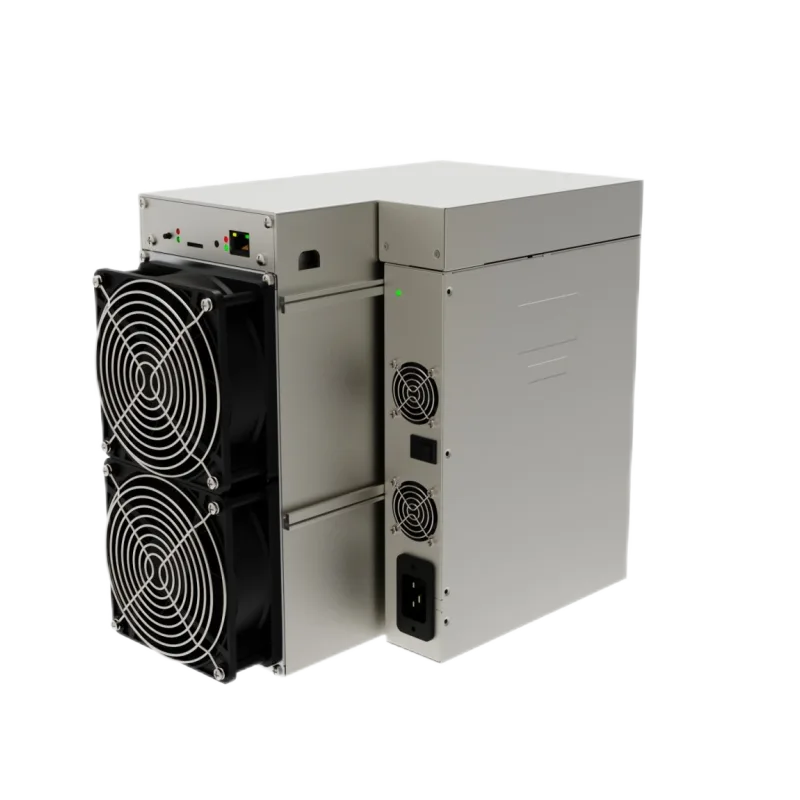
IceRiver KS5L
Large-format Kaspa miner from IceRiver, requires industrial-grade power and cooling
Réponse rapide
The IceRiver KS5L is a KHeavyHash miner rated about 12 TH/s at roughly 3,400 W, built on the Custom ASIC ASIC. An industrial-class unit — loud and power-hungry, best suited to a dedicated mining space, not living areas.
Professional-Grade Miner
This miner draws 3,400W and produces 75 dB of noise — it is designed for dedicated mining environments, not living spaces. Professional-grade miners deliver the highest hashrate and revenue per unit but require proper infrastructure: a 240V circuit, adequate ventilation or exhaust ducting, and a space where noise is not a concern (garage, basement, warehouse, or outdoor enclosure).
For home miners looking for a quieter alternative, consider our Bitcoin Space Heater builds or explore open-source miners like the Bitaxe that are purpose-built for residential environments.
Heater-Class Miner
At 3,400W, this miner outputs approximately 11600.8 BTU/hr of heat — equivalent to a standard electric space heater. Every watt consumed by an ASIC miner is converted to heat with 100% efficiency, making it a space heater that also mines Bitcoin.
During heating season, miner heat can offset part of the heat a room would otherwise need from another electric heater. The economics depend on your electricity rate, room heat demand, BTC price, network difficulty, and noise constraints.
Calculateur de rentabilité
| Period | Revenue | Electricity Cost | Profit |
|---|---|---|---|
| Daily | $0.38 | $5.71 | $-5.33 |
| Weekly | $2.66 | $39.98 | $-37.33 |
| Monthly | $11.39 | $171.36 | $-159.97 |
| Yearly | $138.55 | $2,084.88 | $-1,946.33 |
Heating offset estimates the value of heat replacing an electric space heater during heating season (~6 months/year in Canada). Actual savings depend on your heating setup and climate.
Where to Buy the IceRiver KS5L
D-Central Technologies is a Bitcoin-only company. For this miner, check out our trusted partner retailers below.
ASIC Miner Market
United StatesWide selection of new and used ASIC miners. US-based shipping.
MagasinerMinersDeals
United StatesCompetitive prices on new ASIC miners with coupon codes.
MagasinerPartner links may earn D-Central a commission at no extra cost to you. Have you considered Bitcoin mining instead? Explore Bitcoin miners →
Full Specifications
| Model | IceRiver KS5L |
|---|---|
| Model Number | KS5L |
| Manufacturer | IceRiver |
| Algorithme | KHeavyHash |
| Coins Mined | Kaspa (KAS) |
| Taux de hachage | 12 TH/s |
| Consommation électrique | 3,400 W |
| Efficiency | 283.33 J/TH |
| Niveau de bruit | 75 dB |
| Chip Model | Custom ASIC |
| Cooling | Air |
| Voltage Range | 200-240V AC |
| Operating Temperature | 5-40°C |
| Dimensions | 430x200x300 |
| Weight | 15 |
| Interface | Ethernet |
| BTU Output | 11600.8 BTU/hr |
| Equivalent Heater | Equal to a 3,400W space heater |
| Daily Power Cost | $5.71/day |
| Monthly Power Cost | $171.36/mo |
| Circuit Requirement | 240V circuit required |
| Release Date | 2024-07-01 |
| MSRP | $12,000.00 |
| État | Active |
Home Mining Assessment
Large-format Kaspa miner from IceRiver, requires industrial-grade power and cooling
The IceRiver KS5L is an air-cooled Kaspa (kHeavyHash) ASIC that delivers 12 TH/s for about 3,400 W at the wall, an efficiency near 283 J/TH. Released in July 2024, it is a large-format, 240 V industrial miner built for a dedicated, ventilated mining space rather than a living room.
IceRiver KS5L at a glance
The KS5L is the lower-binned member of IceRiver’s KS5 family, sitting just under the 15 TH/s KS5M while sharing the same physical platform and 3,400 W power envelope. It mines only the kHeavyHash algorithm, which today means Kaspa (KAS) — IceRiver builds dedicated single-algorithm machines, not multi-coin hardware. Everything below is grounded in the verified specification for this unit.
| Specification | IceRiver KS5L |
|---|---|
| Algorithm / coin | kHeavyHash / Kaspa (KAS) |
| Hashrate | 12 TH/s |
| Wall power | ~3,400 W |
| Efficiency | ~283 J/TH (283 W/TH) |
| Cooling | Air (forced, dual-fan tunnel) |
| Noise | ~75 dB |
| Dimensions | 430 × 200 × 300 mm |
| Weight | 15 kg |
| Input voltage | 200–240 V AC |
| Operating temperature | 5–40 °C |
| Network interface | Ethernet (RJ45) |
| Heat output | ~11,600 BTU/h |
| Released | July 2024 |
| Launch MSRP | ~US$12,000 |
Chip and hashboard architecture
The KS5L runs on IceRiver’s own proprietary kHeavyHash ASIC. Unlike the Bitmain BM-series or MicroBT silicon that powers SHA-256 Bitcoin miners, IceRiver’s Kaspa chips are an in-house, closed design, and the company does not publish die size, process node, or per-board chip counts. We will not invent those numbers: where the manufacturer stays silent, the honest answer is that the internal die specifications are undocumented. What is observable is that the KS5L is a large-format unit — its 15 kg mass and 3,400 W draw are consistent with a multi-hashboard machine carrying a dense array of these ASICs, fed by a central control board over the standard chain interface and cooled by a front-to-back air tunnel.
kHeavyHash itself is what the silicon is hardwired to compute. It pairs a matrix-multiplication (« heavy ») stage with Keccak hashing, a structure Kaspa chose deliberately so that the proof-of-work leans on fixed-function arithmetic rather than large memory tables. That is precisely the kind of workload an ASIC accelerates well, which is why dedicated machines like the KS5L displaced GPUs on the Kaspa network. Because the design is fixed-function, the chip cannot be repurposed for SHA-256, Scrypt, or any other algorithm — a KS5L is a Kaspa machine for its entire service life. For background on how purpose-built mining silicon is laid out in general, see our ASIC chip reference.
Real-world power and efficiency
At roughly 283 J/TH, the KS5L’s efficiency should be read against other Kaspa hardware, not against Bitcoin SHA-256 figures. The two are not comparable: a « TH » of kHeavyHash and a « TH » of double-SHA-256 are entirely different units of work, so the sub-20 J/TH numbers you see quoted for modern Antminers have no bearing here. Within IceRiver’s own catalogue the KS5L is firmly in the efficient tier — the 2023 KS1, KS2, and KS3 generation ran at 400–600 J/TH, so the KS5 platform nearly halved energy per terahash. Treating this machine as a « legacy » space heater, the way generic efficiency bands sometimes do, mischaracterises it.
The 3,400 W figure is a wall-draw rating at 200–240 V AC, and real consumption will sit close to it under full load, drifting up with higher intake temperatures and down if the operator dials the unit back. Expect to provision a dedicated 240 V circuit with comfortable headroom rather than running it near a breaker’s limit. Tuning latitude on IceRiver hardware is narrow: the stock firmware exposes a limited set of operating modes rather than the deep, community-built profile libraries that exist for Antminer-class machines. You can compare its draw and J/TH against other models in our ASIC power profiles database, but be aware the richest tuning data there is for Bitmain SHA-256 hardware, not Kaspa miners.
One genuine upside of pushing 3,400 W of electricity is heat: the KS5L sheds about 11,600 BTU/h. In a workshop or outbuilding through the cold months, that waste heat is real and can offset a space heater — but at ~75 dB it is far too loud for occupied living space, which is why its home-suitability score lands low.
Firmware, control, and monitoring
The KS5L ships with IceRiver’s closed stock firmware and is managed entirely over Ethernet through a built-in web dashboard, where you configure the Kaspa pool, worker credentials, and the unit’s operating mode. There is an important honesty here: the mature third-party firmware ecosystem that defines Bitcoin mining — BraiinsOS+, VNish, LuxOS — does not exist for IceRiver hardware. Those projects target Bitmain and MicroBT SHA-256 machines; none of them flash a Kaspa miner, and features that only live in that world, such as native Stratum V2 support or a runtime autotuner, simply do not apply to the KS5L. Our own DCENT_OS work is likewise focused on SHA-256 Antminer-class hardware, so it is not a firmware option for this machine either. We would rather state that plainly than imply a tuning path that is not there.
What you can do is monitor it well. Open-source fleet tooling such as pyasic recognises IceRiver as a supported vendor and can poll the KS5L over the network for hashrate, temperatures, fan speeds, and pool status, which lets you fold it into a unified dashboard alongside other brands without touching its firmware. For day-to-day operation, the practical reality is: run the stock firmware, keep it on a current version, and manage it through external monitoring.
Common faults and troubleshooting
Large air-cooled Kaspa miners fail in the same families as any high-density ASIC. The most common issues we see are:
- Hashrate shortfall. A single failed hashboard on a multi-board unit drops a large, roughly proportional slice of the rated 12 TH/s and usually shows up as a board reading zero or a climbing hardware-error rate.
- Power supply faults. PSU degradation under a sustained ~3,400 W load is a leading cause of dead or intermittently restarting units.
- Thermal throttling and shutdowns. A failing fan, blocked intake, or hot room pushes chip temperatures up; the firmware throttles or halts to protect the boards. Dust and ambient heat above the 40 °C ceiling are frequent culprits.
- Network or control-board issues. A unit that will not appear on the LAN or hangs on boot points at the controller, cabling, or firmware state rather than the hashboards.
Work the problem methodically before condemning a board: confirm input voltage and PSU output, verify airflow and ambient temperature, and read the front-panel indicators. Our ASIC fault finder walks the diagnostic tree by symptom, and the status LED blink-code guide helps decode what the unit is signalling before you open it.
Repair and longevity
A KS5L is worth repairing rather than scrapping. D-Central has serviced ASICs in-house since 2016, and the IceRiver KS line is a supported repair platform — dedicated KS-series hashboard test fixtures exist for the brand, so a suspect board can be bench-tested and diagnosed at the component level instead of guessed at. Typical service work includes hashboard-level fault isolation and reflow, PSU repair or replacement, fan and thermal-path restoration, and control-board recovery. Our general ASIC hashboard repair guide explains the bench process, and you can start a service request through our ASIC repair page.
Because the KS5L is single-algorithm hardware, its working life is tied to Kaspa’s price and network difficulty rather than to any firmware upgrade path. Keeping the machine mechanically and thermally healthy is therefore the main lever an owner controls: clean filters, sound fans, a stable PSU, and a cool intake will keep it on the network for years past warranty.
Who the KS5L is for
This is a serious operator’s machine. It wants a 240 V circuit, real ventilation, and a tolerance for ~75 dB — it belongs in a garage, workshop, dedicated mining room, or hosted facility, not a home office. Anyone committed to Kaspa who can supply that environment gets a capable, repairable air-cooled unit at a sensible price-per-terahash on the secondary market today.
If you are choosing within the family, the 15 TH/s KS5M shares the same chassis and 3,400 W envelope while delivering more hashrate at a better ~227 J/TH, so compare the two on landed price before deciding. Bitcoiners arriving from SHA-256 should note the KS5L mines a different coin entirely and cannot be cross-purposed. Browse and compare full specs in our ASIC miner database, and see current availability on our buy ASIC miners in Canada page.
Where the KS5L sits in the Kaspa generation
The KS5 platform was IceRiver’s mid-2024 air-cooled flagship generation and a clear step beyond the company’s 2023 line. The lineage shows how quickly Kaspa hardware matured:
| Model | Hashrate | Power | Efficiency | Released |
|---|---|---|---|---|
| IceRiver KS1 | 1 TH/s | 600 W | ~600 J/TH | 2023 |
| IceRiver KS2 | 2 TH/s | 1,200 W | ~600 J/TH | 2023 |
| IceRiver KS3M | 6 TH/s | 3,400 W | ~567 J/TH | 2023 |
| IceRiver KS3 | 8 TH/s | 3,200 W | ~400 J/TH | 2023 |
| IceRiver KS5L | 12 TH/s | 3,400 W | ~283 J/TH | 2024 |
| IceRiver KS5M | 15 TH/s | 3,400 W | ~227 J/TH | 2024 |
IceRiver was not alone in driving Kaspa mining forward, and credit is due to the makers who built the category alongside it. Bitmain brought its Antminer KS-series — including higher-hashrate, more efficient air-cooled units such as the KS5 Pro — and Goldshell shipped its own kHeavyHash machines, all of which pushed Kaspa efficiency lower still. Against that backdrop the KS5L is best understood honestly: a well-built, mid-2024 air-cooled miner that was efficient for its moment and remains a sound choice when bought on price-per-terahash, even though newer hardware has since raised the bar. For a Kaspa operator who values a serviceable, repair-supported machine over chasing the absolute efficiency frontier, it still earns its rack space.
Broken miner? Get a real quote.
Tell us the symptom and get an instant repair-tier estimate ($95 / $145 / $195 CAD). Mail-in from across Canada, bench in Laval, Quebec.
Send it to D-Central — start a repair →Related Miners
Bitmain KAS KS7
Iceriver KS2
Antminer KS5 Pro
Goldshell KA BOX Pro
Foire aux questions
What are the current mining economics for the IceRiver KS5L?
At $0.07/kWh, the IceRiver KS5L currently shows an estimated daily net cost of $5.33 before pool fees and hardware cost. Lower electricity rates, network changes, BTC price changes, or useful heat recovery can change the result.
Can I mine Bitcoin at home with the IceRiver KS5L?
The IceRiver KS5L has a home mining score of 8/100. With 75 dB noise and 3,400W power draw, it may require a dedicated space like a garage, basement, or outdoor enclosure. Consider noise insulation and proper ventilation.
Can the IceRiver KS5L heat my home?
The IceRiver KS5L outputs approximately 11600.8 BTU/hr of heat. For reference, a typical space heater produces 5,000-5,500 BTU/hr. All electrical energy consumed by the miner is converted to heat, making it 100% efficient as a heater. D-Central offers Bitcoin Space Heater builds designed specifically for home heating integration.
What power supply does the IceRiver KS5L need?
The IceRiver KS5L draws 3,400W of power. You need a power supply rated for at least 3,740W with appropriate voltage (200-240V AC). D-Central stocks compatible power supplies in our shop. Always use a quality PSU from a reputable manufacturer to protect the miner and wiring.