
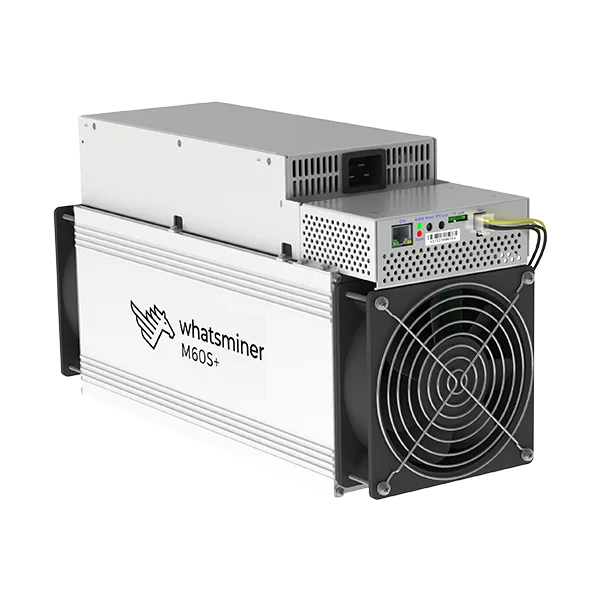
Whatsminer M60S++
Top-bin M60S variant pushing 220 TH/s. Best efficiency in the M60 lineup at 18 J/TH. Integrated PSU.
Réponse rapide
The Whatsminer M60S++ is a Bitcoin miner rated about 220 TH/s at roughly 3,960 W (about 18 J/TH), built on the WM3610 ASIC. An industrial-class unit — loud and power-hungry, best suited to a dedicated mining space, not living areas.
Professional-Grade Miner
This miner draws 3,960W and produces 75 dB of noise — it is designed for dedicated mining environments, not living spaces. Professional-grade miners deliver the highest hashrate and revenue per unit but require proper infrastructure: a 240V circuit, adequate ventilation or exhaust ducting, and a space where noise is not a concern (garage, basement, warehouse, or outdoor enclosure).
For home miners looking for a quieter alternative, consider our Bitcoin Space Heater builds or explore open-source miners like the Bitaxe that are purpose-built for residential environments.
Calculateur de rentabilité
| Period | Revenue | Electricity Cost | Profit |
|---|---|---|---|
| Daily | $6.99 | $6.65 | $0.33 |
| Weekly | $48.91 | $46.57 | $2.34 |
| Monthly | $209.62 | $199.58 | $10.03 |
| Yearly | $2,550.35 | $2,428.27 | $122.08 |
Heating offset estimates the value of heat replacing an electric space heater during heating season (~6 months/year in Canada). Actual savings depend on your heating setup and climate.
Where to Buy the Whatsminer M60S++
D-Central Technologies
CanadaBitcoin Mining Hackers since 2016. Ships from Laval, Quebec.
magasiner le materiel de minage BitcoinASIC Miner Market
United StatesWide selection of new and used ASIC miners. US-based shipping.
MagasinerMinersDeals
United StatesCompetitive prices on new ASIC miners with coupon codes.
MagasinerFull Specifications
| Model | Whatsminer M60S++ |
|---|---|
| Model Number | M60S++ |
| Manufacturer | MicroBT |
| Algorithme | SHA-256 |
| Coins Mined | Bitcoin (BTC) |
| Taux de hachage | 220 TH/s |
| Consommation électrique | 3,960 W |
| Efficiency | 18 J/TH |
| Niveau de bruit | 75 dB |
| Chip Model | WM3610 |
| Cooling | Air |
| Voltage Range | 200-240V AC |
| Operating Temperature | 5-40°C |
| Dimensions | 430x155x226 |
| Weight | 14 |
| Interface | Ethernet |
| BTU Output | 13511.5 BTU/hr |
| Equivalent Heater | Equal to a 3,960W space heater |
| Daily Power Cost | $6.65/day |
| Monthly Power Cost | $199.58/mo |
| Circuit Requirement | 240V circuit required |
| Release Date | 2024-06-01 |
| MSRP | $7,000.00 |
| État | Active |
Home Mining Assessment
Top-bin M60S variant pushing 220 TH/s. Best efficiency in the M60 lineup at 18 J/TH. Integrated PSU.
The Whatsminer M60S++ is MicroBT’s top-bin air-cooled M60 unit: a SHA-256 Bitcoin miner rated at 220 TH/s for about 3,960 W (~18 J/TH). It pairs that hashrate with an integrated PSU in a single sealed box, putting it among the most efficient air-cooled machines MicroBT shipped before the 2025 M70 generation.
Chip and hashboard architecture
The M60S++ carries MicroBT’s WM3610-designation SHA-256 ASIC — internally part of the company’s modern « K-series » silicon — spread across three hashboards driven from one control board. The architectural split from Bitmain matters more than the spec sheet suggests: where an Antminer hashboard is managed by a Xilinx Zynq SoC (the ARM-plus-FPGA part clocked at 667 MHz), the M60-generation Whatsminer runs a pure Allwinner H616 application processor (a quad-core 64-bit ARM Cortex-A53) on a CB6 control board, with no FPGA at all. The ASICs are addressed directly over SPI/UART from the ARM rather than through an FPGA state machine, and there is no separate PIC microcontroller in the loop. A Whatsminer is not a re-skinned Antminer, and the tooling, firmware, and spare boards for one do not cross to the other.
Each hashboard carries a long string of ASICs wired in series and grouped into voltage domains. This is the single most misunderstood point about modern miners, so we state it plainly: voltage is regulated per domain, not per chip. A boosted rail feeds a ladder of regulators, and each domain steps that down for its cluster of series-wired chips. The domain voltage equals the per-chip core voltage multiplied by the number of chips in that domain. When one chip degrades, it drags the whole domain off-target — which is why diagnosis happens at the domain test points, not chip by chip. If the voltage between domains goes abnormal, the entire board stops hashing.
MicroBT does not publish die-level data for this generation, and the M60-series firmware images are fully encrypted (more on that below), so we cannot confirm the exact chip count per board or the foundry from a teardown the way the Antminer silicon has been mapped. We keep the process node qualitative: the M6x family is 5nm-class silicon — a clear step beyond the Samsung 5nm M50 generation and well short of nothing we can independently measure. We would rather tell you what we can verify than pin a nanometre figure we cannot stand behind. What we can say with confidence is that it is a three-board, per-domain machine, and that is what governs how it fails and how it is repaired.
Real-world power and efficiency
The headline pairing — 220 TH/s for 3,960 W — is a nameplate figure under MicroBT’s stock tune. There is one honest advantage to how MicroBT rates its hardware: the M60S++ ships with an integrated PSU, and the company’s wall ratings already fold in that supply’s conversion loss. That makes the ~18 J/TH closer to a true at-the-wall number than a chip-only rating you have to gross up. Even so, plan your circuit around real draw: budget meaningfully more than 4 kW per unit at the breaker once supply tolerance and ambient temperature are accounted for, and remember this is a 200–240 V single-phase machine — it is not a 120 V unit.
At roughly 18 J/TH the M60S++ sits at the efficient end of the air-cooled SHA-256 field for its era, competitive with the Antminer S21 generation and a large improvement over the ~25 J/TH M50S that preceded it. Tuning headroom is real but bounded: BTMiner exposes Low / Normal / High power modes plus a power-percentage and target-frequency interface, and the firmware’s autotuner calculates its operating point at runtime for the board it actually has — these are not fixed presets baked into a table. Undervolt toward better J/TH when power is expensive, or push frequency for raw terahash when it is cheap, always inside the thermal envelope. We map those trade-offs on our ASIC power profiles reference; treat any tune as a calculated operating point for your grid and ambient, not a magic setting that is « always best. »
That power is also heat. The M60S++ rejects roughly 13,500 BTU/h — enough to warm a well-sized room. Ducted into a workshop or garage in winter, that waste heat turns money you would otherwise spend on heating into hashrate. At ~75 dB it is loud, so the heat is genuinely useful only in a space where the noise is acceptable.
| Specification | Whatsminer M60S++ |
|---|---|
| Manufacturer | MicroBT |
| Algorithm | SHA-256 (Bitcoin) |
| Hashrate (nameplate) | 220 TH/s |
| Power (nameplate, PSU included) | 3,960 W |
| Efficiency | ~18 J/TH |
| ASIC | WM3610-class (MicroBT K-series, 5nm-class) |
| Cooling | Air (integrated PSU) |
| Hashboards | 3 |
| Control board | Allwinner H616 (CB6), no FPGA |
| Input voltage | 200–240 V AC, single-phase |
| Operating temp | 5–40 °C |
| Network interface | Ethernet |
| Noise | ~75 dB |
| Weight | ~14 kg |
| Dimensions | 430 × 155 × 226 mm |
| Heat output | ~13,500 BTU/h |
| Release | 2024 (M6x generation) |
How it sits in the M-series line
| Model | Hashrate | Power | Efficiency | Era |
|---|---|---|---|---|
| Whatsminer M50S | ~128 TH/s | ~3,276 W | ~25.6 J/TH | 2022 (prior gen) |
| Whatsminer M60S | ~186 TH/s | ~3,441 W | ~18.5 J/TH | 2023 |
| Whatsminer M60S++ | 220 TH/s | 3,960 W | ~18 J/TH | 2024 (top M60 bin) |
| Whatsminer M70S | ~258 TH/s | ~3,480 W | ~13.5 J/TH | 2025 (next gen) |
Figures for neighbouring models are approximate and vary by binning and firmware; the table is for positioning, not precision. The pattern is the point: the M60S++ is the highest-output, top-efficiency bin of the air-cooled M60 line, slotting between the M50 generation it replaced and the markedly more efficient M70 that followed.
Firmware compatibility
Out of the box the M60S++ runs MicroBT’s stock firmware — an OpenWrt-based system with the closed-source btminer daemon, a LuCI web interface served over HTTPS, and the BTMiner API on TCP port 4028 (a newer V3 API also listens on 4433). The read API is open; write commands are gated behind a token-and-encryption handshake and are disabled by default until enabled with MicroBT’s WhatsMinerTool. This is a deliberately hardened platform: the M60-generation control board boots through ARM TrustZone / OP-TEE, runs a dm-crypt encrypted root filesystem, ships a custom packet filter, has SSH removed entirely, and distributes fully encrypted firmware images. Stock firmware is mature, supports pool failover and power-limit modes, and is the right default for most operators.
The third-party reality is far narrower than the Antminer world, and we will be candid about it. BraiinsOS+ does not run on Whatsminer hardware — it is Antminer-only, and because it is the only firmware that natively speaks Stratum V2, that protocol is not a stock option on this machine; the M60S++ mines Stratum V1 unless you put a translating proxy in front of it. The aftermarket Whatsminer builds that circulate are largely a single distribution re-hosted under different brand names — our firmware analysis found one prominent « vendor » channel to be byte-for-byte identical to another’s release, installed by SD card and shipping an unsigned, plaintext root filesystem (a real security regression versus stock’s encryption). The TrustZone-and-dm-crypt hardening is exactly why most M60-class operators stay on stock: it is a hard target, and we will not point you at a specific anonymous binary whose dev fee and provenance you cannot verify.
For fleet operators, the practical good news is tooling: the open-source pyasic library speaks the BTMiner protocol natively, so an M60S++ shows up in a subnet scan and reports hashrate, temps, fans, and pools through the same unified interface as the rest of your fleet. And for owners who want sovereign, auditable control, D-Central is reverse-engineering this exact H616 platform toward a DCENT_OS Whatsminer driver track — our GPL-3.0 firmware effort, in public beta as of July 2026. We mention it not as a sales pitch but because we would rather you wait for firmware you can read the source of than gamble on an unsigned image.
Common faults and troubleshooting
After thousands of repairs, M60-class failures cluster predictably:
- Hashboard not detected — a board that fails to enumerate, often a chip-ID read error at boot or a fault in the boost/buck stage that leaves the domains without voltage. The board reports zero chips and zero hashrate.
- Chip-count low / domain voltage abnormal — a broken chain at a domain boundary, or a shorted chip dragging its domain toward zero. The board enumerates short of its full chip count; pinpointing it means probing the domain test points.
- Power-supply failure and efficiency drop — because the PSU is integrated, supply faults present as the whole unit cutting out or a creeping rise in J/TH as the supply ages. The control board reads the PSU over its own management channel, so a comms fault can also masquerade as a power fault.
- Temperature too high and fan-speed errors — dust-loaded heatsinks, a stalled fan, or a hot intake will throttle or halt the miner even when the boards are healthy. First-line checks before opening the case.
- Control-board boot loop and firmware faults — the encrypted, signature-verified boot chain that hardens this platform also means a corrupted update or a failed signature check can leave the H616 board cycling; recovery usually runs through MicroBT’s SD-card/PhoenixCard path rather than a simple reflash.
Work the symptom methodically rather than swapping parts blind. Our interactive ASIC fault finder walks you from a stock error message to the most likely board-level cause and helps you tell a genuine hardware fault apart from a PSU, network, or thermal problem before you open the case.
Repair and longevity
An 18 J/TH machine earns its keep for years on reasonable power, which makes board-level repair — not replacement — the economically sane response to a fault. D-Central has repaired SHA-256 hashboards in-house since 2016, and the M60S++ is squarely in our wheelhouse: we diagnose by voltage domain, reflow or replace failed chips and regulators, service the integrated PSU and its management link, and bench-test under load before a board goes back. Because the per-domain architecture localizes most failures, a single dead board rarely means a dead miner. If yours is throwing chip-count, hashboard, or PSU errors, see our ASIC repair service — repairing a board is almost always cheaper than writing the unit off, and it keeps working hardware out of the e-waste stream.
Who it is for, and buying
The M60S++ is a serious production unit. It suits a self-hosted miner or a small-to-mid Hashcenter that has 240 V single-phase capacity, can tolerate the noise, and wants near-current efficiency without paying flagship-of-the-moment prices. Its waste heat is a genuine asset for anyone heating a workshop or garage, and the integrated PSU keeps the install simple — no separate power-supply matching to get wrong.
If you are mining at home purely for heat or learning the ropes, a smaller and more hackable open-source board such as a Bitaxe is a friendlier place to start. If a production fleet is the goal, compare current and previous-generation units side by side in our ASIC comparison tool, then browse availability in the D-Central catalog and talk to us about matching units, power, and deployment before you commit.
Generational context
The M60 series was MicroBT’s answer to Bitmain’s S21 generation — its bid to stay competitive on air-cooled efficiency in 2023–2024 — and the M60S++ is the top bin of that air-cooled line. Credit where it is due: MicroBT built a genuinely efficient, well-hardened machine here, and the H616-based platform is one of the harder ASICs on the market to tamper with. Measured against the 2025 M70 generation it has been overtaken on raw J/TH, but that is exactly what makes it attractive now: strong efficiency, a falling acquisition cost, and hardware that remains repairable and productive. Buy it for cheap-to-moderate power sites, keep a board-level repair partner on call, and the M60S++ has real runway left.
Broken miner? Get a real quote.
Tell us the symptom and get an instant repair-tier estimate ($95 / $145 / $195 CAD). Mail-in from across Canada, bench in Laval, Quebec.
Send it to D-Central — start a repair →Related Miners
Bitmain Antminer S21+ Hyd
Antminer S19k Pro
Bitmain Antminer S17 Pro (53Th)
Bitmain Antminer S21 Immersion (301Th)
Foire aux questions
What are the current mining economics for the Whatsminer M60S++?
At $0.07/kWh electricity, the Whatsminer M60S++ currently shows an estimated $0.33 daily net result before pool fees and hardware cost. Results depend on your electricity rate and Bitcoin network conditions. Use the calculator above with your actual electricity rate.
Can I mine Bitcoin at home with the Whatsminer M60S++?
The Whatsminer M60S++ has a home mining score of 8/100. With 75 dB noise and 3,960W power draw, it may require a dedicated space like a garage, basement, or outdoor enclosure. Consider noise insulation and proper ventilation.
Can the Whatsminer M60S++ heat my home?
The Whatsminer M60S++ outputs approximately 13511.5 BTU/hr of heat. For reference, a typical space heater produces 5,000-5,500 BTU/hr. All electrical energy consumed by the miner is converted to heat, making it 100% efficient as a heater. D-Central offers Bitcoin Space Heater builds designed specifically for home heating integration.
Does D-Central repair the Whatsminer M60S++?
Yes, D-Central provides professional repair services for the Whatsminer M60S++. Services include hashboard repair, control board diagnostics, fan replacement, and full refurbishment. Ship your miner to our Laval, Quebec facility for diagnosis and repair.
What power supply does the Whatsminer M60S++ need?
The Whatsminer M60S++ draws 3,960W of power. You need a power supply rated for at least 4,356W with appropriate voltage (200-240V AC). D-Central stocks compatible power supplies in our shop. Always use a quality PSU from a reputable manufacturer to protect the miner and wiring.